Short answer
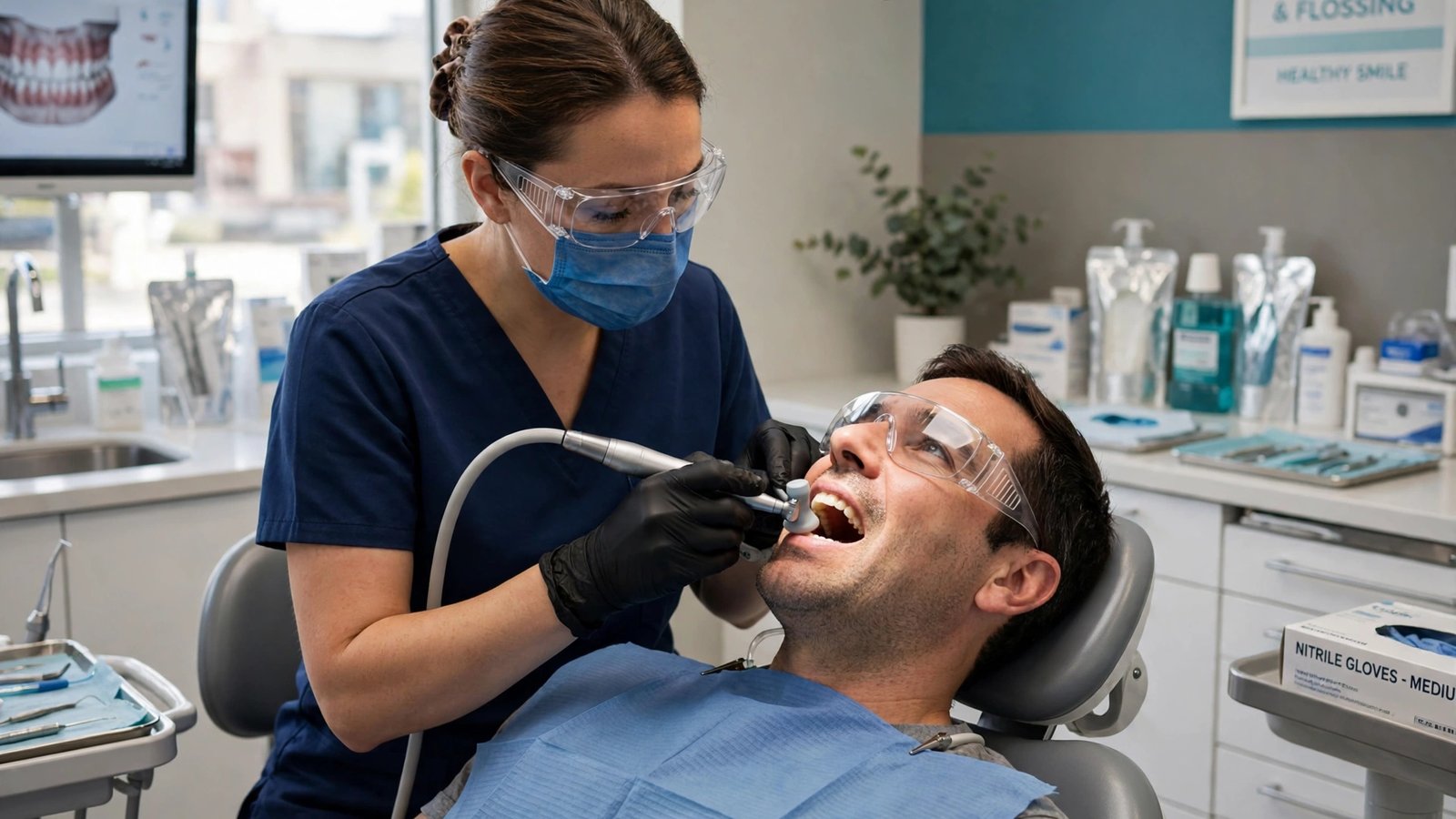
- This article is general information only. It does not diagnose any reader or recommend treatment for any individual mouth. Only a dentist or hygienist who has examined your teeth can decide whether polishing is useful for you at a particular visit. Teeth polishing is a finishing step in a professional dental cleaning. After scaling has removed plaque and tartar, a small soft rubber cup or brush, used with a mildly abrasive paste, smooths the visible surfaces of the teeth and lifts surface stain that scaling has left behind. Cleveland Clinic describes a routine cleaning as two main steps, scaling and polishing, with polishing done next, using a soft rubber cup and special toothpaste. Polishing helps most when there is visible surface stain to remove. It does not remove tartar, it does not treat gum disease on its own, and it does not change the natural color inside a tooth, which is why polishing is not whitening. Teeth often look brighter after a polish because stain on the surface has gone, revealing the color the teeth already were. Polishing also does not have to mean every tooth, at every visit. Much current teaching favors selective polishing: polishing only surfaces with stain or film that needs it, and skipping clean, unstained surfaces. The American Dental Hygienists Association position, as summarized in the professional literature, is that polishing should be performed only as needed, not considered routine in itself. Skipping a polish on teeth that do not need one is a clinical judgment, not a shortcut. Done briefly, with the right paste and light pressure, and only where it is needed, polishing is not expected to cause meaningful harm to healthy enamel. Done repeatedly or aggressively on teeth that are already clean, it adds abrasion without adding benefit. Exposed roots, eroded areas, and some restorations need extra care, because they are softer or easier to scratch than enamel.
What Teeth Polishing Actually Is
Where polishing sits in a professional cleaning
A professional cleaning is an ordered process, and polishing comes near the end of it. Cleveland Clinic lists the two main steps of every dental cleaning as scaling and polishing, in that order. Scaling comes first. The clinician removes plaque and tartar from the tooth surfaces, using hand instruments or a vibrating ultrasonic scaler. Tartar, also called calculus, is plaque that has hardened with minerals from saliva. Once plaque has hardened in that way, ordinary brushing and flossing cannot remove it. Only professional instruments can.
Polishing follows scaling for a practical reason. There is little value in smoothing a surface that still carries hard deposits, and tartar is the part that matters most for gum health, because it holds plaque against the tooth and makes daily cleaning harder. A polish applied over tartar would leave the problem untouched while making the tooth look finished.
A visit may also include an examination, X-rays where needed, and sometimes fluoride or sealants. Cleveland Clinic notes that most routine cleanings take about 30 to 60 minutes, and that the plan varies with the person. Polishing is one component inside that larger appointment, with a real but narrow role. For the deeper cleaning used when gum disease is present, see our explainer on deep cleaning for teeth, what it is and how it differs from a regular cleaning.
What the cup, paste, and technique do
In traditional rubber cup polishing, the clinician loads a small, soft, rotating cup with a paste often called prophy paste, short for prophylaxis paste, and touches it lightly to each surface that needs attention. The Dimensions of Dental Hygiene review describes this method as applying a rubber cup with prophy paste above the gumline to remove plaque and stain, and gives the current technique in specific terms: a slow speed handpiece, one to two seconds per surface, a light touch, and the cup gently flared against the tooth.
Three variables decide how much a polish does, and how much it wears: the paste, whose abrasive particles are graded from fine to coarse; the pressure, where a light touch lets the cup do the work and heavy pressure only adds friction and heat; and the time, where one to two seconds on a stained surface is a very different exposure from sustained polishing of a whole mouth at every visit for years.
Professional polishing should not be copied at home with stronger products or harder scrubbing. The home imitation usually reverses all three safeguards: a harsher abrasive, more pressure, and far more frequent use.
What Polishing Removes, and What It Does Not Do
Polishing works on the outside of the tooth, at the surface. Being precise about that surface work prevents most of the confusion around this procedure.
What polishing removes. Its main target is extrinsic stain, color that sits on the outside of the tooth rather than inside it, commonly from tea, coffee, red wine, and tobacco. Polishing also removes leftover soft plaque film and the thin acquired pellicle layer that coats teeth, and smooths small irregularities left after scaling. The Dimensions review puts the indication plainly: polishing is needed when extrinsic stains are visible, and only the surfaces that need it should be polished.
What the smooth feeling does and does not mean. A smoother surface gives new plaque less texture to grip in the short term, which is a genuine but modest effect. It is not a protective coating. The same review notes that the acquired pellicle begins reforming within minutes after polishing, and plaque builds again with daily life. Daily brushing and cleaning between the teeth are what control that regrowth.
What polishing does not remove. Polishing does not remove tartar, decay, or a cavity. A stained area that is actually decay needs diagnosis and, where appropriate, a filling, not a more thorough polish. See our guide to how long a cavity filling lasts, and the signs that one needs replacing. Polishing also does not clean deep below the gumline, close gum pockets, or reverse gum disease. Polishing a visible crown while inflamed pockets remain untreated would address appearance and leave disease in place.
What polishing does not change. Polishing does not change the internal color of a tooth, straighten teeth, or close gaps. If a tooth is dark because of inner dentin showing through thinner enamel, an old injury, or certain medicines taken while the teeth were forming, surface polishing cannot correct it, because the color is not on the surface.
Polishing Is Not Whitening
The American Dental Association, through its MouthHealthy patient site, explains how whitening actually works: whitening products contain a bleach, either hydrogen peroxide or carbamide peroxide, and those bleaches break stains into smaller pieces so the color becomes less concentrated and the teeth look brighter. That is a chemical change to color, including color within the tooth.
Polishing involves no bleach at all. It is mechanical: an abrasive paste and a rotating cup physically lift stain off the surface, the same principle as a stain removal toothpaste, which the ADA describes as working through mild abrasives that can only remove surface stains and do not change the color of teeth. So the test is simple. If the discoloration is a film on the outside, polishing can help. If the goal is a lighter natural shade than the one under the stain, only bleaching addresses that goal, with its own suitability checks and limits.
Two further ADA limits are worth knowing. Whitening does not work on caps, veneers, crowns, or fillings, and it may not correct discoloration caused by medicines or a tooth injury, so a mixed mouth can end up uneven if whitening is done without a plan. See also our article on teeth whitening aftercare, in general terms.
Does Polishing Damage Enamel?
Why paste, pressure, and time matter
Enamel is the hard outer layer of the crown, and abrasion is a wearing process, so polishing does remove a very small amount of surface. The clinical question is whether that amount matters in context.
The Dimensions of Dental Hygiene review reports research in which a 30 second pumice polishing procedure removed about 4 micrometers of tooth surface, and notes that frequent polishing can damage surfaces through loss of the fluoride rich outer enamel layer. Read that figure carefully: it comes from a sustained procedure in a study setting, not from the one to two seconds of light contact now recommended for a single stained surface. It does not mean a normal selective polish strips teeth. It does mean the effect is cumulative enough that technique, paste choice, and frequency are clinical decisions, not habits.
Set against that, the same literature notes that minerals in saliva continually remineralize tooth surfaces, which is why occasional, careful polishing of healthy enamel is well tolerated. But remineralization does not rebuild enamel that has been physically worn away as a layer. Enamel lost that way does not grow back. The practical conclusion is balanced: polishing stained enamel carries a small cost for a visible benefit, while polishing unstained enamel carries the same kind of cost with no benefit to set against it. That asymmetry drives the selective approach described below.
Roots, erosion, and sensitivity need a gentler plan
Not every surface is healthy enamel. Where gums have receded, part of the root may be exposed, and the root is covered by a much thinner, softer layer than enamel, with softer dentin beneath it. A paste and pressure that are trivial on a crown can wear an exposed root, deepening a groove at the gumline and worsening sensitivity. Eroded teeth, where acid has already thinned the surface, and teeth that are already sensitive deserve the same caution.
Tell the clinician before polishing starts if you have sensitivity, recession, or erosion. That can change the paste grade, the pressure, the surfaces chosen, or the decision itself. Our article on teeth that feel sensitive after a dental cleaning, and when to call, works through what is typical afterward. Sensitivity that is sharp, worsening, lingering, or limited to one tooth should be reported, because decay and cracks can produce similar pain.
The Selective Polishing Debate, Represented Accurately
For much of the twentieth century, a full mouth polish was simply what a cleaning visit ended with. Online, the debate that followed is sometimes presented as though polishing had been discovered to be dangerous, or as though nothing had changed at all. Neither version matches the literature. The documented shift began decades ago. The Dimensions review records that by the 1970s, Esther Wilkins, author of the standard dental hygiene textbook, was already promoting polishing as a selective process because of its removal of surface enamel, and that evidence in the 1990s and 2000s further supported selective polishing. Dental hygiene schools now recommend selective polishing as standard protocol instead of polishing at every maintenance appointment. The American Dental Hygienists Association position, quoted across the professional literature, is that polishing should not be considered a routine procedure, and should be offered only when a hygienist or dentist determines a specific need for it. The reasoning given is that polishing has little therapeutic benefit in itself: tartar is removed by scaling, plaque and debris can be removed by brushing, and stain and rough surfaces are not always present.
Two clarifications keep that position honest. First, selective polishing is not a ban. Where stain is visible, polishing remains the direct way to remove it, and the review calls stain removal an important esthetic procedure even though it is not essential for healthy teeth. Second, polishing is not required before fluoride, because fluoride uptake is not inhibited by plaque biofilm.
If your hygienist polishes only some teeth, or suggests skipping the polish where your teeth are clean and unstained, that is consistent with current professional teaching. Ask which surfaces they saw stain on, and say so if stain was the concern you came in with, because your priorities are part of the assessment.
Air Polishing Compared With Rubber Cup Polishing, in General Terms
Air polishing is the other main method. A device directs a stream of air, water, and a fine powder at the tooth surface. The powder does the cleaning work as it strikes the surface, and the water flushes debris away. The Dimensions review lists air polishers alongside hand scaling and ultrasonic instruments as other means of removing stain. Clinics may consider it for areas a cup reaches awkwardly, including around orthodontic brackets, in crowded areas, and on some implant and restoration surfaces, using powders chosen for those surfaces.
It is not automatically gentler or better, and the powder matters as much as the device. A 2025 commentary in Evidence-Based Dentistry, published through PubMed Central and summarizing a systematic review of laboratory studies, found that air polishing with sodium bicarbonate and calcium carbonate powders roughened restorations significantly more than air polishing with erythritol and glycine powders, which were less abrasive. Its abrasiveness therefore depends on the powder, the settings, and the material, and the review advised interpreting laboratory findings with caution, because test specimens are not the same as a mouth.
A clinician may also avoid or modify air polishing in some situations, including certain respiratory conditions, because the method generates a spray. Those judgments require knowledge of your medical history and your mouth, which is why this article describes the method generically and does not recommend it for or against any reader. If a clinic proposes it, ask which powder will be used and what it is expected to achieve that a rubber cup would not.
Polishing Around Fillings, Crowns, Veneers, and Implants
Restorations change the calculation, because their surfaces are not enamel and do not all tolerate abrasion alike. The Dimensions review lists a possible contraindication directly: abrasive pastes may scratch restoration materials such as composite resin, amalgam, and gold. A scratched restoration is not only cosmetic. A rougher surface can hold plaque more readily, which works against the purpose of the cleaning. Clinicians therefore keep a range of paste grades, including superfine grades for enamel and metallic restorations, and select the paste for the surface in front of them.
The laboratory evidence adds detail. Composite resin and resin modified glass ionomer restorations were the most affected by ultrasonic instrumentation, while high strength ceramics such as zirconia and lithium disilicate were the most resistant. Three studies in that review found that roughness after instrumentation could be reduced by using a rubber cup and polishing paste afterward, a reminder that polishing, used deliberately, can also help protect a restoration. The effect depends on material, instrument, and powder, so tell your dental team what work you have had done, including work done elsewhere, and let them choose instruments surface by surface.
Implants need their own care pathway. An implant crown sits on a metal or ceramic abutment rather than on a natural root, and the surfaces around implants are cleaned with instruments and powders selected to limit surface alteration while still removing biofilm. Expect the approach around implants to differ from natural teeth, and ask how your team maintains them. See our explainer on dental implant systems and how they work. Veneers raise a related point, because their glazed surfaces can lose luster with an unsuitable paste. See our guide to whether veneers are bad for your teeth.
How Often Does Polishing Make Sense?
There is no single correct interval for everyone. Cleveland Clinic states that most dentists recommend a cleaning every six months, that some people need cleanings more often, and that your dentist will help decide what is best for you. That is guidance about cleaning visits. Polishing frequency follows from what is found at them: a person whose teeth stain heavily may be polished at most visits, while a person with unstained, smooth teeth may be polished rarely.
NHS Business Services Authority guidance makes the same distinction, describing scale and polish as appropriate in defined clinical situations, including periodontal maintenance where gum disease has been stabilized, rather than as an automatic add on at every attendance. Need, assessed at the visit, drives the procedure.
Ask how quickly you build tartar, whether stain or gum inflammation is your main issue, and what interval your dentist recommends for you and why. Our guide to how often you should go to the dentist, works through the factors behind that interval. People with gum disease, rapid tartar buildup, braces, or dry mouth are commonly seen more often.
When Polishing Helps Most, and When It Can Be Skipped
Polishing earns its place in defined situations. Visible surface stain is the clearest: tea, coffee, red wine, and tobacco stain that scaling has not fully lifted. It can also help before certain assessments, because a clean, smooth surface makes rough edges and remaining deposits easier to see and feel, and it can be part of maintenance around restorations when the paste is chosen for the material. In each case the benefit is specific and checkable. Stain that was there is gone. A surface that was rough is smooth.
The mirror image list is just as concrete. Clean, smooth, unstained teeth gain no visible benefit, and skipping avoids abrasion that buys nothing. Teeth with exposed roots, erosion, or marked sensitivity may be better served by limiting polishing to stained crown surfaces, using a finer paste, or omitting it at that visit. Where the main problem is gum disease, appointment time is better spent on scaling and home care support than on a cosmetic finish. Skipping is also reasonable where the patient simply prefers it. Polishing is an elective finishing step in most routine situations. State your preference either way, provided nobody mistakes the polish for the part of the visit that protects your gums.
What Polishing Does Not Replace
Polishing sits at the end of a chain, and it cannot substitute for any earlier link. It does not replace scaling, cleaning below the gumline where gum disease is present, daily brushing with fluoride toothpaste, or cleaning between the teeth. Our guide to how to remove plaque from teeth, and which deposits need a professional, explains that division between soft plaque you can manage and hard tartar you cannot. Nor does polishing replace examination, which finds decay and gum changes early, when they are simplest to treat.
Plaque bacteria drive gum inflammation, so if plaque and tartar remain along and below the gumline, inflammation continues whether or not the visible crowns are polished. Our article on the signs of gum disease, from early warnings to reasons to book promptly, lists the pattern to watch for. Treat those signs as the priority, and polishing as a finish applied after the health work, not instead of it.
Home Polishing Products: Limits and Risks
A large market sells imitations of professional polishing: abrasive whitening pastes and powders, charcoal products, polishing kits, and home scaling tools. Described informationally, their limits are consistent.
Abrasive home products can remove some fresh surface stain, because that is what abrasives do. They cannot remove tartar, bleach the inner color of a tooth, or clean below the gumline safely. Their risk is dose. A professional polish happens a few times a year at most, for seconds per surface, with a graded paste. A home abrasive may be used twice a day, indefinitely, with enthusiastic pressure, on enamel, exposed roots, and restoration margins alike. The ADA guidance points to the safer end of this market: stain removal toothpastes carrying the ADA Seal of Acceptance, tested for safety and effectiveness, which still only remove surface stain. Charcoal and other heavily abrasive powders sit at the opposite end of the caution scale. Their stain removal comes from abrasion alone, many such products contain no fluoride, and frequent hard use can wear enamel and irritate gums. As enamel thins, the yellower dentin beneath can show through more, the opposite of the result being chased. Home scaling tools carry a different risk: a sharp instrument used without training or visibility can cut gums, scratch enamel and restorations, and push debris into the pocket. If you can feel a hard deposit, the safe response is an appointment, not a tool purchase.
The routine that maintains a professional result is unglamorous. Brush twice a day with fluoride toothpaste and a soft brush, using gentle pressure, and clean between your teeth daily. Our article on whether mouthwash helps, and what it can and cannot do, is a useful companion on rinses. If surface stain keeps returning, raise it at your next visit and ask about its cause, because diet, tobacco, certain rinses, and a rough old restoration can each drive stain, and each cause has a different fix.
When to See a Dentist or Hygienist Promptly
Most polishing questions can wait. Some signs should not. Book promptly for bleeding gums that persist, swollen or sore gums, a loose tooth, persistent bad breath, pain, a broken filling or crown, or a rough, sharp area you can feel with your tongue. Cleveland Clinic advises calling sooner for bleeding or swollen gums, loose teeth, and toothaches. Sensitivity that lingers long after a hot or cold stimulus also deserves assessment. This article cannot tell you what those signs mean in your mouth. An examination can.
Frequently Asked Questions
What is teeth polishing?
Teeth polishing is the finishing step of a professional cleaning. After scaling has removed plaque and tartar, a dentist or hygienist uses a small soft rubber cup or brush with a mildly abrasive paste to smooth the surfaces and remove surface stain and remaining soft film. Air polishing, using air, water, and a fine powder, is another method some clinics use.
Does polishing teeth damage enamel?
A brief polish with an appropriate paste and light pressure, used only where stain is present, is not expected to cause meaningful damage to healthy enamel, although polishing is abrasive by design and does remove a very small amount of surface. Repeated, unnecessary, or aggressive polishing, especially with a coarse paste, adds wear without benefit, and softer surfaces such as exposed roots and some restorations need gentler treatment or none. That is why many clinicians polish selectively.
Is polishing the same as whitening?
No. Polishing removes surface stain by abrasion. It contains no bleach and cannot change the natural color inside the tooth. Whitening uses a bleaching agent such as hydrogen peroxide or carbamide peroxide to lighten color, as the American Dental Association explains, and is a separate treatment with its own suitability checks.
Does polishing remove tartar?
No. Tartar is hardened plaque, and only professional scaling instruments can remove it. Scaling is the step that comes before polishing. A polish without scaling would smooth the visible surface while leaving hard deposits in place, including deposits that drive gum inflammation.
Can I polish my teeth at home?
You can brush with a fluoride toothpaste, including a stain removal toothpaste carrying the ADA Seal of Acceptance, which will lift some everyday surface stain safely. Do not try to copy professional polishing with charcoal powders, harsh scrubs, aggressive brushing, or home scaling tools. Used often and hard, abrasives can wear enamel and irritate gums, and sharp tools can injure gums and scratch teeth and restorations. None of them removes tartar.
How often should teeth be polished?
There is no single interval for everyone. Many people attend for a cleaning about every six months, as Cleveland Clinic notes, but polishing at a visit depends on whether stain or film is present. Someone who stains quickly may be polished at most visits. Someone with clean, unstained, or sensitive teeth may be polished less often, or not at all at a given visit.
Why did my hygienist not polish all my teeth?
Most likely because they were polishing selectively. Current teaching favors polishing only surfaces with stain or film that needs removal, because polishing unstained teeth adds abrasion without a benefit. The American Dental Hygienists Association position is that polishing should be performed only as needed and not treated as routine. Ask which surfaces your hygienist treated and why, and mention stain if removing it was a priority for you.
Sources & references
- Cleveland Clinic, What Happens During a Dental Cleaning? https://my.clevelandclinic.org/health/treatments/11187-dental-check-up
- Dimensions of Dental Hygiene, To Polish or Not to Polish? https://dimensionsofdentalhygiene.com/article/to-polish-or-not-to-polish/
- American Dental Association (MouthHealthy), Teeth Whitening. https://www.mouthhealthy.org/all-topics-a-z/teeth-whitening.
- NHS Business Services Authority, What band of treatment is a scale and polish? https://faq.nhsbsa.nhs.uk/knowledgebase/article/KA-02034/en-us
- Evidence-Based Dentistry (via PubMed Central), Do ultrasonic instrumentation and air polishing procedures adversely affect dental restorations? https://pmc.ncbi.nlm.nih.gov/articles/PMC12474538/


