Short answer
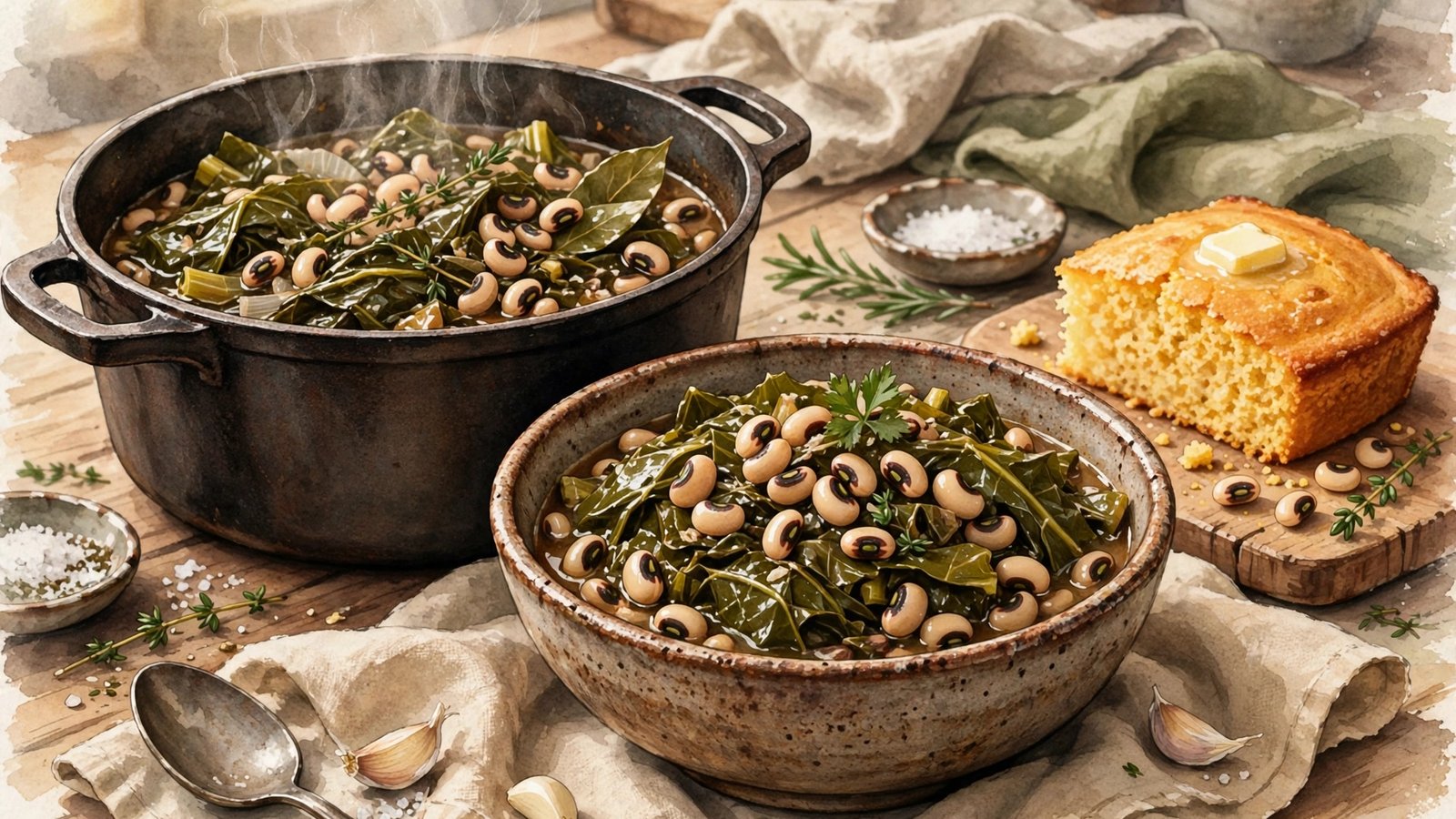
- Wash 2 large bunches of collard greens, about 2 pounds, until the water runs clear, remove the thick center stems, and slice the leaves into ribbons about 1 inch wide. If you use dried peas, soak 1 pound overnight, drain, and simmer in fresh water for 30 to 40 minutes until just tender, then drain again. Soften a diced onion in oil in a large heavy pot for 5 to 7 minutes, add garlic for 1 minute, then add a smoked turkey wing or leg, about 1 pound, and 6 cups of low sodium broth. Add the greens in handfuls, letting each wilt, then add vinegar, salt, pepper, and red pepper flakes if you use them, cover, and simmer gently for 45 to 60 minutes until tender and silky. Remove the smoked meat, shred any meat from it back into the pot, stir in the cooked dried peas or 3 drained and rinsed cans of peas, and simmer uncovered for 15 to 20 minutes more. Serve hot with plenty of pot liquor and cornbread on the side. Refrigerate leftovers within 2 hours, use them within 3 to 4 days, and reheat them to 165°F, bringing the pot liquor to a rolling boil.
Introduction
In many Southern kitchens in the United States, New Year’s Day has a menu with meaning. Black-eyed peas are eaten for luck and prosperity, collard greens are eaten for money and wealth, and cornbread, often served alongside, stands for gold. This article keeps those associations in their proper place. They are a cultural tradition, not a promise, and no pot of greens and peas can guarantee a good year. What the dish can honestly deliver is a warm, filling, inexpensive meal that feeds six to eight people as a main dish with cornbread, or more as a side.
The version below braises collard greens with onion, garlic, and smoked turkey, then folds in black-eyed peas near the end so they stay whole. Dried peas and canned peas both work, with different timing, and both paths are given. The guide also covers washing gritty greens properly, judging tenderness by taste, keeping the pot liquor well seasoned, and storing and reheating leftovers safely. Tradition notes are drawn from Smithsonian Magazine and Cornell Botanic Gardens, greens handling from Clemson Extension, pea nutrition figures from USDA FoodData Central data, and storage, temperature, and allergen guidance from the USDA, FoodSafety.gov, and the FDA, all as reviewed on 30 October 2026.
The Tradition, Stated Carefully
Smithsonian Magazine describes the wider pattern plainly: legumes are often stand-ins for money, lentils especially are said to look like coins when cooked, and the Southern United States version uses black-eyed peas with collard greens to imitate paper money. Cornell Botanic Gardens puts it in almost the same words: slowly cooked collard greens represent dollar bills as a symbol of increased prosperity, while beans represent coins as well as good luck. That is the wording used throughout here, matching the companion soup article on this site: black-eyed peas for luck and prosperity, because the peas suggest coins, and collard greens for money and wealth, because the folded leaves suggest folding or paper money. Cornbread completes the set in many households, its golden color standing for gold.
Families tell the associations slightly differently, and some add pork for progress, since pigs root forward, or avoid chicken, since chickens scratch backward. No single version is the only authentic one, and describing a custom is not promising an outcome. No source checked shows that eating this dish causes luck or wealth.
Cornell notes that black-eyed peas, Vigna unguiculata, are native to tropical West Africa, an important food there for over five thousand years, were part of the provisions fed to captive people on slave ships, were cultivated by enslaved Africans and their descendants in the Americas, and appear in Hoppin’ John, the related dish of peas, rice, and pork, which originated in the kitchens of enslaved Africans. In African American communities, Cornell notes, Hoppin’ John is often associated with the Emancipation Proclamation, effective at midnight on New Year’s Eve in 1862, and with Watch Night, also called Freedom’s Eve, described by the Smithsonian National Museum of African American History and Culture. Smithsonian Magazine adds that early Hoppin’ John recipes called for red peas or cow peas rather than black-eyed peas, quoting an 1895 description of rice and purplish peas seasoned with savory bacon. The pea in the pot has changed over time, so the supportable claim is the smaller one: peas have long meant luck and prosperity in the Southern United States, greens have meant money and wealth, and the two are commonly eaten together on January 1. Cornell, quoting food historian Adrian Miller, adds that West Africans considered peas a good luck charm and that beans swelling in cooking symbolized fortunes increasing.
What the Main Ingredients Bring
Black-eyed peas are cowpeas, and plain cooked peas explain why this dish is filling. The USDA values for cowpeas, common, described as blackeyes, crowder, and southern, mature seeds, cooked, boiled, without salt, as reproduced from USDA FoodData Central data, are 198 calories per cup of 171 grams, with 13.2 grams of protein, 35.5 grams of carbohydrate, 11.1 grams of dietary fiber, 0.9 grams of total fat, no cholesterol, and 356 micrograms of folate. Those figures are for plain boiled peas only, not the finished dish, which contains oil, broth, onion, and smoked meat and will differ, especially for sodium. They still explain the meal: that much protein and fiber per cup makes a hearty pot without cream or cheese.
Collards bring volume that cooks down and leaves sturdy enough for a long braise. Clemson Extension warns that greens cook down by one-quarter or more, which is why 2 pounds of raw collards, which look like too much at first, are right for six to eight servings. Clemson notes that collards are traditionally slowly cooked for several hours, and can also be simmered in seasoned broth for 20 to 30 minutes, with garlic, onion, chili peppers, ginger, or curry. This recipe takes a middle path: 45 to 60 minutes, tasting at 45 minutes and allowing up to about 90 minutes for older leaves. Clemson also warns never to cook greens in aluminum, because it affects appearance and taste, and that overcooking can turn leaves greenish gray and cost some nutritional value. Tender and silky, still green, is the target.
The smoked meat is a seasoning as much as an ingredient. Smoked turkey gives smoky depth without pork. A ham hock gives a richer, fattier result. Either flavors the broth, and the shredded meat returned to the pot is a modest part of each serving.
Ingredients
- 2 large bunches collard greens, about 2 pounds total, washed well
- 1 pound dried black-eyed peas, soaked overnight and drained, or 3 cans, 15 ounces each, black-eyed peas, drained and rinsed
- 1 smoked turkey wing or leg, about 1 pound, or 8 ounces smoked turkey pieces; or, for a pork version, 8 ounces smoked ham hock
- 1 large yellow onion, diced
- 4 garlic cloves, minced
- 2 tablespoons vegetable oil or bacon drippings
- 6 cups low sodium chicken or vegetable broth, plus more as needed
- 1 tablespoon apple cider vinegar, plus more to taste
- 1 teaspoon kosher salt, plus more to taste
- 1/2 teaspoon black pepper
- 1/4 teaspoon red pepper flakes, optional
- Hot sauce, for serving
- Cornbread, for serving
If you must hold fresh greens before cooking, Clemson Extension advises wrapping them in damp paper toweling, placing them in a perforated plastic bag, and refrigerating them, and notes that if purchased in good condition and the toweling is kept moist, most varieties will keep one week. Wash them when ready to use, not before storing.
Preparing the Greens
Collards grow close to the ground and can carry grit, and nothing ruins a pot faster than sand. Clemson Extension gives the method used here: wash greens thoroughly when ready to use, submerge them in a sink of lukewarm water and swish them, remove roots and stem them if necessary, and repeat to remove soil, debris, and possibly bugs. Tepid water helps remove grit faster than cool water. Lift the leaves out so the grit stays behind, and repeat with fresh water until the water runs clear.
Then strip the leaves from the thick center stems: fold each leaf in half and pull the stem away, or cut along either side of the stem. The stems are tough and fibrous; discard them or save them for stock. Stack the leaves, roll them loosely, and slice into ribbons about 1 inch wide, so they cook evenly. Finish this before any heat is on. Pre-washed, pre-cut bagged collards are a workable shortcut; rinse them and pull out thick stem pieces. Frozen chopped collards also work, added without thawing.
Dried, Canned, Fresh, or Frozen Peas
Dried peas cost less, give a firmer texture, and let you control salt, but they need an overnight soak and a separate short cook before they meet the greens. Canned peas save that work, but they start softer and saltier and break apart if simmered too long, which is why they get only the final 15 to 20 minutes here. If you forgot to soak dried peas, simmer them until just tender, checking often and expecting a longer, less predictable time than 30 to 40 minutes for soaked peas. Stop while they are still intact, because they cook a little more in the greens. Fresh peas need no soaking and cook faster than dried; frozen peas also work. With either, simmer separately until just tender, then fold them in. Rinse canned peas well to remove excess salt and starchy liquid that would cloud the pot liquor. Do not add the pea cooking liquid to the greens by default; the seasoned broth is the better base.
How to Make New Year’s Collard Greens with Black-Eyed Peas
Step 1: If using dried peas, cook them first
Soak dried peas overnight in cold water, then drain. Cover by 2 inches with fresh water, bring to a boil, reduce to a simmer, and cook for 30 to 40 minutes, until just tender but not mushy. Drain and set aside. Salt the finished dish to taste, when you can also judge salt from the broth and smoked meat. If using canned peas, skip this step and drain and rinse them shortly before step 4.
Step 2: Build the savory base
Heat the oil in a large, heavy, non-aluminum pot over medium heat. Add the onion and cook for 5 to 7 minutes, until softened and lightly golden. Add the garlic for 1 minute more, until fragrant. Add the smoked turkey or ham hock and stir to coat. Onion softened in oil gives the broth a sweetness that raw onion in liquid does not provide.
Step 3: Braise the greens
Add the broth and bring to a simmer. Add the collards in handfuls, letting each wilt before adding the next. The pot will look impossibly full before it collapses, the cook down Clemson describes. Add the vinegar, salt, pepper, and red pepper flakes if using. Cover, reduce to low, and simmer gently for 45 to 60 minutes, stirring occasionally and adding a splash of liquid if the pot looks dry. The greens should be tender and silky, not squeaky. Taste at 45 minutes and continue if needed; older leaves can take up to 90 minutes. Keep the simmer gentle; a hard boil batters the leaves and clouds the pot liquor.
Step 4: Add the peas and finish
Remove the smoked meat. Shred any meat from it back into the pot, discarding skin and bones. Add the cooked or canned peas and simmer uncovered for 15 to 20 minutes, until heated through. Taste and adjust salt, vinegar, and pepper. The pot liquor, the savory broth in the pot, should taste like a light soup on its own, not plain water, because it will be spooned over each serving. If it tastes thin, simmer uncovered a few minutes more before adding more salt.
Step 5: Serve
Serve in bowls with plenty of pot liquor, cornbread on the side, and hot sauce at the table. Let each person add vinegar or hot sauce to taste rather than over-seasoning the pot for everyone. Serve steaming hot, and keep the pot hot during a long meal or refrigerate it between servings.
Why the Peas Go In Late and the Acid Matters
The order is the recipe. Greens need a long braise; peas, already cooked to just tender or canned and fully cooked, need only a short finish. Braised for the full hour, peas would split and thicken the pot into a porridge, edible but no longer greens with whole peas. The final 15 to 20 minutes heats them through and keeps each pea distinct.
Acid works in two doses. The vinegar added with the greens balances the smoked meat and the earthy leaves. A final small splash of vinegar or lemon juice, after salting and tasting, brightens a dull pot. If the dish tastes bitter or flat, finish the braise first, then check salt, then acid. Vinegar alone will not fix undercooked greens.
Vegetarian and Pork Versions
For a vegetarian version, omit the smoked meat, use vegetable broth, and add 1 teaspoon of smoked paprika and an extra tablespoon of oil. The pot will be lighter but still flavorful, because onion, garlic, paprika, vinegar, and salted broth do the seasoning work. A diced tomato added with the broth breaks down during the braise and adds sweetness and color. Salt after tasting, because broths and canned peas vary in sodium.
For a pork version, replace the turkey with 8 ounces of smoked ham hock, in the same order. Expect a richer, saltier pot, so hold back some salt until step 4. In every version the test is the same: greens silky, peas whole and hot through, pot liquor seasoned like a light soup.
Making It Ahead, Scaling It, and Using a Slow Cooker
Cooked a day early, cooled and refrigerated promptly, and reheated properly, this dish often tastes better the next day, because the greens and peas take up the seasoned broth. December 31 is therefore a sensible cooking day for January 1, provided the storage rules below are followed. Do not make it ahead by leaving the pot on the stove overnight.
Double the recipe in a very large pot for a gathering, tasting for salt at the end, since doubling salt exactly can overshoot. Divide a doubled pot into shallow containers so it cools rapidly.
For a slow cooker, build the onion, garlic, and smoked meat base on the stove first, then transfer it with the broth and greens and cook until tender, checking texture rather than relying only on a timer. Fold in cooked or canned peas near the end. A slow cooker can hold the dish hot only if it keeps the food at 140°F or warmer. Do not use it to reheat leftovers.
Food Safety and Storage
The USDA Food Safety and Inspection Service states that bacteria grow rapidly between 40°F and 140°F, that hot food must be kept hot at 140°F or warmer, and that leftovers must be refrigerated within 2 hours of cooking. Throw away perishable food left out more than 2 hours, or more than 1 hour above 90°F. Do not leave the pot out all afternoon while guests graze; keep it hot at 140°F or warmer, or refrigerate it between servings.
Smoked turkey and ham hock as sold here are already cooked, and the dish should be served steaming hot throughout. If you substitute raw meat, cook it to its safe minimum internal temperature with a food thermometer, using the FoodSafety.gov chart: all poultry to 165°F, pork steaks, roasts, and chops, including raw ham, to 145°F with a 3 minute rest, and ground meats to 160°F. Precooked ham for reheating goes to 165°F, apart from cooked hams packaged in USDA inspected plants, listed at 140°F.
To cool leftovers rapidly, the USDA advises dividing large amounts into shallow containers, because a big pot cools slowly, and notes that hot food can go directly into the refrigerator. Cover or seal leftovers and refrigerate or freeze them immediately, at 40°F or below in the refrigerator. Leftovers keep 3 to 4 days refrigerated or 3 to 4 months frozen; frozen leftovers held continuously frozen remain safe but lose moisture and flavor over time. The FoodSafety.gov Cold Food Storage Chart matches: soups and stews keep 3 to 4 days refrigerated and 2 to 3 months frozen for best quality, cooked meat or poultry leftovers keep 3 to 4 days and 2 to 6 months, and freezer times are for quality only because foods at 0°F or below can be kept indefinitely.
Thaw frozen leftovers in the refrigerator, in cold water in a leak proof package, or in the microwave, or reheat them without thawing in a saucepan or microwave, which the USDA says is safe although slower. Reheat to 165°F with a food thermometer, bring sauces, soups, and gravies to a rolling boil, and cover leftovers so they heat through. Here, bring the pot liquor to a rolling boil and check that the greens and peas are steaming hot throughout. Softer greens after freezing are normal, not a sign of spoilage.
What to Serve With It, and What to Do With Leftovers
Cornbread earns its place twice: in the tradition it stands for gold, and at the table it soaks up pot liquor and adds a sweet contrast. Rice is another traditional base and stretches the pot further. Leftover greens and peas over rice make a complete next day lunch, provided they were refrigerated within 2 hours and are reheated to 165°F with the liquor brought to a rolling boil. A vinegar based slaw adds crunch and acid. Save abundant pot liquor for rice, grits, or a second round of greens, diluting it with unsalted broth if it tastes too salty alone. Do not save liquor that sat out past the 2 hour limit.
Allergy and Label Notes
Packaged ingredients decide the allergen answer for any given pot. Broths, smoked meats, and hot sauces vary by brand, so read labels if you cook for someone with an allergy and keep the packages until the meal is over. The FDA lists nine major food allergens that must be declared on labels of foods it regulates: milk, eggs, fish, Crustacean shellfish, tree nuts, peanuts, wheat, soybeans, and sesame, with sesame becoming the ninth effective January 1, 2023. Labels must identify an allergen source in parentheses after an ingredient or in a contains statement next to the ingredient list, which is why the label, not the recipe title, is the document to trust. Cornbread alongside governs its own ingredients, commonly wheat, milk, and egg.
Common Problems and Fixes
If the greens are still tough after an hour, they need more time. Older collards can take 90 minutes or more, and no shortcut replaces a gentle braise. Add liquid if the pot dries out and taste every 10 minutes or so.
If the dish tastes bitter, the greens may be undercooked, or the pot may need salt and vinegar. Finish the braise first, then adjust both; do not reach for sugar first. If the peas fall apart, they were overcooked before joining the pot or simmered too long after; next time cook dried peas only until just tender and give canned peas only the final 15 minutes. If the pot liquor tastes thin, concentrate it with a short uncovered simmer first, then salt, then acid, tasting after each change. If it is too salty, thin it a little at a time with unsalted broth. If the greens turned dull or gray, they were likely overcooked or cooked in aluminum; stop at tender and still green next time.
Frequently Asked Questions
Do black-eyed peas really bring luck, and collard greens money?
That is a cultural tradition, not a verified outcome. Smithsonian Magazine describes legumes as stand-ins for money and the Southern custom as peas with greens imitating paper money, and Cornell describes collards as dollar bills for increased prosperity and beans as coins and good luck. The wording here is: peas for luck and prosperity, greens for money and wealth, cornbread for gold. No source checked supports a claim that the dish causes luck or wealth.
Can I make this vegetarian?
Yes. Omit the smoked meat, use vegetable broth, and add 1 teaspoon of smoked paprika and an extra tablespoon of oil. Timing does not change. Salt after tasting, because broths and canned peas vary in sodium.
Should I use dried or canned peas?
Both work. Dried peas are firmer and cheaper and let you control salt, but need an overnight soak and a separate 30 to 40 minute simmer. Canned peas save that work; drain and rinse them and add them only for the final 15 to 20 minutes, because they are already cooked and fall apart in a full braise.
How long do leftovers last, and how should I reheat them?
Refrigerate within 2 hours, or 1 hour above 90°F, in shallow covered containers at 40°F or below, and eat within 3 to 4 days. Reheat to 165°F with a food thermometer and bring the pot liquor to a rolling boil.
Can I freeze collard greens with black-eyed peas?
Yes. Cool in shallow containers and freeze at 0°F or below. For best quality, eat within 2 to 3 months, the FoodSafety.gov window for soups and stews; the USDA gives frozen leftovers 3 to 4 months before they lose moisture and flavor. Thaw in the refrigerator, cold water, or microwave, or reheat from frozen in a saucepan, which the USDA says is safe although slower. Bring it back to a rolling boil and 165°F, and expect softer greens.
Can I use other greens instead of collards?
Yes, with timing adjustments. Turnip and mustard greens are traditional in some families; mustard greens are more peppery, so mix them with collards for a first pot. Kale softens faster, so check it earlier. Do not braise baby spinach or salad greens; stir spinach in off the heat at the end as a garnish. For any greens, wash by submerging, swishing, and repeating until the grit is gone, and do not cook in aluminum.
What is pot liquor, and should I serve it?
Pot liquor is the savory broth left in the pot, enriched with onion, garlic, smoked meat or paprika, vinegar, and the greens’ cooking juices. Yes, serve it spooned over each bowl. It is central to the dish, not a byproduct, which is why step 4 seasons it until it tastes like a light soup on its own.
Keep reading: New Year’s Black-Eyed Pea Soup: A Lucky, Hearty Start to the Year
Sources & references
- USDA Food Safety and Inspection Service, Leftovers and Food Safety. Used for bacteria growing rapidly between 40°F and 140°F, hot food being kept hot at 140°F or warmer, leftovers being refrigerated within 2 hours and perishable food left out more than 2 hours, or more than 1 hour above 90°F, being thrown away, cooling rapidly in shallow containers, hot food going directly into the refrigerator, covering or sealing leftovers, leftovers keeping 3 to 4 days in the refrigerator or 3 to 4 months in the freezer while remaining safe indefinitely if held frozen but losing moisture and flavor, thawing in the refrigerator, cold water, or microwave, reheating frozen leftovers without thawing in a saucepan or microwave for a soup or stew, and reheating to 165°F with sauces, soups, and gravies brought to a rolling boil.
- FoodSafety.gov, Cook to a Safe Minimum Internal Temperature. Used for beef, bison, veal, goat, and lamb and pork steaks, roasts, and chops, including raw ham, at 145°F with a 3 minute rest, ground meat and sausage at 160°F, all poultry at 165°F, leftovers at 165°F, and precooked ham for reheating at 165°F with the note for USDA inspected plant hams at 140°F.
- FoodSafety.gov, Cold Food Storage Chart. Used for refrigerator storage at 40°F or below and freezer storage at 0°F or below, soups and stews with vegetable or meat added at 3 to 4 days in the refrigerator and 2 to 3 months in the freezer, cooked meat or poultry leftovers at 3 to 4 days and 2 to 6 months, and freezer guidelines being for quality only.
- Clemson University Cooperative Extension, Home and Garden Information Center, Leafy Green Basics. Used for greens cooking down by one-quarter or more, storing fresh greens in damp paper toweling in a perforated plastic bag with most varieties keeping one week if in good condition, washing by submerging in lukewarm water and swishing with tepid water removing grit faster than cool water and repeating to remove soil, debris, and possibly bugs, never cooking greens in aluminum, overcooking causing a greenish gray color and some nutritional loss, and collards being wide leafed greens traditionally slowly cooked for several hours or simmered in seasoned broth for 20 to 30 minutes with garlic, onion, chili peppers, ginger, or curry.
- USDA FoodData Central, Cowpeas, common (blackeyes, crowder, southern), mature seeds, cooked, boiled, without salt. Used for the plain cooked pea figures only: 198 calories per cup of 171 grams, 13.2 grams protein, 35.5 grams carbohydrate, 11.1 grams dietary fiber, 0.9 grams total fat, no cholesterol, and 356 micrograms folate. The detail view for this entry could not be rendered in the verification passes for this article, so the values are given as reproduced from USDA FoodData Central data and are to be rechecked on the live portal at publication. FoodData Central is managed by the Agricultural Research Service Beltsville Human Nutrition Research Center and hosted by the National Agricultural Library, and its data are public domain.
- Smithsonian Magazine, Don't Make Hoppin' John for New Year's Without Heirloom Beans, 31 December 2014. Used for New Year dishes being supposed to promise prosperity and luck, legumes as stand-ins for money with lentils looking like coins, the Southern riff using black-eyed peas and collard greens to imitate paper money, Hoppin' John as beans and rice cooked together in broth and one of many rice and bean dishes of the African diaspora, early recipes calling for red peas or cow peas rather than black-eyed peas, and the quoted 1895 description of rice and purplish peas standing apart yet together and seasoned with savory bacon.
- Cornell Botanic Gardens, Lucky Peas for the New Year. Used for black-eyed peas, Vigna unguiculata, being native to tropical West Africa and an important food there for over five thousand years, peas as provisions on slave ships and cultivated by enslaved Africans and their descendants, Hoppin' John as traditionally eaten in the southern United States on New Year's Day for good luck and originating in the kitchens of enslaved Africans, its association with the Emancipation Proclamation taking effect at midnight on New Year's Eve in 1862 and with Watch Night or Freedom's Eve as described by the Smithsonian National Museum of African American History and Culture, collards representing dollar bills for increased prosperity, beans representing coins as well as good luck, and the Adrian Miller explanation of peas as a good luck charm and swelling beans symbolizing fortunes increasing.
- United States Food and Drug Administration, Food Allergies: What You Need to Know. Used for the nine major food allergens, milk, eggs, fish, Crustacean shellfish, tree nuts, peanuts, wheat, soybeans, and sesame, sesame being the ninth with the change effective January 1, 2023, FDA enforcement of allergen labeling for foods it regulates, and labels identifying an allergen source in parentheses after an ingredient or in a contains statement next to the ingredient list.


