Short answer
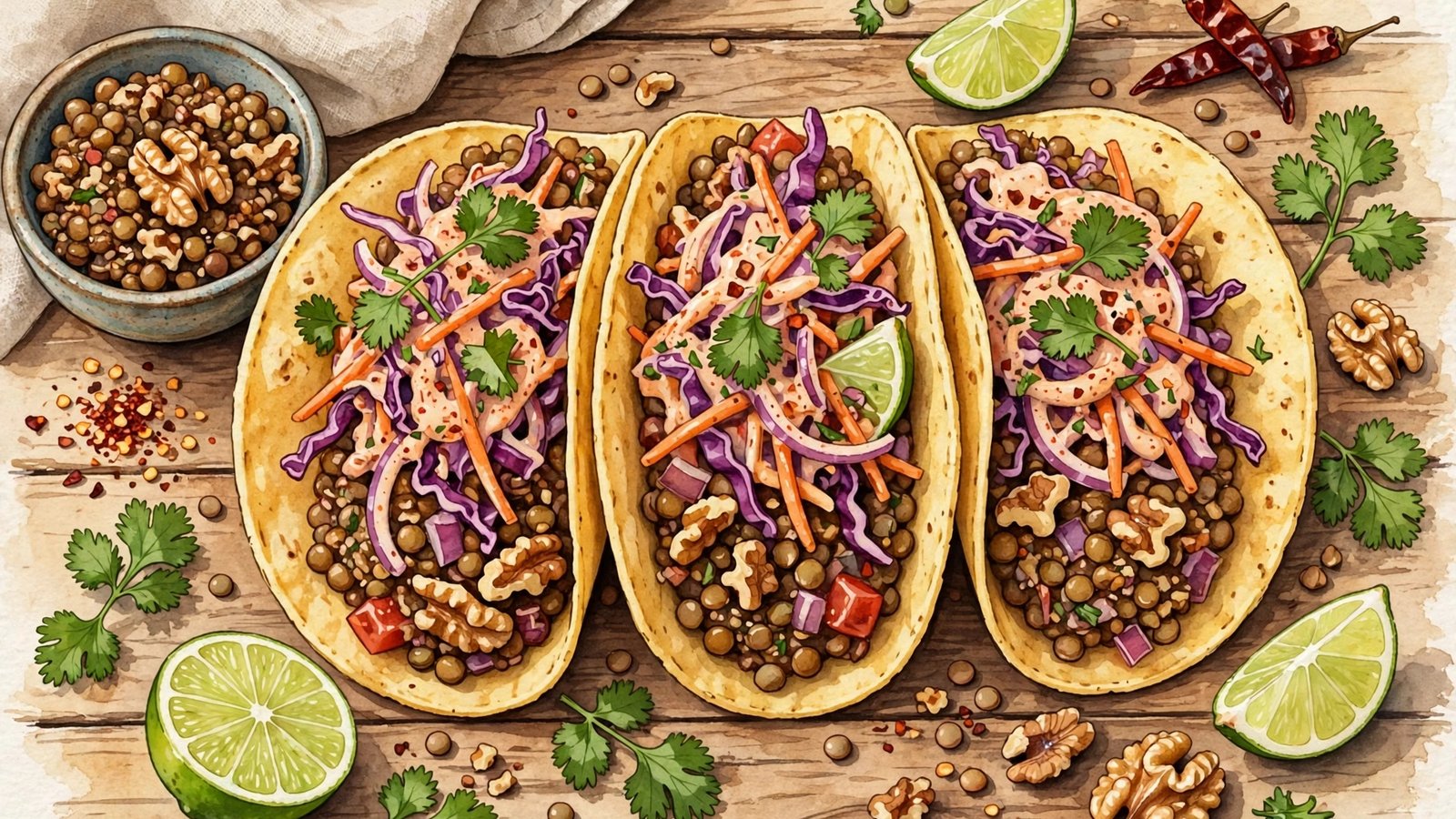
- Cook brown or green lentils until just tender, drain them well, and fold them into a skillet of softened onion, garlic, tomato paste, cumin, smoked paprika, and chili powder with coarsely chopped toasted walnuts. Finish with lime juice and salt. Make the slaw by tossing shredded green and red cabbage and grated carrot with vegan mayonnaise, minced chipotle in adobo, lime juice, and cumin, then rest it for at least 10 minutes. Warm 12 small tortillas, fill each with the lentil walnut mixture, top with slaw, and serve with lime wedges. Refrigerate leftovers within 2 hours, use refrigerated leftovers within 3 to 4 days, and reheat the filling to 165 degrees Fahrenheit measured with a food thermometer. Walnuts are a tree nut and soy sauce brings soy and usually wheat, so read every label if you are cooking for someone with an allergy.
Introduction
A good taco night needs a filling with real substance, toppings with crunch, and a method simple enough for a weeknight. These vegan lentil walnut tacos are built for that job. Lentils bring earthy body and a tender, lightly crumbly texture. Toasted walnuts add richness and chew. A smoky chipotle slaw made with cabbage, carrot, and lime cuts through both with brightness and gentle heat. The result stands on its own as a plant based dinner, not as an apology for a missing ingredient.
The recipe is practical as well as satisfying. Dried lentils are inexpensive, keep well in the pantry, and cook without soaking. Walnuts toast in a few minutes. The slaw can be made first and rested while the filling cooks, so the components come together in a calm order. Nutrition figures, storage times, and allergen notes in this article were checked on 30 October 2026 against United States Department of Agriculture and Food and Drug Administration sources named in the Sources section, because times, temperatures, and label rules should come from primary guidance rather than habit.
Why Lentils and Walnuts Make a Convincing Taco Filling
Good taco filling needs three things: something to chew, something savory to anchor it, and enough moisture that it does not dry into loose crumbs. Lentils provide the anchor. Brown or green lentils hold their shape better than red lentils, which tend to break down toward a puree. You want distinct, tender lentils that can be mashed lightly with a spoon, not a smooth paste. Cooking them until just tender, then draining them well, gives you control over the final texture.
Walnuts provide the chew and the richness. Toasted and chopped, they add a buttery, slightly bitter edge that plays well against smoky spices. Chop them to a coarse, uneven texture rather than grinding them fine. Some larger pieces give the filling character, while smaller crumbs help it cling together. If you have a nut allergy in the household, this is not a recipe to adapt casually: the walnuts are central, and swapping them changes the dish entirely.
The spice blend is deliberately simple. Cumin gives warmth, smoked paprika gives the campfire note that makes the filling taste grilled even when it is cooked on the stove, garlic powder rounds things out, and a little chili powder adds depth. Tomato paste, cooked briefly until it darkens, adds savory richness and helps the mixture bind. A splash of soy sauce or tamari adds salt and savory depth, but it is optional. Choose tamari or a certified gluten free soy sauce if gluten is a concern, and always check the label.
Contrast is what keeps each bite interesting. Lentils alone can taste flat and soft, especially if overcooked. Walnuts alone can feel heavy. Together, with onion sweetness, lime acidity, crisp cabbage, and chipotle smoke, the filling has layers rather than a single note.
What the Main Ingredients Bring to the Plate
Lentils belong to the beans, peas, and lentils subgroup in United States Department of Agriculture MyPlate guidance. MyPlate notes that foods in this subgroup resemble both vegetables and protein foods: like vegetables, they are excellent sources of fiber, folate, and potassium, and like protein foods, they are excellent sources of plant protein and also provide iron and zinc. That dual character is why lentils can carry a main dish.
The measured figures support the role. According to United States Department of Agriculture FoodData Central values for lentils, mature seeds, cooked, boiled, without salt, 1 cup of cooked lentils, at 198 grams, provides about 230 calories, 17.9 grams of protein, 39.9 grams of carbohydrate, 0.75 grams of fat, and about 15.6 grams of fiber. Per 100 grams, the same entry provides about 116 calories, 9.02 grams of protein, and 7.9 grams of fiber. Treat these figures as values for plain boiled lentils, not as a nutrition label for the finished tacos, because oil, walnuts, tortillas, mayonnaise, and toppings all change the totals.
Walnuts bring a different profile: energy and fat rather than bulk protein. A 1 ounce serving of walnuts, about 12 to 14 halves or a quarter cup, provides about 190 calories, 18 grams of total fat, 13 grams of polyunsaturated fat, 4 grams of protein, 2 grams of fiber, and 2.5 grams of alpha linolenic acid, the plant based omega 3 fatty acid usually shortened to ALA, according to a nutrient handout sourced to United States Department of Agriculture FoodData Central, 2019. The National Institutes of Health Office of Dietary Supplements explains that ALA is an essential fatty acid, meaning the body cannot make it and it must come from food, and it lists walnuts among the nuts and seeds that provide omega 3s. The same office lists the average daily recommended amount for ALA as 1.6 grams for men and 1.1 grams for women. The walnuts in this recipe are shared across the whole batch rather than served by the ounce to one person, but they still make the filling notably richer than lentils alone.
Cabbage and carrot add volume, crunch, and freshness, and lime juice lifts the smoke and fat so the slaw tastes bright instead of simply spicy. None of this makes the tacos a medical food, and this article makes no health outcome claim.
| Ingredient, as served in the recipe | Measured value used in this article | Source basis |
|---|---|---|
| Lentils, cooked, 1 cup (198 grams) | About 230 calories, 17.9 grams protein, about 15.6 grams fiber | United States Department of Agriculture FoodData Central, lentils, mature seeds, cooked, boiled, without salt |
| Lentils, cooked, per 100 grams | About 116 calories, 9.02 grams protein, 7.9 grams fiber | Same FoodData Central entry |
| Walnuts, 1 ounce (about 12 to 14 halves) | About 190 calories, 18 grams total fat, 2.5 grams ALA, 4 grams protein | Nutrient handout sourced to United States Department of Agriculture FoodData Central, 2019 |
| ALA, average daily recommended amount | 1.6 grams for men, 1.1 grams for women | National Institutes of Health Office of Dietary Supplements, Omega 3 Fatty Acids consumer fact sheet |
Choosing the Right Lentils, and When Canned Lentils Work
Not every lentil behaves the same in the pot. Brown and green lentils are the first choice because they keep a defined shape through simmering, so the finished filling has separate, tender pieces that hold together when spooned. Black lentils also hold their shape well and can be used in the same quantity. Red and yellow lentils are the wrong tool here: they cook quickly and break down into a soft mass, which suits dals and thickened soups but turns this filling toward paste. If red lentils are all you have, cook them for a shorter time, drain them very well, mash none of them, and expect a softer result.
Dried lentils need no soaking. United States Department of Agriculture household guidance for dry lentils and peas states that lentils and peas are smaller in size and do not require soaking prior to cooking, and it directs cooks to rinse them in a colander, cover them with fresh cold water, simmer over medium heat until tender, and allow 20 to 45 minutes depending on the variety. This recipe narrows that wider range to 20 to 25 minutes for brown or green lentils because the lentils cook a second time in the skillet. Rinsing still matters: dried legumes can occasionally hide small stones or debris, so pick the lentils over as you rinse.
Canned lentils are a fair weeknight shortcut with a texture trade off. Drain and rinse about two standard cans, skip the simmering step, and add the lentils directly to the onion and spice mixture. Canned lentils are usually softer, so mash them less and cook the filling only long enough to heat through and blend the flavors, about 3 minutes. Whichever route you choose, drain thoroughly. Excess water is the most common reason a lentil filling steams instead of browning lightly in the pan.
Ingredients
For the lentil walnut filling
- 1 cup dried brown or green lentils, rinsed and picked over
- 2 and a half cups water or low sodium vegetable broth
- 1 tablespoon olive oil
- 1 small yellow onion, finely diced
- 3 cloves garlic, minced
- 1 cup raw walnuts, toasted and coarsely chopped
- 2 tablespoons tomato paste
- 1 teaspoon ground cumin
- 1 teaspoon smoked paprika
- Half a teaspoon chili powder
- Half a teaspoon garlic powder
- 1 tablespoon soy sauce or tamari (optional; check the label for gluten free needs)
- 1 tablespoon lime juice, freshly squeezed
- Salt and black pepper, to taste
For the smoky chipotle slaw
- 3 cups shredded green cabbage (about a quarter of a medium head)
- 1 cup shredded red cabbage, for color
- 1 medium carrot, grated
- 3 tablespoons vegan mayonnaise or a neutral oil based dressing
- 1 to 2 chipotle peppers in adobo, minced, plus 1 teaspoon adobo sauce
- 1 tablespoon lime juice, freshly squeezed
- 1 teaspoon agave nectar or maple syrup (optional)
- A quarter teaspoon ground cumin
- Salt, to taste
To serve
- 12 small corn or flour tortillas (check labels for vegan and gluten free needs)
- Fresh cilantro leaves (optional)
- Lime wedges
- Sliced avocado or guacamole (optional)
- Pickled red onion (optional)
How to Make the Filling
Start with the lentils. Rinse them in a fine strainer and pick out any small stones or debris. Combine the lentils and water or broth in a medium saucepan, bring to a boil, then reduce the heat to a gentle simmer. Cover partially and cook for 20 to 25 minutes, checking toward the end. You want lentils that are tender when bitten but still hold their shape. Drain them well and set them aside. Overcooked lentils will still taste fine, but the filling will be softer and less interesting, so it is worth checking a few minutes early.
While the lentils cook, toast the walnuts. Spread them in a dry skillet over medium heat and stir often for 3 to 5 minutes, until they smell fragrant and look a shade darker. Watch them closely, because nuts go from toasted to burned quickly. Let them cool for a few minutes, then chop them coarsely. A knife gives you better control than a food processor here, which can turn walnuts into butter if you run it too long. For freshness, the walnut nutrient handout cited in Sources advises keeping walnuts cold, refrigerated away from strong odors, and frozen if stored for a month or longer.
Next, warm the olive oil in a large skillet over medium heat. Add the diced onion and a pinch of salt and cook, stirring occasionally, for 5 to 7 minutes, until the onion is soft and translucent with golden edges. Stir in the garlic and cook for just 30 seconds, until fragrant. Garlic burns easily, and burned garlic turns bitter, so keep the heat moderate and keep stirring.
Add the tomato paste, cumin, smoked paprika, chili powder, and garlic powder. Stir constantly for about a minute, letting the paste darken slightly and coat the onions. This short cooking step matters: raw tomato paste tastes tinny, but cooked paste tastes rich and savory. Add the drained lentils and chopped walnuts, then the soy sauce or tamari if you are using it. Stir well and cook for 3 to 5 minutes, pressing some of the lentils lightly with the back of a spoon as you go. You want a mixture that holds together in a spoon but still has visible lentils and walnut pieces. Add a splash of water if it looks dry. Finish with lime juice, taste, and adjust salt and pepper. The filling should taste bold on its own, because tortillas and slaw will soften the seasoning.
How to Make the Smoky Chipotle Slaw
Combine the green cabbage, red cabbage, and grated carrot in a large bowl. In a small bowl, whisk together the vegan mayonnaise, minced chipotle peppers, adobo sauce, lime juice, sweetener if using, and cumin. Start with one chipotle pepper if you are unsure about heat. Chipotles vary in strength, and you can always add more, but you cannot take heat away once it is mixed in. Pour the dressing over the cabbage and toss well. Season with salt, taste, and add more lime or adobo sauce until the slaw tastes bright, smoky, and balanced rather than simply spicy.
Let the slaw rest for at least 10 minutes before serving, or refrigerate it for up to a few hours. The salt and lime will soften the cabbage slightly while keeping its crunch. If the slaw releases a lot of liquid after sitting, drain a little off before spooning it onto tacos, so the tortillas do not become soggy.
Controlling the Heat Without Losing the Smoke
Chipotle in adobo does two jobs at once: it brings smoke and heat, plus a tangy sauce around the peppers. Because one can varies from the next, the only reliable control is tasting in stages. Whisk the dressing with one pepper and the teaspoon of adobo sauce first, taste it on a piece of cabbage, and only then decide about the second pepper. Heat reads stronger in a concentrated dressing than it will across a full bowl of cabbage and a warm tortilla, so judge the dressed slaw, not the dressing alone.
For a milder table, use the adobo sauce without mincing a whole pepper into the slaw. You keep most of the smoke and color with noticeably less heat, and hot sauce can sit on the side for anyone who wants more. For a hotter batch, add the second pepper or stir a few dashes of hot sauce into the filling, which spreads the heat more evenly. Leftover chipotles from an opened can should be refrigerated promptly in a small covered container, or frozen in small portions for later cooking, and discarded if they have sat out.
Sweetness and acid are the other two dials. The optional teaspoon of agave nectar or maple syrup does not make the slaw sweet; it rounds the sharp edges of lime and smoke. Extra lime sharpens everything. Adjust one dial at a time and taste again.
Assembling the Tacos
Warm the tortillas so they bend without cracking. A dry skillet over medium heat works well: warm each tortilla for 20 to 30 seconds per side, then stack them under a clean kitchen towel. You can also wrap a stack in a damp paper towel and microwave it briefly, checking often so they do not dry out. Warm tortillas are not a small detail; cold, stiff tortillas crack and spill filling everywhere.
Spoon a generous amount of filling down the center of each tortilla, top with a mound of chipotle slaw, and finish with cilantro, avocado, or pickled red onion if you like. Serve lime wedges on the side. Two or three tacos make a satisfying main meal for most adults, especially with a side of rice, beans, or a simple salad. For a group, set the components out in bowls and let people build their own; it keeps the tortillas crisp and lets everyone control the heat level.
Variations and Make-Ahead Notes
The filling is flexible once you understand its structure. For a warmer, deeper flavor, add a pinch of cocoa powder or a small square of dark chocolate melted into the lentils, a trick used in some mole inspired sauces. For a fresher version, stir in a handful of chopped fresh cilantro and extra lime zest at the end. For more heat, add another chipotle pepper to the slaw or a few dashes of hot sauce to the filling. For a milder table, keep the slaw gentle and put hot sauce on the side.
You can cook the lentils a day ahead and refrigerate them in a covered container. The filling reheats well in a skillet over medium heat with a splash of water to loosen it, reheated to the temperature given in the storage section below. The slaw is best within a day, while the cabbage is still crisp. Keep components separate until serving. Assembled tacos do not store well, because the slaw softens the tortilla.
Storage and Food Safety
Refrigerate leftovers promptly, within 2 hours of cooking, in covered containers. The United States Department of Agriculture Food Safety and Inspection Service explains why the clock matters: bacteria grow rapidly between 40 degrees Fahrenheit and 140 degrees Fahrenheit, hot food must be kept hot at 140 degrees Fahrenheit or warmer, and perishable food left at room temperature for more than 2 hours should be thrown away, with that window shortened to 1 hour when the temperature is over 90 degrees Fahrenheit. The same service advises dividing large amounts of food into shallow containers so leftovers cool rapidly, and covering or sealing leftovers to keep bacteria out and retain moisture.
The same guidance states that leftovers can be kept in the refrigerator for 3 to 4 days or frozen for 3 to 4 months, and that frozen leftovers stay safe indefinitely but can lose moisture and flavor over longer storage. Reheat leftovers so they reach 165 degrees Fahrenheit as measured with a food thermometer. Safe thawing methods are the refrigerator, cold water, and the microwave, and after refrigerator thawing the food should be used within 3 to 4 days. Apply the 3 to 4 day window to the filling and to the raw cabbage slaw, and discard the slaw sooner if it looks slimy or has sat out. Do not rely on smell alone to judge safety; when in doubt, throw it out. Freeze the filling, without slaw or tortillas, for longer storage, and thaw it in the refrigerator before reheating.
Allergen and Label Notes That Matter in This Recipe
Allergen notes deserve care, and United States label law explains why the specific food source must be named. The Food and Drug Administration states that the Food Allergen Labeling and Consumer Protection Act of 2004 identified eight major food allergens, and that the Food Allergy Safety, Treatment, Education, and Research Act, signed on 23 April 2021, declared sesame the 9th major food allergen, effective 1 January 2023. The list of nine is: milk, eggs, fish, crustacean shellfish, tree nuts given with the examples almonds, walnuts, and pecans, peanuts, wheat, soybeans, and sesame. Labels must identify the food source name of a major allergen either in parentheses after the ingredient, as in lecithin (soy) or flour (wheat), or in a Contains statement immediately after or next to the ingredient list.
Three of those nine appear in this recipe in ordinary forms. Walnuts are a tree nut, and the specific type must be named, so a label should say walnut rather than only tree nut. Soy sauce contains soybeans and usually wheat, which is why tamari or a certified gluten free alternative matters for some readers, and why skipping the soy sauce and seasoning with salt is the simplest removal. Flour tortillas contain wheat, and corn tortillas, vegan mayonnaise, and chipotle in adobo all vary by brand, so every package needs the same label check.
None of that labeling replaces a conversation. Read every label, and if you are cooking for someone with an allergy, check ingredients with that person rather than assuming a product is safe. The Food and Drug Administration advises consumers with food allergies to always read food labels, avoid foods they are allergic to, learn to recognize the early symptoms of an allergic reaction, and know what to do if a reaction occurs. If a severe nut allergy is part of the household, choose a filling built without tree nuts from the start, and take cross contact in your own kitchen, including shared boards, knives, and toasting pans, seriously.
Frequently Asked Questions
Can I use canned lentils?
Yes, with a texture trade off. Drain and rinse about two standard cans, then skip the simmering step and add them directly to the onion and spice mixture. Canned lentils are softer, so mash them less and cook the filling just long enough to heat through and blend the flavors, about 3 minutes.
Do I need to soak dried lentils?
No. Brown and green lentils cook relatively quickly without soaking, and United States Department of Agriculture household guidance for dry lentils and peas states that lentils do not require soaking prior to cooking. Rinsing and picking them over is enough. Red lentils cook faster and break down more, so they are not the best choice for this filling.
How spicy is the slaw?
It depends on your chipotles. One pepper plus a teaspoon of adobo sauce gives gentle warmth for most people. Two peppers make it clearly spicy. Taste the dressing before tossing it with the cabbage, and remember that the cabbage and tortilla will soften the heat. For smoke with less heat, use adobo sauce alone and put hot sauce on the side.
Can I make this gluten free?
The filling can be made without gluten containing ingredients if you use tamari or a certified gluten free soy sauce, or skip the soy sauce and season with salt instead. Serve with corn tortillas that are labeled gluten free, and check the chipotle and mayonnaise labels as well. Gluten free here describes ingredient choices, not a medical guarantee, and anyone managing celiac disease or a wheat allergy should verify every label and preparation step for their own needs.
How long do leftovers keep, and how should I reheat them?
Refrigerate leftovers within 2 hours, or within 1 hour if the room or outdoor temperature is over 90 degrees Fahrenheit. United States Department of Agriculture guidance gives refrigerated leftovers 3 to 4 days and frozen leftovers 3 to 4 months for best handling, and directs cooks to reheat leftovers to 165 degrees Fahrenheit measured with a food thermometer. Keep the slaw separate, add it cold at serving, and do not refreeze assembled tacos.
What sides go well with these tacos?
Mexican style rice, black beans, roasted corn, a simple cucumber salad, or tortilla chips with guacamole all work. Keep sides simple, because the tacos already carry a lot of flavor. A second batch of plain slaw without chipotle is a useful side for anyone at the table who prefers no heat.
Sources & references
- United States Department of Agriculture, Food Safety and Inspection Service, Leftovers and Food Safety. Used for bacteria growing rapidly between 40 degrees Fahrenheit and 140 degrees Fahrenheit, hot food kept at 140 degrees Fahrenheit or warmer, refrigerating leftovers within 2 hours and discarding perishable food left out for more than 2 hours or more than 1 hour over 90 degrees Fahrenheit, cooling rapidly in shallow containers, covering or sealing leftovers, keeping leftovers in the refrigerator for 3 to 4 days or frozen for 3 to 4 months with frozen leftovers safe indefinitely but losing moisture and flavor, safe thawing in the refrigerator, cold water, or microwave with use within 3 to 4 days after refrigerator thawing, and reheating leftovers to 165 degrees Fahrenheit measured with a food thermometer.
- United States Department of Agriculture, MyPlate, Beans, Peas, and Lentils. Used for beans, peas, and lentils as pulses and a MyPlate vegetable subgroup, and for their nutrition resembling both vegetables and protein foods: excellent sources of fiber, folate, and potassium like vegetables, and excellent sources of plant protein also providing iron and zinc like protein foods.
- United States Department of Agriculture, Agricultural Research Service, FoodData Central, 2019, via the California Walnut Board nutrient handout for 1 ounce of walnuts. Used for walnuts at about 190 calories, 18 grams total fat, 13 grams polyunsaturated fat, 2.5 grams alpha linolenic acid, 4 grams protein, and 2 grams fiber per ounce, 1 ounce described as a quarter cup or 12 to 14 halves, and the storage advice to keep walnuts cold, refrigerated away from strong odors for shorter storage and frozen for a month or longer.
- United States Department of Agriculture, FoodData Central values for lentils, mature seeds, cooked, boiled, without salt, as reproduced in nutrition references consulted on 30 October 2026. Used for 1 cup at 198 grams providing about 230 calories, 17.9 grams protein, 39.9 grams carbohydrate, 0.75 grams fat, and about 15.6 grams fiber, and per 100 grams about 116 calories, 9.02 grams protein, and 7.9 grams fiber.
- National Institutes of Health, Office of Dietary Supplements, Omega 3 Fatty Acids, consumer fact sheet. Used for the three main omega 3 fatty acids being alpha linolenic acid, eicosapentaenoic acid, and docosahexaenoic acid, ALA being an essential fatty acid the body cannot make, walnuts listed among nuts and seeds providing omega 3s, and the average daily recommended ALA amounts of 1.6 grams for men and 1.1 grams for women.
- United States Food and Drug Administration, Food Allergies: What You Need to Know. Used for the Food Allergen Labeling and Consumer Protection Act of 2004 identifying eight major food allergens, the Food Allergy Safety, Treatment, Education, and Research Act signed 23 April 2021 declaring sesame the 9th major food allergen effective 1 January 2023, the nine item list including tree nuts with almonds, walnuts, and pecans as examples, the two label formats using parentheses or a Contains statement, and the advice to always read food labels, avoid allergenic foods, recognize early symptoms, and know what to do if a reaction occurs.
- United States Food and Drug Administration, Food Allergen Labeling and Consumer Protection Act of 2004, statutory text. Used for the major food allergen definition naming tree nuts with almonds, pecans, or walnuts as examples alongside milk, egg, fish, crustacean shellfish, wheat, peanuts, and soybeans, and for the requirement that the name for a tree nut means the specific type of nut.
- United States Department of Agriculture household guidance for cooking with dry lentils and peas, February 2020 bulletin. Used for rinsing lentils in a colander, lentils and peas not requiring soaking prior to cooking because of their smaller size, covering with fresh cold water, simmering over medium heat until tender, and a cooking range of 20 to 45 minutes depending on the variety.


