Short answer
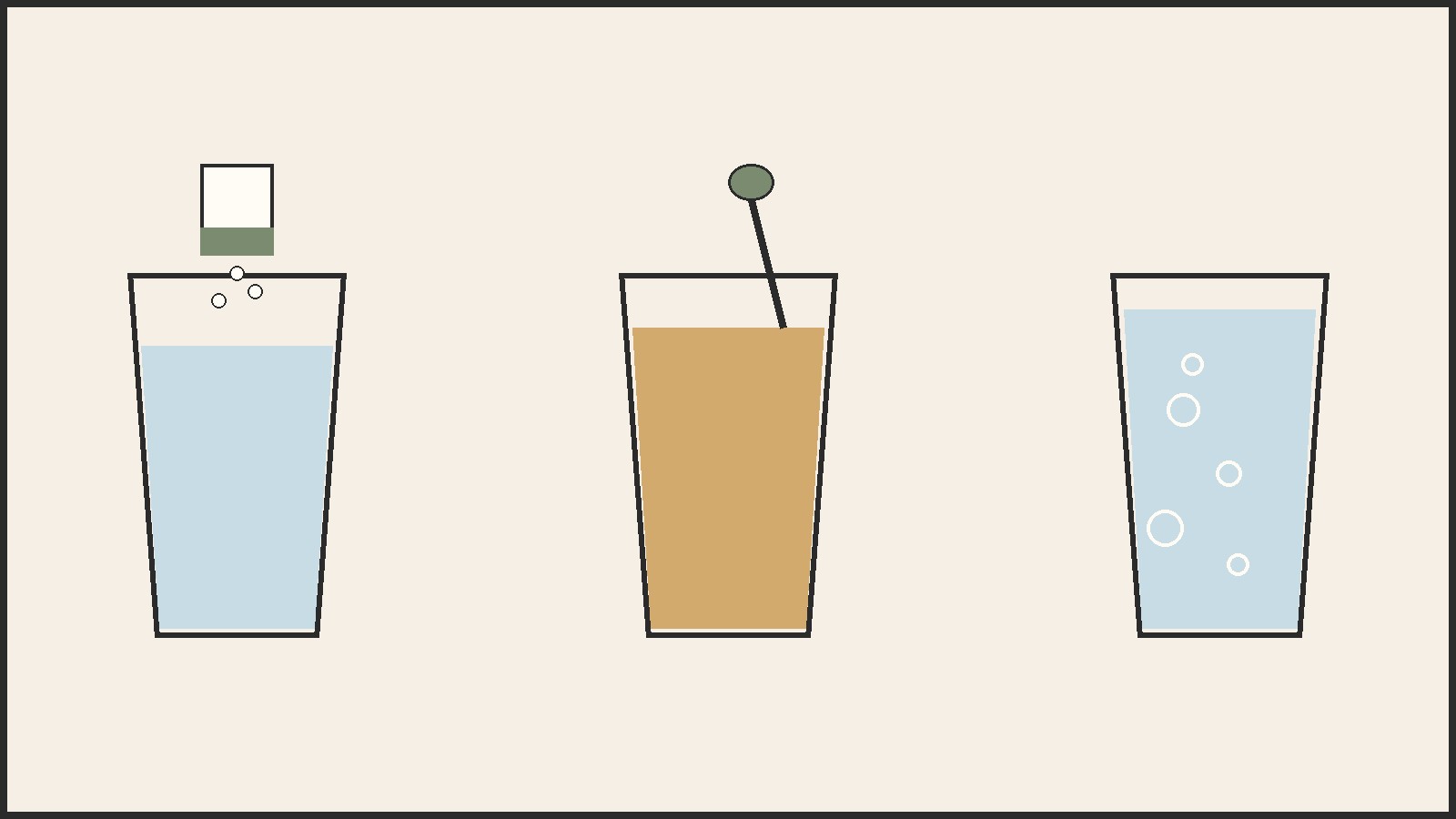
- A solute is the substance that dissolves in another substance to form a solution. In salt water, salt is the solute and water is the solvent. In sweet tea, sugar is the solute and the tea is mainly water acting as the solvent. In a carbonated drink, carbon dioxide gas is the solute dissolved in water. A solution is the uniform mixture that results. It is uniform because solute particles spread evenly through the solvent, so every sample has the same composition. That uniformity separates a true solution from a mixture in which particles simply sit suspended and later settle out. A solute is not always a solid. It can be a solid, a liquid, or a gas. Sugar and salt are solid solutes in water. Ethanol is a liquid solute in some drinks and mixtures. Oxygen is a gaseous solute in air, where nitrogen is the main gaseous solvent. The state of the solute does not decide whether something counts as a solute. The role it plays in the mixture does.
What a Solute Is, in Plain Language
Think of a solution as a mixture with two jobs to fill. One substance does the dissolving. The other substance gets dissolved. The substance that gets dissolved is the solute. The substance that does the dissolving is the solvent.
Textbooks often describe the solute as the minor component and the solvent as the major component. That description works for the most familiar examples. In a glass of salt water made from 10 grams of salt and 100 grams of water, salt is clearly the smaller amount, so salt is the solute and water is the solvent. In a spoonful of sugar stirred into a large cup of tea, sugar is again the smaller amount.
That amount rule is useful, but it is not the whole story. Amount can be measured by mass or by moles, and substances with very different molar masses can make the comparison tricky. The clearer test, in most teaching examples, is the role test: which substance is being dissolved into the other, and which substance sets the phase of the finished mixture? In most cases, the finished solution has the same phase as the solvent. Salt water is liquid because water is liquid. Air is a gas because its main component, nitrogen, is a gas.
A solute does not vanish when it dissolves. That is one of the most common misunderstandings. When sugar dissolves in tea, you can no longer see grains of sugar, but the sugar is still there, spread through the liquid as individual molecules. If you evaporate the water, sugar remains. The same idea applies to salt water. Dissolving changes how a substance is distributed, not whether it exists.
Dissolving is also different from melting. Melting turns one pure substance from solid to liquid by heating it. Dissolving needs a second substance, the solvent, and it can happen far below the melting point of the solute. Table salt melts only at a very high temperature, yet it dissolves readily in water at room temperature. The solvent does the work of pulling solute particles apart and surrounding them.
Solute, Solvent, and Solution: The Three Terms Together
These three words are almost always taught together, because none of them makes full sense alone. A solute without a solvent is just a substance. A solvent without a solute is just a liquid, a gas, or a solid on its own. A solution is what you get when the two combine into a uniform mixture.
| Term | Plain meaning | Example in salt water |
|---|---|---|
| Solute | The substance that is dissolved | Salt |
| Solvent | The substance that dissolves the solute | Water |
| Solution | The uniform mixture formed | Salt water |
The same pattern repeats in many other mixtures:
| Solution | Solute | Solvent |
|---|---|---|
| Seawater | Salts | Water |
| Sweet tea | Sugar | Water |
| Soda water | Carbon dioxide gas | Water |
| Vinegar | Acetic acid | Water |
| Antifreeze mixture | Ethylene glycol | Water |
| Air | Oxygen and other gases | Nitrogen |
Solid, Liquid, and Gas Solutes
Solutes are not limited to solids. A solute can be in any state, and a solvent can be in any state too. The table below shows the main combinations from standard chemistry teaching examples.
| Solvent state | Solute state | Example |
|---|---|---|
| Gas | Gas | Oxygen in nitrogen, as in air |
| Liquid | Gas | Carbon dioxide in water, as in soda water |
| Liquid | Liquid | Ethylene glycol in water, as in antifreeze |
| Liquid | Solid | Salts in water, as in seawater |
Solid solutes are the easiest to picture, because you can see them before they dissolve. Salt, sugar, and baking soda all start as visible solids. Stir them into water, and the visible grains disappear into a clear liquid. That disappearance is not destruction. It is dispersion at a very small scale.
Liquid solutes are easy to miss, because both parts of the mixture are liquids and there is no grain to watch disappear. Vinegar is acetic acid dissolved in water. An alcoholic drink is ethanol dissolved in water, along with flavor substances. In these cases, the way to identify the solute is usually to ask which liquid is present in the smaller amount, or which liquid is being added to the other.
Gas solutes are the most surprising for many readers, because gases are invisible. Carbon dioxide dissolved in water gives a carbonated drink its fizz. When you open the bottle, pressure falls and some of that gas escapes, which is why a warm or long open drink goes flat. Oxygen dissolved in water matters for fish and other aquatic life, even though you cannot see it. In air, oxygen is a gaseous solute and nitrogen is the gaseous solvent, with argon and other gases also present in smaller amounts.
What Happens When a Solute Dissolves
Dissolving happens in steps that explain why some substances dissolve easily and others do not.
First, solvent particles surround the surface of the solute. They pull individual solute particles away from the rest of the solute. For an ionic solid such as table salt, that means pulling sodium ions and chloride ions away from the crystal. For a molecular solid such as sugar, it means pulling individual sugar molecules away from each other.
Next, each freed solute particle becomes surrounded by solvent particles. Chemists call this solvation. When the solvent is water, the same process is called hydration. The solvent shell keeps solute particles separated from one another, so they do not simply clump back together at once.
In a true solution, the dissolved particles are extremely small, usually less than 1 nanometer in diameter, according to standard chemistry teaching material. That small size explains two practical tests for a solution. First, the mixture is stable: dissolved sugar does not settle to the bottom if you leave sweet tea standing. Second, the mixture passes through a filter unchanged: dissolved particles are small enough to pass through ordinary filter paper along with the solvent, while undissolved grains would be caught.
Solute particles can be atoms, ions, or molecules, depending on what dissolved. Salt gives ions in water. Sugar gives molecules. A dissolved gas gives individual gas molecules spread through the liquid. That variety is one reason the word solute is so useful. It covers all of these cases with one role based term.
Everyday and Laboratory Examples
The kitchen is the best place to see solutes at work. Salt in cooking water is a solid solute in a liquid solvent. Sugar in tea or coffee is another. Honey stirred into warm water dissolves as a mixture of sugars, with water as the solvent. A stock cube dissolved in hot water gives a solution containing salt, flavor compounds, and other dissolved material.
Drinks show gas and liquid solutes clearly. A carbonated drink contains carbon dioxide gas as a solute. A fruit squash made by diluting a concentrate with water contains sugars, acids, and flavor substances as solutes. Outside the kitchen, seawater contains dissolved salts, rainwater contains dissolved gases from the air, and tap water contains dissolved minerals. A liquid medicine contains dissolved active substances, which is why a measured dose from any part of the bottle should contain the same amount, provided the medicine is a true solution and has been stored as directed.
The body also runs on solutes. Blood plasma carries dissolved nutrients, salts, gases, and waste products, spread uniformly through a liquid so they can reach tissues. This article makes no medical claim about any specific concentration or treatment. Dissolved oxygen in rivers and lakes supports aquatic life, while dissolved pollutants are a concern for the same reason: once truly dissolved, a substance is spread through the water and cannot be removed by settling or by an ordinary filter.
In a laboratory, the solute is usually the substance a chemist wants to study, measure, or react. A chemist weighs a solid, dissolves it in a solvent, and then uses the resulting solution in measured amounts. A common task is to prepare a solution of known concentration. The chemist weighs the solute, transfers it to a volumetric flask, adds solvent, and fills the flask to a marked volume. The final volume is the volume of the solution, not just the volume of solvent added. That distinction matters, because the solute itself contributes to the total volume. It is a common student error to add a fixed volume of solvent to a weighed solute and assume the total volume is unchanged.
A stock solution is a relatively concentrated solution that is later diluted to the needed strength. Dilution means adding more solvent, which lowers the concentration without changing the amount of solute present. The same amount of solute is now spread through a larger volume. Solutes also appear in purification work. If a solution is cooled or evaporated, solute may come back out as crystals, which can then be collected. That reversibility is a useful check on the idea that dissolving does not destroy the solute.
Concentration: How Much Solute Is Present
Concentration answers a simple question: how much solute is there, relative to how much solvent or solution? Two different kinds of answer exist, and confusing them causes many errors.
Qualitative words describe concentration loosely. Dilute means a solution contains relatively little solute. Concentrated means it contains relatively a lot of solute. Those words are useful in conversation, but they do not give a number. A dilute solution of one substance can contain far more solute, in grams, than a concentrated solution of another substance, because the two substances have different solubilities and different molar masses. Dilute and concentrated are comparisons, not measurements.
Quantitative concentration gives a number with units. The most common unit in chemistry is molarity. Molarity is defined as the number of moles of solute per liter of solution. Its symbol is M, read as molar. The formula is:
Molarity = moles of solute divided by liters of solution
That definition contains two traps that students are warned about repeatedly. First, the moles in the formula are moles of solute, not moles of solvent and not moles of the whole solution. Second, the liters in the formula are liters of solution, not liters of solvent. If you dissolve solute in solvent and then fill to a final volume, that final volume is the one to use.
A worked example makes the point concrete. If 1.5 moles of sodium chloride are dissolved to make 0.500 liters of solution, the molarity is 1.5 divided by 0.500, which equals 3.0 M sodium chloride. The same logic works in reverse. If you know the molarity and the volume, you can work out the moles of solute present. If you know the mass of solute, you convert mass to moles using molar mass before you apply the molarity formula.
Solubility: How Much Solute Can Dissolve
Solubility is the maximum amount of a solute that can dissolve in a given amount of solvent at a given temperature. It is usually expressed as the amount of solute that can dissolve in 100 grams of solvent at a stated temperature. Temperature must be stated, because solubility changes with temperature.
Solubilities vary enormously. Standard teaching tables list potassium bromide at 70.7 grams per 100 grams of water at 25 degrees Celsius, while silver chloride is listed at only 0.00019 grams per 100 grams of water at the same temperature. Both are ionic compounds, both are in water, yet one dissolves in large amounts and the other barely dissolves at all. That range is why a solubility value is meaningless without naming the solute, the solvent, and the temperature.
Three saturation states describe where a solution sits relative to its solubility limit:
| State | Meaning | What happens if you add more solute |
|---|---|---|
| Unsaturated | Less solute than the maximum is dissolved | The added solute dissolves, up to the limit |
| Saturated | The maximum amount is dissolved at that temperature | Added solute does not dissolve and remains as solid, for a solid solute |
| Supersaturated | More solute than the normal maximum is dissolved | The solution is unstable, and added solute, such as a seed crystal, can trigger crystallization |
A supersaturated solution is usually made by heating a solvent, dissolving more solute than would dissolve at room temperature, and then cooling the solution slowly and carefully. It is not stable in the same way as an ordinary solution. Given an opportunity, such as dropping in a crystal of solute, the excess solute will come out of solution, often rapidly.
Solubility is not the same as dissolving speed. A solute can be highly soluble but dissolve slowly, if it is in large chunks with little surface exposed. Crushing, stirring, and heating usually speed up dissolving, because they increase contact between solute and solvent. They do not, by themselves, change the final solubility limit, except that heating changes temperature, which does affect solubility for many substances. Keeping speed and limit separate avoids a common confusion in school practical work.
What Affects Whether a Solute Dissolves
Four factors dominate solubility and dissolving behavior.
First, the nature of the solute and the solvent matters most. The general rule is “like dissolves like.” Polar solutes tend to dissolve in polar solvents, and nonpolar solutes tend to dissolve in nonpolar solvents. Table salt is polar, because it is made of ions, so it dissolves in water, which is polar, but not in vegetable oil, which is nonpolar. Nonpolar wax dissolves in nonpolar hexane but not in polar water. The reason is intermolecular forces: a solute dissolves well when solute and solvent particles experience similar kinds of attractions. The rule is a useful guide, not an absolute law, and it must be applied with care for substances that are partly polar and partly nonpolar.
Second, temperature matters, and it matters differently for solids and gases. For most solid solutes in liquids, raising the temperature increases solubility: hot water dissolves more sugar than cold water does. For gases in liquids, the pattern reverses: gases dissolve better in colder liquids, which is why a warm carbonated drink goes flat faster than a cold one. Some solid solutes are exceptions, and a full solubility curve is needed for precise work, but the solid versus gas contrast is the key pattern for an introductory reader.
Third, pressure matters mainly for gases. Increasing the pressure of a gas above a liquid forces more gas into solution. That is why a sealed carbonated drink holds its fizz until you open it and release the pressure. For solids and liquids, ordinary pressure changes have almost no effect on solubility, because solids and liquids are not easily compressed.
Fourth, particle size and stirring affect speed, not the final limit. Smaller solute particles dissolve faster because more surface is exposed to the solvent. Stirring brings fresh solvent into contact with the solute surface. Neither change, on its own, lets you dissolve more solute than the solubility limit allows at that temperature. A crushed sugar cube and a whole sugar cube in the same amount of water at the same temperature will reach the same final dissolved amount, even though the crushed cube gets there sooner.
How to Identify the Solute: Worked Examples
Identification questions follow a short checklist. Ask: what is being dissolved, what is doing the dissolving, and what is the finished mixture? Then check the amount and phase clues.
-
Salt water made from 10.0 grams of sodium chloride and 100.0 grams of water. Water is present in the larger amount and does the dissolving, so water is the solvent and sodium chloride is the solute. The finished mixture is salt water, a liquid solution.
-
Sweet tea made by dissolving 1.00 gram of sucrose in 100.0 grams of water. By mass and by moles, sucrose is the minor component, so sucrose is the solute and water is the solvent. The fact that the finished mixture has the same phase as water points the same way.
-
Soda water. Carbon dioxide gas is dissolved in liquid water. The gas is the solute and water is the solvent, even though the solute started as a gas and the solvent is a liquid. The fizz you see on opening is gas leaving solution, not a new substance appearing.
-
A solution of 3.33 grams of hydrogen chloride gas in 40.0 grams of liquid methyl alcohol. Hydrogen chloride is the solute and methyl alcohol is the solvent, following the same minor component logic. This example shows that water is not the only solvent, even though it is the most common one in school chemistry.
-
Air. Nitrogen is present in the largest amount and sets the gas phase, so nitrogen is treated as the solvent, while oxygen and argon are solutes. This example surprises many readers, because we do not usually think of air as a solution, but it fits the definition: a uniform mixture in which minor gases are dispersed through a major gas.
Common Mistakes About Solutes
Several mistakes recur in classrooms, and each one traces back to a simple picture that is almost right.
Mistake 1: “The solute disappears.” It does not. It disperses into particles too small to see. Evaporation, crystallization, or chemical testing can show it is still present.
Mistake 2: “A solute must be a solid.” It need not be. Liquids and gases are common solutes, as carbon dioxide in soda water and ethanol in a drink show.
Mistake 3: “The solvent must be water.” Water is the most common solvent, and it is sometimes called the universal solvent because it dissolves a wide range of substances. It is not the only solvent. Ethanol, hexane, acetone, and many other liquids act as solvents, and nitrogen acts as a solvent in air.
Mistake 4: “Dissolving and melting are the same.” They are not. Melting changes one substance by heating. Dissolving mixes two substances, with the solvent pulling solute particles apart. Dissolving can happen well below the solute melting point.
Mistake 5: “If it looks uniform, it must be a solution.” Not always. Some uniform looking mixtures are colloids, in which larger particles are dispersed but not truly dissolved, or suspensions that have not yet settled. A true solution passes the stability and filter tests described earlier: it does not settle on standing, and it passes through ordinary filter paper unchanged. A suspension of sand in water fails both tests, because sand grains are large, visible, and settle out.
Frequently Asked Questions
What is a solute in simple terms? A solute is the substance that dissolves in another substance to form a solution. Salt in salt water, sugar in sweet tea, and carbon dioxide in soda water are all solutes.
What is the difference between a solute and a solvent? The solute is the substance that gets dissolved. The solvent is the substance that does the dissolving. In salt water, salt is the solute and water is the solvent. The solvent is usually present in the larger amount, and the finished solution usually has the same phase as the solvent.
What is the difference between a solute, a solvent, and a solution? The solute dissolves, the solvent dissolves it, and the solution is the uniform mixture they form together.
Can a solute be a liquid or a gas? Yes. A solute can be a solid, a liquid, or a gas. Ethanol in a drink is a liquid solute. Carbon dioxide in soda water is a gas solute. Oxygen in air is a gas solute in nitrogen.
Is water always the solvent? Water is the most common solvent, and in a water based solution chemists normally call water the solvent. Water is not the only solvent, though. Ethanol, hexane, and other liquids can be solvents, and nitrogen is the main solvent in air.
How do you identify the solute in a mixture? Ask which substance is being dissolved and which is doing the dissolving. In most simple cases, the solute is the smaller amount by mass or by moles, and the solvent sets the phase of the finished mixture. For water based mixtures, follow the convention that water is the solvent.
What is an example of a solute in everyday life? Salt in seawater, sugar in tea, carbon dioxide in a carbonated drink, and acetic acid in vinegar are all everyday examples. Each one is dissolved in a larger amount of another substance to form a uniform mixture.
Does a solute disappear when it dissolves? No. It spreads through the solvent as atoms, ions, or molecules too small to see. It does not settle out on standing, and it passes through ordinary filter paper with the solvent. Evaporating the solvent or crystallizing the mixture can recover it.
What is concentration, and how does it relate to a solute? Concentration states how much solute is present relative to solvent or solution. Dilute and concentrated are loose descriptions. Molarity is a precise measure: moles of solute per liter of solution. Always use liters of solution, not liters of solvent, in the molarity formula.
What is solubility? Solubility is the maximum amount of a solute that can dissolve in a given amount of solvent at a given temperature. It is often given in grams per 100 grams of solvent. A solution below that limit is unsaturated, at the limit is saturated, and above the normal limit, made by careful heating and cooling, is supersaturated and unstable.
Why do some solutes not dissolve in water? Because dissolving depends on intermolecular attractions. The rule “like dissolves like” summarizes the pattern: polar solutes tend to dissolve in polar solvents such as water, while nonpolar solutes tend to dissolve in nonpolar solvents such as hexane. Oil does not dissolve in water because their attractions do not match well enough.
Does heating always help a solute dissolve? Heating usually speeds up dissolving, and for most solid solutes it also increases solubility, so more can dissolve. For gases, heating has the opposite effect on solubility: gases dissolve less well in warmer liquids, which is why warm soda goes flat faster. Heating changes the rate and, for many substances, the limit, so the two effects should not be confused.
What is the difference between dissolving and melting? Melting turns one pure substance from solid to liquid by heating it. Dissolving mixes a solute with a solvent, which pulls solute particles apart and surrounds them. Dissolving can happen far below the solute melting point, and it needs a second substance to do the work.
Sources & references
- Chemistry LibreTexts, University of Pittsburgh at Bradford, "7.10: Solute and Solvent," https://chem.libretexts.org/Courses/University_of_Pittsburgh_at_Bradford/CHEM_0106%3A_Chemistry_of_the_Environment/07%3A_The_Atmosphere_and_Oceans/7.10%3A_Solute_and_Solvent (solution as a homogeneous mixture of solute in solvent; solute as the substance being dissolved; solvent as the dissolving medium; solution types including nitrogen and oxygen in air, water and carbon dioxide in soda water, water and ethylene glycol in antifreeze, water and salts in seawater; aqueous examples including vinegar, alcoholic drinks, and liquid cough medicines; true solution stability, filter test, and dissolved particles usually less than 1 nanometer in diameter, as atoms, ions, or molecules; solute as the smaller amount and solvent as the larger amount in the summary)
- Open Washington Pressbooks, Lake Washington Institute of Technology, Chem and 121 Introduction to Chemistry, "9.1 Solutions," https://openwa.pressbooks.pub/chem121lwtech/chapter/some-definitions/ (solvent as the major component and solute as the minor component, by mass or by moles; solutions in every phase combination, including solid sodium chloride in liquid water, gaseous carbon dioxide in liquid water, and gaseous oxygen in gaseous nitrogen; finished solution phase matching the solvent phase; worked examples including 1.00 gram of sucrose in 100.0 grams of water, 3.33 grams of hydrogen chloride gas in 40.0 grams of methyl alcohol, and 10.0 grams of sodium chloride with 100.0 grams of water in related teaching material; dilute and concentrated as qualitative terms; solubility as a maximum amount, usually in grams per 100 grams of solvent at a given temperature; solubility table values including silver chloride 0.00019, potassium bromide 70.7, and related ionic compounds at 25 degrees Celsius; saturated, unsaturated, and supersaturated definitions, including supersaturation by heating, dissolving, and slow cooling, and precipitation on adding a crystal; like dissolves like, with sodium chloride in polar water but not in oil, and nonpolar wax in hexane but not in water, as a general rule rather than an absolute statement)
- Chemistry LibreTexts, Fresno City College, "9.3.2: Solution Concentration, Molarity," https://chem.libretexts.org/Courses/Fresno_City_College/Introductory_Chemistry_Atoms_First_for_FCC/09:_Aqueous_Solutions/9.03:_Measures_of_Concentration/9.3.02:_Solution_Concentration-_Molarity (molarity as moles of solute per liter of solution, symbol M; worked example of 1.5 moles of sodium chloride in 0.500 liters of solution giving 3.0 M; warning that molarity uses liters of solution, not liters of solvent, and that the solute contributes to total volume; conversion of mass to moles using molar mass before applying the molarity formula)


