Short answer
- A recession is a significant, economy-wide decline in activity lasting more than a few months, visible in production, employment, real income, and sales.
- In the United States, the Business Cycle Dating Committee of the National Bureau of Economic Research (NBER) sets the official start and end dates.
- The famous rule of two consecutive quarters of falling GDP is a popular shorthand, not the official test. The Bureau of Economic Analysis (BEA) says so explicitly.
- A depression is an exceptionally severe downturn, like that of the 1930s. A correction is a stock market term, not an economic one.
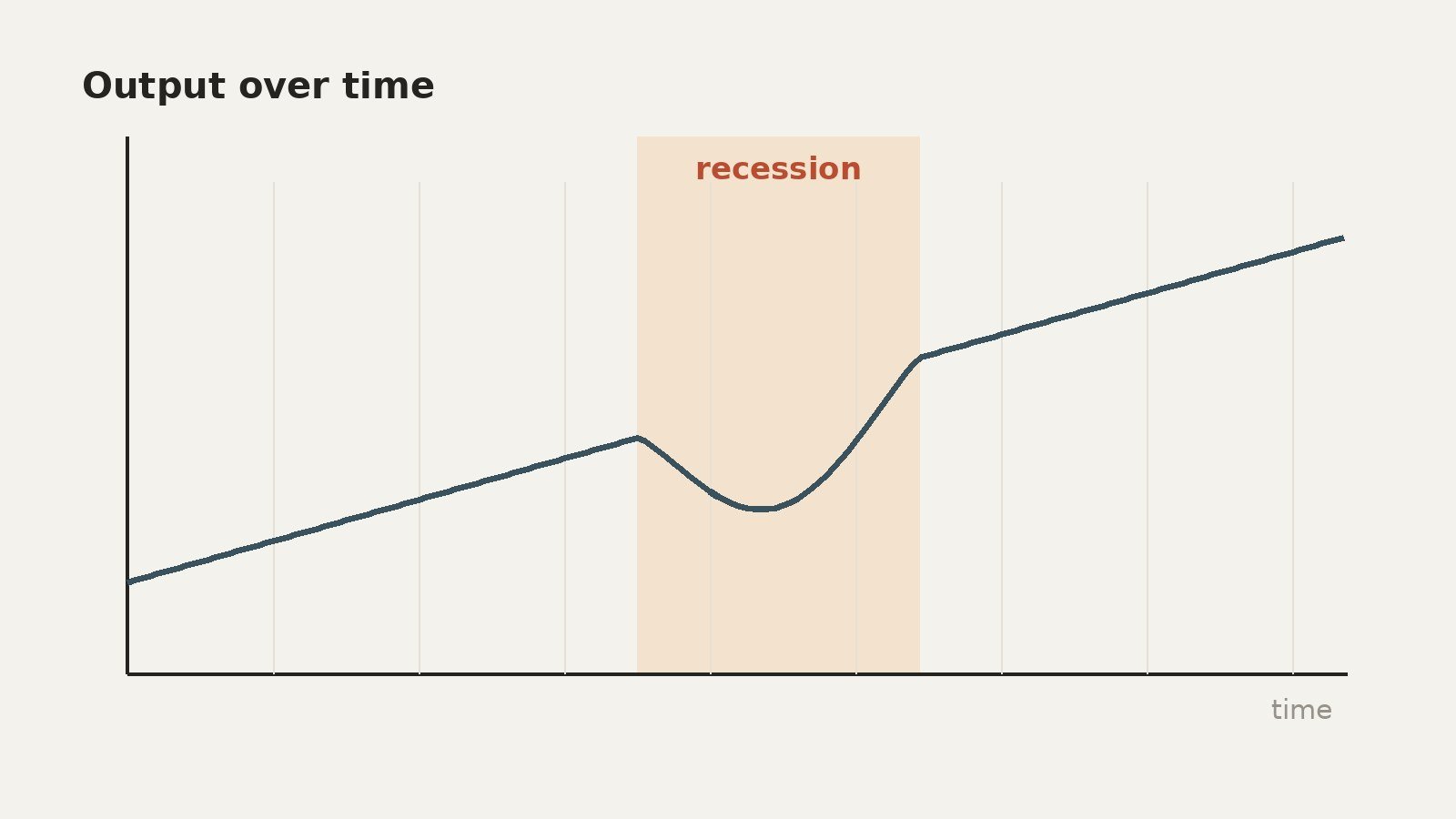
A recession is a significant decline in economic activity that spreads across the whole economy and lasts more than a few months. That is the working definition used in the United States, and it is broader than the version most people know, which counts only falling GDP. This article explains the official definition, who decides when a recession has begun and ended, and why the popular two-quarters rule is only a shorthand.
The Official Definition
The National Bureau of Economic Research is a private, nonprofit research organization, and its Business Cycle Dating Committee is generally treated as the official arbiter of United States recession dates. The NBER defines a recession as “a significant decline in economic activity spread across the economy, lasting more than a few months, normally visible in real GDP, real income, employment, industrial production, and wholesale-retail sales.”
Three ideas inside that sentence do the real work, and the committee names them directly: depth, diffusion, and duration. The decline must be significant (depth), it must affect many parts of the economy rather than one industry or region (diffusion), and it must persist for more than a very brief dip (duration). The committee treats the three criteria as somewhat interchangeable, so an extremely deep and widespread fall can qualify even if it is short. That is how the February to April 2020 downturn, only two months long, was classified as a recession: the collapse in activity was so large and so widely spread that its brevity did not disqualify it.
A recession begins just after the economy reaches a peak of activity and ends when it reaches a trough, the low point. The period from trough to peak is an expansion, and the alternating pattern of expansions and recessions is the business cycle. The NBER notes that expansion is the normal state of the economy and that most recessions are brief.
Who Decides, and When
The Business Cycle Dating Committee maintains a monthly chronology of peaks and troughs going back to the nineteenth century. Because GDP is published quarterly and is heavily revised, the committee relies mainly on monthly indicators and announces its decisions only after enough data has accumulated. The dates are therefore set retrospectively, often many months after the fact.
The Great Recession is the clearest example. The committee announced on December 1, 2008, that economic activity had peaked in December 2007, a full year earlier. That delay is deliberate: the committee’s role is to be definitive rather than fast, so that researchers and statisticians all work from the same dates.
The Two-Quarters Rule, and Why It Is Not the Official Test
Many news reports describe a recession as two consecutive quarters of declining real GDP. The shorthand is common because GDP, measured by the Bureau of Economic Analysis, is the broadest single gauge of economic activity, and two falling quarters have accompanied most historical recessions. But it is not the official designation. The BEA states this directly in its glossary: “the often-cited identification of a recession with two consecutive quarters of negative GDP growth is not an official designation,” and dating a recession is the province of the NBER committee, which weighs monthly indicators alongside quarterly GDP.
The shorthand fails in both directions, and the Federal Reserve Bank of St. Louis has documented both cases:
- It can produce a false alarm. Real GDP declined in both the first and second quarters of 2022, yet the NBER did not designate a recession, because employment and other monthly measures the committee emphasizes kept growing. Two negative GDP quarters alone were not enough.
- It can miss a real recession. The recession of 2001, dated by the NBER from March to November of that year, never produced two consecutive quarters of falling GDP, because GDP fell in the first and third quarters but rose in the second. Judged only by the shorthand, that recession would not exist.
GDP is also an estimate, issued in successive versions and revised afterward, so a rule built on two quarterly prints would keep changing its answer as the numbers change.
The Indicators the Committee Watches
Because a recession is by definition economy-wide, the committee emphasizes measures that capture the whole economy rather than a single sector. The main ones are:
- Employment. The count of workers on business payrolls, published monthly by the Bureau of Labor Statistics. The committee has described payroll employment as the most reliable comprehensive estimate of employment, and it treats production and employment as the primary measures of economic activity.
- Real personal income. Income received by households, adjusted for inflation and excluding government transfer payments, published by the BEA.
- Industrial production. Output of factories, mines, and utilities, published monthly by the Federal Reserve.
- Real GDP and real gross domestic income. The BEA’s quarterly measures of output and of the income earned producing it. The committee views real GDP as the single best measure of aggregate activity but uses it alongside the monthly series because it is quarterly.
- Wholesale and retail sales. Measures of goods moving through the economy, adjusted for inflation, showing whether the decline is reaching trade and spending.
No single indicator decides the question. The committee weighs the set together against depth, diffusion, and duration.
Recession vs. Depression vs. Correction
These three words are often used interchangeably, but they mean different things.
A depression is not a separate official category. The NBER does not define the term or date depressions; it is reserved in practice for downturns of exceptional severity, above all the Great Depression of the 1930s. The contraction from August 1929 to March 1933 lasted 43 months, and according to the Bureau of Economic Analysis, real GDP fell 27 percent between 1929 and 1933, roughly six times the peak-to-trough decline of the deepest postwar recession. A second severe contraction followed from May 1937 to June 1938. The distinction is one of scale: every depression contains a recession, but very few recessions approach depression severity.
A correction belongs to a different subject entirely. It is a stock market term: by market convention, a correction is a decline of 10 percent or more in a market index from a recent high, and a fall of 20 percent or more is called a bear market. Corrections describe prices, not economic activity. They can occur during expansions, they sometimes accompany recessions, and they play no official role in dating the business cycle.
How Long Recessions Last: Three Examples
The Great Recession (December 2007 to June 2009). At 18 months, this was the longest postwar recession in the NBER chronology. It followed the collapse of the United States housing market and a global financial crisis, and it spread through employment, income, production, and trade.
The COVID-19 recession (February to April 2020). At two months, the shortest recession in the NBER chronology. Activity collapsed with extraordinary speed as the pandemic shut down large parts of the economy, then began recovering. Its classification, despite its brevity, is the committee’s depth and diffusion criteria at work.
The typical postwar recession. Across the contractions the NBER dates from 1945 to 2020, the average length is about 10 months. Recessions have also become less frequent over time: the expansion that ended in February 2020 had lasted 128 months, the longest in the chronology.
Frequently Asked Questions
Who officially declares a recession in the United States?
The Business Cycle Dating Committee of the National Bureau of Economic Research. It is a committee of economists at a private nonprofit research organization, not a government agency, but its dates are the ones official statisticians use.
Is two quarters of falling GDP the definition of a recession?
No. It is a popular rule of thumb. The BEA states that the identification of a recession with two consecutive quarters of negative GDP growth is not an official designation, and history includes both a recession without two straight falling quarters (2001) and two straight falling quarters without a recession (2022).
Why does the announcement come so long after a recession starts?
Because the committee waits for complete, revised data and confirms that a decline is deep, widespread, and lasting before fixing a date. The peak of December 2007 was announced in December 2008.
What is the difference between a recession and a depression?
Severity and duration. Depression has no formal definition or dating; it is the label kept for exceptionally severe downturns, above all the 1930s, when real GDP fell 27 percent from 1929 to 1933. An ordinary recession is far shallower.
Can the stock market fall sharply without a recession?
Yes. A correction is a fall of 10 percent or more in a market index, by convention, and it can happen during an expansion for reasons specific to markets. The NBER dates recessions from economy-wide activity, not from share prices.
Conclusion
A recession is a significant decline in economic activity, spread across the economy and lasting more than a few months, as judged by the NBER’s Business Cycle Dating Committee from employment, income, production, sales, and GDP. The two-quarters formula is a useful shorthand that history has falsified in both directions, which is why the official system uses a basket of monthly indicators instead. A depression is the same phenomenon at exceptional severity, and a correction is a stock market event that should not be confused with either.
This article explains concepts; it is not financial advice.
Keep reading: What Is a Savings Bond? Series EE and Series I Explained
Keep reading: Characteristics of an Oligopoly: How Few-Seller Markets Work
Sources & references
- National Bureau of Economic Research (nber.org), Business Cycle Dating: the recession definition and the depth, diffusion, and duration criteria.
- National Bureau of Economic Research (nber.org), U.S. Business Cycle Expansions and Contractions: peak and trough dates and durations; the twelve contractions dated from November 1948 to April 2020 average 10.3 months.
- National Bureau of Economic Research (nber.org), Business Cycle Dating Committee Announcement, December 1, 2008: determination of the December 2007 peak.
- Bureau of Economic Analysis (bea.gov), Glossary, "Recession": the two-consecutive-quarters identification is not an official designation; real GDP fell 27 percent between 1929 and 1933 (as cited in the NBER's dating FAQ).
- Federal Reserve Bank of St. Louis (stlouisfed.org), "Dating Economic Recessions in Real Time Is a Challenge" (2022): the 2022 and 2001 limits of the two-quarter rule.
- Bureau of Labor Statistics (bls.gov): publisher of the monthly payroll employment figures.


