Short answer
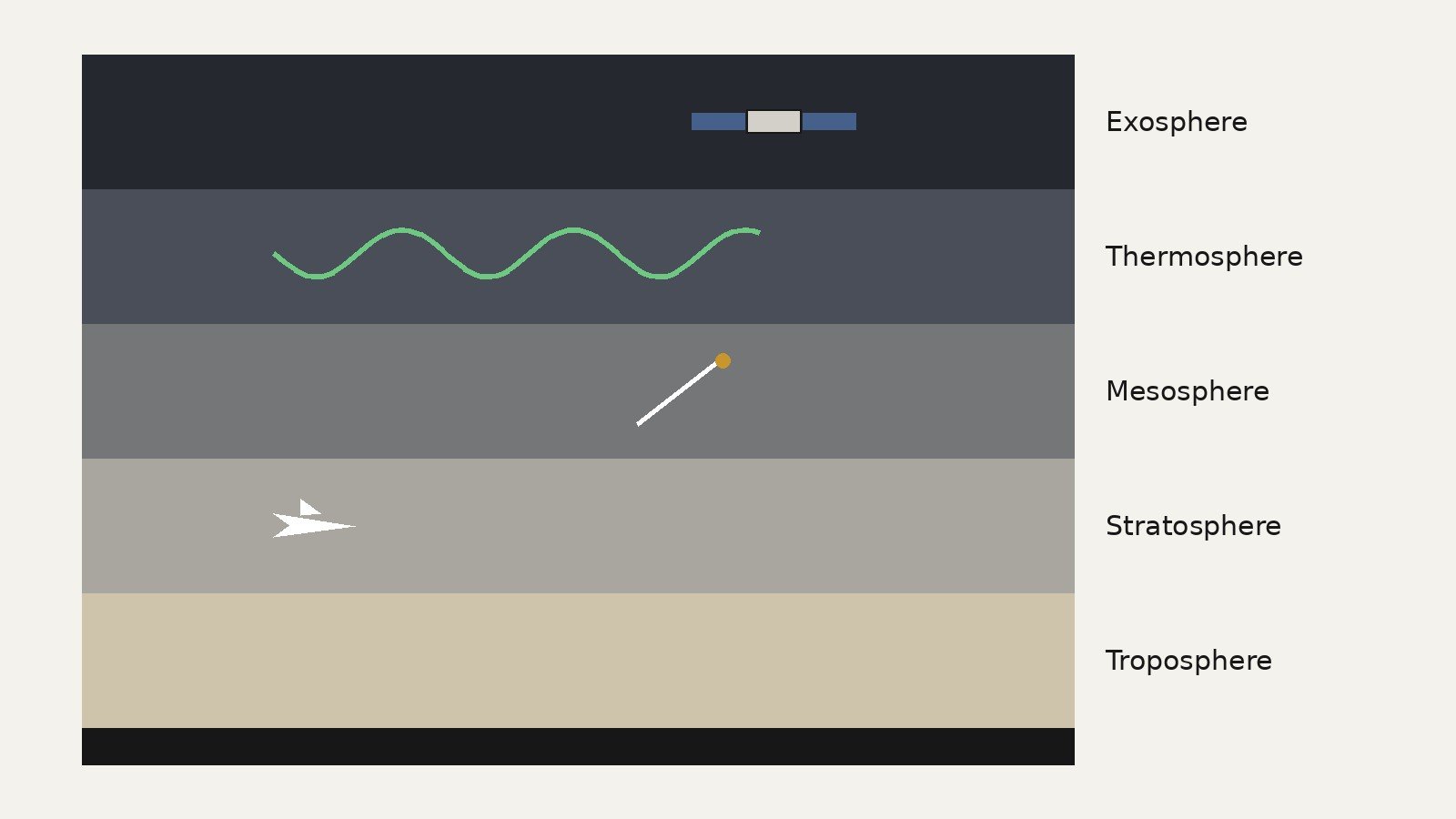
- The five layers, bottom to top: troposphere (surface to about 8 to 14.5 km), stratosphere (to about 50 km), mesosphere (to about 85 km), thermosphere (to about 600 km), and exosphere (fading into space beyond that).
- Layers are defined by temperature trends. Temperature falls with height in the troposphere, rises in the stratosphere, falls in the mesosphere, and rises steeply in the thermosphere.
- Almost all weather happens in the troposphere, the densest layer, which holds about 99 percent of the atmosphere's water vapor.
- The ozone layer is a region inside the stratosphere, not a separate layer, and the ionosphere is an electrically charged region overlapping three layers, not a layer in the temperature scheme.
- Boundary heights are approximate. They shift with latitude, season, and solar activity; the numbers below are standard reference values from NASA and NOAA educational sources.
Introduction
Earth’s atmosphere is not one uniform blanket of air. Sorted by how temperature behaves with height, it falls into five distinct layers: the troposphere, stratosphere, mesosphere, thermosphere, and exosphere. In one layer the air gets colder as you climb; in the next it gets warmer; then colder again, then hotter than a furnace, at least by the thermometer’s definition, in air too thin to feel warm at all.
Knowing the layers explains a string of everyday facts: why weather stops at a ceiling, why airliners cruise where they do, where meteors burn up, where auroras dance, and why there are two different altitudes both called “the edge of space.” This explainer walks up through the five layers in order, gives the approximate height and temperature behavior of each, explains what happens inside it, and then sorts out two structures, the ionosphere and the ozone layer, that are often drawn as layers but are not.
How the Layers Are Defined
The layering is not based on what the air is made of; the proportions of nitrogen (about 78 percent) and oxygen (about 21 percent) stay nearly the same through the lower atmosphere. It is based on temperature. Fly a thermometer upward and it falls steadily, then at some height starts rising, then falls again, then rises sharply. Each reversal marks a boundary, and the boundaries have names: the tropopause tops the troposphere, the stratopause tops the stratosphere, and the mesopause tops the mesosphere. Above the thermosphere, the boundary is the thermopause, also called the exobase.
Because these boundaries are set by temperature behavior rather than by any physical wall, their heights move. The tropopause sits higher over the warm tropics and lower over the cold poles, and most boundaries breathe up and down with the seasons and with the Sun’s activity. Treat every altitude in this article as a well-established approximation, not a survey line.
How the Layers Were Discovered
The layer structure was a surprise. Into the late 1800s, the working assumption was that air simply grew colder and thinner all the way up. French meteorologist Léon Teisserenc de Bort tested that assumption with instrumented, unmanned hydrogen balloons flown from his observatory at Trappes. His thermometers showed temperature falling steadily to about 11 kilometers, then stopping: above that height it stayed roughly constant as far as his balloons could reach. Suspecting his instruments were being warmed by sunlight, he repeated the measurements more than 200 times, many of them at night, before announcing the result to the French Academy of Sciences on 28 April 1902 (the German meteorologist Richard Assmann reached the same finding almost simultaneously). Teisserenc de Bort concluded that the atmosphere had two layers, and in the years that followed he gave them the names still used today: the troposphere below, from the Greek for “turning,” because its air overturns, and the stratosphere above, the layered sphere. Later instruments extended the story upward and found the reversals that define the remaining layers, but every name in the scheme still follows his pattern.
Layer 1: The Troposphere (Surface to About 8 to 14.5 km)
The troposphere is where we live. Per NASA, it starts at the surface and extends 8 to 14.5 kilometers high (5 to 9 miles), lower over the poles and higher over the tropics. It is the most dense part of the atmosphere, and it contains about 99 percent of all the water vapor in the air, which is why almost all weather is confined here: clouds, rain, storms, and snow all happen in this lowest layer.
Its defining behavior is cooling with height. Sunlight warms the ground, the ground warms the air touching it, and air temperature falls as you climb, on average by about 6.5 degrees Celsius per kilometer. That steady fall is why mountaintops are cold and why temperature, not oxygen alone, limits climbers. The cooling trend is also what drives weather: warm surface air rises, cools, and dumps its moisture as cloud and rain.
Commercial jets cruise near the top of this layer, around the tropopause, to ride above most weather. The jet streams, fast ribbons of wind, flow near the troposphere’s upper border.
Layer 2: The Stratosphere (About 14.5 to 50 km)
Above the tropopause, the temperature trend reverses. The stratosphere extends to about 50 kilometers (31 miles) above the ground, and through it the air grows warmer with height, from roughly minus 60 degrees Celsius near its base to around 0 degrees at its top, the stratopause. (Figures are approximate; the warming trend, not any single value, is the point.)
The cause is the ozone layer, a region within the stratosphere where ozone molecules are concentrated. Ozone absorbs high-energy ultraviolet radiation from the Sun and converts it into heat, warming the air around it. This absorbed ultraviolet is exactly the radiation that damages living tissue, so the stratosphere quietly performs a shielding job for the whole surface biosphere.
Warmed from above, the stratosphere is stable and layered, with little of the rising-and-sinking turbulence of the troposphere. That smoothness is the second reason airliners favor its lower reaches on long flights: less weather below, calmer air at altitude.
Layer 3: The Mesosphere (About 50 to 85 km)
In the mesosphere the trend reverses again: temperatures fall with height, reaching about minus 90 degrees Celsius (minus 130 degrees Fahrenheit) near the top, the coldest temperatures found anywhere in Earth’s atmosphere. The mesosphere extends from about 50 to about 85 kilometers (53 miles).
This is the layer where most meteors burn up. The air here is extremely thin; pressure at the bottom of the layer is already well below 1 percent of sea-level pressure. Yet it is dense enough that a meteoroid arriving at tens of thousands of kilometers per hour rams into molecule after molecule, heats to incandescence from the friction and compression, and usually vaporizes completely. The streaks of a meteor shower are the mesosphere at work, roughly 80 kilometers overhead.
The mesosphere is the least directly explored layer. It sits too high for aircraft and weather balloons, which top out in the stratosphere, and too low for satellites in stable orbit, so much of what we know comes from sounding rockets passing through and from ground-based radar and lidar. It does host one visible phenomenon from the ground: noctilucent clouds, Earth’s highest clouds, thin ice formations that appear at about 76 to 85 kilometers up, near the mesopause (NASA Earth Observatory). They form when the scant water vapor near the top of the mesosphere freezes into ice crystals, and because they sit so high they remain sunlit after the ground below has gone dark, glowing against the twilight sky in summer at high latitudes.
Layer 4: The Thermosphere (About 85 to 600 km)
The thermosphere begins above the mesopause, at about 85 kilometers, and extends to roughly 600 kilometers (372 miles) in NASA’s standard diagram. Solar activity swells or shrinks it: UCAR notes that the top of the thermosphere can be found anywhere between about 500 and 1,000 kilometers, depending on how much energy the Sun is pouring in.
Here the temperature reverses one final time, and dramatically. High-energy X-rays and ultraviolet radiation from the Sun are absorbed in this layer, and temperatures climb to hundreds of degrees, reaching about 500 to 2,000 degrees Celsius (932 to 3,632 degrees Fahrenheit) or higher in the upper thermosphere. Auroras occur in this layer, and so do satellites: many artificial satellites orbit within the thermosphere, including the International Space Station, which circles at roughly 400 kilometers up.
How can it be hot and freezing at the same time?
Temperature measures the average kinetic energy of individual molecules, not the total heat available to warm something. Thermosphere molecules move fast, so their temperature is genuinely high. But they are spread so thinly that a cubic meter of thermosphere contains a tiny fraction of the molecules in a cubic meter of surface air. UCAR puts it plainly: the air in this layer is so thin that it would feel freezing cold to us. A human skin surface or a thermometer up there would collide with so few molecules that almost no heat would transfer, while radiating its own heat away to space. “Hot” describes the molecules; “freezing” describes the experience. Both are correct, and the reconciliation is density.
Layer 5: The Exosphere (About 600 km Outward, Fading Into Space)
The exosphere is the outermost layer, where the atmosphere thins into the vacuum of space with no sharp upper boundary. NASA’s layer diagram extends it from the top of the thermosphere up to about 10,000 kilometers (6,200 miles), but that figure is a convention for drawing diagrams; the real exosphere simply fades, its atoms ever farther apart, until Earth’s gas is indistinguishable from interplanetary space.
Its air is mainly the lightest gases, hydrogen and helium (NASA), with atoms so widely separated that they can travel hundreds of kilometers without colliding. Some escape Earth’s gravity entirely, which is one reason Earth slowly loses hydrogen to space. Many of the highest satellites travel through the exosphere’s thin domain. If the troposphere is the atmosphere’s ocean floor, the exosphere is less a layer than the place where the atmosphere gives up.
Two Structures That Are Not Layers
The ionosphere overlaps three layers
The ionosphere is a region of electrically charged particles, electrons and ions created when solar radiation knocks electrons off atoms and molecules. It is not one of the five temperature layers. NASA describes it as stretching from about 48 kilometers (30 miles) above the surface to the edge of space at about 965 kilometers (600 miles), overlapping into the mesosphere and thermosphere; its lower edge reaches the upper mesosphere and its influence extends into the lower exosphere. Because those charged particles interact with radio waves, the ionosphere is what makes long-distance radio communication possible, bending some signals back toward Earth. Auroras occur in the parts of the thermosphere that correspond to ionosphere regions. Draw it on the diagram as a translucent band crossing the layer boundaries, because that is what it is.
The ozone layer is a region, not a layer
Likewise, the ozone layer is not a sixth layer. It is a region of the stratosphere where ozone is concentrated enough to absorb most of the Sun’s ultraviolet radiation, warming the stratosphere as described above. Exam questions that ask students to place “the ozone layer” between two of the five layers are testing a category error; the correct placement is inside the stratosphere.
Where Does Space Begin?
Two conventions compete. The Kármán line, at about 100 kilometers (62 miles) above sea level, sits inside the thermosphere and is the boundary used by the Fédération Aéronautique Internationale; it is named for engineer Theodore von Kármán and approximates the altitude where aeronautical lift gives way to orbital mechanics. The United States has traditionally used a lower figure, 50 miles (about 80 kilometers), the boundary long applied for awarding astronaut wings. Neither is a physical edge; the atmosphere has no lid, and the exosphere fades for thousands of kilometers beyond both lines. The honest statement is that “the edge of space” is a legal and engineering convention, and both numbers are in legitimate use.
The Five Layers at a Glance
| Layer | Approximate height | Temperature with height | Known for |
|---|---|---|---|
| Troposphere | Surface to 8 to 14.5 km (5 to 9 mi) | Falls | Weather, clouds, 99 percent of water vapor |
| Stratosphere | To about 50 km (31 mi) | Rises | Ozone layer absorbing ultraviolet; calm air for jets |
| Mesosphere | To about 85 km (53 mi) | Falls | Coldest layer, about minus 90 °C at top; meteors burn up |
| Thermosphere | To about 600 km (372 mi) | Rises steeply | Auroras, satellites, the space station, Kármán line at 100 km |
| Exosphere | From about 600 km, fading outward | Not meaningfully defined | Hydrogen and helium escaping into space |
Glossary
- Exobase (thermopause): the boundary at the top of the thermosphere where the exosphere begins.
- Exosphere: the outermost, thinnest layer, mainly hydrogen and helium, fading into space.
- Ionosphere: a charged-particle region overlapping the mesosphere, thermosphere, and lower exosphere; interacts with radio waves.
- Kármán line: the conventional boundary of space at about 100 km altitude.
- Mesopause: the boundary at the top of the mesosphere, the coldest point in the atmosphere.
- Mesosphere: the middle layer, about 50 to 85 km, where meteors burn up.
- Ozone layer: the region of the stratosphere where ozone absorbs ultraviolet radiation.
- Stratopause: the boundary at the top of the stratosphere.
- Stratosphere: the layer from the tropopause to about 50 km, warming with height because of ozone.
- Thermosphere: the layer from about 85 to about 600 km, very hot by molecular temperature but vanishingly thin.
- Tropopause: the boundary at the top of the troposphere.
- Troposphere: the lowest layer, holding nearly all water vapor and almost all weather.
Frequently Asked Questions
What are the five layers of the atmosphere in order?
From the ground up: troposphere, stratosphere, mesosphere, thermosphere, and exosphere. The order is fixed; only the boundary heights vary with latitude, season, and solar activity.
Why is the atmosphere divided into layers?
Because temperature changes direction with height. Each layer is a region where temperature consistently falls or rises as altitude increases, and the reversals between them define the boundaries. The pattern is caused by how and where solar energy is absorbed: at the surface, in the ozone layer, and in the upper atmosphere.
In which layer do we live, and where does weather happen?
We live in the troposphere, the bottom layer. Almost all weather occurs there too, because the troposphere holds about 99 percent of the atmosphere’s water vapor and is heated from below, which keeps it churning.
Where is the ozone layer?
Inside the stratosphere, the second layer. It is a region of concentrated ozone, not a layer of its own, and it absorbs the Sun’s ultraviolet radiation, which is why the stratosphere warms with height.
How high does the atmosphere go?
There is no definite top. The exosphere fades gradually into space; NASA’s standard diagram draws it out to about 10,000 km, and its outermost atoms extend much farther. For legal and engineering purposes, space is conventionally said to begin at the Kármán line, about 100 km up, or at 80 km under the traditional US boundary.
Why is the thermosphere hot but cold at the same time?
Its few molecules move very fast, which is what temperature measures, but they are so sparse that they transfer almost no heat to anything passing through. The temperature figure is real and the freezing sensation is real; density explains both.
Conclusion
Five layers, four temperature reversals, one rule: the atmosphere is organized by how it absorbs energy. The troposphere, warmed from the ground, cools as it rises and hosts the weather. The stratosphere, warmed by its own ozone, turns stable and calm. The mesosphere cools to the coldest temperatures on the planet while incinerating incoming meteors. The thermosphere absorbs the Sun’s fiercest radiation, runs hot by the thermometer and freezing by the touch, and carries auroras and orbiting stations. The exosphere lets go entirely, leaking hydrogen into space. Learn the temperature pattern and the layers, their heights, and their contents follow from it.
Sources & references
- NASA, "Earth's Atmospheric Layers" (image article, nasa.gov): troposphere 8 to 14.5 km and the densest layer; stratosphere to 50 km with the ozone layer; mesosphere to 85 km, where meteors burn up; thermosphere to 600 km, where aurora and satellites occur; ionosphere from about 48 km to about 965 km, overlapping the mesosphere and thermosphere; exosphere extending to 10,000 km.
- UCAR Center for Science Education, "Layers of Earth's Atmosphere" (scied.ucar.edu, NOAA-affiliated): troposphere to about 10 km with 99 percent of the water vapor; stratosphere warming with height, jets and jet streams; mesosphere to about 85 km with the coldest temperatures, about minus 90 °C; thermosphere temperatures from about 500 °C to 2,000 °C or higher, top varying between 500 and 1,000 km, air so thin it would feel freezing; Kármán line at about 100 km; ionosphere as regions within the mesosphere and thermosphere, not a distinct layer; exosphere with no clear-cut upper boundary.
- NASA Scientific Visualization Studio, "Carruthers Atmospheric Layers Animation" (svs.gsfc.nasa.gov): five-layer summary; troposphere to about 10 miles; stratosphere to about 31 miles; mesosphere about 31 to 53 miles, the coldest layer; thermosphere about 53 to 375 miles containing the ionosphere; exosphere extremely thin, composed mainly of hydrogen and helium.
- NASA Earth Observatory, "Polar Mesospheric Clouds, South Pacific Ocean" (science.nasa.gov): noctilucent (polar mesospheric) clouds form between about 76 and 85 km near the mesopause, the highest clouds in the atmosphere.
- Discovery history: Léon Teisserenc de Bort's instrumented balloon soundings (more than 200 ascents), announced to the French Academy of Sciences on 28 April 1902, with the names troposphere and stratosphere introduced by him; Richard Assmann reported the same result in Germany within days (historical accounts via university atmospheric-science teaching materials and reference biographies).


