Short answer
- Goldilocks and the Three Bears is a 19th-century literary fairy tale, first published by Robert Southey in The Doctor in 1837 as "The Story of the Three Bears." In Southey's version the intruder was an old woman, and the three bears were bachelors of graduated size. Over the following decades editors replaced the old woman with a young girl, who was called Silver Hair in 1849, Silver-Locks in 1858 and Golden Hair around 1868, before the name Goldilocks appeared around 1904. The bears meanwhile became Father Bear, Mother Bear and Baby Bear, and the tale settled into the form told today.
Almost everyone knows the beats of this story. A girl with golden hair walks into a cottage in the woods, helps herself to porridge, chairs and beds that are not hers, and is caught asleep by the three bears who live there. What most readers do not know is that the first published version had no little girl and no Goldilocks at all. The intruder in the original telling was a bad-tempered old woman, the bears were three bachelors, and the name Goldilocks did not appear in print until roughly 70 years after the tale was first published.
This article retells the story in its familiar modern form, then traces how it changed. Between 1837 and the early 1900s the tale was rewritten again and again, and each generation of editors softened the intruder, renamed her, rearranged the bears into a family and tidied the ending. The result is a case study in how a folk tale gets made, and remade, in print.
The Story, Retold
Here is the tale in the form most families know it, told in our own words.
Once there were three bears who lived in a cottage in the woods: a great big Father Bear, a middle-sized Mother Bear and a small Baby Bear. One morning Mother Bear made porridge for breakfast, but it was too hot to eat, so the three bears went out for a walk in the forest while it cooled.
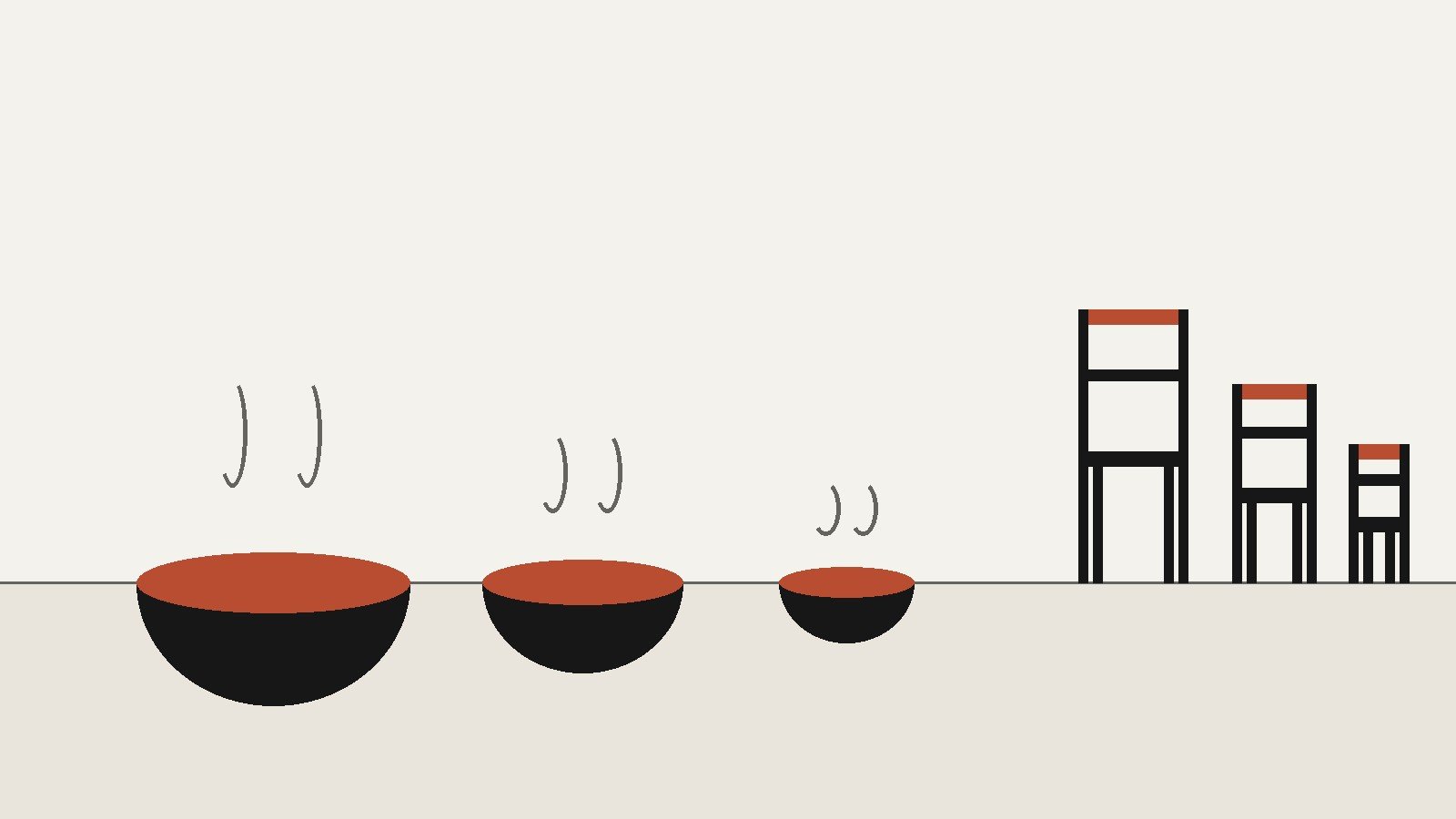
While they were gone, a little girl named Goldilocks, who had been walking in the woods herself, came upon the cottage. She knocked, and when nobody answered she peeped through the window, then lifted the latch and walked in. On the table stood three bowls of porridge. Goldilocks tasted the big bowl first, but it was too hot. The middle bowl was too cold. The smallest bowl was just right, and it tasted so good that she ate every last spoonful.
Then she wanted to sit down. The big chair was too hard, the middle chair was too soft, and the smallest chair was just right, until she rocked back in it and the bottom fell out, and she landed on the floor. Worn out from her walk, she climbed the stairs and tried the beds. The big bed was too high at the head, the middle bed was too high at the foot, and the smallest bed was just right, so she curled up under the blanket and fell fast asleep.
Soon the bears came home, hungry from their walk. Father Bear looked at his bowl and growled in his great big voice that somebody had been eating his porridge. Mother Bear looked at her bowl and said the same in her middle-sized voice. Baby Bear looked at his bowl and squeaked in his tiny voice that somebody had been eating his porridge and had eaten it all up. Then the bears noticed the chairs, and each in turn, big voice, middle voice and tiny voice, said that somebody had been sitting in their chair, with Baby Bear adding that somebody had broken his. Upstairs the pattern repeated over the beds, until Baby Bear cried out that somebody was still lying in his.
Goldilocks woke to find three bears staring at her. She jumped out of the window and ran home through the woods as fast as her legs would carry her, and in the modern telling that is the end of it. As the sections below show, the old woman of the original version was not always so lucky, and her story ended on a much darker note.
Before Print: A Story Southey Was Already Telling
Although the tale feels timeless, its documented history starts with a named author. Robert Southey (1774 to 1843) was one of the leading writers of his day and served as Britain’s Poet Laureate. Southey presented the story as an old tale he had heard rather than one he had invented, and the evidence suggests it circulated in his circle for years before it reached print. He was telling the story to friends as early as 1813, more than two decades before publication.
One remarkable survival from those years is a handwritten version made in 1831 by a woman named Eleanor Mure. Mure wrote the tale out in verse as a handmade birthday booklet for her young nephew, Horace Broke, and dated it six years before Southey’s printed text appeared. Her little book, which still survives in the Osborne Collection of the Toronto Public Library, proves the story was being passed around in manuscript before it was published, and it preserves a version that differs from Southey’s in striking ways. In Mure’s telling, the bears are served milk rather than porridge, and the old woman breaks into the house after being offended during a courtesy visit. Her ending is grimmer still: the old woman is impaled on the steeple of St Paul’s Cathedral in London. Nothing in Mure’s booklet was written for the general public, which makes it valuable evidence of the tale as Southey’s contemporaries actually knew it.
Southey Publishes the Tale in 1837
The story first appeared in print in 1837, in the fourth volume of The Doctor, a long, eccentric prose work Southey published anonymously. His chapter was headed “The Story of the Three Bears,” and Southey introduced it as an old acquaintance rather than a new invention. A verse version by the publisher George Nicol appeared the same year, its prefatory verses addressing the still-anonymous author as “the great, original concocter of the story.” When the tale was reissued in 1848, Southey was openly named as its author.
Southey’s bears are not the family of the modern story. They are three bachelors sharing a house, “a Little, Small, Wee Bear, a Middle-sized Bear, and a Great, Huge Bear,” and Southey is careful to describe them as well-behaved animals: good-natured, trusting, harmless, tidy and hospitable, each with his own porridge pot, chair and bed kept in graduated sizes. Their visitor is the opposite of a sweet lost child. She is, in Southey’s words, an “impudent, bad old Woman,” a vagrant whom her own family had disowned. She breaks in, eats the Wee Bear’s porridge, breaks the bottom out of his chair and falls asleep in his bed, exactly as Goldilocks would later do.
The ending is the biggest difference. When the bears find her, the old woman leaps from the bedroom window and runs, and Southey deliberately refuses to say what became of her. Perhaps she broke her neck in the fall, he writes, perhaps she was lost in the wood, or perhaps she was caught and sent to the House of Correction, the workhouse-like prison of the period. All the reader is told is that the three bears never saw her again. It reads less like a nursery story and more like a cautionary tale about vagrancy told for adult amusement, which is probably close to what it was.
How an Old Woman Became Goldilocks
The transformation of the old woman into Goldilocks happened in stages, and folklore scholars Iona and Peter Opie documented the steps in their standard history, The Classic Fairy Tales (1974). The trail, as the Opies recorded it and the SurLaLune fairy tale archive summarizes it, runs as follows.
In 1849, the editor Joseph Cundall included the tale in A Treasury of Pleasure Books for Young Children, and he changed the intruder from an old woman into a pretty young girl. Cundall explained in a note to his own children that he made the change because there were already so many stories about old women. His heroine was called Silver Hair. In 1858, a version in Aunt Mavor’s Nursery Tales called her Silver-Locks. Around 1868, in Aunt Friendly’s Nursery Book, she had become Golden Hair. Only around 1904, in a collection called Old Nursery Stories and Rhymes, illustrated by John Hassall, does the name Goldilocks appear in print for the first time. Flora Annie Steel’s English Fairy Tales of 1918, illustrated by Arthur Rackham, then helped fix the Goldilocks version as the standard one that later retellers followed.
Each change softened the story. An old vagrant who breaks into a house and is threatened with prison belongs to a cautionary tale for adults. A curious little girl who means no harm and simply runs away belongs to the nursery. As the heroine got younger and blonder, the harsh open ending quietly disappeared with her age, replaced by the harmless flight home that children know today.
How Three Bachelor Bears Became a Family
The bears changed just as much. Southey’s trio are three male bears defined only by size, big, middle and small, and nothing in his text makes them relatives. Victorian and later retellers, retelling the story for children in family settings, gradually turned the size ladder into a household: the great bear became Father Bear, the middle bear became Mother Bear and the little bear became their child, usually called Baby Bear.
The shift was well under way by the 1870s. When Leo Tolstoy retold the tale for Russian children in 1875, his bears were already a father, a mother and a cub, and he gave them Russian names: Mikhail Ivanovich, Nastasya Petrovna and little Mishutka. In Tolstoy’s version the girl herself is left unnamed, and in later Russian tradition she is generally called Masha. By the early 20th century the family arrangement was so standard that modern readers tend to assume the bears were always a family, which is one of the clearest signs of how completely the retellings overwrote Southey’s original.
Making the bears a family changed the story’s emotional shape. Baby Bear is the one who suffers in all three tests: his porridge is eaten up, his chair is broken and his bed is occupied. Once Baby Bear is a child rather than a small bachelor, he becomes the character young listeners identify with, and the story becomes a gentle lesson about how it feels when someone uses your things without asking.
The Rule of Three and the Meaning of “Just Right”
Why has this particular story lasted? Part of the answer is its structure, which is about as simple and sturdy as a plot can be. Folklorists call the pattern the rule of three: events come in threes, in ascending or descending order, and the third term resolves the pattern. Goldilocks tries three bowls, three chairs and three beds. The bears speak in three voices, great, middle and small, and repeat the same discoveries three times over. Young children can follow the pattern, anticipate the third beat and join in, which is one reason the tale remains a favorite first story for reading aloud.
The other lasting idea is the middle term itself. Goldilocks rejects what is too much and what is too little and chooses what is “just right.” The phrase escaped the nursery long ago. Scientists speak of a “Goldilocks zone,” the band around a star where a planet is neither too hot nor too cold for liquid water, and the expression “Goldilocks principle” is used in fields from astronomy to economics for any happy middle between two extremes. Few fairy tales have donated a working term to science.
The moral of the story has been read differently in different eras, and it is worth separating those readings. In Southey’s 1837 version, the intruder is a vagrant and the candidate endings include prison, so the tale reads as a warning about trespass and disorder aimed at adult readers. Modern classroom and parenting discussions usually frame it as a story about respecting other people’s property, asking before you take, and thinking about consequences. Educators also point to the empathy angle: because Baby Bear loses out in every test, the story invites children to see the break-in from the bears’ side rather than the intruder’s. None of these morals is printed in the tale itself. Each era projects its own lesson onto a plot simple enough to carry all of them.
What Kind of Tale Is It?
Folklore indexes file the story as tale type AT 171 in the Aarne-Thompson classification (now maintained as the ATU index), where it sits as the type known simply as “The Three Bears.” Its place there is unusual, because most tale types were collected from oral storytellers, whereas this one began its documented life in print, in a book by a famous poet who said he was writing down something older. Whether a substantial oral tradition really stood behind Southey is something scholars cannot now prove. The surviving evidence, his own tellings from 1813 and Mure’s manuscript of 1831, shows the story circulating before publication, but no version older than Southey’s circle has been found.
The Opies also noted a partial relative in “Snow White,” where the heroine enters the dwarfs’ house, samples their food and drink and sleeps in their beds, and the returning householders cry out in turn over each disturbance. And there is a stranger variant of the three bears themselves: a version in which the intruder is not a person at all but a fox called Scrapefoot. The folklorist Joseph Jacobs suggested that the fox might be the older form of the visitor, since “vixen” was also an insult for a sharp-tongued woman, which could explain how a female fox hardened into Southey’s bad old woman. That is a hypothesis rather than a proven history, but it shows how deeply the tale’s roots are debated.
Famous Versions and Adaptations
Because the tale is short, visual and built on repetition, it has been retold constantly. Flora Annie Steel’s English Fairy Tales (1918), with Arthur Rackham’s illustrations, carried the Goldilocks version to a wide audience and is still reprinted. Tolstoy’s 1875 Russian version became a classic in its own right and is the ancestor of the Masha tradition in Russian children’s books. In the late 20th century, the story found a permanent home on Sesame Street, where the characters Baby Bear and Goldilocks became recurring figures in sketches about the tale and about manners more generally. Picture-book artists also keep returning to it because the three-part structure suits illustration so well: three bowls, three chairs and three beds, each spread a variation on the last. Meanwhile the story’s central idea, the search for the option that is just right, has passed into everyday language far beyond children’s books, which is the surest sign of how deeply the tale has settled into the culture.
Frequently Asked Questions
Who wrote Goldilocks and the Three Bears?
Robert Southey was the first to publish it, in The Doctor in 1837, where it appeared anonymously under the title “The Story of the Three Bears.” Southey said he was retelling an older tale rather than inventing one. He was openly credited as the author in an 1848 reissue, and Eleanor Mure’s handwritten version of 1831 shows the story was already circulating in his circle before it reached print.
Was Goldilocks always a little girl?
No. In Southey’s 1837 original the intruder was an old woman, described as impudent and bad, and the tale reads as a cautionary story about a vagrant. Editors later replaced her with a young girl: Silver Hair in 1849, Silver-Locks in 1858, Golden Hair around 1868, and finally Goldilocks around 1904.
Why is the character called Goldilocks?
The name arrived last, after decades of hair-based names. Retellers first called the heroine Silver Hair (1849), then Silver-Locks (1858) and Golden Hair (around 1868), as her hair color shifted from gray-white to gold. “Goldilocks,” first found in print around 1904, combined the golden color with “locks,” meaning strands of hair, and Flora Annie Steel’s popular 1918 version helped make it permanent.
What happens to Goldilocks at the end?
In modern versions she simply wakes up, jumps out of the window and runs home, and that is the end. Southey’s original ending for the old woman was darker and deliberately unresolved: Southey lists the possibilities, a broken neck from the fall, being lost in the wood, or arrest and the House of Correction, and says only that the bears never saw her again.
Are the three bears a family in the original story?
No. Southey’s bears are three bachelors, a great bear, a middle-sized bear and a little, small, wee bear, sharing a tidy house. Retellers turned them into Father Bear, Mother Bear and Baby Bear during the later 19th century. Tolstoy’s Russian version of 1875 already uses a father, mother and cub with individual names, which shows how early the family reading took hold.
What is the moral of Goldilocks and the Three Bears?
The tale carries no printed moral, and readings have changed over time. Southey’s version works as a warning about trespass and vagrancy. Today the story is usually taught as a lesson in respecting other people’s property and privacy, and in empathy, since Baby Bear is wronged in every test: his porridge is eaten, his chair is broken and his bed is slept in.
Conclusion
Goldilocks and the Three Bears looks like a simple nursery tale, and at one level it is: three bowls, three chairs, three beds and a flight out of the window. But its paper trail is unusually complete for a fairy tale. We can watch it move from Southey’s circle in the 1810s, through Eleanor Mure’s handmade booklet of 1831, into print in 1837 with an old woman at its center, and then through name after name, Silver Hair, Silver-Locks, Golden Hair, until Goldilocks arrives around 1904 and the bachelor bears settle down into a family. Few stories show so clearly that a “traditional” tale is not a fixed text but a long chain of editors’ choices, each one adapting the story to the children, and the worries, of a new generation.
Keep reading: Hansel in Hansel and Gretel: The Character and the Tale
Sources & references
- Robert Southey, "The Story of the Three Bears," in The Doctor (1837): the first published version, source for the bachelor bears, the old woman intruder, the graduated porridge pots, chairs and beds, and the unresolved ending.
- Heidi Anne Heiner, SurLaLune Fairy Tales, annotations to "The Story of the Three Bears": the standard online annotation of the tale, quoting Iona and Peter Opie's The Classic Fairy Tales (1974) for the name sequence Silver Hair (1849), Silver-Locks (1858), Golden Hair (c. 1868) and Goldilocks (c. 1904), the Scrapefoot fox variant and Joseph Jacobs's vixen suggestion, the Snow White analogue, and the tale-type number AT 171.
- Iona and Peter Opie, The Classic Fairy Tales (1974): the scholarly history behind the name and text changes described above.
- Wikipedia, "The Story of the Three Bears" and "Goldilocks and the Three Bears," consulted and checked against the sources above: publication details of The Doctor (1837), George Nicol's verse version and the 1848 attribution, Southey telling the story from 1813, Eleanor Mure's 1831 manuscript (milk, the St Paul's steeple ending, Osborne Collection, Toronto Public Library), and Flora Annie Steel's English Fairy Tales (1918).
- Victoria and Albert Museum, National Art Library: on Tolstoy's Three Bears (1875), his bears' names Mikhail Ivanovich, Nastasya Petrovna and Mishutka, and the girl's later Russian name Masha.
- Muppet Wiki: on Goldilocks and Baby Bear as recurring Sesame Street characters from the 1990s onward.


