Short answer
- Next full moon: Monday, October 26, 2026, at 04:12 UTC (Hunter's Moon).
- A full moon occurs when the Moon is exactly opposite the Sun as seen from Earth. That moment is the same instant worldwide, though the calendar date can differ by time zone.
- Full moons repeat every 29.53 days on average, the length of the lunar cycle, so the date drifts earlier through the calendar from year to year.
- Every date and time in the table below was verified against the U.S. Naval Observatory's published phase tables on October 23, 2026.
- Four of the next twelve full moons qualify as supermoons on the commonly used definition, and three coincide with penumbral lunar eclipses. None of the twelve months contains a blue moon.
The next full moon falls on Monday, October 26, 2026, reaching its exact full moment at 04:12 UTC (12:12 a.m. Eastern Daylight Time). It is the Hunter’s Moon, the full moon that follows the Harvest Moon. After that, full moons arrive roughly every 29.5 days: the Beaver Moon on November 24, the Cold Moon on December 24, and so on through the table below, which gives the date, time, and traditional name of every full moon for the next twelve months. This article also explains how those dates are worked out, so you can find the next full moon for any date, not just this one, and what blue moons, supermoons, and full-moon eclipses actually are.
How the Date of a Full Moon Is Determined
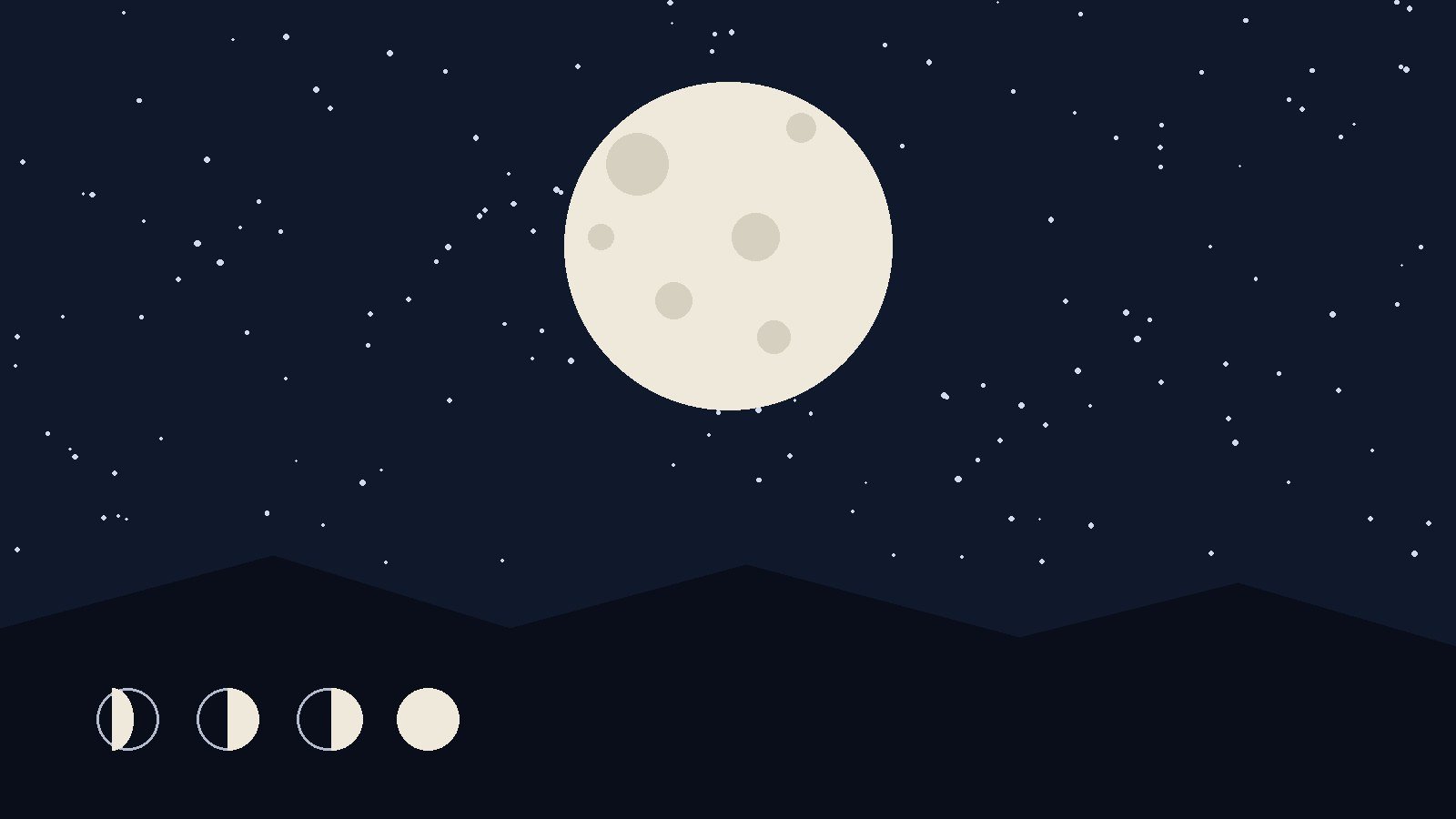
A full moon is not a night or a day; it is an instant. The Moon orbits Earth, and once each cycle it reaches the point directly opposite the Sun, with Earth in between. Astronomers call that alignment opposition. At that moment the Moon’s Earth-facing side is fully lit, and its phase is, by definition, full.
The time between one full moon and the next is called the synodic month, and it averages 29.53 days. It is not a fixed interval: the Moon’s orbit is elliptical and its speed varies, so real gaps between full moons range from about 29.3 to 29.8 days. That is why no simple rule of thumb (“add 29 days”) stays accurate for long, and why published tables, computed from the Moon’s actual orbital motion, are the reliable source. The U.S. Naval Observatory (USNO) publishes those computations years in advance, and NASA uses the same underlying astronomy.
Two practical consequences follow. First, the exact full moment can fall in daylight where you live; the Moon still looks full on the nights either side of it, because illumination changes slowly near the peak, so watchers treat the surrounding evening as “the full moon night.” Second, because the full moment is a single instant in Universal Time, the local calendar date depends on your time zone. The December 2026 full moon, for example, is timed at 01:28 UTC on December 24, which is 8:28 p.m. Eastern Standard Time on December 23 in the United States. Both dates are correct; they describe the same moment in different zones. The table below uses UTC dates and times throughout, with U.S. Eastern dates noted where they differ.
Because 29.53 days is shorter than every calendar month except February, full moon dates also drift. A full moon falls about 11 days earlier each year on the calendar, which is why the full moon nearest a fixed event, such as the autumn equinox, changes from year to year, and why, every two or three years, one calendar month catches two full moons and produces a blue moon.
Full Moon Dates for the Next 12 Months
Dates and times are UTC, from the U.S. Naval Observatory. Names are the traditional ones in wide use in the United States. Notes flag supermoons (on the definition used by the Old Farmer’s Almanac, following Fred Espenak’s tables) and eclipses listed by NASA.
| Date (UTC) | Time (UTC) | Traditional name | Notes |
|---|---|---|---|
| Monday, October 26, 2026 | 04:12 | Hunter’s Moon | The next full moon |
| Tuesday, November 24, 2026 | 14:53 | Beaver Moon | Supermoon |
| Thursday, December 24, 2026 | 01:28 | Cold Moon | Supermoon; closest full moon of 2026; falls on December 23 in U.S. Eastern Time |
| Friday, January 22, 2027 | 12:17 | Wolf Moon | Supermoon |
| Saturday, February 20, 2027 | 23:23 | Snow Moon | Supermoon; penumbral lunar eclipse the same night |
| Monday, March 22, 2027 | 10:44 | Worm Moon | |
| Tuesday, April 20, 2027 | 22:27 | Pink Moon | |
| Thursday, May 20, 2027 | 10:59 | Flower Moon | |
| Saturday, June 19, 2027 | 00:44 | Strawberry Moon | Falls on June 18 in U.S. Eastern Time |
| Sunday, July 18, 2027 | 15:45 | Buck Moon | Penumbral lunar eclipse the same night |
| Tuesday, August 17, 2027 | 07:29 | Sturgeon Moon | Penumbral lunar eclipse the same night |
| Wednesday, September 15, 2027 | 23:03 | Harvest Moon | September’s moon takes the Harvest name in 2027 (see below) |
Dates and times verified against the U.S. Naval Observatory, “Dates of Primary Phases of the Moon,” on October 23, 2026. Supermoon designations follow the Old Farmer’s Almanac, using perigee data by Fred Espenak; eclipses are as listed on NASA’s eclipse calendar.
How to Find the Next Full Moon for Any Date
You do not need this article to be current to answer the question. The method is the same one used to build the table:
- Start from a known full moon. Any verified date will do, for example October 26, 2026 from the table above.
- Add or subtract whole lunar cycles. Each step is about 29.53 days. Counting forward from a known date in steps of 29 or 30 days gets you within a day of the right answer for months ahead; the error grows slowly because the cycle is an average, not a constant.
- Confirm the exact date and time with an authoritative table. The USNO’s “Dates of Primary Phases of the Moon” page gives the four main phases for any year, in UTC, and NASA’s Daily Moon Guide and skywatching pages give the phase for any specific day. Almanacs and calendar apps draw on the same computations.
- Convert to your time zone. Subtract your offset from UTC (five hours for U.S. Eastern Standard Time, four during daylight time). If the conversion crosses midnight, your local full moon date is the day before the UTC date.
- For watching, aim for moonrise. The Moon looks its largest and most striking as it rises around sunset on the full moon evening, thanks to the Moon illusion, and it appears essentially full on the nights immediately before and after the exact moment too.
One shortcut worth knowing: lunar dates repeat on the same calendar dates every 19 years, a pattern called the Metonic cycle, because 19 years is almost exactly 235 lunar cycles. The fit is close but not perfect, drifting by roughly a day over a few centuries.
Why Full Moons Have Names
Long before printed calendars, the Moon was the calendar. Each full moon marked a unit of time, and communities named the moons for what the season brought, so the name itself carried information: when to hunt, plant, harvest, or expect snow. Most of the names in standard use in the United States descend from the lunar calendars of Indigenous nations of the Northeast, including Algonquian-speaking peoples, blended with names from colonial and European farming tradition. Almanacs, above all the Old Farmer’s Almanac in the 20th century, carried one blended list into wide circulation, which is why the same twelve names appear almost everywhere today. Individual nations always had, and still have, their own names in their own languages; the familiar list is a popular selection, not a universal one.
Read as a set, the names describe the Northern Hemisphere year: the Wolf Moon of deep winter, the Snow Moon, the Worm Moon as the ground thaws and earthworms return, the Pink Moon (named not for the Moon’s color but for moss phlox, an early pink wildflower), the Flower Moon, the Strawberry Moon of the short wild strawberry season, the Buck Moon as deer grow new antlers, the Sturgeon Moon for the great fish once easily caught in the Great Lakes in late summer, the Beaver Moon as beavers finish their lodges before the freeze, and the Cold Moon of the longest nights.
Two of the twelve are defined by position rather than by month. The Harvest Moon is the full moon nearest the autumnal equinox, whether it falls in late September or early October; its light rises soon after sunset for several evenings running, which once let farmers work late in the fields. The moon after it is the Hunter’s Moon. Because the Harvest name moves, September’s moon is the Harvest Moon in some years and the Corn Moon in others.
The September full moon, and why its name changes
Readers often search for a specific month’s moon, such as the September full moon of 2025, and find two names attached to it. That September moon fell on September 7, 2025. In 2025 the full moon closest to the equinox (September 22) was October’s, so October took the Harvest Moon name and September’s moon was the Corn Moon. It was an eventful one: it coincided with a total lunar eclipse, visible across Asia, Australia, Africa, and Europe, during which the Moon passed fully into Earth’s shadow and turned a deep red. In the table above, the pattern reverses: in 2027 the September 15 full moon falls about a week before the equinox while October’s falls more than three weeks after it, so September’s moon is the Harvest Moon of 2027.
Blue Moons, Explained
Despite the name, a blue moon is a calendar event, not a color. Two definitions coexist:
- The monthly blue moon is the second full moon in a single calendar month. Because the cycle is 29.53 days and most months are 30 or 31 days long, this happens roughly once every two or three years. The most recent was on May 31, 2026, when May had full moons on both the 1st and the 31st. No month in the table above contains two full moons, so there is no blue moon in the coming twelve months.
- The seasonal blue moon is the older definition: the third full moon in an astronomical season that contains four. The popular monthly meaning grew out of a 1946 article in Sky & Telescope magazine in which writer James Hugh Pruett misread the older almanac rule, and the simpler version stuck. Sources differ on which definition they use, which is why blue moon dates occasionally disagree between websites.
The Moon itself can very rarely look blue, when smoke or ash from large fires or volcanic eruptions filters red light out of its image, as was reported after the eruption of Krakatoa in 1883. That has nothing to do with the calendar term.
Supermoons, Explained Carefully
The Moon’s orbit is an ellipse, so its distance from Earth varies through the month, from roughly 356,500 kilometers at its closest (perigee) to about 406,700 kilometers at its farthest (apogee). A supermoon is a full moon that occurs near perigee, so it looks slightly larger and brighter than an average full moon. NASA puts the maximum effect at up to about 14 percent larger and 30 percent brighter than the year’s most distant full moon; compared with an ordinary full moon the difference is a few percent, real but subtle, and most people cannot spot it without a side-by-side comparison.
Two cautions keep this honest. First, “supermoon” is not an official astronomical term. It was coined by astrologer Richard Nolle in 1979, and the working definition most publishers use is his rule of thumb: a full or new moon occurring within 90 percent of the Moon’s closest approach for that orbit. Astrophysicist Fred Espenak’s published tables apply that definition, but because there is no single official threshold, different websites list slightly different supermoons. Second, the dramatic size many people notice at moonrise is mostly the Moon illusion, a trick of perception that affects every rising moon, supermoon or not.
On the Espenak-based reckoning used by the Old Farmer’s Almanac, four of the next twelve full moons count as supermoons: the Beaver Moon of November 24, 2026 (about 360,800 kilometers away), the Cold Moon of December 24, 2026, which at about 356,700 kilometers is the closest full moon of 2026, the Wolf Moon of January 22, 2027 (about 357,600 kilometers), and the Snow Moon of February 20, 2027. A supermoon’s extra gravitational pull does raise slightly higher “perigean spring” tides, but studies have found no link between supermoons and natural disasters, a claim that circulates after almost every one.
Full Moons and Eclipses
A lunar eclipse can only happen at full moon, because that is the only time Earth sits directly between the Sun and the Moon. It does not happen every month, because the Moon’s orbit is tilted about five degrees to Earth’s orbit around the Sun; most months, the Moon passes a little above or below Earth’s shadow. Eclipses come in seasons, a few weeks long and roughly six months apart, when the alignment is close enough.
When it does align, the type of eclipse depends on which part of the shadow the Moon crosses. In a total lunar eclipse, the Moon passes through the dark central shadow (the umbra) and turns copper red, as sunlight filtered through Earth’s atmosphere bends into the shadow; this is the origin of the “blood moon” nickname, including the total eclipse that accompanied the Corn Moon of September 7, 2025. In a partial eclipse only part of the Moon enters the umbra. In a penumbral eclipse, the Moon crosses only the faint outer shadow, and the effect is a subtle shading that many observers miss entirely.
Three full moons in the table above coincide with penumbral lunar eclipses, all in 2027: February 20, July 18, and August 17, as listed on NASA’s eclipse calendar. Expect a slight dimming on one side of the Moon rather than a red spectacle. Solar eclipses, for the record, belong to the opposite phase: they occur at new moon, such as the total solar eclipse of August 2, 2027.
Frequently Asked Questions
How often is there a full moon?
Once per lunar cycle, every 29.53 days on average. That works out to 12 full moons in most years and 13 in some, including 2026, which had its extra moon as the blue moon of May 31.
Is the full moon on the same date everywhere in the world?
The full moment is a single instant, so the phase is the same everywhere, but the local date and time differ by time zone. The December 2026 full moon is dated December 24 in UTC and December 23 in U.S. Eastern Time, for the same event.
Why do full moon dates change every year?
Because 12 lunar cycles take about 354 days, roughly 11 days less than a calendar year. Full moons therefore arrive about 11 days earlier each year until the drift resets the pattern, which is also why events fixed to the lunar calendar move through the seasons.
Can a month have no full moon?
Yes, but only February, the one month shorter than the lunar cycle. A February with no full moon is sometimes called a black moon month; it last happened in February 2018, and such a February always has a blue moon in both January and March around it.
Does a full moon affect people?
Popular tradition links full moons to sleeplessness and strange behavior, and scientists have tested those claims. The results are mixed, small, and contested, and no robust effect on behavior has been established. The Moon’s real, measurable effects on Earth are light and tides.
Conclusion
The next full moon is the Hunter’s Moon of Monday, October 26, 2026, and the twelve that follow it are set out, with their names, in the table above. The pattern behind the table is simple: a full moon every 29.53 days, drifting steadily against the calendar, decorated from time to time with a blue moon when a month catches two, a supermoon when fullness meets perigee, and an eclipse when the alignment is exact. Once you have one verified date, you can step forward or backward through the cycle to find the next full moon for any date you care about, and check the exact moment against the Naval Observatory’s tables.
Keep reading: What Causes the Northern Lights? The Science of the Aurora Explained
Sources & references
- U.S. Naval Observatory, "Dates of Primary Phases of the Moon" (aa.usno.navy.mil): full moon dates and times in UTC for 2026 and 2027; every entry in the table above was checked against these pages on October 23, 2026.
- NASA (science.nasa.gov): "What Is a Supermoon?" (up to 14 percent larger and 30 percent brighter than the most distant full moon; the term describes a perigean full moon), Daily Moon Guide, and NASA's eclipse calendar (the penumbral lunar eclipses of February 20, July 18, and August 17, 2027, and the total solar eclipse of August 2, 2027).
- Old Farmer's Almanac (almanac.com): full moon names and their seasonal meanings; supermoon listings and distances using perigee data by Fred Espenak (November 24 and December 24, 2026; January 22 and February 20, 2027; December 24, 2026 the closest full moon of its year).
- EarthSky (earthsky.org): the total lunar eclipse of the Corn Moon, September 7, 2025 (full moon at 18:09 UTC, totality about 83 minutes), and background on the Harvest Moon rule.