Short answer
- The shortest day of the year is the winter solstice. In the Northern Hemisphere that is the December solstice, which falls on December 21 or 22. In 2026 the solstice moment is December 21, at 20:50 UTC (3:50 p.m. Eastern Standard Time).
- "Shortest" means the least daylight between sunrise and sunset. How short depends on latitude: on December 21, 2026, Miami gets 10 hours 31 minutes of daylight, New York 9 hours 15 minutes, Anchorage about 5 hours 27 minutes, and places inside the Arctic Circle get none.
- The solstice is an instant, not a day: the moment the South Pole tips closest to the Sun and the Sun stands over the Tropic of Capricorn. Your local calendar date for it depends on your time zone.
- The earliest sunset of the year is not on the solstice. At the latitude of New York it falls around December 7, and the latest sunrise around January 4, an offset caused by the equation of time.
- After the solstice the day lengthens, but by seconds a day at first, and almost all of the early gain is in the evening. Mornings keep getting later until early January.
- In the Southern Hemisphere the same December moment is the summer solstice and the longest day of the year: Sydney gets about 14 hours 25 minutes of daylight on December 21, 2026.
The shortest day of the year in the Northern Hemisphere is the day of the December solstice: in 2026, Monday, December 21. That much fits in one line, and it is also where most explanations stop. They should not, because the interesting questions start immediately after it. Shortest where, exactly, since Miami keeps ten and a half hours of daylight that day while Anchorage keeps five and a half? Why does the Sun start setting later in early December, more than two weeks before the shortest day arrives? And if the solstice is the turning point, why do the darkest mornings of the year still lie ahead of it, in January? This article answers the date question properly, with exact times for the next five years, and then works through the geometry that makes the shortest day stranger than it sounds.
What “Shortest Day” Actually Means
Every day of the year is about 24 hours long; the planet does not spin faster in winter. “Shortest day” is shorthand for the day with the shortest period of daylight, the longest stretch between sunrise and sunset being smallest, and the night at its longest. That day is fixed by geometry. Earth’s axis leans about 23.5 degrees from vertical and holds that lean as the planet orbits. At the December solstice the lean points the North Pole as far away from the Sun as it ever gets, and the South Pole as far toward it. The Sun, seen from Earth, reaches its southernmost point of the year and stands directly overhead at noon along the Tropic of Capricorn, at latitude 23.5 degrees south.
For the Northern Hemisphere, three things follow at once. The Sun takes its lowest, shortest path across the sky, climbing least high at noon: in New York it reaches only about 26 degrees above the southern horizon, less than a third of the way to overhead. Daylight lasts the fewest hours of any day of the year. And the sunlight that does arrive comes in at the shallowest angle, spread thin over the ground, which is the real reason December is cold, a point the distance-from-the-Sun myth gets backwards: Earth is actually near its closest approach to the Sun, perihelion, in early January.
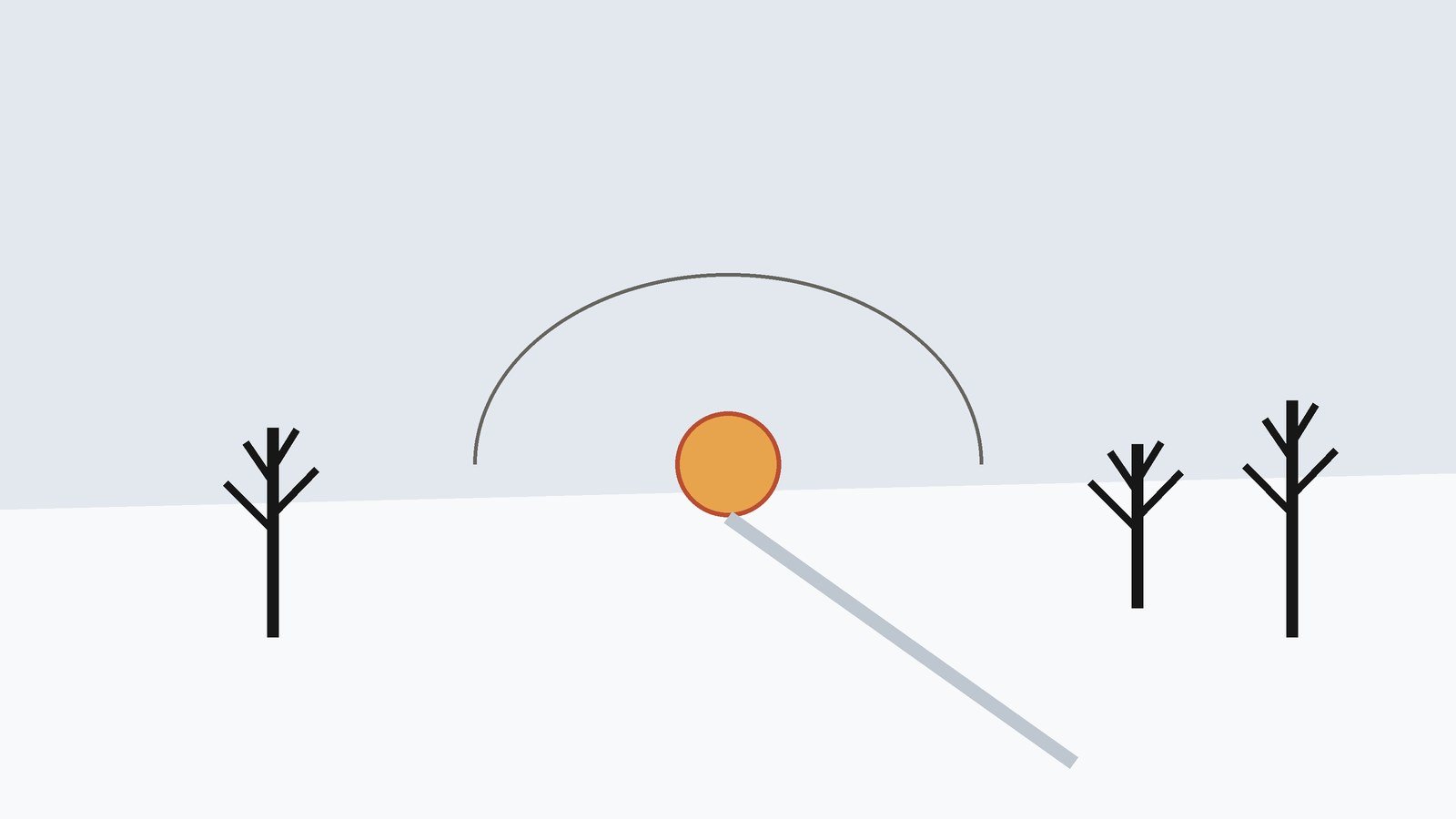
The word solstice comes from Latin roots meaning “the Sun stands still,” because for several days around this point the Sun’s noon height and its rising and setting positions along the horizon barely change from one day to the next before they begin, almost imperceptibly, to retreat. That standstill matters for everything below: near the solstice, day length itself nearly stops changing, which is exactly what allows smaller effects, like the drift of solar noon, to take over the sunrise and sunset times.
The Next Five December Solstices
The solstice happens at one moment, the same moment for the whole planet. What varies is the local date and clock time you attach to it. The U.S. Naval Observatory’s Earth’s Seasons data service publishes these instants in Universal Time (UTC); the table adds U.S. Eastern Standard Time, which is five hours behind UTC.
| Year | Solstice in UTC | Solstice in U.S. Eastern (EST) |
|---|---|---|
| 2026 | December 21, 20:50 | December 21, 3:50 p.m. |
| 2027 | December 22, 02:43 | December 21, 9:43 p.m. |
| 2028 | December 21, 08:20 | December 21, 3:20 a.m. |
| 2029 | December 21, 14:14 | December 21, 9:14 a.m. |
| 2030 | December 21, 20:09 | December 21, 3:09 p.m. |
Read the 2027 line twice. In UTC the solstice falls on December 22, but in the Eastern time zone it is still the evening of December 21, and on the U.S. West Coast it is early evening on December 21. So “the shortest day is December 21” is a statement about where you live as much as about astronomy: the shortest day is the calendar day on which the solstice instant falls in your time zone, and the daylight minimum itself is so flat near the solstice that the days either side of it differ by only a few seconds. Times for 2026 to 2029 are the Observatory’s published values, computed from Jet Propulsion Laboratory ephemerides; the 2030 time is computed from the same ephemeris series rather than taken from a published Observatory table, and independent computations of these instants agree to within a minute.
Why the Date Moves Between December 21 and 22
The calendar is the problem, not the astronomy. A full cycle of the seasons, the tropical year, takes about 365 days, 5 hours, and 49 minutes. The civil year rounds that down to 365 days, so each year the solstice arrives roughly six hours later than the year before, edging from December 21 toward December 22. Every four years the leap day at the end of February pulls every later date back by about 18 hours against the Sun, and the solstice resets to the earlier side of the window. That six-hours-later, one-day-back rhythm is why the December solstice alternates between the 21st and the 22nd in our era, why 2027 lands on the 22nd in UTC, and why a leap year like 2028 pulls the instant back to early on the 21st. The same mechanism moves the June solstice between June 20 and 21; Amberaisle’s companion article on the first day of summer works through the June table in the same terms.
How Much Daylight You Actually Get
The solstice date is universal. The shortest day is not. Day length on the solstice is set almost entirely by latitude, because the farther north you are, the more of the Sun’s daily circle stays hidden below the horizon when the pole is tipped away. The figures below are for December 21, 2026, computed from standard sunrise and sunset data of the kind the U.S. Naval Observatory publishes.
| Place | Latitude | Daylight on Dec 21, 2026 | Sunrise and sunset (local) |
|---|---|---|---|
| Miami, Florida | 25.8° N | 10 hours 31 minutes | about 7:03 a.m. to 5:34 p.m. |
| New York City | 40.7° N | 9 hours 15 minutes | 7:16 a.m. to 4:31 p.m. |
| Anchorage, Alaska | 61.2° N | about 5 hours 27 minutes | about 10:14 a.m. to 3:41 p.m. |
| The Arctic Circle | 66.6° N | none to a brief glimpse | the Sun’s upper edge skims the horizon at noon |
| Utqiaġvik, Alaska | 71.3° N | none | no sunrise at all; a few hours of twilight |
The gradient steepens as you go. Miami loses barely an hour and a half against a 12-hour day; it is a mild shortening, noticed mostly in the early evening. New York loses nearly three hours and gets the classic northern winter day, dark before the evening commute. Anchorage, at the latitude of southern Greenland and central Scandinavia, compresses its whole day into the middle hours: the Sun rises after 10 in the morning, never climbs more than a few degrees, and sets before 3:45 in the afternoon.
At the Arctic Circle the geometry closes entirely. The Sun’s center reaches exactly the horizon at noon and no higher; allowing for the Sun’s width and the bending of light in the atmosphere, its upper edge can peek above the horizon around midday, but no full sunrise occurs. North of the circle there is no sunrise at all, only a band of twilight that brightens toward the south at midday and fades. Utqiaġvik, Alaska’s northernmost community, is the working example. NASA’s Earth Observatory describes its polar night plainly: the Sun sets there in mid-November and does not rise again until mid-January. In 2025 the last sunset came on November 18 and the next sunrise on January 22, 2026, roughly 65 days later, and even at the depth of the solstice the town still receives just under three hours of civil twilight, the pale light before sunrise, around the middle of the day. At the North Pole itself the Sun set at the September equinox and will not rise until the March equinox: six months of night, with weeks of round-the-clock darkness at its depth around the solstice.
The equator, for calibration, barely notices any of this. Day length there stays close to 12 hours all year, running just over 12 hours on the solstice because sunrise and sunset are timed by the Sun’s upper edge and the atmosphere bends a little extra light over the horizon.
The Solstice Paradox: The Earliest Sunset Is Not on the Shortest Day
Here is the fact that catches almost everyone. If December 21 has the least daylight, it should also have the earliest sunset and the latest sunrise. At mid-northern latitudes it has neither. The earliest sunset of the year comes first, roughly two weeks before the solstice: around December 7 at the latitude of New York, and a few days later farther north. The latest sunrise comes last, roughly two weeks after the solstice, in early January; around January 4 at New York’s latitude. The shortest day sits in between, holding neither record.
The U.S. Naval Observatory’s explainer on this point names the cause directly: our clocks do not run on Sun time. The interval from one solar noon to the next, the true solar day, is not exactly 24 hours. Through the stretch from mid-November to early February, each solar day runs longer than 24 hours, by anywhere from a few seconds to about half a minute. The reasons are the same two that drive the equation of time: Earth’s orbit is slightly elliptical, so the planet moves faster near its early-January closest approach, and the tilted axis changes how the Sun’s motion projects onto the clock. The effect compounds. Because each solar day overruns the clock day, solar noon arrives a little later by the clock every day through December, and sunrise and sunset, which hang either side of noon, are dragged later with it.
Now put the two trends together. Approaching the solstice, the day is still shrinking, which by itself would pull sunset earlier and sunrise later. But the clock drift is pushing both events later, and in early December the drift is the stronger of the two at the evening end. So sunset stops getting earlier, bottoms out around December 7 at New York’s latitude, and starts retreating later while the day as a whole is still shrinking: the shrinking is being taken entirely out of the morning. At the solstice the day length bottoms out and begins, by seconds, to grow. The drift still rules the morning end, though, so sunrise keeps arriving later into early January, until the now-quickening growth of the day finally overpowers it around January 4. Only then do both ends of the day start moving the right way.
The practical consequence is lopsided and worth knowing: the worst of the dark evenings is over before the shortest day even arrives, while the darkest mornings of winter are still to come after it. If you commute home in the dark, the solstice is genuinely the turning point. If you commute to work in the dark, your turning point is in the first week of January.
The Same Day, Upside Down: The Southern Hemisphere
The December solstice is one instant, experienced in opposite ways. While the North Pole tips away from the Sun, the South Pole tips toward it, so December 21 is the Southern Hemisphere’s summer solstice and longest day. Sydney, Australia, at about 34 degrees south, gets 14 hours 25 minutes of daylight on December 21, 2026, sunrise at 5:40 a.m. and sunset at 8:05 p.m. local time. Cape Town, South Africa, at nearly the same latitude, gets an almost identical long summer evening. Meteorological summer in the south begins on December 1, and the season runs through December, January, and February.
The sunrise and sunset offsets mirror too. Because the equation-of-time drift is a property of Earth’s orbit, not of any hemisphere, solar noon drifts later through December everywhere on the planet. South of the equator that means the earliest sunrise of the year precedes the December solstice and the latest sunset follows it in early January, the same sequence as the north’s, with sunrise and sunset swapping roles. One planet, one tilt, one drifting clock: two opposite calendars of light, running in lockstep.
After the Solstice: How the Light Comes Back
The return of the light is real but, at first, almost undetectable. Day length changes slowest exactly at the solstice, because that is the point where the Sun’s southward slide stops and reverses. Around December 21 the daily change in day length is measured in seconds: published sun tables for Anchorage show the day still shortening by a few seconds on the 21st and lengthening by a few seconds on the 22nd, a rounding error of a day. Through January the gains build from seconds to a minute or more a day, and they are spent first where the drift allows, on the evening end; sunsets get noticeably later weeks before sunrises get noticeably earlier. By the approach of the March equinox the day is lengthening at close to its fastest pace of the year, roughly two and a half minutes a day at the latitude of New York, and by the equinox itself New York has gained back close to three hours against the solstice, standing at a little over 12 hours of daylight. The arc from the shortest day is therefore not a ramp but a curve: flat at the bottom in late December, steepening through February, steepest at the equinox, and flattening again toward the June solstice, where the whole pattern mirrors.
One more lag deserves a mention, because it surprises people every January. The shortest day is not the coldest day. Just as land and ocean store summer’s heat and release it slowly, they go on losing heat after the solstice: the weakest sunlight of the year arrives in December, but the accumulated cold of the season peaks weeks later, which is why the coldest weather of a northern winter typically falls in January, on the far side of the turning point. The light turns at the solstice. The temperature takes its time following.
Frequently Asked Questions
When is the shortest day of the year in 2026?
Monday, December 21, 2026, in the Americas and in most time zones. The solstice instant is 20:50 UTC, which is 3:50 p.m. Eastern Standard Time on December 21. In time zones far east of UTC the instant falls on December 22 local time, and those places take December 22 as their shortest day.
Is the shortest day always on December 21?
No. It falls on December 21 or 22 depending on the year and your time zone. The seasonal year is about six hours longer than the 365-day calendar year, so the solstice creeps later until a leap year pulls it back. In 2027, for example, the solstice is December 22 in UTC but still December 21 in U.S. time zones.
Why is the earliest sunset before the shortest day?
Because clocks and the Sun keep slightly different time. From mid-November to early February each true solar day runs a little longer than 24 hours, so solar noon, sunrise, and sunset all drift later by the clock through December. That drift makes sunset bottom out around December 7 at New York’s latitude, while the still-shrinking day pushes sunrise later and later, past the solstice to around January 4.
What is the shortest day at the North Pole and the equator?
At the North Pole there is no sunrise at all on the solstice: the Sun set at the September equinox and does not return until the March equinox, so the pole spends the solstice in full night. At the equator the shortest day is barely shorter than any other day: day length stays close to 12 hours year round, and is just over 12 hours even on the December solstice.
Is the shortest day also the coldest day of the year?
Usually not. Land and water keep losing heat after the daylight minimum, so the coldest average temperatures in most northern locations arrive in January, several weeks after the solstice. The solstice is the turning point of the light, not of the temperature.
Does the Southern Hemisphere have its shortest day in December?
No, the opposite. The December solstice is the Southern Hemisphere’s longest day: Sydney gets about 14 hours 25 minutes of daylight on December 21, 2026. The south’s shortest day comes at the June solstice, around June 21, which is the Northern Hemisphere’s longest day.
Conclusion
The shortest day of the year is a single tilted-planet moment: the December solstice, December 21, 2026, at 20:50 UTC, when the North Pole leans its farthest from the Sun. Everything else follows from where you stand. That one fact sets Miami’s mild 10 hours 31 minutes against Anchorage’s 5 hours 27 and Utqiaġvik’s none at all; it explains why the date wobbles between the 21st and the 22nd; and, once the equation of time is added, why the evenings start recovering two weeks before the solstice while the mornings wait until January. The solstice is not the darkest evening, the latest morning, or the coldest day of the year. It is the hinge all three of them swing on, and after it, measurably if slowly, the light comes back.
Sources & references
- U.S. Naval Observatory (aa.usno.navy.mil), "Earth's Seasons" data service: equinox and solstice instants in UTC, including the December solstices 2026 (December 21, 20:50), 2027 (December 22, 02:43), 2028 (December 21, 08:20), and 2029 (December 21, 14:14), computed from Jet Propulsion Laboratory ephemerides; corroborated against independent reproductions of the same tables. The 2030 instant (December 21, 20:09) is computed from the same JPL ephemeris series rather than taken from a published Observatory table; independent computations of it span 20:09 to 20:10 UTC.
- U.S. Naval Observatory (aa.usno.navy.mil), FAQ, "Sunrise and Sunset Times Near the Solstices": the day of least daylight is always the winter solstice, but the earliest sunset falls in early December and the latest sunrise in early January, because true solar days from mid-November to early February each run longer than 24 hours by a few seconds to about half a minute, so solar noon and both sunrise and sunset drift later by the clock.
- timeanddate.com, city sun tables for December 2026: New York (December 21: sunrise 7:16 a.m., sunset 4:31 p.m., 9 hours 15 minutes of daylight); Miami (December 21 daylight 10 hours 31 minutes); Anchorage (December 21 daylight about 5 hours 27 minutes); Sydney (December 21: sunrise 5:40 a.m., sunset 8:05 p.m., daylight 14 hours 25 minutes, the longest day of its year).
- NASA Earth Observatory (earthobservatory.nasa.gov), "Months in the Midnight Sun": at Utqiaġvik, Alaska, the polar night runs from a last sunset in mid-November to the next sunrise in mid-January (November 18, 2025 to January 22, 2026, about 65 days, per NASA and NOAA reporting); the town still receives civil twilight around midday through the solstice period.