Short answer
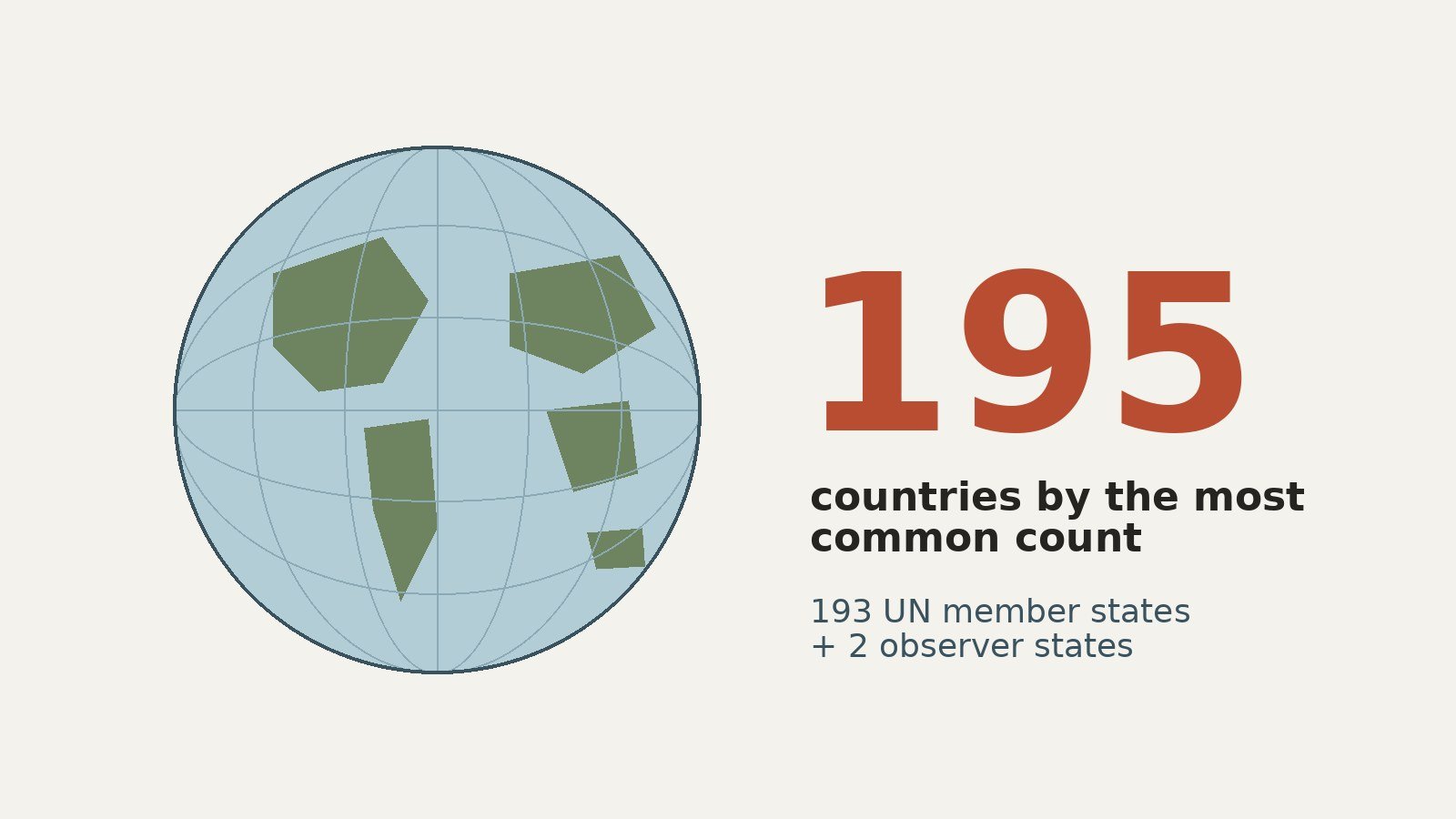
- The most widely used answer is 195 countries: the 193 member states of the United Nations plus its 2 non-member observer states, the Holy See and the State of Palestine.
- Counts differ because recognition differs. Some states are recognized by many governments but not others, and many lists also count territories that are not sovereign states.
- By region, using the United Nations geoscheme, Europe has 44 countries and Asia has 48 on the sovereign-state count. Lists that give 49 for Asia are counting Taiwan separately.
- The largest country by area is Russia, at about 17.1 million square kilometers in total. The smallest is Vatican City, at about 0.49 square kilometers.
- The count has grown mainly through decolonization and the breakup of states. The United Nations began with 51 member states in 1945 and reached 193 when South Sudan joined in 2011.
Ask a simple question and you get several defensible answers. Depending on whose list you use, the world has 193, 195, or more than 200 countries. The differences are not mistakes. They come from how a list treats recognition, territories, and places whose status is disputed. Here is the standard answer, and why the count keeps moving.
The Standard Answer: 195
The United Nations has 193 member states. Two further states hold permanent observer status at the UN General Assembly without being members: the Holy See, which represents Vatican City in international affairs, and the State of Palestine, granted non-member observer state status in 2012. Adding the members and the two observer states gives 195, the figure used by most reference works and by the U.S. Department of State, whose Independent States in the World list also totals 195 independent states.
Observer states can take part in General Assembly debates and maintain missions at UN headquarters, but they cannot vote in the Assembly. That halfway status is exactly why the headline number needs a footnote: 195 counts two states that the UN system treats as states for most purposes but not as members.
Why Different Lists Give Different Numbers
Recognition is not universal
There is no world registry that stamps a country into existence. A state emerges when it governs itself and other states treat it as a state, and those two tests do not always agree.
Taiwan is the clearest example. It has its own government, population, and territory, and it functions independently. However, the People’s Republic of China claims Taiwan as part of China, and most states, including the United States, maintain formal diplomatic relations with Beijing rather than Taipei. Taiwan therefore appears on some lists of countries and not on others, and this article takes no position on its status: it simply reports that lists differ.
Kosovo declared independence from Serbia in 2008. It has been recognized by more than 100 UN member states, including the United States and most members of the European Union, but Serbia does not recognize it, and neither do some other states, including Russia and China. Published recognition totals vary, because governments and trackers disagree about withdrawals of recognition. Kosovo is not a UN member, so it sits outside the 195 count while appearing on many longer lists.
The same logic applies in reverse to the observer states above: Palestine is recognized as a state by a large majority of UN members, and the Holy See is recognized almost universally, yet neither is a UN member state.
Two further cases show the same traps in miniature. Ireland is one island but two states — the Republic of Ireland and Northern Ireland, which is part of the United Kingdom.
Capitals cause a mirror-image confusion: Mexico City is the capital of Mexico, one name doing duty for both a city and a country.
The Montevideo test
International lawyers often start with the Montevideo Convention on the Rights and Duties of States, signed in 1933 and in force from 1934. Its first article says a state should have four things: a permanent population, a defined territory, a government, and the capacity to enter into relations with other states. The convention also states that a state’s political existence is independent of recognition by other states. In practice, meeting the four tests has never been quite enough on its own, which is why recognition, covered above, still decides most borderline cases. Those are rights and duties between states; the rights a government owes to individuals inside its own legal system are a separate tradition, covered in our guide to due process and the Bill of Rights amendments.
Territories are not sovereign states
Many longer lists quietly mix in territories: places with their own flags, governments, and sometimes their own teams in international sports, but which are governed as part of, or in association with, another state. Puerto Rico and Guam are territories of the United States. Greenland is part of the Kingdom of Denmark. The Cook Islands and Niue are self-governing in free association with New Zealand. Adding territories and dependencies pushes a list well past 200 entries. That is useful for postal services, sporting federations, and phone codes, but it answers a different question from “how many sovereign countries are there?”
How Many Countries Are in Each Region?
The United Nations Statistics Division maintains the geoscheme known as M49, which assigns every country or area to a region for statistical use. Counting sovereign states under that scheme gives the figures most often quoted for the two most searched regions.
Europe: 44 countries. This total surprises readers who think first of the European Union, which has 27 members. The UN region of Europe is much broader: it runs from Iceland and Ireland in the west to Russia’s European part in the east, and it includes microstates such as Andorra, Monaco, and San Marino alongside large states such as France, Germany, and Ukraine.
Asia: 48 countries. The UN divides Asia into Central (5), Eastern (5), Southern (9), South-eastern (11), and Western (18) subregions, and counting the sovereign states in them gives 48, including the State of Palestine in Western Asia. The count includes the island states of Japan, Indonesia, and the Philippines, the states of the Arabian Peninsula, and transcontinental cases assigned to Asia under the scheme. The figure of 49 quoted by many lists results from counting Taiwan separately.
Totals for other regions follow the same method: Africa has the most countries of any continent on this counting basis, followed by Asia and Europe, while Oceania has the fewest sovereign states, mostly small Pacific island nations. Regional totals change only when states join, split, or merge, or when the geoscheme itself is revised.
How Many Continents Are There?
Countries sit inside continents, and the continent count has its own ambiguity. The model taught in the United States and much of the English-speaking world counts seven continents: Africa, Antarctica, Asia, Europe, North America, South America, and Australia (often grouped with nearby islands as Oceania). Other school systems teach six, joining Europe and Asia as Eurasia, or joining North and South America into a single American continent. Continents are a geographic convention rather than a legal category, so no authority settles the question the way UN membership settles the country count.
Largest and Smallest Countries
By total area, the ranking is not close. Russia is the largest country in the world at about 17.1 million square kilometers in total, of which about 16.4 million square kilometers is land, spanning eastern Europe and northern Asia. Canada, the United States, and China follow, each between roughly 9 and 10 million square kilometers.
At the other end, Vatican City is the smallest state at about 0.49 square kilometers, an enclave inside Rome. Monaco, on the French Mediterranean coast, covers about 2 square kilometers. The smallest country outside Europe is Nauru, a Pacific island state of about 21 square kilometers, and also the world’s smallest island nation and smallest republic by area among the states in these rankings.
By population, the order changed recently. On United Nations estimates published in 2023, India became the world’s most populous country that year, moving ahead of China, which is second on the same estimates. Both countries count more than 1.4 billion people on that 2023 vintage of UN figures, so year labels matter: population rankings are estimates, revised as new data arrives, not census certainties.
The Oldest Country Claim
If the newest state on the standard list is South Sudan (2011), the oldest claim belongs to San Marino. By tradition, San Marino was founded in 301, when, as the story is told, a Christian stonemason named Marinus settled on Monte Titano. The tradition framing matters: documentary evidence for the community comes centuries later, and historians treat the 301 date as the republic’s own founding tradition rather than a verified record. San Marino presents itself as the world’s oldest surviving republic, and its institutions have operated continuously for centuries within Italy’s borders.
How the Count Grew: From 51 to 193
The United Nations began in 1945 with 51 founding member states, the countries that signed or ratified its Charter at the end of the Second World War. Membership then grew in waves. Decolonization across Africa and Asia added dozens of states in the 1950s and 1960s. The breakup of the Soviet Union in 1991 added 15 states, and Yugoslavia’s breakup added several more in the same decade. The most recent addition is South Sudan, admitted on 14 July 2011 as the 193rd member state after its independence referendum earlier that year. No state has joined since, which is why the 193 and 195 figures have been stable for well over a decade.
Frequently Asked Questions
How many countries are there in the world in total?
195 on the standard count: 193 UN member states plus the 2 non-member observer states, the Holy See and the State of Palestine. Longer lists add partially recognized states and territories.
How many countries are in Europe?
44, counting sovereign states under the United Nations geoscheme. The European Union, a political union within Europe, has 27 members, which is a different and smaller number.
How many countries are in Asia?
48, counting sovereign states under the United Nations geoscheme, across its Central, Eastern, Southern, South-eastern, and Western Asian subregions. Lists that give 49 are counting Taiwan separately.
What is the newest country in the world?
South Sudan. It became independent from Sudan on 9 July 2011 and was admitted to the United Nations on 14 July 2011 as the 193rd member state.
What is the smallest country in the world?
Vatican City, at about 0.49 square kilometers. It is followed by Monaco, at about 2 square kilometers, and Nauru, at about 21 square kilometers.
Why do some websites say there are 197 or more countries?
They usually add partially recognized states such as Taiwan and Kosovo to the standard 195, and some lists also add territories and dependencies, which can push the total past 200. The difference is in the counting rules, not in the map.
Conclusion
The honest answer to “how many countries in the world” is 195, with the method attached: 193 United Nations member states plus the Holy See and the State of Palestine as observer states. Every other total you will meet, from 193 to well over 200, comes from a stated or unstated choice about recognition and territories. Once you know which rule a list is using, its number usually makes sense.
Sources & references
- United Nations (un.org): 193 member states; growth from 51 founding members in 1945; South Sudan admitted as the 193rd member on 14 July 2011
- United Nations (un.org): non-member observer states, the Holy See and the State of Palestine (observer status granted 2012)
- United Nations Statistics Division (unstats.un.org): Standard Country or Area Codes for Statistical Use (M49), the geoscheme behind the Europe and Asia counts
- U.S. Department of State (state.gov): Independent States in the World list, totaling 195
- CIA World Factbook (cia.gov): area figures for Russia, Vatican City, Monaco, and Nauru
- UN Population Fund, State of World Population 2023 (unfpa.org): 2023 estimates placing India first and China second, each above 1.4 billion


