Short answer
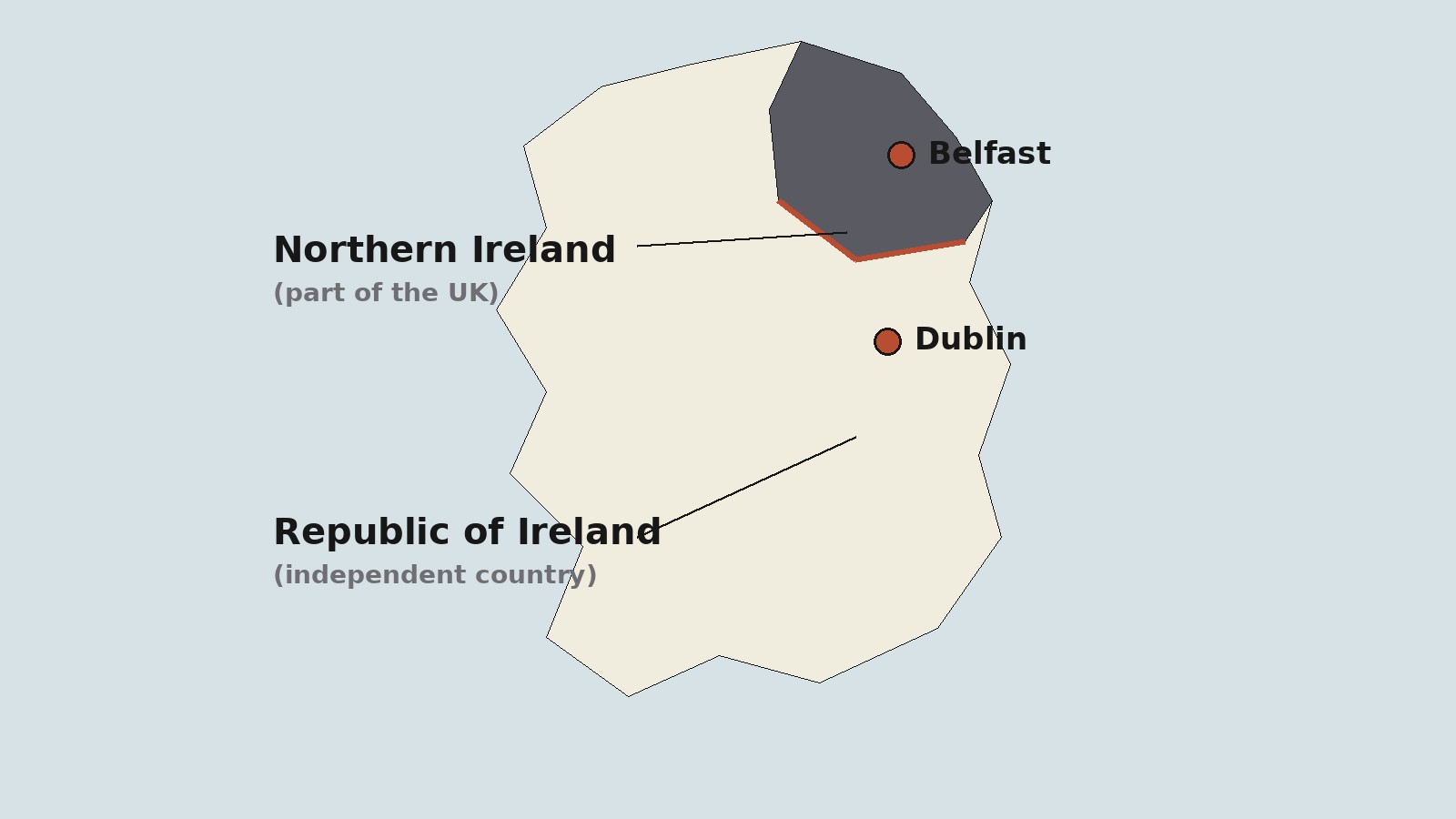
- No, the Republic of Ireland is not part of the United Kingdom. It is an independent sovereign state, and Ireland's own constitution says so directly: "Ireland is a sovereign, independent, democratic state." The confusion comes from Northern Ireland, which is a different place. Northern Ireland occupies the northeastern corner of the island of Ireland, and it is part of the United Kingdom. So the island of Ireland contains two political entities: the Republic of Ireland, covering about five-sixths of the island, and Northern Ireland, which belongs to the UK. Their capitals are Dublin and Belfast, respectively.
The question “Is Ireland part of the UK?” sounds like it should have a one-word answer, and at its core it does: no. But the reason so many people ask it is that the names overlap in confusing ways. “Ireland” can mean an island or a country. “Britain,” “Great Britain,” and “the UK” are three different things. And Northern Ireland sits inside the United Kingdom while sharing an island with a country that does not. This article untangles each of those knots, explains how the island came to be divided, and keeps the politics strictly factual, because on this topic precision is a form of respect.
One Island, Two States
Start with geography, because the map is the source of most of the confusion. Ireland is an island off the northwestern coast of Europe. Politically, that single island is divided into two parts, as Encyclopaedia Britannica puts it: Ireland, which occupies the southern five-sixths of the island, and Northern Ireland, which is a constituent part of the United Kingdom.
The Republic of Ireland is the larger of the two, covering most of the island’s land area. Northern Ireland sits in the northeastern corner. The two share a land border, and there is no other country on the island. That is the whole political map: one island, two jurisdictions, and only one of them has anything to do with the United Kingdom.
This is why the head question misleads. It treats “Ireland” as one thing, but on the ground there are two distinct political entities with different governments, different capitals, and different relationships to the UK. Once you hold those two apart, every other piece of the puzzle falls into place.
The Name Problem: Ireland, Ireland, and the Republic of Ireland
Part of the confusion is baked into the names themselves. The word “Ireland” does double duty: it is the name of the island, and it is also the name of the state that covers most of that island. When someone says “Ireland,” they might mean either, and listeners cannot always tell which.
The state’s official naming is precise, and it comes from Irish law. Article 4 of the Constitution of Ireland states: “The name of the State is Éire, or, in the English language, Ireland.” The phrase “Republic of Ireland” is the state’s official description, declared by the Republic of Ireland Act of 1948, which says “it is hereby declared that the description of the State shall be the Republic of Ireland.” In practice, “Republic of Ireland” is the label most often used in English to distinguish the state from the island and from Northern Ireland, and this article follows that convention.
A related point: the southern state is not officially called “Southern Ireland,” and Irish official usage does not employ that term. The constitutionally correct name is Ireland; the statutory description is the Republic of Ireland. Using those two avoids the most common naming error on this topic.
Northern Ireland’s name is simpler: it describes position, not politics. It is the northern part of the island of Ireland, and it lies partly within the historic province of Ulster. Its name tells you where it is; the United Kingdom’s legislation tells you what it is, which the next section covers.
A Quick Guide to Getting the Names Right
Because the names overlap, a short style guide helps:
- Use the Republic of Ireland (or Ireland, where the context is clear) for the independent state. Its constitutional name is Ireland; “Republic of Ireland” is the official description that distinguishes it from the island and from Northern Ireland.
- Use Northern Ireland for the UK constituent part. “The North” is informal shorthand; in writing, the full name is clearer and unambiguous.
- Do not call the southern state “Southern Ireland.” It is not an official name, and Irish official usage does not employ it.
- Do not use “Great Britain” when you mean the UK. Great Britain excludes Northern Ireland, so the substitution quietly erases the very place the question is about.
- “Ireland” alone is fine when everyone in the conversation means the same thing by it, but in writing, the two-word forms remove the ambiguity that started this whole confusion.
None of this is about political correctness. It is about saying precisely which of the two entities on the island you mean, which is exactly what the original question was trying to do.
Northern Ireland: The Part That Is in the UK
Northern Ireland is the part of the island that belongs to the United Kingdom, and that status is written into UK law. Section 1 of the Northern Ireland Act 1998 declares that “Northern Ireland in its entirety remains part of the United Kingdom.” The same section adds the condition under which that could change: Northern Ireland would cease to be part of the UK only if a majority of its people voted for that in a poll, a principle known as consent. This article states the law as it stands; it takes no position on what any future vote should decide.
In the UK government’s own terminology, the United Kingdom is a constitutional monarchy made up of four constituent parts: three countries (England, Scotland, and Wales) and one province, Northern Ireland. In everyday speech and in sporting contexts, all four are often called countries, and you will see Northern Ireland described as a constituent country of the UK. Both wordings point at the same fact: Northern Ireland is inside the United Kingdom.
Northern Ireland was created as a separate political entity in the early 1920s, formed from six of Ireland’s 32 traditional counties, and it has its own devolved institutions. Its capital is Belfast, which became the seat of Northern Ireland’s government after the Government of Ireland Act of 1920. Belfast sits on the River Lagan in the northeastern part of the island, and to remove any doubt on the head question: Belfast is in Northern Ireland, which is part of the United Kingdom. It is not part of the Republic of Ireland.
Since 1998, Northern Ireland has had a substantial measure of devolved government through its own assembly, alongside the parliament in Scotland and the Senedd in Wales. Devolution means many day-to-day matters are decided in Belfast rather than London, but devolved status does not change the constitutional fact: Northern Ireland remains part of the UK.
The flag follows the same distinction: the Union Flag combines the crosses of England, Scotland and Ireland, and Northern Ireland has no separate cross of its own in it.
The Republic of Ireland: The Part That Is Not
The Republic of Ireland is a fully independent country, and its independence is not a matter of interpretation. Article 5 of its constitution states plainly: “Ireland is a sovereign, independent, democratic state.” It has its own president, its own parliament (the Oireachtas, with two houses, the Dáil and the Seanad), and its own government headed by the Taoiseach.
Its capital is Dublin, on the east coast of the island. The state is organized as a parliamentary republic made up of 26 counties. It has been a member state of the European Union since 1 January 1973, and its currency is the euro. None of the United Kingdom’s institutions govern it, and none of its laws come from Westminster. When the question asks whether Ireland is part of the UK, this is the Ireland most people mean, and the answer for it is an unqualified no.
The contrast with Northern Ireland is the entire answer to the head question in miniature. Two neighbors on one island: one an independent republic inside the EU, the other a devolved part of the United Kingdom outside it. Everything else in this article is the explanation of how that came to be.
Counting countries in Europe runs into the same definition problem: the United Nations counts 44, the Council of Europe has 46 members, and some lists reach 50.
The Two Irelands at a Glance
For readers who want the comparison in one place:
| Republic of Ireland | Northern Ireland | |
|---|---|---|
| Political status | Independent sovereign state | Part of the United Kingdom |
| Capital | Dublin | Belfast |
| In the European Union | Yes, since 1973 | No, left with the UK in 2020 |
| Currency | Euro | Pound sterling (the UK currency) |
| Government | Parliamentary republic; president and Taoiseach | Devolved power-sharing government within the UK |
One caution on the currency row: Northern Ireland uses the pound sterling because it is part of the UK’s currency area, while the Republic of Ireland adopted the euro as an EU member. Do not read anything political into the money; it follows directly from the constitutional facts above.
The United Kingdom, Great Britain, and the British Isles Are Three Different Things
Much of the muddle around Ireland and the UK comes from three terms that people use interchangeably but that mean different things. The UK government’s own toponymic guidelines, written for mapmakers and editors, define them carefully, and they are worth quoting in spirit:
The United Kingdom, short for the United Kingdom of Great Britain and Northern Ireland, is the sovereign state: the political union of England, Scotland, Wales, and Northern Ireland. When a question is about membership, laws, or citizenship, this is the term that matters.
Great Britain is a geographical and political term for the largest island in the group: England, Scotland, and Wales, considered together. It does not include Northern Ireland. The guidelines are explicit that “Great Britain” is not a synonym for the United Kingdom, even though the two are constantly mixed up.
The British Isles is, in the words of the UK’s Ordnance Survey, “purely a geographical term.” It refers to the islands of Great Britain and Ireland, including the Republic of Ireland, plus the roughly 5,000 smaller islands scattered around their coasts. It describes geography, not nationality: the Republic of Ireland sits within the British Isles geographically, and its people are not British.
Apply those definitions and the head question answers itself. Is the Republic of Ireland part of the United Kingdom (the state)? No. Is it part of Great Britain (the island)? No, it is on the island of Ireland. Is it within the British Isles (the archipelago)? Geographically, yes, but that says nothing about politics. Because the term “British Isles” carries political overtones for some readers, this article otherwise uses neutral phrasing like “the island of Ireland” and “Britain and Ireland” where a geographical label is needed.
How the Island Came to Be Divided
The division of the island is about a century old, and its milestones are a matter of public record on both sides of the border. Here they are, in order, stated factually.
1801: the whole island joins the United Kingdom. Ireland was formally incorporated into the United Kingdom in 1801, creating the United Kingdom of Great Britain and Ireland. For more than a century afterward, the entire island was part of the UK.
1914 to 1920: Home Rule fails, partition is legislated. A Home Rule Act for Ireland was passed in 1914 but never implemented; Britannica notes pro-union militancy in the north among the reasons, alongside the outbreak of the First World War and the subsequent Irish War of Independence. In 1920 the island was effectively partitioned with the creation of Northern Ireland: a six-county area with devolved powers inside the United Kingdom.
1921 to 1922: treaty and the Free State. On 6 December 1921, representatives signed the Anglo-Irish Treaty, which provided for the other 26 counties to become the Irish Free State. The Free State was formed in 1922, and with most of the island now outside the union, the old 1801 title no longer fit: since 1927 the state has been termed the United Kingdom of Great Britain and Northern Ireland, the name it carries today.
1937: a new constitution. The southern state adopted a new constitution, enacted by the people in July 1937 and in operation from December of that year, which gave a more robust expression of its sovereignty. Its Article 4 fixed the state’s name as Éire, or in English, Ireland.
1948 to 1949: the republic is declared. In 1948 the Irish parliament passed the Republic of Ireland Act, declaring that the description of the state would be the Republic of Ireland and transferring the last remaining formal functions of the British monarch in relation to Ireland to the Irish president. In 1949 the state formally left the Commonwealth as the Republic of Ireland.
That is the complete arc: from the whole island inside the UK in 1801, to partition in the early 1920s, to a fully independent republic by 1949, with Northern Ireland remaining in the UK throughout.
1998 and the Border Since
The most recent landmark in this story is the agreement reached in 1998. On 10 April 1998, the agreement known as the Good Friday Agreement, or the Belfast Agreement, was concluded, and Ireland’s own constitutional amendment records consent to be bound by “the British-Irish Agreement done at Belfast on 10 April 1998.” The agreement underpins the power-sharing devolved government in Northern Ireland and cross-border cooperation between North and South.
The agreement also restated the consent principle from both directions. UK law, in the Northern Ireland Act 1998, provides that Northern Ireland remains part of the UK unless a majority votes otherwise. Ireland’s constitution, as amended after the agreement, states that a united Ireland can be brought about “only by peaceful means with the consent of a majority of the people, democratically expressed, in both jurisdictions in the island.” Both governments therefore recognize the same rule: Northern Ireland’s constitutional status rests on the democratic consent of its people. In 2000, Northern Ireland’s new regional legislature and government took office at Stormont, on the outskirts of Belfast, putting the devolved institutions into operation.
This article describes that framework factually and goes no further. The politics of Northern Ireland’s future are contested, and a neutral explainer reports the agreed rules rather than arguing any outcome.
Frequently Asked Questions
Is Ireland in the UK?
No. The Republic of Ireland is an independent sovereign state and has no constitutional connection to the United Kingdom. Only Northern Ireland, a separate part of the island, is in the UK.
Is Northern Ireland a country?
It depends on the terminology. The UK government describes the UK as three countries (England, Scotland, Wales) plus one province, Northern Ireland. In common usage, including sports, all four are routinely called the four countries of the UK. Either way, Northern Ireland is a distinct constituent part of the United Kingdom, not an independent state.
Is Belfast in the UK or in Ireland?
Belfast is in Northern Ireland, which is part of the United Kingdom. It is the capital of Northern Ireland and sits in the northeastern part of the island of Ireland. It is not part of the Republic of Ireland.
Was all of Ireland once part of the UK?
Yes. From 1801 to 1922 the entire island of Ireland was part of the United Kingdom of Great Britain and Ireland. Partition in the early 1920s created Northern Ireland, which stayed in the UK, while the other 26 counties became first the Irish Free State and eventually the independent Republic of Ireland.
When did Ireland become a republic?
The Republic of Ireland Act was passed in 1948, declaring the state’s official description to be the Republic of Ireland, and in 1949 the state formally left the Commonwealth as the Republic of Ireland. The state’s constitutional name remains Ireland (Éire in Irish).
Is the Republic of Ireland in the EU?
Yes. Ireland has been a member state of the European Union since 1 January 1973, and it uses the euro.
Is Northern Ireland in the EU?
No. Northern Ireland is part of the United Kingdom, and the United Kingdom withdrew from the European Union on 31 January 2020. The Republic of Ireland remained a member. This is one of the practical differences the border now marks: an EU member state on one side, a non-member on the other.
What is the capital of Ireland?
Dublin is the capital of the Republic of Ireland. Belfast is the capital of Northern Ireland. Mixing the two up is one of the fastest ways to reveal confusion about the island, so it is worth fixing them in memory as a pair.
Is Dublin in the UK?
No. Dublin is the capital of the Republic of Ireland, an independent state. It has no connection to the United Kingdom beyond the normal relations between neighboring countries.
Is Ireland in the Commonwealth?
Not anymore. The Republic of Ireland formally left the Commonwealth in 1949, when it became a republic in the full sense. The United Kingdom, including Northern Ireland, remains a member.
Conclusion
The answer to “Is Ireland part of the UK?” is no, with one precisely defined exception that explains why the question keeps being asked. The Republic of Ireland is a sovereign, independent state with its capital at Dublin. Northern Ireland, in the island’s northeastern corner with its capital at Belfast, is part of the United Kingdom. The island holds both; the United Kingdom holds only one of them. The split dates to the early 1920s, the republic dates to 1949, and the current framework, including the consent principle recognized by both governments, dates to the 1998 agreement. Keep the island and the states separate in your mind, keep the three terms for Britain straight, and the geography of these islands stops being confusing at all.
Keep reading: How Many Countries Are There in the World?
Sources & references
- UK Government, "Toponymic guidelines for map and other editors, United Kingdom of Great Britain and Northern Ireland": the UK is a constitutional monarchy of 4 constituent parts (3 countries: England, Scotland, Wales; 1 province: Northern Ireland); Great Britain is England, Scotland and Wales and excludes Northern Ireland; the Irish Free State was formed in 1922 by 26 of the 32 counties of Ireland; since 1927 the union has been termed the United Kingdom of Great Britain and Northern Ireland; since 1998, Scotland, Wales and Northern Ireland have had devolved government (a parliament in Scotland, an assembly in Northern Ireland, a Senedd in Wales); Irish is the first official language of neighbouring Ireland.
- UK legislation, Northern Ireland Act 1998, Section 1: "It is hereby declared that Northern Ireland in its entirety remains part of the United Kingdom and shall not cease to be so without the consent of a majority of the people of Northern Ireland voting in a poll" (point-in-time view as at 25/04/2000; substance unchanged in the current revised text).
- European Union, "Ireland: EU country": capital Dublin; EU Member State since 1 January 1973; currency euro; "Ireland is a parliamentary republic consisting of 26 counties." Page last updated 16 October 2026.
- Encyclopaedia Britannica, "Ireland" (island article): "It is divided politically into Ireland (which occupies the southern five-sixths of the island) and Northern Ireland (a constituent part of the United Kingdom)."
- Encyclopaedia Britannica, "Ireland" (country article): formally incorporated into the United Kingdom in 1801; the 1914 Home Rule Act passed but never implemented, with pro-union militancy in the north among the reasons; in 1920 the island was effectively partitioned with the creation of Northern Ireland; under the Anglo-Irish Treaty of December 6, 1921, the other 26 counties became the Irish Free State; in 1937 the southern state passed a new constitution; in 1949 it formally left the Commonwealth as the Republic of Ireland; capital Dublin; joined the EEC (forerunner of the EU) in 1973.
- Encyclopaedia Britannica, "Belfast": "Belfast, city, district, and capital of Northern Ireland"; seat of the government of Northern Ireland after the Government of Ireland Act, 1920; "Belfast is in Northern Ireland, which is part of the United Kingdom... it is not part of the Republic of Ireland"; the Good Friday Agreement (Belfast Agreement) of 1998; Northern Ireland's new regional legislature and government took office at Stormont in 2000.
- Encyclopaedia Britannica, "Northern Ireland": "Northern Ireland, part of the United Kingdom, lying in the northeastern quadrant of the island of Ireland"; "sometimes referred to as Ulster, although it includes only six of the nine counties which made up that historic Irish province"; occupies about one-sixth of the island; capital Belfast; monetary unit pound sterling; legislature the Northern Ireland Assembly.
- Irish Statute Book, Constitution of Ireland: Article 4, "The name of the State is Éire, or, in the English language, Ireland"; Article 5, "Ireland is a sovereign, independent, democratic state"; Article 3, a united Ireland only "by peaceful means with the consent of a majority of the people, democratically expressed, in both jurisdictions in the island"; enacted by the people 1 July 1937, in operation from 29 December 1937; Nineteenth Amendment note records consent to the "British-Irish Agreement done at Belfast on 10 April 1998."
- Irish Statute Book, The Republic of Ireland Act, 1948: as enacted: "It is hereby declared that the description of the State shall be the Republic of Ireland" (21 December 1948).
- US Department of State, Office of the Historian, "Ireland": "Ireland gained independence from the United Kingdom on December 6, 1921, when representatives of the two states signed the Anglo-Irish Treaty," providing for 26 counties as the Irish Free State "while six counties of northeast Ulster chose to remain a part of the United Kingdom."
- Ordnance Survey (UK), "The difference between UK, Great Britain and the British Isles": the UK is the political union of England, Wales, Scotland and Northern Ireland; "from 1801 to 1922 the UK also included all of Ireland"; Great Britain is England, Scotland and Wales and does not include Northern Ireland; the British Isles is "purely a geographical term" covering Great Britain, Ireland including the Republic of Ireland, and around 5,000 smaller islands.
- EUR-Lex (EU law portal), "Brexit: EU-UK relationship": "The United Kingdom withdrew from the European Union on 31 January 2020... the United Kingdom left the European Union and became a third country." Cited from search result; page not opened in this pass.


