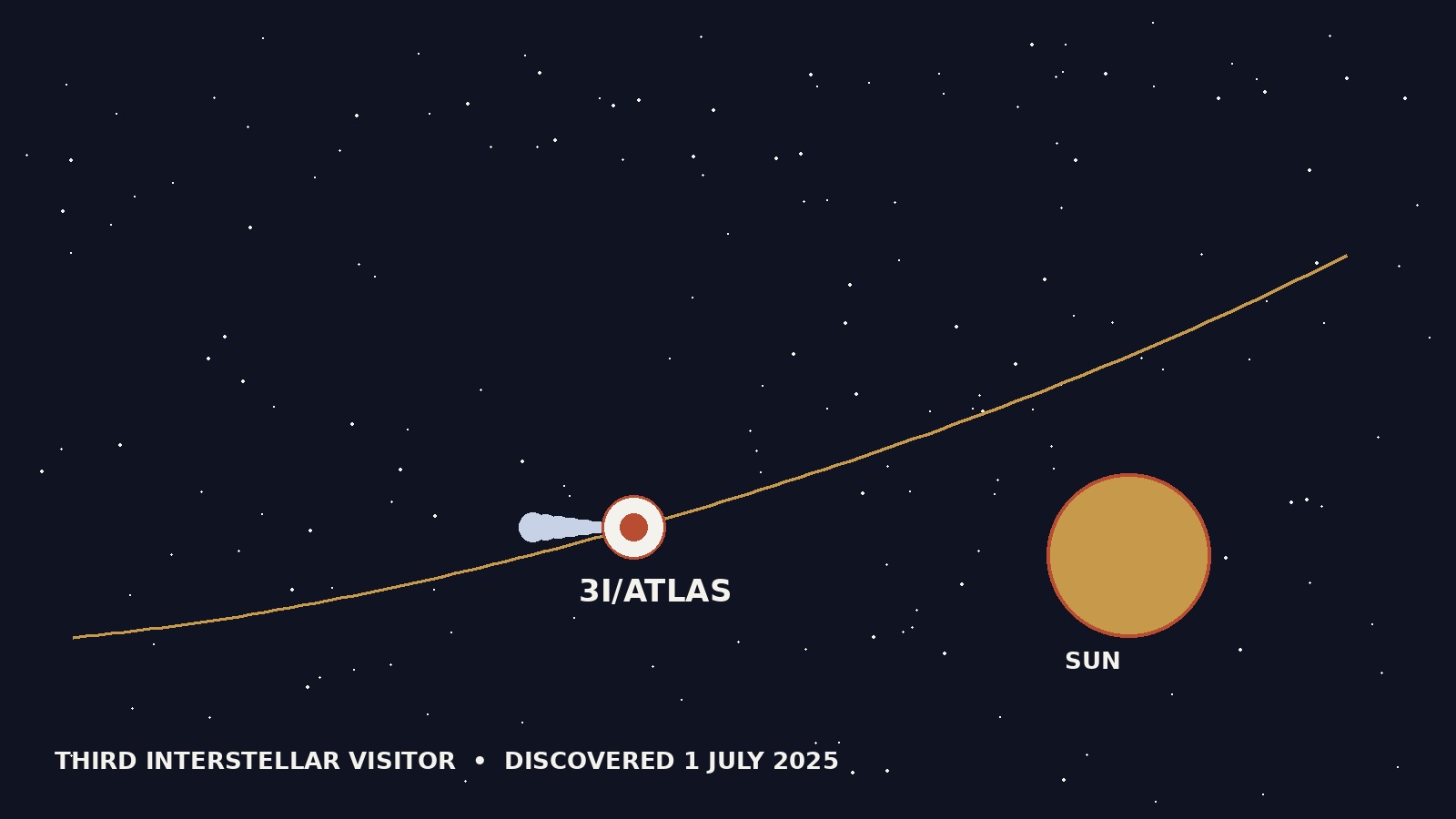
Somewhere out beyond the orbit of Jupiter right now, a chunk of ice and rock from another star is falling away from the Sun, never to return. Its name is 3I/ATLAS. It was only the third object from interstellar space ever detected passing through our solar system, and astronomers spent the better part of a year watching it as closely as their telescopes allowed.
This article is an explainer, not breaking news. The comet’s visit is largely over: it rounded the Sun in late October 2025, passed Mars and then Earth, and is now outbound for good. What remains is the science, which turned out to be richer than anyone expected. A 2026 analysis of its chemistry, published in the journal Nature, suggests it may be one of the oldest comets ever studied, a survivor from the early days of our galaxy.
Every figure below is date-stamped and attributed to its source. The primary sources for this article are NASA, the European Space Agency (ESA), and the peer-reviewed discovery paper published by the team that characterized the object.
How it was discovered
On 1 July 2025, the ATLAS (Asteroid Terrestrial-impact Last Alert System) survey telescope in Rio Hurtado, Chile, picked up a faint moving object and reported it to the Minor Planet Center, the international clearinghouse for such sightings (NASA, July 2025). ATLAS is a NASA-funded network of telescopes that scans the sky for asteroids, part of NASA’s planetary defense network.
The object was unremarkable at first glance: a speck of about magnitude 17.7 to 17.9, moving against the background stars. But its motion was strange. Within a day, follow-up observations by ATLAS telescopes in Hawaii, South Africa, and the Canary Islands, plus dozens of other observatories worldwide, showed that it was moving far too fast to be a normal solar system body (discovery paper, Seligman et al., 2025).
Astronomers then went digging through archives. So-called precovery images, pictures taken before anyone knew the object existed, were found in ATLAS data and in data from Caltech’s Zwicky Transient Facility at Palomar Observatory in California, extending the observation record back to 14 June 2025 (NASA, 2025). The object had been quietly brightening for weeks before anyone noticed it.
Its arrival direction was also notable. 3I/ATLAS came from the general direction of the constellation Sagittarius, toward the center of the Milky Way, and it was already inside the orbit of Jupiter when found, about 670 million kilometers (410 million miles) from the Sun (NASA, 2025).
Why it is called 3I/ATLAS
Comet names follow a coded system run by the International Astronomical Union, and this one decodes neatly (ESA, 2025):
- 3: it is the third interstellar object ever identified passing through our solar system.
- I: the letter stands for “interstellar,” the category for objects that come from outside our solar system.
- ATLAS: the survey program that operates the telescope which first spotted it.
Its formal cometary designation is C/2025 N1 (ATLAS). In that system, “C” marks it as a non-periodic comet (one that does not orbit the Sun on a repeating schedule), “2025” is the year of discovery, and “N1” is code for the first comet discovered in the first half of July (ESA, 2025). When it was first logged, before its cometary nature was confirmed, it carried the provisional label A11pl3Z (discovery paper, 2025).
What “interstellar object” actually means
An interstellar object is a natural body, an asteroid or comet, that formed around another star and was ejected into the space between the stars, eventually wandering into our solar system. The giveaway is the shape of its path.
Most comets follow elliptical orbits: closed loops that bring them back to the Sun again and again. 3I/ATLAS follows a hyperbolic trajectory, an open curve. The discovery team measured an orbital eccentricity of about 6.1 (a perfect circle is 0; anything above 1 is unbound) and an incoming excess velocity of about 58 kilometers per second, meaning it will leave the solar system at essentially the same speed it arrived with (discovery paper, 2025). As NASA puts it, the object was moving too fast to be bound by the Sun’s gravity, so it simply passed through and continued into interstellar space, never to be seen again (NASA, 2025).
The speeds involved are difficult to picture. At discovery, 3I/ATLAS was traveling about 221,000 kilometers per hour (137,000 miles per hour). Pulled by the Sun’s gravity, it accelerated to about 246,000 kilometers per hour (153,000 miles per hour) at its closest approach to the Sun (NASA, 2025). ESA gives a rounded figure of roughly 250,000 kilometers per hour at closest solar approach and notes that this is the highest speed ever recorded for a visitor to the solar system (ESA, 2025). On its way out, it slowed again under the Sun’s pull, exactly as physics predicts, and NASA notes that the small trajectory nudges from outgassing were consistent with normal cometary activity (NASA, 2025).
The two visitors that came before
3I/ATLAS is the third confirmed interstellar object, which makes the first two worth knowing (NASA; ESA, 2025).
1I/’Oumuamua (2017) was the first. It was a small, elongated object that showed no visible cometary activity, no coma, no tail, yet its trajectory showed a small nongravitational push that puzzled astronomers. It arrived with an excess velocity of about 26 kilometers per second (discovery paper, 2025). Its strange combination of features, dark, inactive, yet slightly accelerating, generated years of debate.
2I/Borisov (2019) was the second, and it behaved much more like a familiar comet, with clear outgassing and dust ejection. Its coma chemistry was unusual, though: it was enriched in carbon monoxide relative to water compared with most solar system comets. It arrived with an excess velocity of about 32 kilometers per second (discovery paper, 2025).
3I/ATLAS (2025) is different again. It is unambiguously an active comet, with a bright coma and tail, and it is by far the fastest of the three, arriving at about 58 kilometers per second, more than twice ‘Oumuamua’s speed (discovery paper, 2025). Each visitor has been weirder than the last, which is exactly why astronomers consider the sample so valuable: with only three examples, every new one rewrites the picture.
Its path through the solar system
Here is the visit in chronological order, with dates and distances as reported by NASA and ESA:
- 14 June 2025: earliest precovery images (ATLAS archives, Zwicky Transient Facility) (NASA, 2025).
- 1 July 2025: discovery reported by ATLAS Chile to the Minor Planet Center; the comet is about 670 million kilometers from the Sun, inside Jupiter’s orbit (NASA, 2025).
- 21 July 2025: the Hubble Space Telescope images the comet from 277 million miles away, revealing a teardrop-shaped cocoon of dust streaming from its nucleus (NASA, 2025).
- 6 August 2025: the James Webb Space Telescope observes the comet with its near-infrared spectrograph (NASA, 2025).
- 7 to 15 August 2025: NASA’s SPHEREx observatory collects infrared data on the coma’s dust, water, organic molecules, and carbon dioxide (NASA, 2025).
- September 2025: a busy month. The Psyche spacecraft tracks it (8 to 9 September), the Lucy spacecraft spots it from about 240 million miles away (16 September), NASA’s STEREO mission stacks images of it (11 September to 2 October), the PUNCH mission images its tail (20 September to 3 October), and the MAVEN spacecraft at Mars images hydrogen around it in ultraviolet light (28 September) (NASA, 2025).
- 2 to 4 October 2025: Mars gets its turn. The Mars Reconnaissance Orbiter’s HiRISE camera observes the comet from about 18.6 million miles away (2 October), and the Perseverance rover photographs it in the Martian night sky (4 October) (NASA, 2025). ESA’s Mars Express and ExoMars Trace Gas Orbiter also observe it around its closest approach to Mars, about 29 million kilometers on 3 October 2025; the ExoMars data later improved predictions of the comet’s position tenfold (ESA, 2025).
- 15 to 26 October 2025: the ESA/NASA SOHO mission catches a faint glimpse near the Sun, and NASA’s Parker Solar Probe images it from its unique vantage point near our star (NASA; ESA, 2025).
- 29 to 30 October 2025: perihelion, the closest approach to the Sun. ESA gives 29 October at 203 million kilometers; NASA gives 30 October at about 210 million kilometers (1.4 astronomical units), just inside the orbit of Mars. Earth was on the opposite side of the Sun at the time (ESA; NASA, 2025).
- November 2025: ESA’s Juice spacecraft, then near the Sun and using its main antenna as a heat shield, manages observations with several instruments; a quickly downloaded navigation-camera image reveals an active comet, while the full dataset only arrived in February 2026 and remains under analysis as of the ESA page (ESA, 2025). NASA’s Europa Clipper also images it on 6 November from about 164 million kilometers away (NASA, 2025).
- Late November to early December 2025: the X-ray telescopes XRISM and XMM-Newton detect a diffuse X-ray glow around the nucleus, making 3I/ATLAS the first interstellar comet ever observed in X-ray light (ESA, 2025).
- Early December 2025: the comet reappears from behind the Sun as seen from Earth, allowing renewed observations; Hubble reobserves it on 30 November, and SPHEREx records its brightening coma from 8 to 15 December (NASA, 2025).
- 15, 18 to 19 January 2026: NASA’s TESS spacecraft observes the comet during a special run to study its activity and rotation (NASA, 2025).
- March 2026: the comet passes Jupiter on its way out of the solar system (NASA, 2025).
- Spring 2026: per NASA’s page (last updated May 2026), the comet was expected to remain observable from Earth, in the pre-dawn sky, through about spring 2026, after which it fades beyond the reach of most telescopes for good (NASA, 2026).
How big it is and what it is doing
Astronomers do not know the exact size of 3I/ATLAS, because the solid nucleus is hidden inside its bright coma. From Hubble observations as of 20 August 2025, they estimated the nucleus diameter at no less than 440 meters (1,400 feet) and no more than 5.6 kilometers (3.5 miles) (NASA, 2025). ESA gives the same picture in plain language: a few hundred meters to a few kilometers across (ESA, 2025).
What is certain is that it is active. Hubble’s July 2025 image showed a teardrop-shaped cocoon of dust coming off the solid, icy nucleus, and later images showed a coma and tail (NASA, 2025). ESA’s page describes Hubble images from early August 2025 capturing a dust plume ejected from the Sun-warmed side, and Juice’s November 2025 navigation-camera image showing the coma with a hint of two tails (ESA, 2025).
This activity is the reason astronomers classify it as a comet rather than an asteroid. As NASA explains, the object showed a bright cloud of gas and dust surrounding an icy nucleus, growing as it approached the Sun, which is the defining behavior of a comet (NASA, 2025). That also settles one common question: despite early speculation in some corners of the internet, its characteristics, color, speed, and direction are all consistent with what astronomers expect from a comet (NASA, 2025).
What it is made of
The chemistry of 3I/ATLAS turned out to be its most scientifically valuable feature, and the results arrived in two waves.
Wave one: 2025. As the comet heated up approaching the Sun, telescopes sampled the gases boiling off it. James Webb Space Telescope observations of the coma in late August 2025 revealed carbon dioxide, water, carbon monoxide, carbonyl sulfide, and water ice being released (ESA, 2025). It was clearly a volatile-rich body, carrying the ices you would expect from something that formed in the cold outer reaches of a planetary system.
Wave two: 2026. The deeper story came after perihelion. In December 2025, with the comet freshly warmed and its ancient ices sublimating into a bright coma, astronomers interrupted the Webb telescope’s planned schedule to point its Near-Infrared Spectrograph at the object (NASA, 2026). The results, published in the journal Nature on 22 June 2026 by a team led by NASA Goddard astrochemist Martin Cordiner, were striking (NASA, 2026):
- The water in the coma contained about 30 times more deuterium (heavy hydrogen) than water in solar system comets, a ratio never seen in any solar system comet.
- The carbon showed only traces of heavy carbon-13 compared with lighter carbon-12. Because stars enrich the galaxy with carbon-13 over successive generations, a low carbon-13 fraction points to material that formed very early, before much stellar processing had occurred.
- Working backward from these ratios, the team estimates 3I/ATLAS may have formed 10 to 12 billion years ago, during an era of intense star formation astronomers call “cosmic noon.” For comparison, our Sun and solar system are about 4.5 billion years old (NASA, 2026).
That would make 3I/ATLAS roughly twice as old as our solar system, a surviving fragment from one of the Milky Way’s earliest planetary systems, knocked loose when larger planets formed and drifting through the galaxy ever since (NASA, 2026). ESA’s page frames the age argument more simply: the comet’s breathtaking speed is itself evidence that it has been drifting through space for a very long time, and the agency lists its age as “billions of years old” (ESA, 2025).
How the world’s telescopes watched it
Few astronomical objects have ever been observed by so many spacecraft. NASA lists the assets that gathered data on 3I/ATLAS: Hubble, Webb, TESS, Swift, SPHEREx, the Perseverance Mars rover, the Mars Reconnaissance Orbiter, MAVEN, Europa Clipper, Lucy, Psyche, the Parker Solar Probe, PUNCH, and the ESA/NASA SOHO mission (NASA, 2025). ESA adds its own fleet: the ExoMars Trace Gas Orbiter and Mars Express at Mars, the Juice mission en route to Jupiter, and ground-based telescopes in Hawaii, Chile, and Australia coordinated through its Planetary Defence Office (ESA, 2025).
Some of the observations were firsts. The X-ray detection made 3I/ATLAS the first interstellar comet ever seen in X-ray light (ESA, 2025), and the ExoMars Trace Gas Orbiter’s tracking data improved the predicted position of the comet tenfold, a practical contribution to the global observing effort (ESA, 2025).
Was it dangerous? Was it aliens?
Two questions came up constantly, so here are the authoritative answers.
No, it was not dangerous. At its closest, on 19 December 2025, 3I/ATLAS was still about 270 million kilometers (1.8 astronomical units) from Earth, nearly twice the Earth-Sun distance, and on the far side of the Sun at the time (NASA; ESA, 2025). NASA states plainly that there was no danger to Earth from this comet (NASA, 2025).
No, it is not an alien spacecraft. This speculation circulated online, but every space agency that studied the object describes a natural comet. NASA’s assessment is that the object’s characteristics, color, speed, and direction are all consistent with a comet, and that the small perturbations to its trajectory are compatible with normal outgassing as its ices sublimated near the Sun (NASA, 2025). It looks like a comet and behaves like a comet, and the extraordinary 2026 chemistry results point to a natural origin in the early galaxy, not an artificial one.
Why astronomers care so much
Interstellar objects are the only pieces of other planetary systems that astronomers can study up close. Exoplanets can only be studied from light-years away, and their compositions must be inferred indirectly. A visitor like 3I/ATLAS carries the actual chemistry of its home system into our neighborhood, where telescopes can take it apart molecule by molecule (NASA, 2026).
That is why the differences between 3I/ATLAS and solar system comets matter. Its extreme deuterium enrichment and unusual carbon ratios suggest that the conditions in its birth system were unlike those that formed our own, which in turn tells astronomers something about how unusual, or how ordinary, our solar system might be (NASA, 2026). As ESA puts it, every planet, moon, asteroid, and comet in our solar system shares a common origin, but interstellar comets are true outsiders, carrying clues about the formation of worlds far beyond our own (ESA, 2025).
And more visitors are coming. Astronomers expect new sky surveys, including the Vera C. Rubin Observatory, to find interstellar objects far more often than the current rate of roughly one every few years. ESA is already building for that future: its Comet Interceptor mission, following in the footsteps of the Rosetta mission that landed on Comet 67P in 2014, is designed to visit a pristine comet from the outer solar system, and while it is very unlikely given their rarity, it could in principle encounter an interstellar one (ESA, 2025). When the fourth interstellar object arrives, astronomers plan to be ready.
Frequently asked questions
When was 3I/ATLAS discovered? On 1 July 2025, by the NASA-funded ATLAS survey telescope in Rio Hurtado, Chile, which reported it to the Minor Planet Center the same day. Precovery images later extended the record back to 14 June 2025 (NASA, 2025).
What does 3I/ATLAS mean? It is the third (3) interstellar (I) object ever identified, discovered by the ATLAS survey. Its formal comet designation is C/2025 N1 (ATLAS): a non-periodic comet (C) found in 2025, the first (N1) of the July discovery half-month (ESA, 2025).
How fast was 3I/ATLAS moving? About 221,000 kilometers per hour at discovery, accelerating to about 246,000 kilometers per hour at its closest approach to the Sun, then slowing as it left. Its incoming excess velocity of about 58 kilometers per second is the highest ever recorded for a solar system visitor (NASA, 2025; ESA, 2025; discovery paper, 2025).
Will 3I/ATLAS ever come back? No. It follows a hyperbolic trajectory, an open curve, not a closed orbit, so it will leave the solar system at the same speed it arrived with and never return (NASA, 2025).
How big is 3I/ATLAS? The nucleus is estimated at between 440 meters and 5.6 kilometers across, based on Hubble observations from August 2025. The exact size is unknown because the nucleus is hidden inside its bright coma (NASA, 2025).
Could you see 3I/ATLAS from Earth? For a while, yes, with a telescope. NASA noted it was observable in the pre-dawn sky and expected to remain visible to ground-based telescopes through about spring 2026. After that it fades beyond practical reach, outbound for good (NASA, 2026).
Keep reading: What Is a Black Hole? (The “Dark Hole” in Space, Explained)
Sources & references
- NASA Science, "3I/ATLAS Facts and FAQS" (published 13 Nov 2025; updated 28 May 2026).
- NASA Science, "Comet 3I/ATLAS" mission timeline and overview (published 3 Jul 2025; updated 28 May 2026).
- NASA Science, "NASA's Webb Finds Clues to Ancient, Distant Origin of Comet 3I/ATLAS" (published 22 Jun 2026; updated 21 Sep 2026).
- ESA, "Comet 3I/ATLAS, frequently asked questions".
- Space Telescope Science Institute, news release 2026-118, "NASA's Webb Finds Clues to Ancient, Distant Origin of Comet 3I/ATLAS" (22 Jun 2026).
- Seligman et al., "Discovery and Preliminary Characterization of a Third Interstellar Object: 3I/ATLAS" (2025), peer-reviewed discovery paper.


