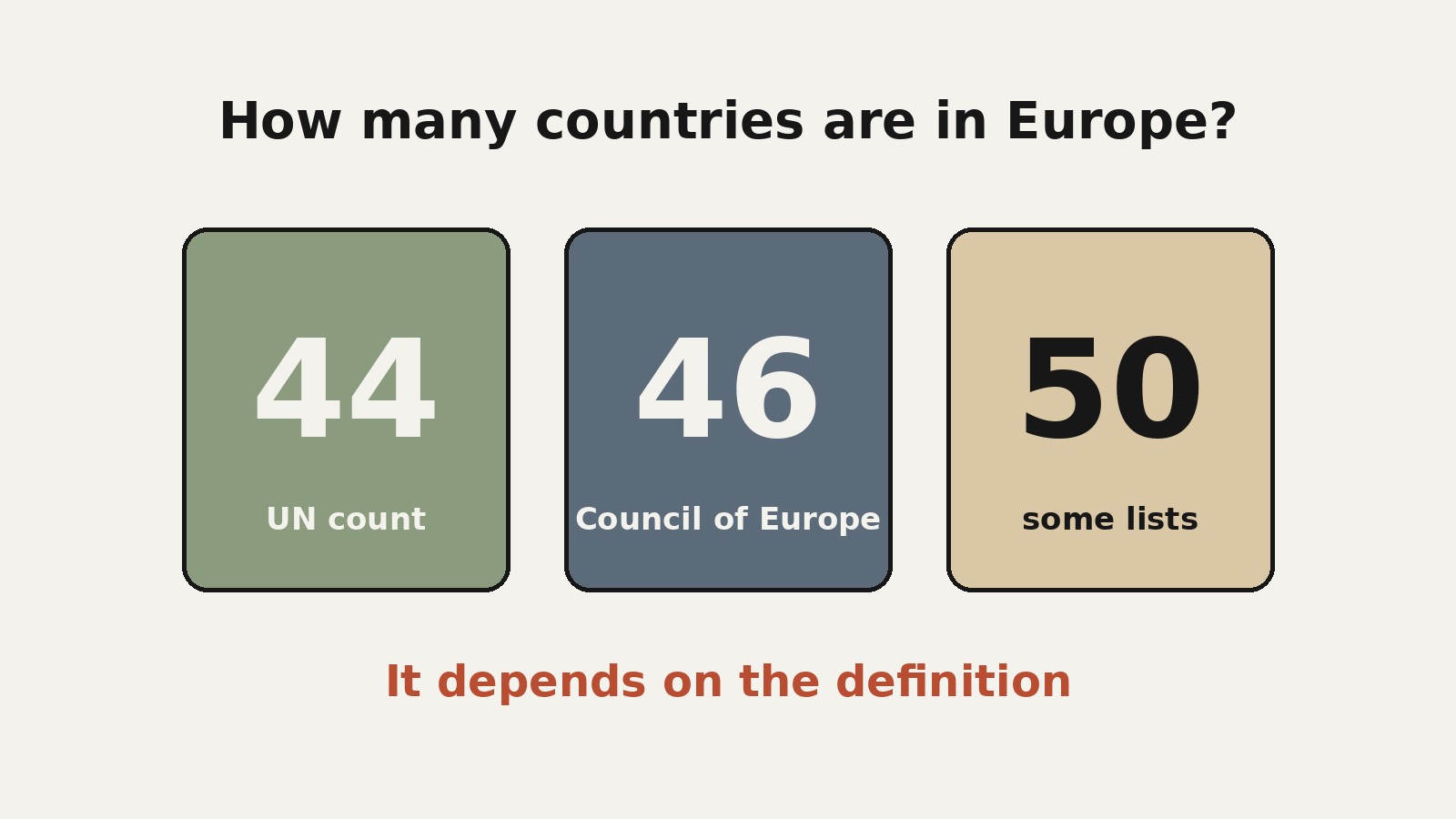
Ask a simple question, get three defensible answers. “How many countries are in Europe?” sounds like it should have one number, the way “how many countries are in South America?” does (twelve). Instead, search results argue with each other: 44, 46, 48, 49, 50. The disagreement is built into the question, because Europe is the one continent whose edge is a convention rather than an ocean, and because “in Europe” can mean geographically European, politically European, or European for one organization’s purposes.
Why there is no single official number
Nobody owns the definition of Europe. Continents are conventions, not legal entities, and no treaty fixes Europe’s borders. On three sides water does the work: the Arctic Ocean to the north, the Atlantic to the west, and the Mediterranean to the south. On the fourth side, the east, Europe simply continues into Asia across one enormous landmass, Eurasia, and every line drawn through it is a human choice.
Two consequences follow. First, the body whose count is quoted most often, the United Nations, is not ruling on what Europe “really” is: its Statistics Division maintains the UN geoscheme (formally the M49 standard) purely so statistics can be compiled consistently. Second, different institutions count for different purposes, and their lists legitimately differ: a human rights organization admits members, a football federation admits associations, and a statistical office files countries in regions. A website that says “there are X countries in Europe” without naming its authority has hidden the only part of the answer that matters.
The UN count: 44 countries
The figure 44 comes from the UN geoscheme, and it is the best default answer because it rests on a published, checkable rule: every sovereign state is assigned to exactly one subregion, whole and indivisible, even if its territory straddles the conventional boundary. Under that rule, Europe’s four subregions hold these sovereign states:
| UN subregion | Countries | Count |
|---|---|---|
| Northern Europe | Denmark, Estonia, Finland, Iceland, Ireland, Latvia, Lithuania, Norway, Sweden, United Kingdom | 10 |
| Western Europe | Austria, Belgium, France, Germany, Liechtenstein, Luxembourg, Monaco, Netherlands, Switzerland | 9 |
| Eastern Europe | Belarus, Bulgaria, Czechia, Hungary, Moldova, Poland, Romania, Russia, Slovakia, Ukraine | 10 |
| Southern Europe | Albania, Andorra, Bosnia and Herzegovina, Croatia, Greece, Holy See (Vatican City), Italy, Malta, Montenegro, North Macedonia, Portugal, San Marino, Serbia, Slovenia, Spain | 15 |
| Total | 44 |
Worldometer’s widely used country table, built on UN statistics, publishes exactly this list of 44, with Russia the largest by population and the Holy See the smallest. Three features of the UN scheme surprise people. First, Russia is filed entirely under Eastern Europe, even though most of its land area lies east of the Ural Mountains in Asia: the assignment is by whole country. Second, the Baltic states (Estonia, Latvia, Lithuania) sit in Northern Europe, not Eastern Europe, which often clashes with Cold War era habits. Third, several familiar names are missing altogether, because the UN files them in Asia: Turkey, Cyprus, Armenia, Azerbaijan, Georgia, and Kazakhstan appear nowhere in the Europe table. That is where the rival counts come from.
The Council of Europe count: 46 member states
The Council of Europe is the continent’s oldest political organization, founded in 1949 to uphold human rights, democracy, and the rule of law. It is not the European Union, and confusing the two is the source of many wrong answers. The Council has 46 member states, and the difference from the UN’s 44 is exact arithmetic, not vagueness:
- Start with the UN’s 44.
- Subtract Russia, expelled from the Council on March 16, 2022, after its full-scale invasion of Ukraine (the Council had 47 members until that day).
- Subtract Belarus, which has never been a member.
- Subtract the Holy See, which holds observer status rather than membership.
- Add Armenia, Azerbaijan, Georgia, and Turkey, which the UN files in Western Asia but which are full Council of Europe members.
- Add Cyprus, likewise filed by the UN in Western Asia and a Council member since 1961.
- The result is 46.
So when a source says Europe has 46 countries, it usually means “46 states belong to the Council of Europe,” a political definition of Europe that deliberately reaches across the Caucasus and the Bosphorus. When a source says 44, it means the UN’s statistical geography. Both are naming a real list; they are just answering slightly different questions.
Where Europe ends: the boundary problem
Every count above depends on where Europe stops, and the eastern boundary is a line geographers have argued about for centuries. The conventional line, the one most atlases print, runs like this from south to north: the Aegean Sea and the Turkish Straits (the Dardanelles, the Sea of Marmara, and the Bosphorus), then the Black Sea, then the watershed of the Greater Caucasus mountains, then the Caspian Sea, then the Ural River, and finally the Ural Mountains up to the Arctic coast.
Encyclopaedia Britannica, surveying the options, notes that even this line is only the most widely adopted of several schemes. Some geographers route the boundary along the Emba River and the Mughalzhar Hills in Kazakhstan instead of the Ural River. Others draw it along the crest of the Greater Caucasus, which puts the northern Caucasus slopes in Europe and the southern republics in Asia. A third scheme follows the Aras River and the Turkish border, which would place Armenia, Azerbaijan, and Georgia inside Europe entirely. There is no experiment that can settle which scheme is “true,” because the line marks a cultural and historical idea laid over continuous land. What can be settled, and what careful counters do, is which scheme a given list is using.
The boundary matters because five countries sit squarely on it, and each authority handles them differently.
The transcontinental five, one by one
Russia. The largest straddler. Most of Russia’s territory lies in Asia (everything east of the Urals is Siberia), but its capital, Moscow, its second city, St. Petersburg, and most of its people are on the European side, and its historical heartland is European. The UN files the whole country in Eastern Europe, so Russia is inside the 44, and the Council of Europe treated it as a European member from 1996 until its expulsion in 2022. Only lists that split countries by landmass, which almost none do, would treat Russia as partly Asian.
Turkey. Turkey’s land is split by the straits: East Thrace, the small portion west of the Bosphorus, is in Europe and holds the European half of Istanbul, while the great bulk of the country, Anatolia, is in Asia. The UN files Turkey in Western Asia, so it is outside the 44. Politically, though, Turkey has been a Council of Europe member since 1949, is a UEFA member, and is a long-standing NATO ally, which is why so many lists include it and reach totals above 44.
Kazakhstan. A small slice of western Kazakhstan lies west of the Ural River and is therefore geographically in Europe under the conventional boundary, though the overwhelming majority of the country is Central Asian steppe. The UN files Kazakhstan in Central Asia. Its football federation, however, left the Asian confederation and joined UEFA in 2002, which is why Kazakhstan appears in European football competitions and in some popular lists of European countries.
Azerbaijan. Part of Azerbaijan lies north of the Greater Caucasus watershed, which under the crest scheme makes that portion geographically European. The UN files Azerbaijan in Western Asia. It is a Council of Europe member and a UEFA member, and it participates in European cultural institutions (it has won the Eurovision Song Contest), so broader counts usually include it.
Georgia. Georgia sits south of the Greater Caucasus crest for the most part, with a sliver of territory on the northern side. The UN files it in Western Asia. Like Azerbaijan, it is a Council of Europe member (since 1999) and a UEFA member, and it is routinely counted as European in political and cultural contexts.
A sixth case deserves a mention because it reverses the pattern: Cyprus. Geographically the UN places the island in Western Asia, yet Cyprus is a member of the European Union and the Council of Europe, uses the euro, and is treated as European by almost every political institution. If any single country proves that “in Europe” is a choice rather than a measurement, it is Cyprus.
Kosovo: the country some counts add
Kosovo declared independence from Serbia on February 17, 2008, and its status is the second great source of counting disputes. Kosovo is recognized as independent by more than 100 of the UN’s 193 member states (third-party counts put the figure at about 110, though Kosovo’s government claims more and Serbia claims some recognitions have been withdrawn), including the United States, the United Kingdom, France, and Germany. Serbia does not recognize it and still claims it as an autonomous province, and Russia and China also withhold recognition, which keeps Kosovo out of the United Nations itself.
Because the UN does not list Kosovo, it is outside the official 44. Lists that reach 45 usually mean “the UN’s 44 plus Kosovo.” UEFA admitted Kosovo’s football association in 2016, and Kosovo has applied to join the Council of Europe, so in sporting and political practice it is increasingly treated as one of Europe’s countries, while in strict UN terms it is a partially recognized state whose final status remains disputed.
The microstates are already counted
Small size causes no counting problem at all, and this is worth stating because many people assume the opposite. All six of Europe’s microstates are sovereign states, and all six are inside the UN’s 44: Vatican City, Monaco, San Marino, Liechtenstein, Andorra, and Malta. Vatican City is the extreme case: at 0.44 square kilometers it is, in Britannica’s words, “the world’s smallest fully independent nation-state,” with a population of under a thousand, yet it holds a full place in the count. (One precision: the entity named in the UN’s statistical list is technically the Holy See, the juridical entity that governs Vatican City.) Monaco, the second smallest at about 2.1 square kilometers, is likewise a full UN member. A country does not need to be big, or even visible on a classroom map, to be counted.
Places that are not counted, and why
The flipside of the microstates is the set of European places that feel like countries but are not sovereign states, and so appear in no count above:
- The Faroe Islands, a self-governing territory within the Kingdom of Denmark (which even has its own UEFA football association, without being a sovereign state).
- Gibraltar, a British Overseas Territory at Spain’s southern tip; it too has a UEFA association, admitted in 2013.
- The Isle of Man, Jersey, and Guernsey, Crown Dependencies of the British Crown: not part of the United Kingdom, but not sovereign either.
- Åland, an autonomous, Swedish-speaking province of Finland.
- Svalbard, a Norwegian Arctic territory.
The UN geoscheme lists these as separate areas within Europe’s subregions for statistical purposes, and Worldometer shows them in a separate dependencies table, but no authority counts them as countries, because foreign policy and ultimate sovereignty sit in Copenhagen, London, Helsinki, or Oslo.
The United Kingdom: one country, or four?
The last trap is a naming one. The United Kingdom is a single sovereign state: it holds one UN seat, appears once in the UN’s 44 (under Northern Europe), and is counted once by every authority in this article. Yet it is made up of four constituent countries, England, Scotland, Wales, and Northern Ireland, each with its own identity, and in Scotland and Wales’s case their own devolved governments and legislatures. Both statements are true because the word “country” is doing two jobs: a sovereign state in international law, and a historic nation within a union at home.
Sport exposes the double meaning better than any definition. UEFA has four separate associations from the UK (England, Scotland, Wales, and Northern Ireland), one of the reasons its membership of 55 associations cannot be read as a count of countries at all. For counting purposes, though, the rule is simple: the United Kingdom is one country in Europe, and England, Scotland, Wales, and Northern Ireland are not counted separately. (Whether Ireland, the separate sovereign state, is part of the UK is a different question with its own article-length answer: it is not, and has not been for a century.)
The counts side by side
| Who is counting | Number | What the number actually means |
|---|---|---|
| UN geoscheme (UN Statistics Division) | 44 | Sovereign states the UN files in Europe for statistics; the standard geography answer |
| Council of Europe | 46 | Member states of Europe’s human rights body; includes Turkey and the Caucasus states, excludes Russia (expelled 2022) and Belarus |
| Broader geographic and cultural lists | 48 to 50 | The UN 44 plus some or all of Turkey, Armenia, Azerbaijan, Georgia, Kazakhstan, and Cyprus |
| The broadest common lists | 51 | The above plus Kosovo, the partially recognized state |
| European Union | 27 | Members of the EU, a political and economic union; not a count of European countries |
| UEFA | 55 | Football associations, including Israel and Kazakhstan and four from the UK; not a count of countries |
So which number should you use?
Use 44 when you mean geography: quizzes, atlases, schoolwork, and general reference, because it is the count with a published rule behind it, maintained by the UN’s statisticians. Use 46 when you mean political Europe in the human rights sense, and name the Council of Europe when you do. If you meet a list claiming 48, 49, 50, or 51, do not assume it is wrong: check which of the edge cases it has added, usually Turkey, the three Caucasus states, Kazakhstan, Cyprus, and Kosovo, and you will find the arithmetic reconciles almost every time. The only genuinely wrong answers are the ones that present a number with no definition attached.
Europe’s country count at a glance
- Standard answer: 44 countries (UN geoscheme)
- Council of Europe: 46 member states
- Counts including transcontinental states and Cyprus: 48 to 50
- Including Kosovo as well: up to 51
- Not country counts: EU 27 (a union’s membership), UEFA 55 (football associations)
- Largest of the 44 by population: Russia; smallest: the Holy See (Vatican City)
- Excluded despite feeling European: Turkey, Cyprus, Armenia, Azerbaijan, Georgia, Kazakhstan (all filed by the UN in Asia)
- Excluded because they are not sovereign: the Faroe Islands, Gibraltar, the Isle of Man, Jersey, Guernsey, Åland, Svalbard
Frequently asked questions
How many countries are in Europe according to the United Nations?
Forty-four. The UN Statistics Division’s geoscheme assigns every sovereign state to one region, and its Europe region holds 44 states across four subregions: 10 in Northern Europe, 9 in Western Europe, 10 in Eastern Europe, and 15 in Southern Europe. Dependencies such as the Faroe Islands and Gibraltar are listed separately and are not counted.
Is Russia counted as a European country?
In the standard count, yes. The UN files the whole of Russia under Eastern Europe, even though most of its land lies in Asia, because its capital and most of its population are west of the Ural Mountains. Russia was also a Council of Europe member until its expulsion on March 16, 2022, a political change that did not alter its geographic filing.
Is Turkey a country in Europe?
Partly, and it depends on the counter. Geographically, only East Thrace, west of the Bosphorus, is in Europe; the rest is in Asia, and the UN files Turkey in Western Asia, so Turkey is not in the 44. Politically, Turkey is a founding-era member of the Council of Europe and a UEFA member, so counts based on those definitions include it.
Why do some lists say there are 50 countries in Europe?
They start from a broader definition. Adding Turkey, Armenia, Azerbaijan, Georgia, Kazakhstan, and Cyprus to the UN’s 44 gives 50; adding Kosovo as well gives 51. Lists at 48 or 49 have added only some of those edge cases. The differences are definitional, not errors, provided the list says what it has done.
Is Kosovo a country in Europe?
It is a partially recognized state in Europe. Kosovo declared independence from Serbia in 2008 and is recognized by about 110 UN member states, but Serbia, Russia, and China do not recognize it, and it is not a UN member, so it is not in the official count of 44. UEFA has admitted its football association, and it has applied to join the Council of Europe.
How many countries are in the European Union?
Twenty-seven. That is the membership of one political and economic union, not the number of countries in Europe: large European states such as the United Kingdom, Norway, Switzerland, and Ukraine are not EU members, and every EU member is also inside the geographic counts above.
Is the United Kingdom one country or four?
Both, in different senses. Internationally it is one sovereign state with one UN seat, counted once in Europe’s 44. Within it sit four constituent countries: England, Scotland, Wales, and Northern Ireland. They are not counted separately in any international count, though each fields its own football association in UEFA.
Sources & references
- UN Statistics Division, M49 standard (the UN geoscheme: Europe's four subregions and their composition; Russia filed in Eastern Europe; Turkey, Cyprus, Armenia, Azerbaijan, and Georgia filed in Western Asia; Kazakhstan filed in Central Asia).
- Worldometer, "How many countries in Europe?" (44 countries according to the United Nations, listed with subregions; dependencies including the Isle of Man, the Faroe Islands, and Gibraltar listed separately).
- UK Parliament, House of Commons Library Research Briefing, "Work of the Council of Europe" (June 14, 2022: membership reduced from 47 to 46 following the expulsion of Russia in March 2022; the 46 member states listed; the Holy See among the observer states).
- Council of Europe, statement on the exclusion of the Russian Federation (Resolution CM/Res(2022)2 on the cessation of Russia's membership, adopted by the Committee of Ministers on March 16, 2022; Russia had joined the Council of Europe on February 28, 1996).
- Encyclopaedia Britannica, "Europe" (the eastern boundary debate: the adopted limits excluding the Caucasus region; the Greater Caucasus crest scheme; the Aras River scheme placing Armenia, Azerbaijan, and Georgia in Europe; the Emba River and Mughalzhar Hills variant in Kazakhstan). Archived copy as retrieved 24 Oct 2026.
- Encyclopaedia Britannica, "Vatican City" (the world's smallest fully independent nation-state; total area 0.44 sq km; population 882, 2024 est.).
- Encyclopaedia Britannica, list of the smallest countries by area (Vatican City 0.44 sq km; Monaco second at 2.1 sq km; Andorra 468 sq km; Liechtenstein 160 sq km; San Marino 61 sq km; Malta 315 sq km).
- Wikipedia, "International recognition of Kosovo" (declaration of February 17, 2008; at least 110 of 193 UN member states recognizing as of December 2025; Kosovo claims 120, Serbia claims the number is 84; Serbia does not recognize Kosovo).
- Wikipedia, "UEFA" (55 member associations; members partially or entirely outside Europe include Armenia, Azerbaijan, Russia, Georgia, Kazakhstan, Israel, Cyprus, and Turkey; the UK divided into four associations; Gibraltar approved 2013; Kosovo approved 2016; Kazakhstan affiliated 2002).
- Social Science LibreTexts, "Europe: Overview" (College of DuPage: Europe's eastern boundary as a cultural and historical distinction; the Caucasus, the Caspian Sea, the Ural River, and the Ural Mountains; the Bosphorus and the European sliver of Turkey).


