Short answer
- A black hole is a region of space where gravity is so strong that nothing, not even light, can escape from inside its boundary, which is called the event horizon.
- Most black holes are born when a very massive star collapses. NASA describes the trigger: a star with more than about 20 times the Sun's mass runs out of fuel and its core crushes under its own weight.
- Black holes come in sizes. Stellar-mass black holes weigh a few to dozens of Suns; supermassive ones, found at the centers of galaxies, weigh from hundreds of thousands to billions of Suns.
- We cannot see a black hole itself, but we can see its effects: hot gas glowing as it falls in, stars whipping around an invisible mass, ripples in spacetime from black hole collisions, and, since 2019, the black hole's shadow outlined by glowing gas.
- A black hole does not suck things in from far away. At a safe distance its gravity behaves like the gravity of any object of the same mass.
Introduction
People searching for a “dark hole” in space are almost always looking for the same object astronomers call a black hole. There is no separate thing in astronomy named a dark hole. The informal name is a good description, though: a black hole is the darkest object that exists, because it is a place where gravity has become so strong that nothing can climb back out, including light itself.
A black hole is not a hole in the ordinary sense. It is not an empty pit or a tunnel through space. It is a concentration of matter squeezed into a region so small that, inside a certain boundary, every possible path leads further in. This article explains what a black hole is, what its parts are, how one forms, the main types astronomers recognize, the two black holes that have now been photographed, and how scientists study objects that give off no light of their own.
What a Black Hole Actually Is
Start with escape velocity, the speed something must reach to break free of an object’s gravity. To leave Earth’s surface, a rocket must reach about 11.2 kilometers per second. Escape velocity rises if the object is more massive, and it also rises if the same mass is packed into a smaller space, because you start closer to the center of the mass.
Push that logic to its limit. If a mass is compressed into a small enough sphere, the escape velocity at its surface reaches the speed of light, about 299,792 kilometers per second. Since nothing can travel faster than light, nothing can leave. That sphere’s surface is a one-way boundary, and the object is a black hole.
Albert Einstein’s theory of general relativity, published in 1915, describes gravity as the curvature of spacetime by mass and energy, and it predicts that sufficiently compact masses produce exactly this situation. Within a year, Karl Schwarzschild had produced the first exact solution of Einstein’s equations describing the space around such an object. For decades black holes were treated as a mathematical curiosity. Only in the 1960s and 1970s, when astronomers found objects that behaved the way the theory said black holes should, did they become accepted physical things. The first widely accepted example, Cygnus X-1, was identified in the early 1970s.
The name is descriptive. A black hole is black because no light escapes it to reach your eyes, and it is called a hole because anything that crosses the boundary disappears from the observable universe, even though physically it is a body, an object with mass, spin and electric charge, not an absence in space.
The Parts of a Black Hole
The event horizon
The event horizon is the black hole’s boundary surface. Cross it, and escape becomes impossible for anything, in any direction, at any speed, because inside the horizon all paths through spacetime lead toward the center. NASA calls the event horizon the black hole’s “surface,” while stressing that matter and radiation fall in but cannot get out. Nothing dramatic is built into the horizon itself. It is not a wall or a membrane; it is a threshold defined purely by the geometry of spacetime.
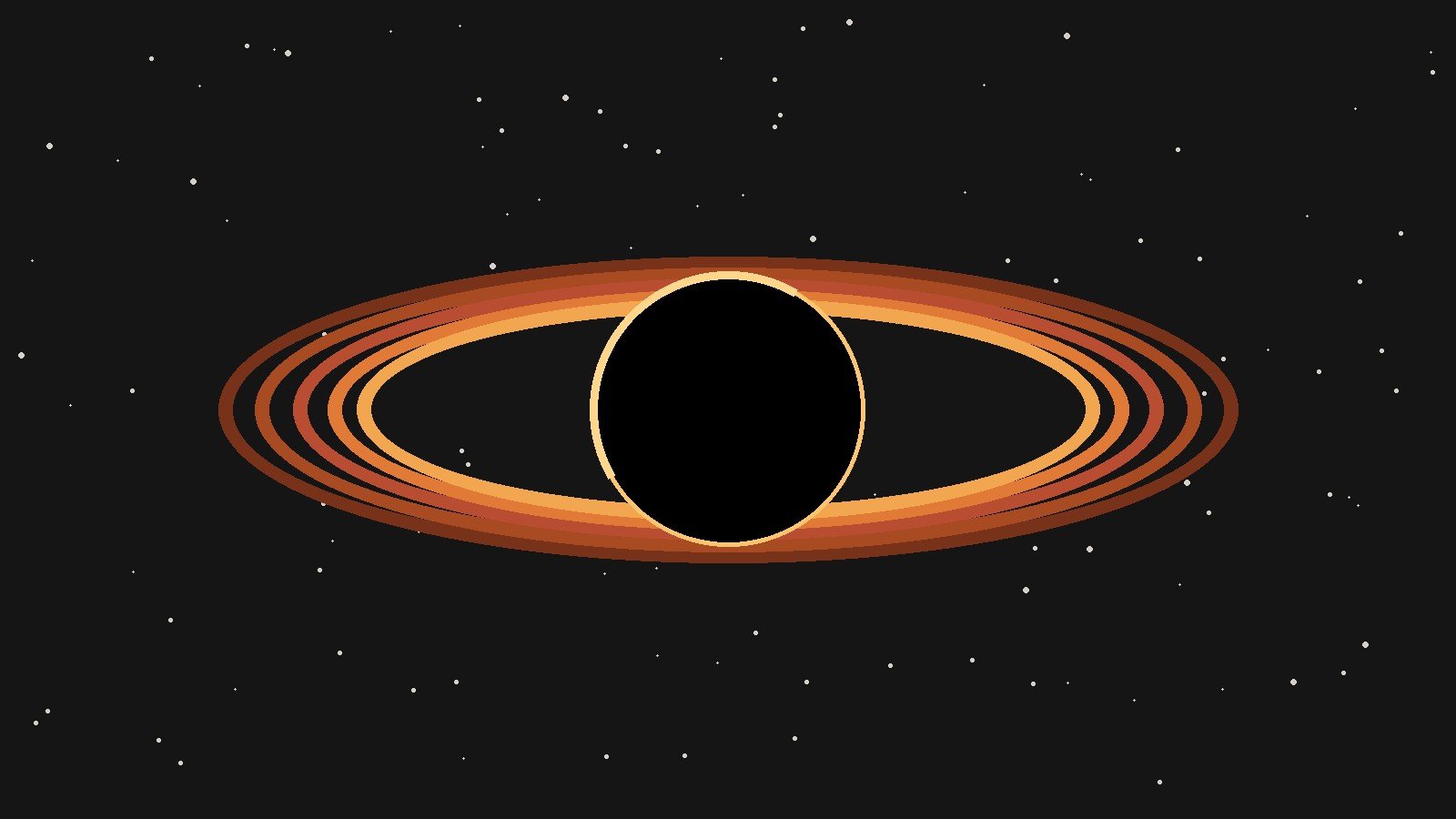
The images released by the Event Horizon Telescope show a dark region somewhat larger than the event horizon itself. That dark region, the black hole’s “shadow,” is the area from which light aimed at us has been captured or bent away, ringed by glowing gas whose light has been lensed around the hole.
The singularity
At the center, general relativity says, the infalling matter is crushed toward a point of infinite density called a singularity. This is the theory describing its own limit. Physicists generally regard the singularity not as a literal physical point but as the place where general relativity breaks down and a quantum theory of gravity, which does not yet exist in complete form, would be needed to say what actually happens. Honest explanations of black holes keep that caveat attached: the equations predict a singularity; what nature does there is unknown.
The Schwarzschild radius: a worked example
For a non-rotating black hole, the radius of the event horizon is called the Schwarzschild radius, and it depends only on mass:
Schwarzschild radius = 2GM / c², where G is the gravitational constant, M is the mass, and c is the speed of light. In round terms, every solar mass corresponds to about 3 kilometers of Schwarzschild radius.
Two worked examples, both standard in NASA’s educational material:
- The Sun. Squeeze the Sun’s mass (about 2 × 10³⁰ kg) down to a sphere with a radius of about 3 kilometers, and it would become a black hole. Its actual radius is nearly 700,000 kilometers, so the real Sun is in no danger of this: it is nowhere near compact enough, and it will never collapse that far.
- Earth. Earth’s mass would have to be compressed into a sphere with a radius of about 9 millimeters, roughly the size of a marble, before its escape velocity reached light speed.
These numbers are why black holes are rare and extreme. Ordinary matter is nowhere near this dense. It takes the collapse of a massive star, or the accumulated mass at a galaxy’s center, to reach it.
How a Black Hole Forms
The best understood birth is the death of a massive star. A star spends its life in a balance: nuclear fusion in its core pushes outward while gravity pulls inward. When a star with more than about 20 times the Sun’s mass exhausts its fuel, NASA explains, the outward push fails. The star’s outer layers are blasted away in a supernova, and the core collapses under its own weight.
What the core becomes depends on its mass. A lighter core stops as a neutron star, an object so dense that a teaspoon of it would weigh about a billion tons. But if the crushed core still holds more than about three times the Sun’s mass, no known force can halt the collapse. It continues past the neutron star stage, through its own Schwarzschild radius, and a black hole is born.
Black holes then grow. They gain mass by drawing in gas, by capturing material stripped from a companion star, and by merging with other black holes. The supermassive black holes at the centers of galaxies are thought to have built up over billions of years by some combination of this accretion, mergers, and possibly the direct collapse of enormous early gas clouds, although, as NASA notes, the origin of supermassive black holes is still poorly understood. They appear to exist from the very earliest days of galaxies’ lifetimes, which is part of the puzzle.
The Main Types of Black Holes
| Type | Mass range | Status | Where found |
|---|---|---|---|
| Stellar-mass | About 3 to dozens of times the Sun | Extensively observed | Throughout galaxies, often in binary systems with a normal star |
| Intermediate-mass | About 100 to more than 10,000 Suns | Candidates identified; evidence mostly indirect | Dense star clusters and small galaxies (proposed) |
| Supermassive | About 100,000 to billions of Suns | Extensively observed | The centers of most large galaxies, including the Milky Way |
| Primordial | Hypothetical; any mass, possibly tiny | Predicted by theory in the 1970s; none confirmed | Would have formed from dense regions in the first moments after the Big Bang |
The intermediate class deserves a note, because for years it was a gap in the record: theory predicted black holes between the stellar and supermassive ranges, but firm examples were scarce. NASA points to the most convincing case so far. On May 21, 2019, the LIGO gravitational-wave observatory detected two black holes merging and forming a single black hole of about 142 solar masses, squarely in the intermediate range, the first solid detection of one.
Primordial black holes are different in kind. They are a hypothesis, proposed by Stephen Hawking and Bernard Carr in the 1970s, not an observation. No primordial black hole has ever been confirmed, and any article that lists them alongside the observed types without that label is misleading you.
Two Black Holes We Have Actually Photographed
Because a black hole emits no light, a photograph of one means a photograph of its shadow: the dark region where light has been captured, silhouetted against the glowing gas that orbits just outside the horizon. Getting such an image required a telescope effectively the size of Earth. The Event Horizon Telescope (EHT) is a network of radio observatories around the world whose data are combined so they work as a single planet-scale instrument.
M87*, the first image (April 10, 2019). The EHT’s first target was the black hole at the center of Messier 87, a giant elliptical galaxy about 55 million light-years away. Its mass is about 6.5 billion times the Sun’s. The image, a bright, lopsided ring of superheated gas around a dark center, was the first direct visual evidence of a black hole’s shadow, and its size matched the predictions of general relativity.
Sagittarius A*, our own galaxy’s black hole (May 12, 2022). Three years later the EHT released the first image of Sagittarius A* (pronounced “Sagittarius A-star”), the supermassive black hole at the center of the Milky Way, about 27,000 light-years from Earth. It weighs about 4 million Suns, which makes it more than a thousand times lighter than M87*, and it flickers far faster because its gas orbits in minutes rather than days, which made it in some ways the harder of the two to photograph. Before the image, Sagittarius A* was already known from decades of star tracking: astronomers had watched stars loop around an invisible, compact mass of millions of Suns, work that earned a share of the 2020 Nobel Prize in Physics. The 2022 image confirmed that the object is a black hole.
One clarification matters. Neither image shows the event horizon itself as a visible object, and neither shows the singularity. They show the shadow and the hot gas around it. Everything inside the dark region is, by definition, beyond observation.
How We Detect Something That Emits No Light
Astronomers have four main ways of finding and measuring black holes, all of them based on effects rather than direct light from the hole itself.
Accretion disks. Gas falling toward a black hole does not drop straight in. It orbits, flattens into a disk, and heats by friction as it spirals inward, glowing brightly, often in X-rays, before it crosses the horizon. The brilliant quasars seen across the universe are supermassive black holes feeding this way. Cygnus X-1 was found through X-rays from gas it was stripping from a companion star.
Stellar orbits. Stars near a galactic center move as if orbiting something enormously massive and very small. Measuring their orbits gives both the mass and the size limit of the invisible object, which is how Sagittarius A* was weighed long before it was imaged.
Gravitational waves. When two black holes spiral together and merge, they shake spacetime itself, producing ripples called gravitational waves. The LIGO observatories (with Virgo in Europe) first detected such a merger in 2015, and have since recorded many more. These signals measure the masses of black holes that may emit no light at all, including the 2019 event that produced the 142-solar-mass black hole.
The shadow. Since 2019, direct imaging of the shadow against its glowing ring, as described above.
Falling In: Tides, Spaghettification, and the Quiet Horizon
What would happen to an object falling into a black hole depends on the black hole’s size, because the danger is not gravity itself but its gradient, the difference in pull between the near end and the far end of the falling object. Those tidal forces stretch an object along its direction of fall and squeeze it from the sides, a process physicists call spaghettification.
For a stellar-mass black hole, the gradient near the horizon is ferocious. An astronaut falling feet-first would be torn apart by the difference in pull between feet and head long before reaching the event horizon. For a supermassive black hole, the horizon is so far from the center that the gradient there is gentle. In principle, an astronaut could cross the event horizon of a black hole like Sagittarius A* and notice nothing special at the moment of crossing. No signal they sent could ever get back out, and the center would still be unavoidable, but the boundary itself would feel like nothing at all. The lethal stretching would come later, deeper inside.
This scaling, danger set by the gradient rather than by raw mass, is the part most popular accounts leave out, and it is why “black holes shred everything at their edge” is wrong for the biggest ones.
Hawking Radiation: Real Theory, Not Yet Observed
In 1974 Stephen Hawking showed, by combining general relativity with quantum theory, that black holes should not be perfectly black. At the event horizon, quantum effects should cause the black hole to emit a faint stream of particles and very slowly lose mass, a process now called Hawking radiation. Over almost inconceivably long times, an isolated black hole would evaporate entirely.
Two honest qualifications. First, this is a theoretical prediction, widely accepted by physicists but never directly observed for a real astronomical black hole. The predicted temperature of a black hole of the Sun’s mass is about 60 billionths of a degree above absolute zero, far colder than the 2.7-degree background glow of the universe left over from the Big Bang, so real black holes currently absorb far more energy than they radiate. Second, Hawking radiation is connected to a genuine unsolved problem, the information paradox: general relativity and quantum mechanics disagree about whether information about what fell in can ever come back out. That problem remains open, and it is one reason physicists expect the singularity and the horizon to be where a future theory of quantum gravity will be tested.
Common Misconceptions
“A black hole is a cosmic vacuum cleaner.” No. A black hole’s gravity at a distance is ordinary gravity. NASA uses the cleanest version of this point: if the Sun were replaced by a black hole of exactly the same mass, Earth’s orbit would not change at all. We would freeze in the dark, but we would not be pulled in. You only fall in if you get close, inside a few Schwarzschild radii, which for the Sun’s mass means within kilometers of the center.
“A black hole is a hole you could fall through to somewhere else.” The “hole” is a nickname, not a description. A black hole is an object with mass. Ideas about wormholes and passages to other regions of spacetime come from extending the mathematics beyond what is observed, and there is no evidence that any black hole is a doorway.
“Nothing can escape a black hole, so how do jets exist?” Some feeding black holes launch narrow jets of particles at close to the speed of light. The jets come from the accretion disk and the magnetic fields outside the event horizon, from material that has not crossed the boundary. Nothing in a jet has escaped from inside.
“Black holes are rare freaks.” Stellar-mass black holes are thought to number in the tens of millions in the Milky Way alone, and nearly every large galaxy appears to hold a supermassive one at its center. They are a normal, if extreme, stage in the life of massive stars and galaxies.
Frequently Asked Questions
Is a “dark hole” the same as a black hole?
Yes, in practice. “Dark hole” is an informal way people describe and search for the same object. Astronomy uses “black hole,” and that is the term you will find in NASA and journal sources. One different space phenomenon is sometimes described in similar words: a coronal hole, a darker, cooler patch in the Sun’s outer atmosphere where its magnetic field opens into space. That is a region on the Sun, not a collapsed object in deep space, and it is not what this article is about.
Can a black hole swallow Earth?
Not from any distance that matters. The nearest known black holes are thousands of light-years away, and a black hole only captures objects that come within a few times its Schwarzschild radius. Even a black hole passing through the outer solar system would disturb orbits gravitationally, as any massive object would, rather than vacuuming anything up.
What is inside a black hole?
General relativity describes matter collapsing to a central singularity surrounded by the event horizon, but the singularity is where the theory itself breaks down. The honest answer is that the interior cannot be observed, even in principle, and its true description probably requires a quantum theory of gravity that does not yet exist.
How big is a black hole?
Physically, a black hole’s size is quoted as its event horizon. That scales directly with mass: about 3 kilometers of radius per solar mass. So a 10-solar-mass black hole has a horizon radius of about 30 kilometers, Sagittarius A* (about 4 million solar masses) has a horizon radius of roughly 12 million kilometers, and M87* (about 6.5 billion solar masses) has one of roughly 19 billion kilometers. The singularity itself, in the classical theory, is a point.
Will the Sun become a black hole?
No. The Sun is far below the roughly 20-solar-mass threshold for the kind of collapse that makes a black hole, and even its leftover core will be well under the roughly three-solar-mass limit above which collapse cannot be stopped. The Sun will end as a white dwarf.
Do black holes die?
In theory, yes, through Hawking radiation, but the timescales are so long that no black hole in the universe today has lost any meaningful fraction of its mass. A black hole of the Sun’s mass would take on the order of 10⁶⁷ years to evaporate, vastly longer than the current age of the universe, about 13.8 billion years.
Conclusion
A black hole is what you get when matter is compressed so far that escape velocity passes the speed of light: a region bounded by an event horizon, hiding a center that our best theory of gravity cannot fully describe. They form when the most massive stars die, they sit at the centers of galaxies including our own, and they have moved in a century from a disputed prediction of Einstein’s equations to objects that have been weighed, heard colliding across the universe, and photographed. The “dark hole” of the search box and the black hole of the journals are the same thing, and it is stranger, better measured, and less like a cosmic drain than its nickname suggests.
Sources & references
- NASA (nasa.gov), "What Are Black Holes?": definition and event horizon; stellar-mass black holes form when a star of more than 20 solar masses collapses; core above about three solar masses cannot stop collapsing; mass ranges of the stellar, intermediate and supermassive classes; the May 21, 2019 GW190521 merger forming a black hole of about 142 solar masses.
- NASA, Imagine the Universe! (imagine.gsfc.nasa.gov), "Black Holes": escape velocity and the Schwarzschild radius formula (Rs = 2GM/c²); the Sun compressed to about 3 km, Earth to about 9 mm; the statement that a black hole is not a cosmic vacuum cleaner and Earth's orbit would be unchanged if the Sun were replaced by an equal-mass black hole.
- Event Horizon Telescope Collaboration (eventhorizontelescope.org), press release, April 10, 2019: first image of a black hole; M87* at 55 million light-years with a mass 6.5 billion times the Sun's; planet-scale array of eight radio telescopes.
- Event Horizon Telescope Collaboration and National Science Foundation releases, May 12, 2022: first image of Sagittarius A*, about 27,000 light-years away and four million times the mass of the Sun; the image as direct visual evidence of the black hole at the Milky Way's center.
- NASA Science, Hubble black hole pages (science.nasa.gov): detection by the motion of surrounding matter, accretion disks, and stellar orbits.
- Encyclopaedia Britannica (britannica.com), "Black hole": general relativity background, Schwarzschild's 1916 solution, and the historical acceptance of black holes including Cygnus X-1.


