Short answer
- If the flag is two plain horizontal bands, it is one of three: Poland (white on top), Indonesia (red on top, proportions 2:3), or Monaco (red on top, proportions 4:5, noticeably squarer). Proportions are the only reliable difference between Indonesia and Monaco.
- If it is white with a red disc, it is Japan. If it is white over red with a two-tone disc offset toward the hoist, it is Greenland.
- If it is a red flag with a white cross that stops short of the edges, it is Switzerland, and the flag is square. If the white cross reaches the edges and sits off-center toward the hoist, it is Denmark, and you are looking at the Nordic cross family.
- Red flags with white symbols include Turkey and Tunisia (crescent and star), Bahrain and Qatar (a serrated white band at the hoist, five points for Bahrain, nine for Qatar), and Tonga (a red cross inside a white canton).
- The green, white, and red family is headed by Italy and Mexico (vertical bands; Mexico's has a coat of arms), Bulgaria, Hungary, and Iran (horizontal bands, in three different color orders).
- Every description in this article follows the CIA World Factbook's flag listing, cross-checked against Encyclopaedia Britannica.
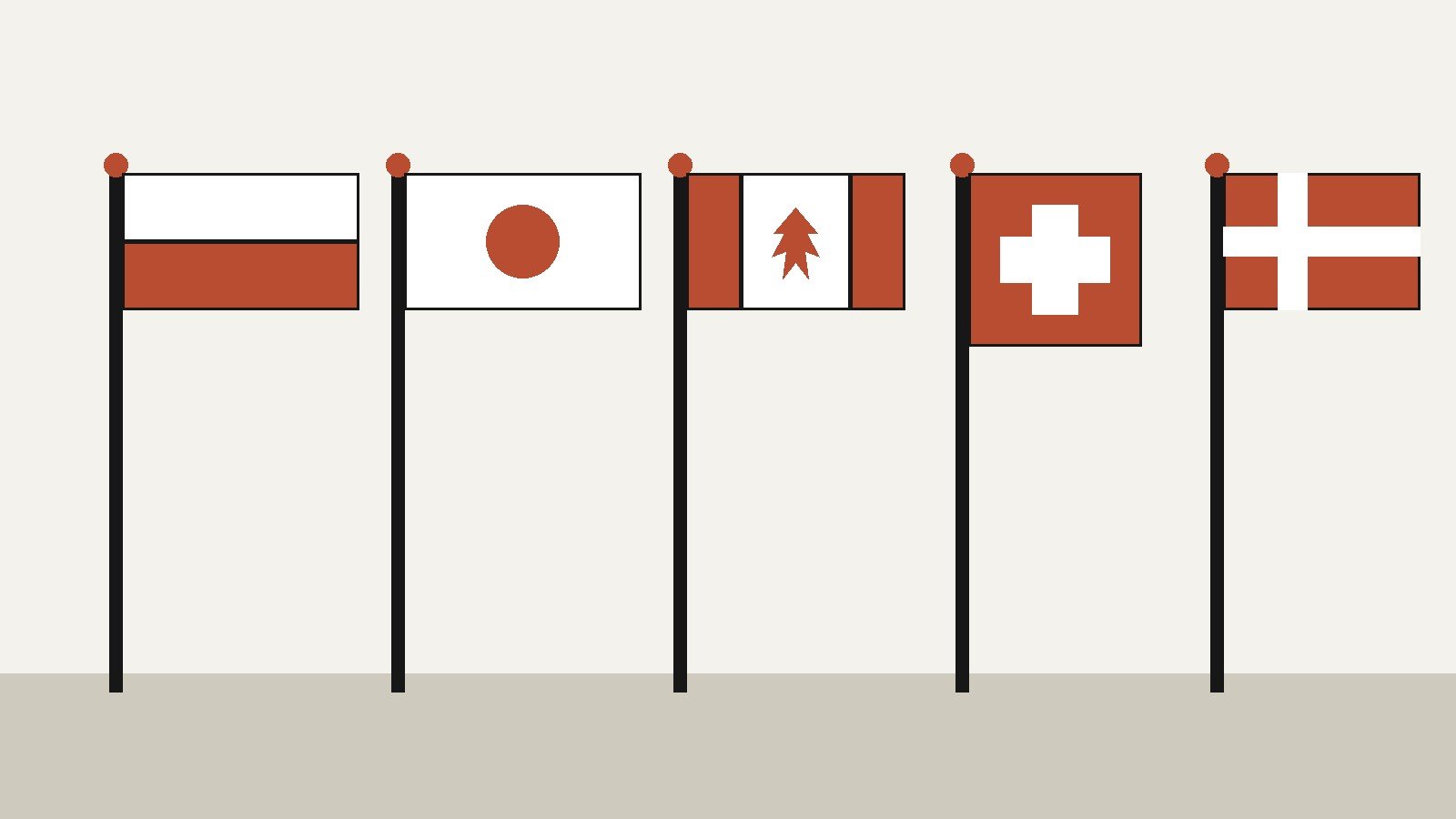
Red and white is the most common two-color combination in world flags, which is exactly why “red and white flag” is such a hard search. It might mean Poland’s plain white-over-red banner, Japan’s white flag with a red sun disc, Canada’s maple leaf, Switzerland’s white cross, or a dozen other designs. This guide identifies them the way vexillologists do: not by color alone, but by pattern. Work through three questions in order, and almost every red and white flag in the world resolves to a single country. The guide then covers the two neighboring color families that searches constantly confuse with it: the green, white, and red flags, and the green and white flags.
Step One: Read the Pattern, Not Just the Colors
Three observations identify a flag almost every time.
First, the layout. Are the colors horizontal bands, vertical bands, a plain field with a symbol, or a cross? This one step separates Poland (bands) from Japan (field and disc) from Switzerland (cross), even though all three use only red and white.
Second, the emblem. Many flags share a layout and differ only in what sits on it. A red-over-white bicolor with a crescent and five stars in the red band is Singapore. White and red vertical halves with a small cross in the corner is Malta. A red field with a white crescent is Turkey. Emblems are where lookalikes come apart.
Third, the proportions. Flag ratios are specified in national law and are more diagnostic than most people expect. The single most famous identification problem in vexillology, Indonesia versus Monaco, cannot be solved by design at all, because the designs are identical. It can only be solved by shape: Indonesia’s flag is half again as long as it is tall (2:3); Monaco’s is nearly square (4:5).
With that method in hand, here are the flags, family by family.
The Plain Bicolors: Poland, Indonesia, and Monaco
Three sovereign countries fly a flag of nothing but two horizontal red and white bands. The CIA World Factbook, which itself cross-references the three in each other’s entries, describes the difference in a single line: Poland’s flag is “white (top) and red,” while Indonesia and Monaco are “red (top) and white,” and Monaco’s is “shorter.”
| Country | Bands | Proportions | Adopted | Distinguishing point |
|---|---|---|---|---|
| Poland | White over red | 5:8 | 1919 | The only one with white on top; colors from the white eagle on a red shield |
| Indonesia | Red over white | 2:3 | 1945 | Called Sang Saka Merah-Putih; red and white trace to the Majapahit empire |
| Monaco | Red over white | 4:5 | 1881 | Nearly square; Grimaldi family colors used since the 14th century |
Poland is the easy one: it is the only national flag in this group with the white band on top. The colors are constitutional, taken from the national arms, a white eagle on a red field, and were formally adopted as national colors in 1831 and as the flag in 1919. A variant carrying the coat of arms in the white band exists, but it is reserved by law for official use abroad and at sea, so the plain version is the one you will normally see.
Indonesia and Monaco are the classic confusion. Both are red over white, both are completely plain, and at the sizes flags are usually printed or displayed, they look identical. The difference is real but purely geometric: Indonesia’s flag is a 2:3 rectangle, clearly longer than it is tall, while Monaco’s 4:5 ratio is close to square. If the flag in front of you looks noticeably short and squat, it is Monaco’s. The resemblance is coincidence, not borrowing. Monaco’s red and white are the heraldic colors of the House of Grimaldi, in use since at least 1339, and the present bicolor dates to April 4, 1881, generations before Indonesia adopted its flag at the proclamation of independence on August 17, 1945.
A footnote for completeness: two German states also fly plain red-and-white bicolors, Hesse red over white and Thuringia white over red, and the white-red-white horizontal tricolor is the historic flag of Belarus, created in the early twentieth century and long used by the Belarusian national movement. Neither is a sovereign national flag today, but both appear often enough in searches to be worth naming.
Red and White Bands with Something Extra
The next group keeps the banded structure but adds a third band or an emblem. All of the following are genuinely red and white flags, and each is identified by its addition.
Austria flies the closest relative of the bicolors: three equal horizontal bands of red, white, and red, a design of medieval origin and one of the oldest national flags in the world. If a Peru flag is nearby, compare them: Peru uses the identical colors in the identical order, but its bands run vertically.
Latvia also flies red, white, red horizontally, but the white band is only half the width of the red bands, and the red is a distinctive dark shade, officially maroon in the Factbook’s description and known in Latvia as Latvian red. The narrow white stripe is the instant tell.
Canada turns the pattern upright: two vertical red bands flank a white square, with an eleven-pointed red maple leaf centered in the white. The proportions are 1:2, twice as long as tall, and the flag dates to February 15, 1965.
Malta divides its flag into two equal vertical halves, white at the hoist and red at the fly. In the upper hoist corner sits a representation of the George Cross, edged in red: the medal awarded to the island’s people by King George VI in 1942 for their endurance under siege in the Second World War, written into the flag adopted at independence in 1964.
Singapore is red over white like Indonesia, but the red band carries a white crescent moon and five white stars near the hoist. The flag was adopted in 1959. If a red-over-white flag has anything at all in its upper corner, it is not Indonesia or Monaco; check Singapore first.
Lebanon closes the group and bridges to the next color family: red, white (double width), and red horizontal bands, with a single green cedar tree in the center of the white band. It is a red and white flag with exactly one green detail.
Discs on White: Japan and Greenland
Two flags in this family are organized around a circle.
Japan flies the most minimal national flag in the world: a white rectangle with a large crimson-red disc in the center, representing the sun. The disc’s diameter is set at three-fifths of the flag’s height, and the flag’s proportions are 2:3. The design is centuries old as a banner and was specified in modern law in 1999. Nothing else on Earth is close: if the flag is plain white with a red circle, it is Japan.
Greenland, an autonomous territory within the Kingdom of Denmark, flies a flag of two horizontal bands, white over red, with a large disc placed slightly toward the hoist. The disc is counterchanged, meaning its colors reverse against the bands behind it: the upper half of the disc is red where it crosses the white band, and the lower half is white where it crosses the red band. Designed by Thue Christiansen and adopted on June 21, 1985, it is the only flag in the Danish realm that breaks with the Nordic cross.
A caution against a near neighbor: Bangladesh also has a large red disc, but its field is green, not white, so it belongs to a different family entirely.
Red Flags with White Symbols
Reverse the figure and ground, and red becomes the field. Four designs matter here, plus one Oceanic outlier.
Turkey flies a red field with a white crescent, its closed side toward the hoist, and a white five-pointed star placed just outside the crescent’s opening. Tunisia is also red with a crescent and star, but its symbols are red, not white, set inside a white disc at the center of the flag. Side by side, the two are easy: Turkey’s crescent floats directly on red; Tunisia’s sits in a white circle.
Bahrain and Qatar are the Gulf pair, and they confuse people exactly as Indonesia and Monaco do, by being one design in two versions. Both flags are a colored field with a broad white serrated band at the hoist side. Bahrain’s field is red and the serration has five white points, which represent the five pillars of Islam; its proportions are 3:5, and the five-point form dates to 2002. Qatar’s field is a distinctive maroon, known as Qatar maroon, and its serration has nine white points; its proportions are an extreme 11:28, making it the only national flag more than twice as wide as it is tall. Count the points and check the shade: five and red is Bahrain, nine and maroon is Qatar.
Tonga, in the South Pacific, flies a red field with a white rectangle in the upper hoist corner bearing a bold red cross. It is usually grouped with the cross flags below, and it is the clearest bridge between the two families.
The White Cross on Red: Switzerland, Denmark, and the Nordic Family
The supporting search “red flag with white cross” names this family directly, and it contains the family’s most famous member.
Switzerland is the flag most searchers are looking for: a red square with a bold, equilateral white cross in the center that, crucially, does not reach the edges of the flag. The square shape is the first tell. Switzerland and Vatican City are the only two sovereign states with square national flags. The white cross on red is also the inverted source of the Red Cross emblem, which was adopted as a compliment to Switzerland.
Denmark is the family’s ancestor. The Dannebrog is a red flag with a white cross that does extend to the edges, and the cross is not centered: its vertical arm is shifted toward the hoist. Legend assigns the design to the year 1219, and it is generally regarded as the oldest national flag in continuous use. As the Factbook notes, the shifted cross was subsequently adopted by the other Nordic countries, which is why the Nordic cross pattern now defines a whole region.
Within that family, the cross stays but the colors change. Norway keeps Denmark’s red field and off-center cross but makes the cross blue, outlined in white. Sweden pairs a yellow cross with a blue field, Finland a blue cross with a white field, and Iceland a red cross outlined in white on blue. Only Denmark, of the five, is a purely red and white flag.
Two flags complete the cross picture by reversing it. England’s flag is a red cross centered on a white field, the cross of Saint George, and Georgia’s flag is a white field with a large central red cross reaching all four sides and a small red cross in each corner, the five-cross flag. If the cross is red and the field is white, it is one of these two, never Switzerland.
The Neighboring Family: Green, White, and Red Flags
Search data show that “red and white flag” queries constantly collide with a second family: flags combining green, white, and red. Five countries account for nearly all of these searches, and the same three-question method separates them.
Two are vertical tricolors, and they are the family’s famous confusion pair. Italy flies three equal vertical bands of green, white, and red, completely plain. Mexico flies the same three vertical bands in the same order, but with the national coat of arms, an eagle perched on a cactus with a snake in its beak, centered in the white band. The emblem is the decisive difference, and there are two supporting ones: Mexico’s flag is longer in proportion (4:7 against Italy’s 2:3) and its green is a darker shade. If there is a detailed emblem in the middle, it is Mexico; if the flag is plain, it is Italy.
The other three are horizontal, and each uses a different color order, which is the whole trick of telling them apart.
| Country | Order, top to bottom | Emblem | Proportions |
|---|---|---|---|
| Bulgaria | White, green, red | None (plain) | 3:5 |
| Hungary | Red, white, green | None (plain) | 1:2 or 2:3 |
| Iran | Green, white, red | Red stylized emblem (the word Allah as a tulip) centered in the white band, with white script along the band edges | 4:7 |
Bulgaria is white over green over red, plain. Hungary is red over white over green, plain, and note what that means for searchers: a flag described as “red white green” from top to bottom is Hungary’s. Iran is green over white over red, and it is never plain: a red emblem sits in the center of the white band, and the phrase “God is great” is repeated in white stylized script along the inner edges of the green and red bands. If the flag has writing on it, it is Iran’s.
Beyond the five, the same three colors appear in other arrangements that a quick pattern check sorts out: Madagascar pairs a white vertical band at the hoist with horizontal red over green bands; Oman sets a red band at the hoist beside horizontal white, red, and green; and Lebanon, already covered above, keeps red and white dominant with a single green cedar. The color set is shared across continents; orientation and emblems are what identify the country.
Green and White Flags
The last neighboring family pairs green with white and no red at all.
Pakistan is the most searched: a dark green field with a vertical white band at the hoist, one quarter of the flag’s width, and a large white crescent and star centered in the green. The Factbook records that the white band symbolizes the country’s religious minorities. If a green and white flag has a crescent, it is Pakistan’s.
Nigeria is the family’s bicolor-style design: three equal vertical bands of green, white, and green, entirely plain, the mirror image in structure of Mexico and Italy with the red removed. Saudi Arabia is a green field carrying the Shahada, the Muslim profession of faith, in large white Arabic script above a white horizontal saber; it is the only flag in this guide that is essentially text, and uniquely, it is never flown at half-mast, because of the sacred words it bears. Algeria splits the difference between the families: two equal vertical bands, green at the hoist and white at the fly, with a red crescent and star centered on the boundary, the only entry in this section that reintroduces red.
Quick Identification Checklist
For a flag you can see but not name, ask in this order:
- Is the cross white on red, stopping short of the edges, on a square flag? Switzerland. Does a cross reach the edges, off-center? Denmark (white cross), or Norway if the cross is blue outlined in white.
- Is the field white with a red disc? Japan. White over red with a two-tone disc? Greenland.
- Is it two plain horizontal bands? White on top: Poland. Red on top: Indonesia (2:3) or Monaco (4:5, squarer).
- Is the field red with a white crescent? Turkey, or Tunisia if the crescent sits inside a white disc. A serrated white band at the hoist? Bahrain (five points, red) or Qatar (nine points, maroon).
- Do the bands carry an emblem or a third band? Recheck in the families above: Austria and Latvia (red-white-red), Canada (maple leaf), Malta (George Cross), Singapore (crescent and stars).
- Is green present? Vertical bands with an emblem: Mexico; without: Italy. Horizontal bands: Bulgaria (white first), Hungary (red first), Iran (green first, with script). Green and white only: Pakistan (crescent), Nigeria (plain vertical), Saudi Arabia (script), Algeria (split field, red crescent).
Frequently Asked Questions
Which country has a red and white flag with no other colors and no emblem?
Three do, in the plain two-band form: Poland (white over red), Indonesia (red over white, proportions 2:3), and Monaco (red over white, proportions 4:5). Japan is the fourth purely red and white design, a white flag with a red disc, and Austria and Latvia are purely red and white in three bands.
How can you tell the flags of Indonesia and Monaco apart?
Only by proportions. The designs are identical, two horizontal bands, red over white. Indonesia’s flag is a 2:3 rectangle, half again as long as it is tall. Monaco’s is 4:5, nearly square. Monaco’s design is also far older: it was adopted in 1881 using Grimaldi colors that date to the fourteenth century, while Indonesia’s dates to independence in 1945.
What is the red flag with a white cross?
Usually Switzerland: a red square flag with a bold white cross in the center that does not touch the edges. If the white cross extends to the edges of the flag and is shifted toward the hoist, the flag is Denmark’s Dannebrog, the model for all the Nordic cross flags. A red cross on a white field is a different flag again: England’s Saint George’s cross, or Georgia’s five-cross flag.
What flag is green, white, and red?
Five main countries, and the order and orientation decide. Vertical bands: Italy (plain) and Mexico (coat of arms in the center). Horizontal bands: Bulgaria (white, green, red from the top), Hungary (red, white, green), and Iran (green, white, red, with a red emblem and white script). Lebanon uses the same three colors in red, white, and red bands with a green cedar tree.
Which flag is green and white?
Most commonly Pakistan: a dark green field, a white band at the hoist, and a white crescent and star. Also Nigeria (vertical green, white, green), Saudi Arabia (green with white script and a saber), and Algeria (green and white halves with a red crescent and star).
Why do so many flags use red and white?
Because the combination predates modern flag design. Red and white were heraldic colors, the tinctures of medieval coats of arms, which is where Poland, Monaco, and Austria all trace their colors, and red dyes were among the cheapest and most colorfast available for cloth flown outdoors. Simplicity helped too: two bands of contrasting color can be recognized at a distance and sewn by anyone, which is why the pattern kept being reinvented, from the Grimaldi banner of the 1300s to Indonesia’s independence flag of 1945.
Conclusion
Color alone never identifies a flag, and red and white is the proof: the world’s most common flag colors belong to plain bicolors, royal standards, a square cross flag, a sun disc, a maple leaf, and a maroon Gulf banner with nine serrated points. The reliable route is pattern first, emblem second, proportions third. Two bands, white on top, is Poland; red on top, long, is Indonesia, and square is Monaco. A white cross that floats is Switzerland’s, and one that reaches the edges is Denmark’s. And when green enters the picture, order is everything: green-white-red vertical is Italy or Mexico, and the same three colors stacked white-green-red are Bulgaria’s. Read the pattern, and the country follows.
Keep reading: How Many Countries Are There in the World?
Sources & references
- CIA World Factbook, Flag Description field listing (archived listing, via the University of North Texas Libraries web archive of cia.gov): the source of the formal descriptions used throughout, including Poland ("two equal horizontal bands of white (top) and red"), Indonesia, Monaco ("similar to the flag of Indonesia which is longer and the flag of Poland which is white (top) and red"), Austria, Latvia, Canada, Malta, Singapore, Greenland, Turkey, Tunisia, Bahrain ("five white points represent the five pillars of Islam"), Qatar ("maroon with a broad white serrated band (nine white points)"), Tonga, Switzerland ("red square with a bold, equilateral white cross"), Denmark (the Dannebrog, and the adoption of its shifted cross by the other Nordic countries), Norway, Georgia, Italy, Mexico, Hungary, Bulgaria, Iran, Pakistan, Nigeria, Saudi Arabia, Algeria, and Lebanon.
- Encyclopaedia Britannica (britannica.com), national flag entries: cross-checks for the flag histories, including Poland's arms-derived colors and the reserved status of its arms-bearing variant, Italy and Mexico's distinguishing features, and the origins of the Nordic cross family.
- Smithsonian Institution, DK Complete Flags of the World: proportions and adoption data, including Monaco (4:5, adopted April 4, 1881), Qatar (11:28, maroon standardized and adopted at independence in 1971), and Bahrain (3:5, five points).


