Short answer
- A catalyst is a substance that increases the rate of a chemical reaction without being consumed by it; it emerges from the reaction chemically unchanged and can act repeatedly.
- It works by providing an alternative reaction pathway with a lower activation energy, so more molecular collisions succeed and the reaction speeds up.
- A catalyst does not change the reaction's energy balance or equilibrium. It changes how fast equilibrium is reached, not where equilibrium lies.
- The three broad types are homogeneous (same phase as the reactants), heterogeneous (different phase, usually a solid surface), and biocatalysts, above all enzymes.
- Familiar examples: platinum-group metals in catalytic converters, iron in the Haber process for ammonia, vanadium(V) oxide in sulfuric acid manufacture, and enzymes throughout the body.
- In everyday English, a catalyst is a person or event that triggers change, as in "a catalyst for reform."
Introduction
Some chemical reactions are stubbornly slow. The gases leaving a car engine would eventually react into less harmful substances on their own, but “eventually” is far too long when the exhaust is gone in a fraction of a second. Fertilizer production, fuel refining, and nearly every reaction inside a living cell face the same problem: the chemistry is possible, but it does not happen fast enough to be useful.
A catalyst is the standard solution. It is a substance that makes a reaction go faster without being used up in the process, so a small amount can do the same job over and over again. This explainer covers what the word means in chemistry, how catalysis actually works at the level of energy and molecular collisions, the main types of catalyst, the special case of enzymes, and the everyday and industrial examples that show the idea at work, from car exhausts to ammonia plants. It closes with the word’s second life in ordinary English, where a catalyst is anything that sparks change.
What the Word Means in Chemistry
IUPAC, the International Union of Pure and Applied Chemistry, whose Gold Book is the standard reference for chemical terminology, defines a catalyst as “a substance that increases the rate of a reaction without modifying the overall standard Gibbs energy change in the reaction.” Two parts of that definition matter. First, the catalyst changes the rate, the speed. Second, it does not change the overall energy change, which is why it cannot make an impossible reaction possible; it can only accelerate a reaction that is energetically allowed in the first place.
Encyclopaedia Britannica gives the plainer version: a catalyst is any substance that increases the rate of a reaction without itself being consumed. “Without being consumed” needs one refinement. A catalyst usually does take part in the reaction’s steps; it may bond to reactants, change shape, or temporarily change its own chemical state. The point is that by the end it is regenerated, restored to its starting form, so the net amount is unchanged. Chemists sum this up by saying the catalyst is both a reactant and a product of the reaction as a whole.
The word has a precise history. The Swedish chemist Jöns Jakob Berzelius coined the term catalysis in 1835 to group together reactions that were sped up by substances that remained unchanged afterward. He built it from the Greek katalysis, meaning dissolution or untying, from kata (down) and lyein (to loosen). The underlying concept is older: Elizabeth Fulhame had described catalysis-like experiments in 1794, and in the 1820s Johann Wolfgang Döbereiner built a commercial lighter that ignited hydrogen on a sponge of platinum metal, an early heterogeneous catalyst in everyday use. Wilhelm Ostwald later put the science of reaction rates on a systematic footing and received the 1909 Nobel Prize in Chemistry for his work on catalysis.
How a Catalyst Works: Activation Energy
To understand catalysis, start with why reactions are slow at all. When molecules collide, only a fraction of collisions lead to reaction. The molecules must meet with the right orientation and, crucially, with enough combined energy to climb over an energy barrier called the activation energy (written Ea). Think of the reaction as a journey over a mountain pass: reactants sit in one valley, products in another, and the pass between them has a height. Most collisions are like travelers who reach the slope, lack the energy to cross, and fall back. Only the energetic minority get over, which is why many reactions crawl even when they release energy overall.
A catalyst works by opening a lower pass. It provides a different route for the reaction, a different sequence of steps, in which the highest point is lower than the original barrier. With a lower barrier, a much larger fraction of ordinary collisions carry enough energy to succeed, so the reaction speeds up, often dramatically, at the same temperature. Nothing else about the landscape changes: the two valleys stay exactly where they were.
That picture is easiest to follow on the standard energy diagram, so here it is described in words. The vertical axis is energy; the horizontal axis is progress through the reaction. The curve starts at the energy level of the reactants, rises to a peak, which is the energy of the unstable arrangement of atoms at the top of the barrier, called the transition state, and then falls to the energy level of the products. For the uncatalyzed reaction the peak is tall. For the catalyzed reaction the curve follows a different, often multi-step path whose highest peak is lower. Both curves start and end at the same heights, because the reactants and products are the same either way. The gap between start and peak is the activation energy, and the catalyst’s whole effect is to shrink that gap. The gap between start and finish, the overall energy change of the reaction, is untouched.
How does a substance open that lower route? In practice, a few recurring mechanisms do most of the work:
- Providing a surface. On a solid catalyst, reactant molecules stick briefly to the surface (adsorption), which holds them in favorable positions, weakens bonds that need to break, and brings partners together. This is how most industrial heterogeneous catalysts work.
- Forming a temporary intermediate. The catalyst reacts with one reactant to form a short-lived intermediate compound, which then reacts onward and releases the catalyst again in its original form.
- Stabilizing the transition state. Especially in enzymes, the catalyst binds most tightly to the reaction’s highest-energy arrangement, which lowers that arrangement’s energy and so lowers the barrier.
- Shuttling participants. Some catalysts carry atoms, electrons, or protons between reactants, splitting one difficult step into several easier ones.
A household-scale demonstration makes the idea concrete. Hydrogen peroxide slowly decomposes into water and oxygen, slowly enough that a bottle keeps for years. Add a little manganese(IV) oxide and the same solution fizzes vigorously and decomposes within minutes: 2H₂O₂ → 2H₂O + O₂. The black powder is doing no more than providing a faster route, and it can be filtered out afterward, unchanged.
What a Catalyst Cannot Do
The limits of catalysis are as important as its powers, and they follow directly from the definition:
- It cannot change the energy change of a reaction. The overall Gibbs energy change, and with it the question of whether a reaction is energetically favorable at all, is fixed by the reactants and products. A catalyst cannot rescue a reaction that thermodynamics forbids.
- It cannot shift an equilibrium. A catalyst lowers the barrier for the forward and reverse reactions equally, so a reversible reaction reaches equilibrium faster but settles at exactly the same final mixture. Industrial chemists care about this: the catalyst gets them to equilibrium quickly, and other tricks, like removing a product as it forms, do the shifting.
- It does not appear in the overall equation. Because it is regenerated, the catalyst is written above the reaction arrow rather than among the reactants or products.
- It is needed only in small amounts, but it is not immortal. A catalyst can process many times its own quantity of reactant, a property measured as turnover. Over time, though, real catalysts degrade: surfaces foul, structures sinter or break down, and poisons block them, which is why industrial catalysts are periodically regenerated or replaced.
The Three Broad Types of Catalysis
Chemists classify catalysis by the relationship between the catalyst and the reacting mixture.
Homogeneous catalysis
In homogeneous catalysis, the catalyst is in the same phase as the reactants, typically all dissolved in the same liquid, or all gases. The catalyst mixes at the molecular level, so every catalyst molecule is available for work and the chemistry can be tuned very precisely. Acid catalysis is the classic case: the acid-catalyzed conversion of starch to glucose, studied by Gottlieb Kirchhoff in 1811, was the first organic reaction recognized as catalyzed. The trade-off is separation: getting a dissolved catalyst back out of the product can be difficult and expensive.
Heterogeneous catalysis
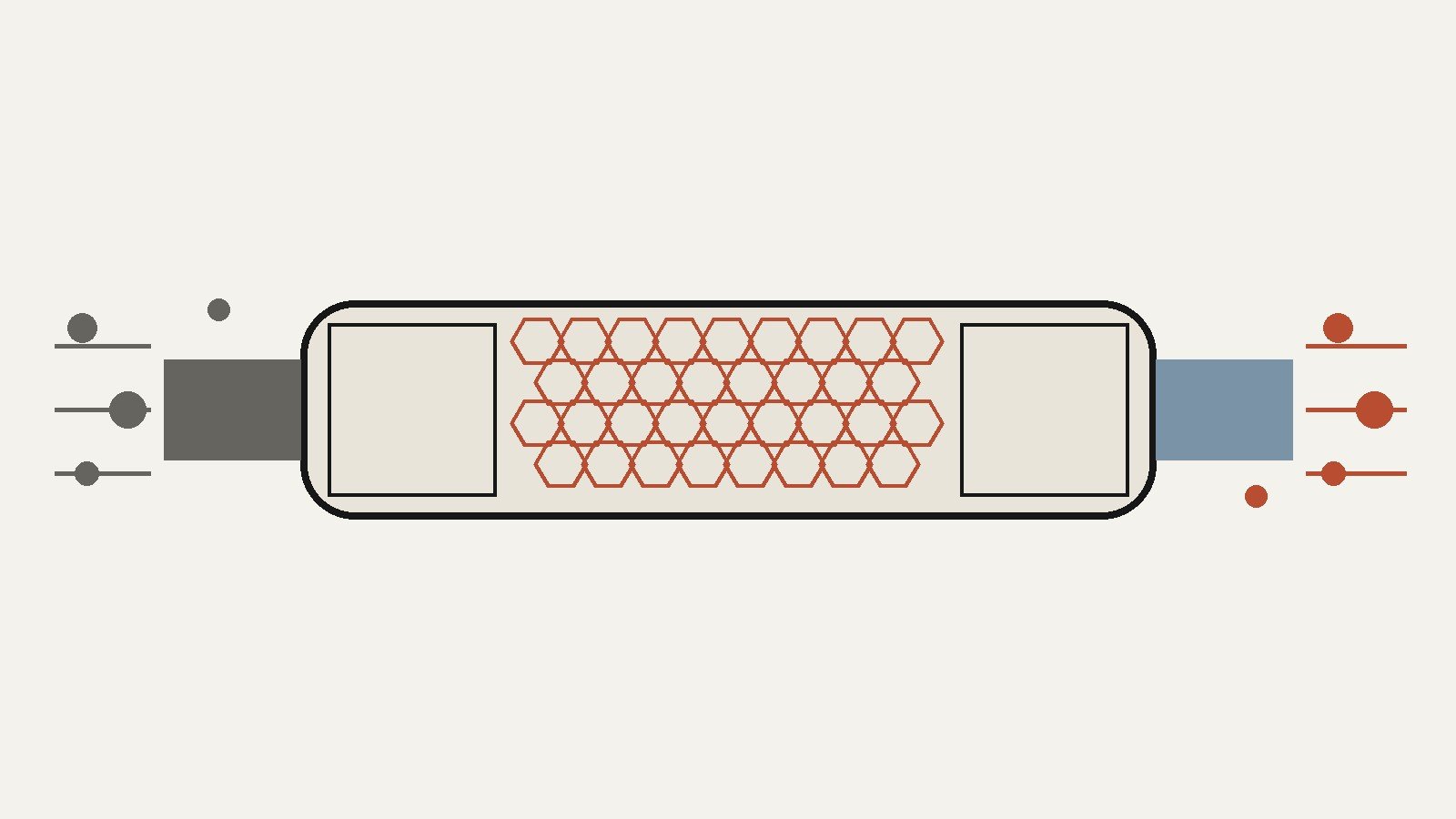
In heterogeneous catalysis, the catalyst is in a different phase, usually a solid acting on gases or liquids that flow over it. The reaction happens at the surface, so surface area is everything: industrial catalysts are made as porous pellets, fine powders, or thin coatings on honeycomb supports to expose as much surface as possible. Heterogeneous catalysts dominate heavy industry because the product simply flows away from them, leaving the catalyst in place for the next batch. The catalytic converter and the Haber process below are both heterogeneous.
Biocatalysis
Biocatalysis is catalysis by biological molecules, principally enzymes, the protein catalysts of living cells, with a smaller contribution from ribozymes, catalytic RNA molecules. Enzymes are the most accomplished catalysts known: they work in water, at body temperature, and they are extraordinarily selective, usually accelerating one specific reaction among thousands of chemically similar possibilities. Because they are central to the cluster of questions around this topic, they get their own section next.
| Feature | Homogeneous | Heterogeneous | Biocatalysis (enzymes) |
|---|---|---|---|
| Phase of catalyst | Same as reactants (usually liquid) | Different (usually solid) | In solution in the cell, or membrane-bound |
| Typical setting | Liquid-phase industrial and laboratory reactions | Gas or liquid flowing over a solid surface | Living cells, and increasingly industrial reactors |
| Separation from products | Often difficult | Easy: product flows away | Varies; enzymes can be immobilized for reuse |
| Selectivity | High and tunable | Moderate to high | Extremely high |
| Examples | Acid catalysts in solution | Iron (Haber process), platinum metals (converters) | Digestive enzymes, enzymes in laundry detergents |
Enzymes: Nature’s Catalysts
Every reaction that keeps a cell alive, building proteins, copying DNA, releasing energy from food, is run by enzymes. Without them, those reactions at body temperature would be far too slow to sustain life.
An enzyme works at a small region of its structure called the active site, a pocket whose shape and chemistry fit the molecule it acts on, called its substrate. Two models describe the fit, and the difference between them is a tidy example of a scientific idea being updated rather than discarded. In 1894 Emil Fischer proposed the lock-and-key model: enzyme and substrate have rigid, complementary shapes, like a key cut for one lock, which neatly explains why enzymes are so specific. In 1958 Daniel Koshland proposed the induced-fit model: the active site is flexible, and as the substrate binds, both adjust their shapes to achieve the best fit. Induced fit is the model accepted today, because it also explains how binding can strain the substrate toward its transition state, which is part of how enzymes achieve their enormous rate increases. The lock-and-key picture survives as a first approximation and as the reason specificity exists at all.
Enzymes share the defining limits of all catalysts, and add conditions of their own. They are not consumed, they do not alter equilibria, and they are highly specific. But being proteins, they are sensitive: activity peaks near an optimum temperature and pH and falls off outside it, and strong heat permanently unravels, or denatures, most enzymes, destroying the active site. Cells regulate enzymes with activator and inhibitor molecules, tuning whole reaction pathways up and down as conditions change.
Examples, in the Garage, the Factory, and the Refinery
Catalytic converters
A gasoline car’s exhaust contains carbon monoxide, unburned hydrocarbons, and nitrogen oxides. A three-way catalytic converter cleans all three at once using coatings of the platinum-group metals platinum, palladium, and rhodium on a ceramic honeycomb, whose structure exposes a large surface area while using only a few grams of metal. The “three ways” are three reactions: rhodium mainly drives the reduction of nitrogen oxides to nitrogen and oxygen (for example, 2NO + 2CO → N₂ + 2CO₂, in which one pollutant consumes another), while platinum and palladium mainly drive oxidation: carbon monoxide to carbon dioxide (2CO + O₂ → 2CO₂) and unburned hydrocarbons to carbon dioxide and water vapor. All three reactions are energetically favorable but far too slow in a fast-moving exhaust stream; the catalyst surface gives them a lower-barrier path. This example also introduces poisoning: lead compounds coat and disable converter catalysts, which is a central reason vehicles with converters require unleaded fuel.
The Haber process
Ammonia, the basis of most nitrogen fertilizer, is made by reacting nitrogen from the air with hydrogen: N₂ + 3H₂ ⇌ 2NH₃. Nitrogen’s triple bond is exceptionally strong, so the reaction needs an iron catalyst, typically promoted with small amounts of potassium and aluminum oxides, at about 450 °C and pressures around 200 atmospheres. Those conditions are a compromise that shows the catalyst’s limits clearly: the catalyst speeds the reaction but cannot move the equilibrium, so temperature and pressure are chosen to balance a reasonable yield against a reasonable rate.
The contact process
Sulfuric acid, among the highest-volume industrial chemicals, is made by the contact process. Its key step converts sulfur dioxide to sulfur trioxide, 2SO₂ + O₂ ⇌ 2SO₃, over a catalyst of vanadium(V) oxide at about 450 °C. The sulfur trioxide is then absorbed into concentrated sulfuric acid and diluted, rather than dissolved directly in water, to avoid forming a corrosive acid mist. The process takes its name from the older “contact” language for surface catalysis: the gases react on contact with the solid catalyst.
Catalytic cracking
Crude oil contains long-chain hydrocarbons that are less in demand than the shorter molecules of gasoline. In fluid catalytic cracking, vaporized heavy oil passes over a hot zeolite catalyst, a porous mineral with an enormous internal surface, at around 500 °C. The catalyst’s acidic surface helps break the long carbon chains into shorter, more valuable ones. The same unit continuously regenerates its catalyst by burning off the carbon that deposits on it, a reminder that real-world catalysts must be maintained, not just installed.
Inhibitors, Poisons, and Promoters: The Negative Space
Catalysis is defined partly by what opposes it. IUPAC is explicit that a substance which reduces a reaction’s rate should not be called a catalyst at all; it is an inhibitor. Inhibitors work by deactivating a catalyst, blocking an active site, or intercepting reactive intermediates such as free radicals. Industry uses them deliberately as well as suffering them accidentally: small amounts of inhibitor are added to some stored chemicals to stop them reacting prematurely.
A substance that permanently disables a catalyst is a catalyst poison. Lead in fuel poisoning converters is the famous case; sulfur compounds are another common industrial poison, which is why feedstocks are often purified before they reach an expensive catalyst bed. The mirror image is a promoter, a substance that is not itself a catalyst but boosts a catalyst’s performance, like the potassium and aluminum oxides in the Haber process iron. Together, catalysts, inhibitors, poisons, and promoters form the practical vocabulary: industry does not just choose a catalyst, it manages a whole system for keeping the catalyst fast and alive.
One more relative deserves a mention: autocatalysis, in which a product of the reaction catalyzes the reaction itself. Such reactions start slowly, then accelerate as product accumulates, the opposite pattern from a reaction running out of fuel.
The Figurative Meaning: “A Catalyst for Change”
Because the primary keyword asks for the meaning of the word, its second sense matters too. Merriam-Webster lists the figurative definition first: a catalyst is “a person or thing that provokes or speeds significant change or action,” as in a catalyst for economic growth. Collins similarly leads its learner’s dictionary entry with the figurative sense: something you describe as a catalyst causes a change or event to happen.
The metaphor works because it borrows the chemistry precisely. A figurative catalyst is not the main substance of the change, just as a chemical catalyst is neither reactant nor product. It is comparatively small, a single report, a court case, one person’s arrival, yet it lowers the barrier to a transformation that the situation was already primed for, and afterward the larger change proceeds on its own momentum. Used carefully, the metaphor even preserves the chemist’s caveat: the catalyst cannot create the possibility of change, only release it faster. When writers say an event “was the catalyst,” the claim embedded in the word is that the conditions for change already existed, and this was the thing that finally let them react.
Glossary
- Activation energy (Ea): the minimum energy a collision needs for a reaction to occur; the height of the barrier a catalyst lowers.
- Active site: the pocket on an enzyme where the substrate binds and the reaction takes place.
- Adsorption: the sticking of molecules onto a surface, the first step in heterogeneous catalysis.
- Autocatalysis: catalysis in which a product of the reaction is itself the catalyst, so the reaction accelerates as it proceeds.
- Catalysis: the process of increasing a reaction’s rate by adding a catalyst.
- Enzyme: a biological catalyst, usually a protein, that accelerates a specific reaction in living organisms.
- Gibbs energy change (ΔG): the overall energy change of a reaction, which a catalyst does not alter.
- Heterogeneous catalysis: catalysis where the catalyst is in a different phase from the reactants, usually a solid surface.
- Homogeneous catalysis: catalysis where catalyst and reactants are in the same phase.
- Inhibitor: a substance that decreases a reaction’s rate; IUPAC reserves the word catalyst for substances that increase it.
- Transition state: the highest-energy arrangement of atoms during a reaction, at the top of the activation barrier.
Frequently Asked Questions
What is a catalyst in simple terms?
A substance that makes a chemical reaction happen faster without being used up. It gives the reaction an easier route, so the reaction speeds up while the catalyst itself comes out unchanged and ready to work again.
Does a catalyst get used up in a reaction?
No. It may take part in intermediate steps, but it is regenerated by the end, so its overall amount is the same before and after. That is why a small amount of catalyst can process a large amount of reactant. Real catalysts do slowly degrade in service, through fouling or poisoning, which is different from being consumed by the reaction itself.
Can a catalyst make an impossible reaction happen?
No. A catalyst only speeds up reactions that are already energetically possible. It cannot change the overall energy change of a reaction or shift its equilibrium; it shortens the journey, it does not move the destination.
What is the difference between a catalyst and an enzyme?
An enzyme is a catalyst, specifically a biological one: a protein (occasionally an RNA molecule) made by living cells to accelerate particular reactions. All enzymes are catalysts, but most catalysts, such as iron or platinum metals, are not enzymes.
Why do catalytic converters need unleaded fuel?
Because lead is a catalyst poison. Lead compounds deposit on the converter’s platinum-group metal surfaces and block the active sites, permanently reducing its ability to clean the exhaust.
What does “a catalyst for change” mean?
It is the figurative use of the word: a person, event, or thing that triggers or accelerates a change that the situation was already capable of, the way a chemical catalyst triggers a reaction without being part of its final products.
Conclusion
A catalyst is defined by a small set of strict ideas: it increases a reaction’s rate, it does so by opening an alternative pathway with a lower activation energy, and it is not consumed, does not change the reaction’s energy balance, and cannot move its equilibrium. Around those ideas sit the three great families, homogeneous, heterogeneous, and biological, the counterweights of inhibitors, poisons, and promoters, and some of the most consequential technology in daily life, from the converter in a car exhaust to the iron catalyst behind the world’s fertilizer supply. The figurative meaning that fills newspapers is the same idea in human dress: something small that lets a ready system finally change.
Keep reading: Cells, Mitosis, Meiosis and Photosynthesis: Explained Simply
Keep reading: How to Start a Vegetable Garden for Beginners
Sources & references
- IUPAC (International Union of Pure and Applied Chemistry), Gold Book, "catalyst": the formal definition, the reactant-and-product characterization, the exclusion of rate-reducing substances (see "inhibitor"), and the homogeneous/heterogeneous classification.
- Encyclopaedia Britannica, "catalyst" and "catalysis": the plain-language definition of a substance that increases reaction rate without being consumed, and background on heterogeneous and homogeneous catalysis.
- Chemistry LibreTexts (chem.libretexts.org), "Catalysis": activation energy and energy diagrams, the manganese(IV) oxide and hydrogen peroxide demonstration, and the three classes of catalysts.
- Royal Society of Chemistry and UK curriculum references on industrial processes: Haber process conditions (iron catalyst, about 450 °C, about 200 atmospheres, promoters), contact process (vanadium(V) oxide, about 450 °C), and catalytic converter chemistry (platinum, palladium, rhodium; oxidation and reduction reactions; lead poisoning and unleaded fuel).
- Merriam-Webster, "catalyst": the figurative definition and word history (catalysis from Greek, figurative sense in use by the 1940s); Collins English Dictionary, catalyst entry, figurative and chemistry senses.


