Short answer
- The Internet Archive is a nonprofit digital library founded in 1996 by Brewster Kahle. Its Wayback Machine, opened to the public in 2001, is a searchable archive of saved web pages: software crawlers copy pages at particular moments, and anyone can view those copies by date. The archive passed one trillion saved web pages in October 2025, according to the Archive. The Hachette lawsuit concerned the Archive's separate book-lending program, controlled digital lending, not the Wayback Machine.
Web pages are far less permanent than they look. Pages are edited, moved and deleted every day, and when a link dies, the record usually dies with it. The Internet Archive exists to fight that loss. The San Francisco nonprofit has spent three decades building a digital library of the world’s knowledge, and its best-known service, the Wayback Machine, holds a copy of the public web as it appeared at particular moments, stretching back to 1996. Journalists use it to check what a company said last year, researchers use it to cite pages that no longer exist, and courts have accepted its captures as evidence.
This article explains what the Internet Archive is, how the Wayback Machine works, how big it has grown, and where its limits lie. It also untangles a common confusion: the famous publishers’ lawsuit against the Internet Archive, Hachette v. Internet Archive, was about the Archive’s book-lending program. It was not about the Wayback Machine, and keeping the two apart matters for understanding both.
What Is the Internet Archive?
The Internet Archive is a nonprofit digital library based in San Francisco, founded in 1996 by computer scientist and entrepreneur Brewster Kahle. Its stated mission is “universal access to all knowledge.” The logic of the project is simple. Libraries have always preserved books, newspapers, music and film for future readers, but the web, for all its size, was being preserved by almost nobody. Pages changed silently or vanished, and there was no shelf anywhere holding the earlier versions. Kahle set out to build that shelf.
The web archive is the largest part of the collection, but it is not the whole of it. The Archive also holds digitised books and texts, recorded music and live concert recordings, television news and other video, films, images and a growing library of software, all of it offered free to read, hear or view online. The Archive’s own statistics page, as of September 2024, listed more than 42 million print materials alongside tens of millions of audio recordings, videos and images. In 2025 the Archive was also designated a federal depository library in the United States, a formal library role that Senator Alex Padilla noted in the Congressional Record when marking the Wayback Machine’s trillionth saved page in October 2025.
What Is the Wayback Machine?
The Wayback Machine is the Internet Archive’s public interface to its web archive: a tool that lets anyone look up a web address and see copies of that page saved at different dates. Kahle and his colleague Bruce Gilliat built it on the Archive’s crawl data, and it opened to the public in October 2001. Its earliest captures reach back to 1996, the Archive’s founding year, so it covers most of the web’s public history. The name is a joke for older readers: the “WABAC machine” was the time machine in the Peabody’s Improbable History segments of The Adventures of Rocky and Bullwinkle, pronounced “wayback.”
Using it is simple, and the Archive’s own help pages describe the basic flow. You type or paste a web address into the search box. The Machine answers with a calendar view showing the days on which that page was captured, with a timeline bar across the top summarizing captures by year. Clicking a date and time opens the saved copy, which you can read and click through much as a visitor would have done on the day it was taken. The archive stores the actual files that made up the page, its text, images and code, rather than a picture of the page, which is why saved pages can usually be browsed rather than merely looked at.
How the Wayback Machine Works
The raw material comes from web crawlers, automated programs that move from page to page following links and copying what they find, much as search engines index the web. The Internet Archive runs its own crawls and has also built its collection from crawl data gathered by partners and donors over the years, including large amounts of data donated by Alexa Internet in the Archive’s early period. Institutions such as national libraries and universities run their own focused crawls through the Archive’s Archive-It service, and those collections flow into the same store. Everything is kept in the Archive’s data centers in standard web archive files.
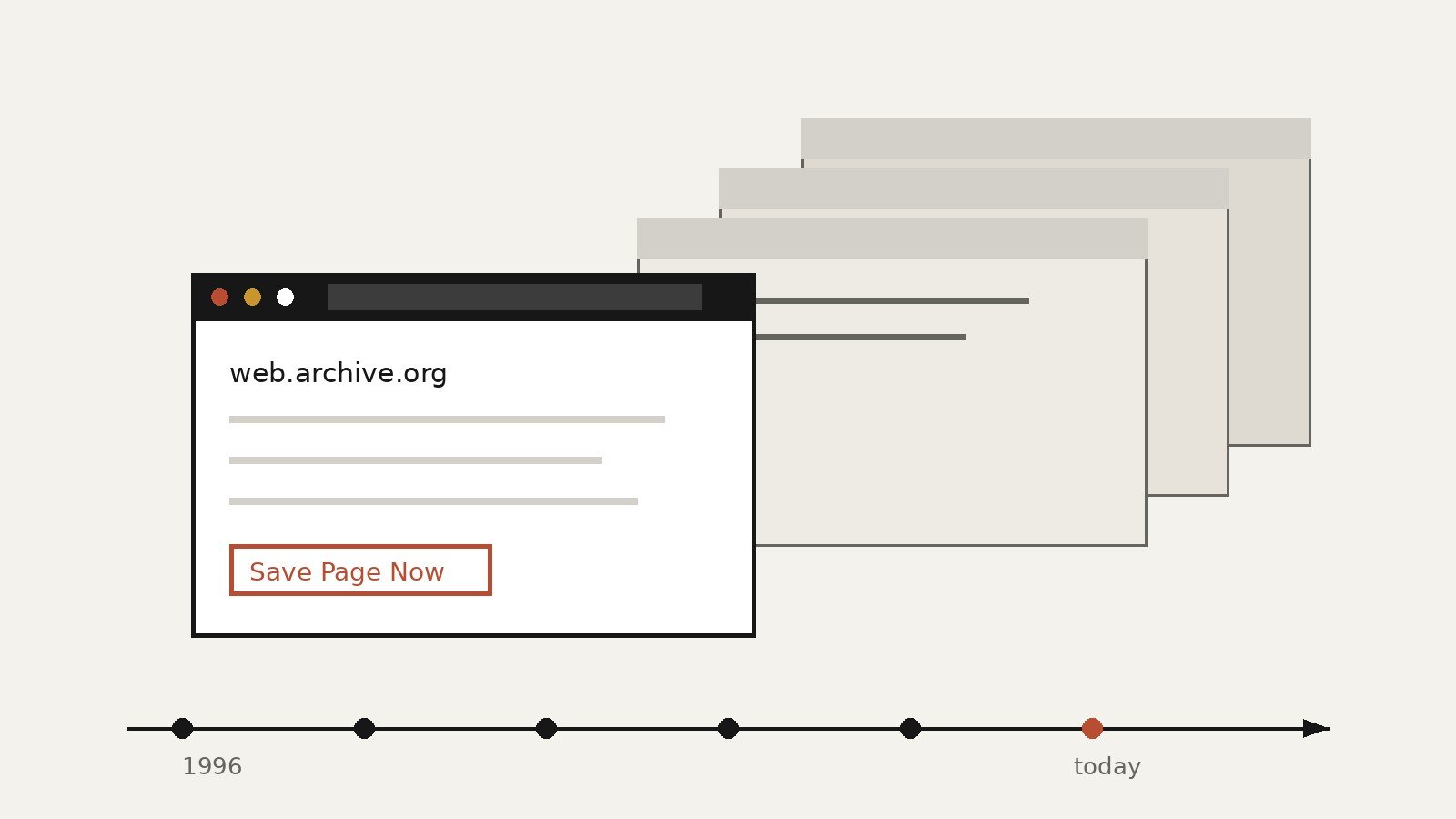
Two features of this system matter for anyone using the results. First, there is no fixed schedule. The Archive does not promise to copy any given page at any given interval. Popular pages may be captured many times in a single day, while a small page on a quiet site may be captured rarely or not at all, and the depth of each crawl varies too, since a crawler may save a front page without following every link beneath it. Second, the public can feed the machine directly. A feature called Save Page Now lets anyone submit a page’s address and ask the Archive to capture it on the spot, which journalists and researchers use to preserve pages they expect to be changed or removed.
Every capture is also stamped with the date and time it was taken, and that stamp forms part of the saved page’s own address in the archive. This is what makes precise citation possible: a researcher can link not just to a page but to the page as it stood at a stated moment, and a reader following the link sees the same capture rather than whatever the live page shows today. The timeline view exists to navigate those stamps, showing at a glance which moments in a page’s history the Archive actually holds.
How Big Is the Archive?
The scale is difficult to picture, so it helps to use the Archive’s own figures, with their dates attached. The Archive’s statistics page, as of 5 September 2024, put the web archive at more than 866 billion saved web pages. Growth since then has been steep. In October 2025 the Internet Archive announced that the Wayback Machine had passed one trillion web pages preserved, a milestone it celebrated at its San Francisco headquarters on 22 October 2025, and it describes the underlying data as more than 100,000 terabytes. Treat any single number as a snapshot rather than a constant: the collection grows by billions of pages, and the Archive updates its totals as it goes.
Even at that scale, the archive is a sample, not a mirror. A trillion saved pages sounds like everything, but the live web is larger still, and the archive’s coverage follows where crawlers have been sent. That distinction, between an enormous archive and a complete one, is the key to using the Wayback Machine well.
What People Use It For
The most common use is verification. When a company quietly rewrites a policy page, a public figure’s website drops a claim, or a news story is corrected without a note, a dated Wayback capture can show what the page said before the change. Journalists rely on this routinely, and researchers cite captures as sources for pages that have since moved or disappeared. When a site shuts down entirely, its captures may be the only surviving copy of its content, which makes the Machine a recovery tool as well as a checking tool.
Public institutions are heavy users and heavy contributors. The Archive works with libraries and government bodies to preserve official web publishing, and end-of-administration crawls have captured the federal web at the close of every United States presidential administration since 2008, as Senator Padilla’s Congressional Record statement noted. The Machine is also used in everyday disputes: to show what a price, a job advert, a product description or a terms page said on a given date. As the court section below shows, that evidentiary role has been tested and accepted by judges.
The Limits: What the Wayback Machine Cannot Show
The Archive is candid about the gaps, and its help center lists the main reasons a page you want may not be there. The crawlers may simply never have found the site. The material may sit behind a password, as much email, subscription and account content does. The site may have blocked the Archive’s crawlers through its robots.txt file, the small instruction file sites use to tell automated visitors where they may not go, and owners can also ask the Archive to exclude their pages, in which case earlier captures may stop being displayed. A lookup can fail for any of these reasons even when a page definitely existed.
There are softer limits too. The Machine is searched by address, not by the full text of pages, so you generally need to know the address of the page you are looking for, or the site it sat on. Pages built from databases and scripts, interactive tools, comment systems and personalized content, often save incompletely: the shell of the page may be there while the content it once pulled in is missing, and images or embedded files are sometimes absent from a capture. And because captures are irregular, the copy nearest to the date you care about may be days, months or years away from it. A capture proves what a page looked like at the moment it was saved. It does not prove what the page showed on the days in between.
The Lawsuit That Was Not About the Wayback Machine
In June 2020, four major publishers, Hachette, HarperCollins, John Wiley and Sons, and Penguin Random House, sued the Internet Archive in New York. Despite the Archive’s fame resting on the Wayback Machine, the case had nothing to do with web archiving. The target was a separate program, the Archive’s Open Library book lending, and the practice known as controlled digital lending. Under that practice, the Archive scanned physical books it owned and lent the digital copies to one reader at a time, matching the number of copies it held. In March 2020, as libraries closed during the COVID-19 pandemic, the Archive went further and opened a National Emergency Library, which removed the one-copy limit and let many readers borrow the same scanned book at once. The publishers argued this was mass copyright infringement, not library lending, and the emergency library closed in June 2020, shortly after the suit was filed.
The courts sided with the publishers. In March 2023, Judge John G. Koeltl of the United States District Court for the Southern District of New York ruled for the publishers on summary judgment, rejecting the Archive’s fair use defense. The Archive appealed, and on 4 September 2024 the United States Court of Appeals for the Second Circuit affirmed the judgment. The appeals court treated the Archive’s purpose as noncommercial, a point on which it differed from the district court, but it held that all four fair use factors favored the publishers: the lending was not transformative, and it stood in for the licensed ebook market through which publishers and authors are paid. In December 2024 the Archive announced it would not ask the Supreme Court to review the case, which brought the litigation to an end.
The distinction matters because the two programs rest on different legal ground. Controlled digital lending involved the Archive making and distributing copies of books still sold and licensed by their publishers, and it lost. The Wayback Machine’s captures, by contrast, were not the subject of the case at all, and no court ordered the web archive shut down or its trillion pages deleted. Reporting that blurred the two together misled many readers at the time.
The Wayback Machine in Court
Far from being condemned by judges, Wayback captures are routinely used as evidence in American courts, and the Archive’s material has been cited at every level of the federal system. The usual route is authentication under Rule 901 of the Federal Rules of Evidence: a witness from the Internet Archive explains how the capture process works and confirms that a given printout is a true copy of what was saved, and courts accept that foundation.
Concrete examples show how established the practice is. In United States v. Bansal, decided by the Third Circuit in 2011, the court upheld the use of Wayback evidence after an Archive witness explained the service and the underlying data. In United States v. Gasperini, the Second Circuit in 2018 likewise accepted Wayback captures authenticated through testimony about how the Machine collects and stores pages. And in Marten Transport v. PlattForm, a federal court in Kansas not only admitted Wayback screenshots of the defendant’s own websites, supported by a declaration from an Archive employee, but took judicial notice of the captures, observing that the fact the Wayback Machine does not capture everything does not undermine the accuracy of the pages it did capture. For a free public tool built by a nonprofit, that level of judicial trust is a striking measure of its standing.
Frequently Asked Questions
Is the Wayback Machine free to use?
Yes. Searching the archive, viewing saved pages and using Save Page Now are free to the public, and no account is needed simply to look up a page. The Internet Archive is a nonprofit and funds its work largely through donations and partnerships with libraries and institutions.
When did the Wayback Machine start?
The Internet Archive was founded in 1996, and its oldest saved pages date from that year. The Wayback Machine itself, the public tool for searching those saves, opened in October 2001. It was built by Brewster Kahle and Bruce Gilliat, and its name plays on the WABAC machine from the Rocky and Bullwinkle cartoons.
How many pages has the Wayback Machine saved?
According to the Internet Archive, the total passed one trillion saved web pages in October 2025, held in more than 100,000 terabytes of data. A year earlier, in September 2024, the Archive’s statistics put the figure at more than 866 billion pages, which shows how fast the collection is still growing.
Why is a page missing from the Wayback Machine?
The Archive’s help center gives the main reasons: its crawlers may never have come across the site, the page may have been behind a password, the site may have blocked crawlers in its robots.txt file, or the owner may have asked for pages to be excluded. Pages built from databases and interactive scripts can also save incompletely, so a capture may exist but lack some of its content.
Did the Hachette lawsuit shut down the Wayback Machine?
No. Hachette v. Internet Archive was about the Archive’s book-lending program, controlled digital lending through its Open Library, not about web archiving. The publishers won: the district court ruled against the Archive in 2023, the Second Circuit affirmed in September 2024, and the Archive ended the case in December 2024 by not petitioning the Supreme Court. The Wayback Machine was not a target of the suit and continues to operate.
Can anyone save a page to the Wayback Machine?
Yes, for pages the Archive is permitted to capture. The Save Page Now feature lets any visitor submit a web address and request an immediate capture, which is how many researchers and journalists preserve pages they think may later be changed or deleted. Pages that sites protect or exclude, such as password-protected content, cannot be captured this way.
Conclusion
The Internet Archive is best understood as a library that happens to collect websites. Founded in 1996, it has grown from one project’s crawl data into a public memory for the web, and the Wayback Machine is its reading room: imperfect, uneven in coverage, and completely open. Its captures have become working tools for journalists, researchers, institutions and courts, even as its separate book-lending program met a decisive legal defeat that is often, wrongly, reported as a judgment on the archive itself. Knowing what the Machine holds, how it gathers pages and where its gaps are is the difference between citing it well and being misled by it.
Sources & references
- Internet Archive, Help Center, "Using the Wayback Machine" (help.archive.org): how lookup, the calendar and timeline work, Save Page Now, and the Archive's own list of reasons pages are missing, including password protection, robots.txt blocks and owner exclusion requests.
- Internet Archive, statistics and announcements: holdings figures as of 5 September 2024 (more than 866 billion web pages, 42.5 million print materials); the Archive's announcement of one trillion web pages preserved, celebrated 22 October 2025, and its figure of more than 100,000 terabytes.
- Wikipedia, "Wayback Machine" and "Internet Archive," consulted and checked against the sources above: the 1996 founding by Brewster Kahle, development by Kahle and Bruce Gilliat, the public launch in October 2001, the WABAC name reference, and Alexa Internet's donated crawl data.
- Congressional Record, statement of Senator Alex Padilla, 28 October 2025: the trillion-page milestone, the Archive's designation as a federal depository library, end-of-administration web archiving since 2008, and citation of Archive material by every federal circuit court and the Supreme Court.
- Hachette v. Internet Archive: reporting on the June 2020 suit by Hachette, HarperCollins, John Wiley and Sons and Penguin Random House over controlled digital lending and the National Emergency Library; Judge John G. Koeltl's summary judgment for the publishers (Southern District of New York, March 2023); the Second Circuit's affirmance of 4 September 2024 (all four fair use factors for the publishers, the use treated as noncommercial); and the Archive's December 2024 decision not to petition the Supreme Court.
- Court treatment of Wayback evidence: United States v. Bansal, 663 F.3d 634 (3d Cir. 2011); United States v. Gasperini (2d Cir. 2018); Marten Transport v. PlattForm (D. Kan.), on authentication under Rule 901 of the Federal Rules of Evidence through Internet Archive testimony and judicial notice under Rule 201.


