Short answer
- Project-based inquiry science organizes a whole unit around one driving question or challenge; students learn the required science by investigating it.
- As a proper name, Project-Based Inquiry Science (PBIS) is a published three-year middle school curriculum from Activate Learning, built from research at the University of Michigan.
- It differs from generic project-based learning because the curriculum, learning progression, and assessments are designed in advance; the project serves the science rather than decorating it.
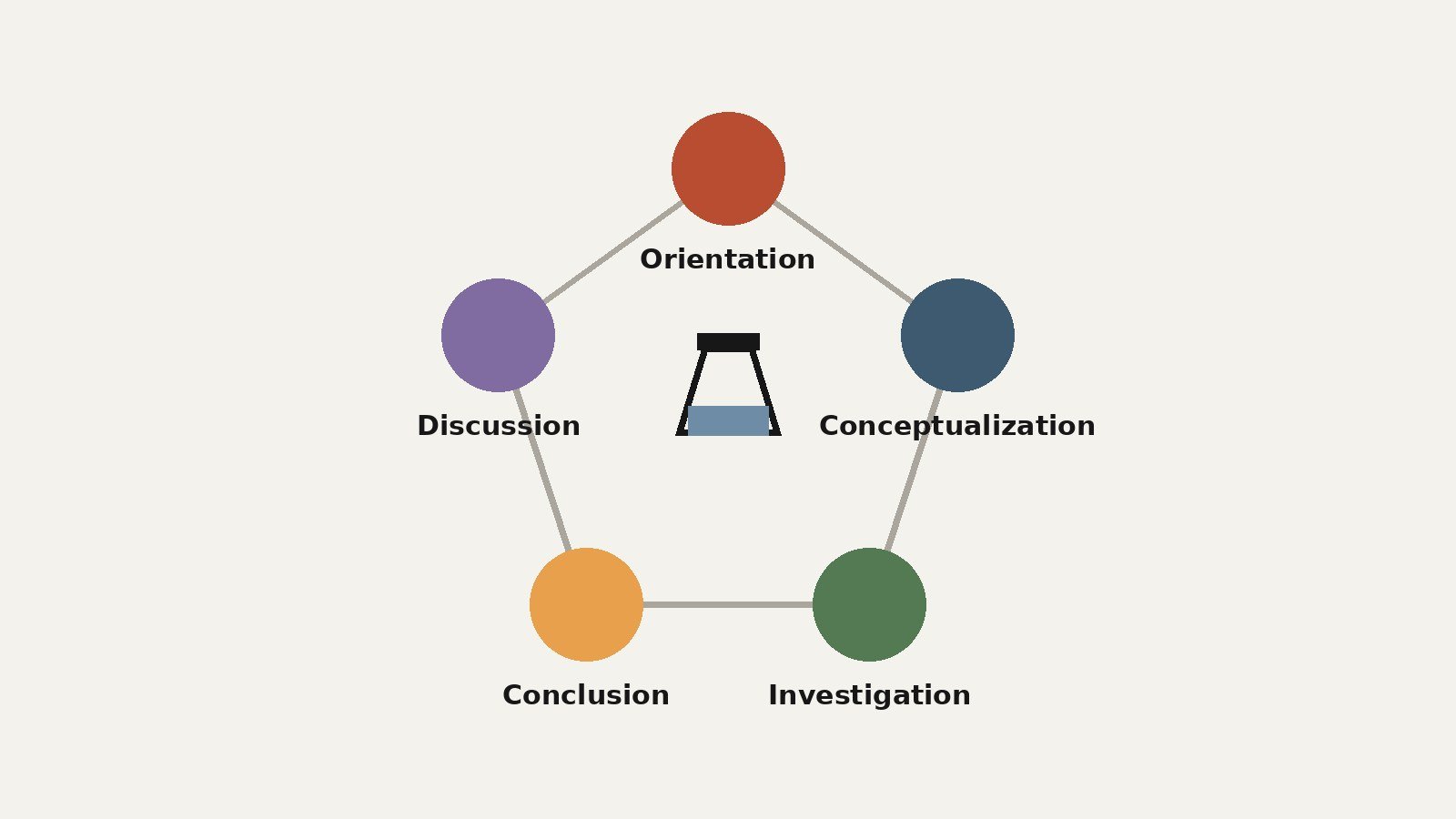
- The inquiry cycle moves through orientation, conceptualization, investigation, conclusion, and discussion, and it repeats within a unit rather than running once.
- The strongest evidence supports guided versions: Detroit studies found higher state test pass rates, and a 2012 meta-analysis found teacher-led inquiry notably more effective than student-led inquiry. Large international survey data point the other way, so design and guidance decide the result.
Science class in many schools still runs on a coverage model: the teacher explains a topic, students read about it, a lab confirms what the book already said, and a test checks recall. In the National Assessment of Educational Progress (NAEP) science assessment for 2019, reported by the National Center for Education Statistics (NCES), 35 percent of eighth graders performed at or above the NAEP Proficient level, and about one third performed below NAEP Basic. Project-based inquiry science is a different way of organizing the same required content. It is also a more specific term than it first appears. This article explains the curriculum that carries the name and the approach behind it, how it differs from traditional instruction and from ordinary project work, what the research does and does not show, and where it commonly goes wrong.
What Project-Based Inquiry Science Is
Project-based inquiry science is an approach in which a unit is anchored by a single worthwhile question or design challenge, and students build the target knowledge by carrying out investigations, creating artifacts that show their thinking, and revising those artifacts as their understanding improves. Two uses of the term need separating.
As a general approach, it descends from the project-based science work developed at the University of Michigan beginning in the 1990s, much of it in partnership with the Detroit Public Schools. As a proper name, Project-Based Inquiry Science, often shortened to PBIS, is a three-year middle school curriculum published by Activate Learning. According to the publisher, each unit is designed around a project meaningful to students’ lives, framed by a Big Question or a Big Challenge. Units can be taught stand-alone, organized by domain (life, physical, Earth, and space science) or integrated across domains each year, and the curriculum is designed to align with the Next Generation Science Standards.
Inside a PBIS unit, the organizing tools are consistent. A Project Board, created with the class at the start of the unit, records what students think they know about the Big Question, what they need to investigate, and, as the unit proceeds, what they have learned and the evidence behind it. Work is organized in Learning Sets, sequences of lessons and investigations that each resolve part of the question. The unit typically ends with a Solution Showcase, in which groups present their answer or solution, the evidence they used, and what they tried along the way, followed by class discussion comparing the different answers.
The Design Principles Behind It
The research model underneath PBIS was set out by Singer, Marx, Krajcik, and Chambers (2000) as five design principles, still a useful checklist for telling the genuine approach from an imitation.
- Establish a meaningful context. A driving question and sub-questions give the unit a problem space that is challenging, connected to students’ lives, and tied to standards.
- Engage in scientific inquiry. Students pose questions, collect and analyze data, and communicate findings.
- Collaborate to share and refine understanding. Small-group work and structured discussion let students negotiate meaning rather than work in isolation.
- Use learning tools. Technologies and other tools support the hard parts: collecting data, building models, communicating results.
- Create artifacts. Students produce representations of their ideas, such as concept maps, models, and reports, that can be shared, critiqued, and revised. The artifact is where learning becomes visible.
How It Differs From Traditional Science Teaching
The contrast is clearest side by side. In a traditional unit, the teacher is the source of explanations, the sequence is set by a textbook chapter, and labs usually verify a result students have already been told. Knowledge is delivered first and applied later, if time allows. Assessment sits mostly at the end, and mostly tests recall.
In project-based inquiry science, the sequence is inverted. A phenomenon or problem comes first, students surface what they do and do not understand, and direct teaching still happens, but inside the work, when students need a concept to move their investigation forward. In the PBIS design these are often called benchmark lessons: focused teaching episodes that build background knowledge and confront common misconceptions, scheduled because the project demands them. Explanations are not removed; they are repositioned. Assessment is distributed through the unit, because notebooks, models, and draft explanations show what students understand while there is still time to act on it.
One misconception is worth correcting: the National Research Council’s Framework for K-12 Science Education (2012), the document behind the Next Generation Science Standards, explicitly rejects a single step-by-step “scientific method.” It describes science instead through eight practices, listed below, combined differently depending on the question. Inquiry is a set of practices used with judgment, not a five-step poster.
How It Differs From Generic Project-Based Learning
Project-based learning (PBL) is a general teaching method used across subjects: a teacher designs a project, students research and produce something, and learning is supposed to happen along the way. Quality varies enormously, because the method specifies very little. A poster project built on a weekend of copying from websites and a semester-long engineering design unit are both, loosely, “project-based.”
Project-based inquiry science is narrower in three ways. First, it is specific to science, and the project’s purpose is to build defined content: concepts are selected in advance from standards and arranged in a learning progression, a research-informed sequence in which ideas build on each other across lessons and years. Second, in PBIS the materials are a complete, tested curriculum rather than a one-off design: student books, teacher guidance, investigations, benchmark lessons, and embedded assessments arrive as a system. Third, the scientific practices are not enrichment. In generic PBL a polished product can hide thin science; in PBIS the investigations, data analysis, and evidence-based explanation are the product, and the artifact is expected to show them.
The practical test is simple: if the project could be completed well without learning the science, it is generic project work; if removing the science makes the project impossible, it is project-based inquiry science.
The Inquiry Cycle, Step by Step
Researchers who synthesized the many published versions of the inquiry cycle (Pedaste and colleagues, 2015) settled on five phases, and a PBIS unit runs those phases at unit scale.
- Orientation. Curiosity is stimulated and the problem is stated. In class, this is the launch: an engaging phenomenon, the Big Question is introduced, and the class builds the Project Board with initial ideas and questions.
- Conceptualization. Students turn the problem into investigable questions and, where appropriate, hypotheses: what they expect and why. Groups plan what data would settle the question.
- Investigation. Students explore, experiment, and collect data, then interpret it: finding patterns and synthesizing what the data do and do not support.
- Conclusion. Students draw conclusions from the data and compare them against their original questions and hypotheses. Claims must be traceable to evidence, not opinion.
- Discussion. Findings are communicated, feedback is collected, and the cycle is reflected on. In PBIS this includes group conferences, whole-class discussion around the Project Board, and the closing Solution Showcase.
Two points matter in practice. The cycle is not linear: conclusions routinely send a class back to investigation with a better question, and the Project Board is revisited at the start and end of each Learning Set so the looping stays visible. Across the cycle, students use the eight science and engineering practices named in the Framework (2012): asking questions and defining problems; developing and using models; planning and carrying out investigations; analyzing and interpreting data; using mathematics and computational thinking; constructing explanations and designing solutions; engaging in argument from evidence; and obtaining, evaluating, and communicating information.
A Worked Example (Illustrative)
The following is an illustrative composite example, written to show the moving parts. It is not a report of a real school or a real class.
A seventh-grade class begins a unit with the Big Question: What is the quality of the water in the creek behind our school, and what could improve it? At the launch, students examine cloudy water samples and a local news brief about a fish kill, then build the Project Board: they think the water is “probably polluted,” and list what they need to find out, including what “polluted” would mean in measurable terms.
In the first Learning Set, benchmark lessons teach pH, dissolved oxygen, and macroinvertebrates as indicators, because students cannot investigate quality until they can measure it. Groups then plan sampling: where along the creek, how often, how to keep samples comparable. Investigation produces messy first data, including one group’s results that contradict everyone else’s; class discussion traces the problem to a sampling error near a storm drain, which becomes a lesson on method rather than an embarrassment. In the next Learning Set, groups analyze patterns, connect a dissolved oxygen dip to a fertilizer-heavy lawn uphill, and build explanations. The unit ends with a Solution Showcase: each group presents a claim about water quality, its evidence, and one recommendation, such as a buffer planting, and defends it against questions. The content (ecosystems, water chemistry, human impact) was learned because the question required it, and the final artifact is an evidence-based explanation, not a decoration.
The Teacher’s Role
In this model the teacher’s job gets harder, not easier, and it changes shape. The teacher is a designer of conditions: framing the driving question, sequencing benchmark lessons, and deciding when a concept needs teaching directly. During investigations the teacher acts as a coach, circulating among groups, pressing for evidence with questions rather than answers, and using conferences, the short structured discussions PBIS builds in, to surface group thinking. The teacher also keeps the Project Board current and reads notebooks, drafts, and models as real-time evidence of understanding.
Research gives this role weight: in the Furtak meta-analysis below, teacher-led inquiry produced notably larger gains than student-led inquiry. Guidance is not the opposite of inquiry; it is the ingredient that makes inquiry teach.
How Assessment Works
Because learning is distributed across a unit, assessment has to be too. Embedded tasks inside lessons check specific ideas at the moment they are taught. Student artifacts, especially models and written explanations that connect claims to evidence, show the quality of reasoning, and because they are revised, assessment feeds improvement rather than only grading a finished product. Notebooks preserve the process. Unit pre- and post-assessments measure growth on target concepts, and in the research below, state tests served as an external check that project work was not trading away testable knowledge.
The honest limitation is workload. Scoring open-ended explanations consistently takes more time and shared criteria than scoring multiple choice; districts must plan for moderation and exemplars, or grades drift.
What the Evidence Shows, and What It Does Not
The evidence is genuinely two-sided, and the details matter more than the slogan.
Supportive findings, from controlled work on specified curricula. In the Detroit collaboration from which PBIS grew, Marx and colleagues (2004) reported data from nearly 8,000 students over three years: students in the inquiry-based, technology-supported units showed statistically significant gains on curriculum-based tests for each year of participation, with effect sizes growing as the reform matured. Geier and colleagues (2008), studying two cohorts of Detroit seventh and eighth graders against the rest of the district on Michigan’s state science test, found the project-based students gained more in content and process skills, had significantly higher pass rates, and kept much of the advantage up to a year and a half later; participation at different grade levels had independent, cumulative effects, and the gender gap for African American boys narrowed. The limits matter: these were quasi-experimental studies, not randomized trials, and the curriculum came with aligned professional development and administrative support. The results describe a well-supported implementation, not a workbook dropped into any classroom.
The broader inquiry literature. Furtak and colleagues (2012) meta-analyzed 37 experimental and quasi-experimental studies of inquiry-based science teaching (1996 to 2006) and found an overall mean effect size of 0.50 in favor of inquiry approaches, a moderate positive result. The crucial nuance was guidance: teacher-led activities had mean effect sizes about 0.40 larger than student-led conditions. What works looks like structured, guided inquiry, which is the PBIS design, rather than minimally guided discovery.
The counterweight. In PISA 2015, the OECD found that, after accounting for students’ and schools’ socio-economic backgrounds, greater exposure to inquiry-based instruction was associated with lower science scores in 56 countries and economies, and in no system did frequently exposed students score higher. That finding is correlational, not experimental: PISA measures how often students say inquiry activities happen, not how well they are designed or taught, and some analyses of the same data found inquiry exposure positively associated with interest in science. Still, it is strong evidence that loose, unstructured inquiry does not deliver achievement gains.
Put together: a specified curriculum, a real driving question, benchmark teaching inside the unit, and active teacher guidance are the conditions under which positive results appear. The name alone guarantees nothing.
Common Pitfalls
- Hands-on, minds-off. Activities happen, but no question organizes them and no explanation is ever built. The artifact and discussion phases convert activity into learning.
- A driving question that can be Googled. If the Big Question has a one-line lookup answer, investigations feel pointless. Good driving questions are feasible, worthwhile, contextual, and impossible to settle without collecting evidence.
- Skipping the benchmark lessons. In the rush to “do projects,” teachers cut the direct teaching that builds background, and investigations collapse into guessing.
- The project swallowing the science. Time migrates to building and decorating the product. If the artifact could succeed without the target concepts, the design has failed.
- Assessment mismatch. Teaching through inquiry, then grading only with a recall test, punishes exactly the reasoning the unit built.
- Unequal group work. Without roles and individual accountability, some students do the science while others watch. Detroit’s gap reduction came from a supported implementation, not grouping alone.
- Underestimating logistics. Multi-week investigations need materials, storage, data management, and schedule flexibility. Units fail quietly when these are not planned.
Frequently Asked Questions
Is project-based inquiry science the same as project-based learning?
No. Project-based learning is a general method used in any subject, with quality set by the individual teacher’s design. Project-based inquiry science is specific to science: content and its learning progression are fixed in advance, scientific practices and evidence-based explanation are the core work, and PBIS is additionally the name of a complete published curriculum built on that model.
What ages is it for?
The published PBIS curriculum covers middle school: three years of stand-alone units across life, physical, Earth, and space science, according to its publisher. The underlying approach has been used from elementary through high school, but the named curriculum is a middle school program.
Does it cover required standards, or is it enrichment?
It is designed as core instruction, not enrichment. The publisher states PBIS aligns with the Next Generation Science Standards, and the research model draws driving questions and content from standards and learning progressions. Teachers should still map units to their state standards, as with any curriculum.
Does the research prove it raises test scores?
No, and that wording is too strong for any curriculum. Detroit studies found higher state test pass rates for project-based students than for comparable district peers, and a meta-analysis of inquiry teaching found a moderate positive average effect, strongest for teacher-guided versions. PISA 2015 survey data point the other way for inquiry frequency in general. Implementation quality and guidance decide which result a school gets.
How is this different from “the scientific method”?
The National Research Council Framework (2012) argues there is no single scientific method; scientists combine eight practices in different orders and proportions. The inquiry cycle here is a teaching structure for organizing that work in a classroom, and it loops: conclusions generate new questions and further investigation rather than ending at a final step.
Conclusion
Project-based inquiry science is a discipline imposed on project work: one driving question, a planned progression of content, investigations that generate real evidence, artifacts that are critiqued and revised, and a teacher who teaches directly inside the unit and guides the inquiry throughout. PBIS packages that discipline for middle schools. The research supports the guided, well-specified version: Detroit studies and a moderate positive meta-analytic effect on one side, PISA’s caution about unstructured inquiry on the other. Schools should plan around the conditions the evidence rewards: strong questions, benchmark teaching, matching assessment, and teacher support.
Keep reading: What Is a Thesis Statement? Definition, Types, and Examples
Keep reading: How to Learn Online: A Practical Guide That Actually Works
Sources & references
- Activate Learning (activatelearning.com), Project-Based Inquiry Science: three-year middle school curriculum, stand-alone units by domain, Big Questions and Big Challenges framing, NGSS alignment.
- Singer, J., Marx, R. W., Krajcik, J., & Chambers, J. C. (2000), design principles for project-based science, as summarized in Lin & Fishman (2006): driving questions, inquiry, collaboration, tools, and artifacts.
- Project-Based Inquiry Science, Energy unit student book (It's About Time / Activate Learning): Project Board routine, Learning Sets, conferences, Solution Showcase.
- National Research Council (2012), A Framework for K-12 Science Education (National Academies Press): the eight science and engineering practices; no single scientific method.
- National Center for Education Statistics (NCES), NAEP 2019 Science (nationsreportcard.gov): 35 percent of eighth graders at or above NAEP Proficient; about one third below NAEP Basic.
- Marx, R. W., et al. (2004), "Inquiry-Based Science in the Middle Grades," Journal of Research in Science Teaching, 41(10), 1063–1080: nearly 8,000 Detroit students, significant gains across three years.
- Geier, R., et al. (2008), "Standardized Test Outcomes for Students Engaged in Inquiry-Based Science Curricula in the Context of Urban Reform," Journal of Research in Science Teaching, 45(8), 922–939: higher state test pass rates, gains up to 18 months later, cumulative effects, reduced gender gap for African American boys.
- Furtak, E. M., Seidel, T., Iverson, H., & Briggs, D. C. (2012), "Experimental and Quasi-Experimental Studies of Inquiry-Based Science Teaching: A Meta-Analysis," Review of Educational Research, 82(3), 300–329: 37 studies, mean effect size 0.50, teacher-led about 0.40 larger than student-led.
- Pedaste, M., et al. (2015), "Phases of Inquiry-Based Learning," Educational Research Review: orientation, conceptualization, investigation, conclusion, discussion.
- OECD (2016), PISA 2015 Results: inquiry-based instruction frequency associated with lower science scores in 56 countries and economies after socio-economic adjustment; correlational.