Short answer
- In a Token Ring network, a control frame called a token passes from computer to computer around a logical ring; only the token's holder may send data.
- Token Ring was developed by IBM, launched in 1985 at 4 Mbit/s, later raised to 16 Mbit/s, and standardized as IEEE 802.5.
- Because turns were orderly, Token Ring had no collisions and behaved predictably under heavy load, its main selling point over early Ethernet.
- It lost to Ethernet on cost and momentum: Ethernet hardware was cheaper, became fast enough quickly, and shed its own collision problem through switching.
- The technology is effectively extinct in offices, but token passing survives in industrial networks and deterministic networking design.
A token ring is a type of local area network (LAN) in which computers take turns sending data. The turns are controlled by a small, special frame called a token that circulates continuously around a logical ring. Only the computer currently holding the token may transmit; everyone else waits. Developed by IBM and standardized as IEEE 802.5, Token Ring was Ethernet’s chief rival through the late 1980s and early 1990s, favored in banks and other IBM-centered offices. It lost the market so completely that most people have never seen one. This article explains how token passing worked, how it differed from Ethernet, why it disappeared, and where its ideas survive.
How Token Passing Works
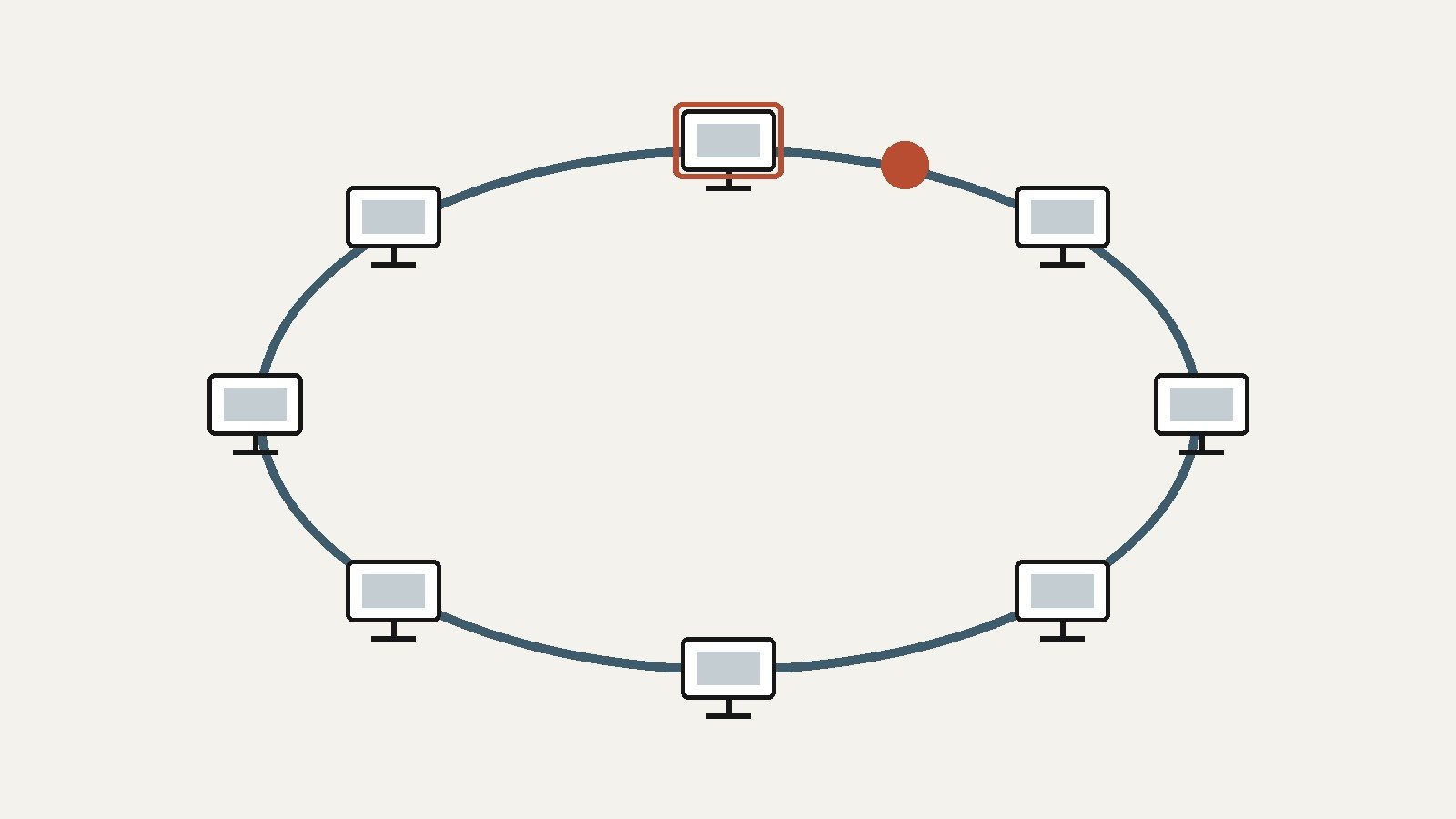
Picture the token as a baton in a relay on a closed-loop track. The token is a short frame, three bytes long in the IEEE 802.5 design, traveling around the ring whenever nobody is sending. Each computer (a station) watches the traffic passing through it.
When a station has data to send, it waits for a free token, claims it, and attaches its data frame: destination address, the data itself, and error-checking information. The combined frame continues around the ring. Every station examines it as it passes; the addressee copies the data, marks the frame as received, and lets it continue. When the frame completes the full circle back to the sender, the sender removes it and releases a fresh token, giving the next station its turn.
Three consequences matter. First, there are no collisions, ever: only one station can hold the token, so only one can transmit. Second, access is fair and bounded: standards limited how long a station could hold the token, so every station was guaranteed a turn within a calculable maximum wait. Engineers call this deterministic behavior, Token Ring’s proudest feature. Third, the ring needs housekeeping: if a token was lost or corrupted, the standard defined recovery procedures, including a designated monitor role, so a clean token could be regenerated.
A Logical Ring Wired as a Star
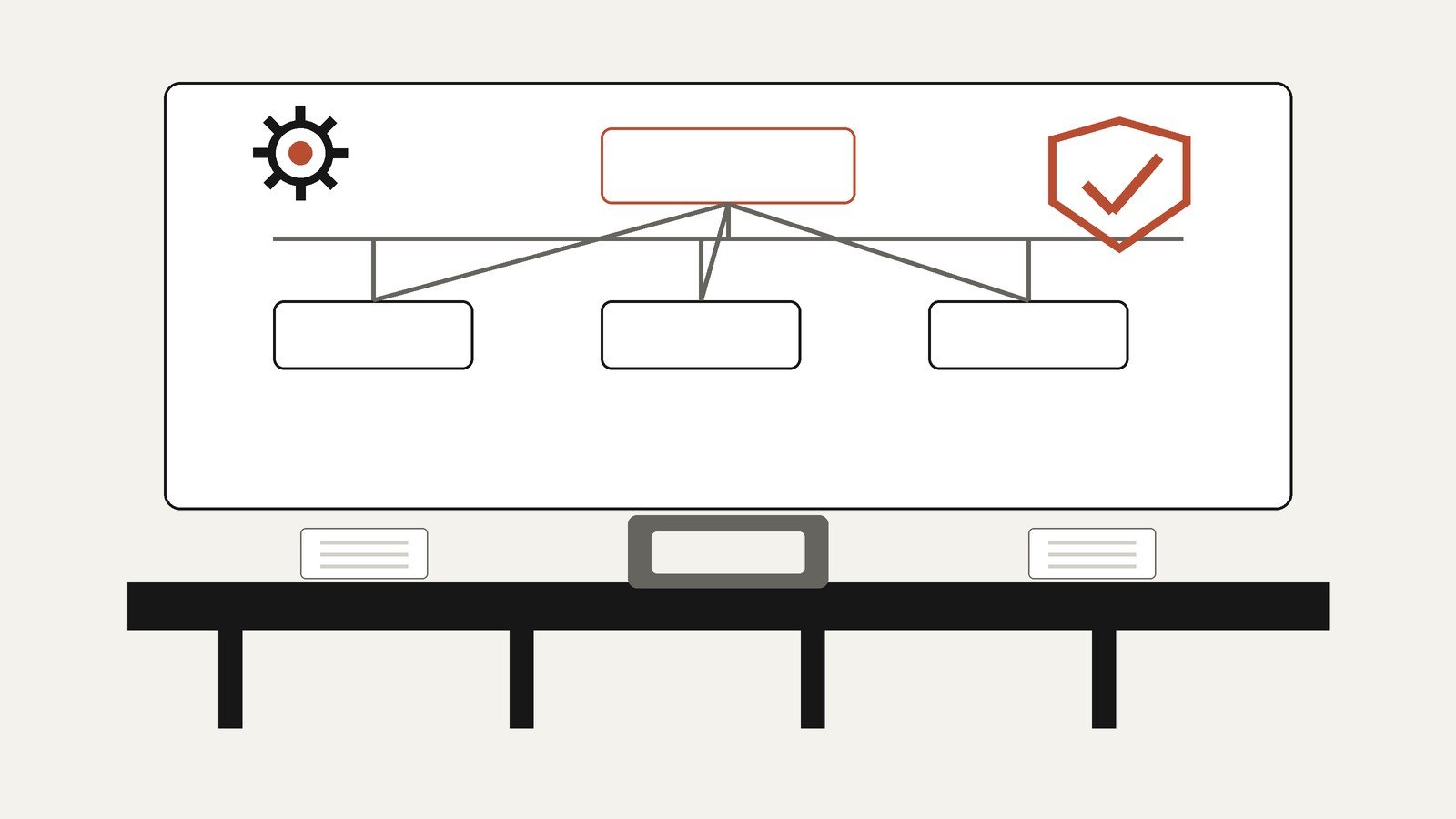
The word ring describes the path data takes, not usually the shape of the cables. In most installations, each computer connected by its own cable to a central wiring box called a multistation access unit, or MAU. Inside the MAU, the connections were chained so that signals still traveled from station to station in a loop: out to one computer, back, out to the next, and so on. Unplugging a computer let the MAU bypass it automatically, so one desk being rearranged did not break the whole office network.
IBM’s original cabling was shielded twisted pair, known as IBM Type 1, with bulky proprietary data connectors. Each station also acted as a repeater, regenerating the signal at full strength as frames passed through, which let rings span a building. Later versions ran over ordinary unshielded telephone-style wiring, but by then the contest was already turning.
A Short History
Ring networks with circulating control signals were explored by several teams in the 1970s, including the Cambridge Ring project in England. IBM’s version was designed chiefly at its Zurich Research Laboratory, by engineers including Werner Bux and Hans Müller. The American firm Proteon shipped its own 10 Mbit/s token ring product, ProNet-10, in 1981.
IBM launched its Token Ring Network on October 15, 1985. It ran at 4 Mbit/s, connected IBM PCs, midrange systems, and mainframes, and used the star-wired arrangement described above. IBM’s design became the basis of the IEEE 802.5 standard, though IBM remained its dominant vendor, and its patents and licensing shaped the market.
Speed was the obvious weakness. A faster 16 Mbit/s version was standardized in 1988, and IBM shipped 16 Mbit/s products in 1989; the standard also added early token release, letting a sender free the token sooner and use the ring more efficiently. A 100 Mbit/s version was standardized in the late 1990s and briefly marketed, but arrived after the market had moved on and saw little use. A 1,000 Mbit/s standard was approved in 2001, yet no products were ever built to it, and 802.5 development effectively stopped.
Token Ring vs. Ethernet
Ethernet, standardized as IEEE 802.3 in 1983, took the opposite approach to sharing a cable. In classic Ethernet, any station could transmit whenever the cable seemed quiet, a method called CSMA/CD (carrier sense multiple access with collision detection). If two stations started at once, their signals collided; both stopped, waited a random interval, and tried again.
| Token Ring (IEEE 802.5) | Classic Ethernet (IEEE 802.3) | |
|---|---|---|
| Access rule | Only the token holder may send | Any station may try when the cable is quiet |
| Collisions | Impossible by design | Possible; handled by stopping and retrying |
| Behavior under load | Predictable maximum wait for every station | Delays grow and become unpredictable as traffic rises |
| Typical speeds | 4, later 16 Mbit/s | 10 Mbit/s, then rapid increases |
| Ecosystem | IBM-led, licensed, costly adapters and hubs | Multi-vendor, increasingly cheap adapters |
IBM argued, with some justification, that Token Ring was the more professional system: on a heavily loaded network, Ethernet’s collisions and retries wasted capacity, while a token ring kept delivering orderly, measurable performance, which suited financial and administrative workloads. Ethernet’s defenders replied that their networks were far cheaper, simpler, and fast enough at ordinary loads.
The argument was settled less by engineering than by economics and timing. Ethernet ran over cheap unshielded telephone wiring with 10BASE-T in 1990, adapters became commodity parts from many competing vendors, and speeds climbed quickly: 100 Mbit/s Fast Ethernet in 1995, Gigabit Ethernet by the end of the decade. Just as important, Ethernet switches gave each computer a dedicated connection, eliminating collisions and removing Token Ring’s best argument. Token Ring, tied to one dominant vendor and pricier hardware, could not keep pace on price or speed.
Why It Disappeared
Four causes reinforced each other. Cost: Token Ring adapters, MAUs, and cabling cost noticeably more than Ethernet equivalents, and licensing obligations on vendors helped keep it that way. Complexity: token housekeeping, monitor functions, and IBM-specific cabling made Token Ring harder to install and troubleshoot than Ethernet’s simpler model. A single-vendor center of gravity: Ethernet was an open standard pushed by many companies, while Token Ring remained identified with IBM, so the industry’s energy pooled elsewhere. Timing: 100 Mbit/s Token Ring arrived in the late 1990s, when Fast Ethernet was already entrenched and gigabit speeds were on the way.
By the early 2000s, new Token Ring installations had effectively ended, and remaining networks were replaced as offices upgraded. The Computer History Museum’s networking timeline captures the era’s shape: Ethernet, born at Xerox PARC in 1973, faced stiff competition from IBM’s formidable Token Ring, and prevailed.
Where the Ideas Survive
The hardware is gone, but token passing solved a real problem, guaranteeing orderly, predictable access to a shared resource, and that bargain survives in several places.
FDDI, the fiber-optic ring standard used for campus backbones in the 1990s, borrowed token passing directly, at 100 Mbit/s. Industrial networks kept the idea longest: fieldbus systems such as PROFIBUS pass a token between master controllers so factory equipment gets deterministic, scheduled access, because on a production line a guaranteed wait matters more than raw speed. The same priority appears in modern time-sensitive networking, which adds strict scheduling to ordinary Ethernet to recover the predictability Token Ring offered natively. And in distributed computing, token-based algorithms, where the right to act circulates among machines, remain a standard way to coordinate access without a central controller. The ring is gone; the turn-taking is not.
Frequently Asked Questions
Is Token Ring the same as a ring topology?
Not exactly. Ring topology describes any network arranged in a loop. Token Ring is a specific technology, IBM’s design standardized as IEEE 802.5, defined by token passing. Most Token Ring installations were physically wired as a star through a MAU while behaving logically as a ring.
Why was Token Ring called deterministic?
Because a station’s maximum wait for the token could be calculated in advance: turns were orderly, token holding times were capped, and no collisions or random retries could intervene. Classic Ethernet could not offer that guarantee, since its delays depended on chance collisions.
Was Token Ring faster than Ethernet?
Not in raw speed. Token Ring launched at 4 Mbit/s against Ethernet’s 10 Mbit/s, reached 16 Mbit/s by 1989, and effectively stalled there, while Ethernet went on to 100 Mbit/s and beyond. Token Ring’s claim was efficiency and predictability under load, not headline speed.
Can you still buy or use Token Ring equipment?
Only as legacy stock and surplus; no mainstream vendor markets it, and IEEE 802.5 development has stopped. Surviving installations are rare and normally replaced rather than expanded. Token Ring is a museum and examination topic now, not a purchasing option.
What is the difference between Token Ring and Token Bus?
Both pass a token to control access. The difference is the layout: Token Ring circulates the token around a ring of stations, while Token Bus, standardized as IEEE 802.4 and once used in factory automation, passes it in sequence along a shared bus cable.
Conclusion
A token ring was an orderly network: a three-byte permission slip circulating endlessly, giving each computer a fair, predictable turn to speak, and eliminating collisions by design. IBM built it well and standardized it as IEEE 802.5. It disappeared anyway, outrun by an Ethernet that was cheaper, good enough, and improving faster, and that eventually solved its own collision problem with switching. Token Ring survives as proof that the best-behaved technology does not always win, and, in industrial control and deterministic networking, as a set of ideas that never stopped being useful.
Keep reading: When Was the Internet Invented — and Who Invented It?
Sources & references
- IEEE (ieee.org): IEEE Std 802.5, Token Ring access method and physical layer specifications; IEEE Milestones program history of Ethernet, recording how IEEE 802.3 expanded past IEEE 802.5 Token Ring.
- Computer History Museum (computerhistory.org), Timeline of Computer History, "Networking and the Web": Ethernet's 1973 origins at Xerox PARC and its competition with IBM's Token Ring.
- Tomsho, G., Guide to Networking Essentials (Course Technology): Token Ring speeds of 4, 16, and 100 Mbit/s; the 1,000 Mbit/s standard approved in 2001 with no products manufactured; token-passing access and deterministic behavior.
- Encyclopedia entry, "Token Ring" (encyclopedia.pub, MDPI): IBM Zurich Research Laboratory origins with Werner Bux and Hans Müller; IBM's launch on October 15, 1985, at 4 Mbit/s; 16 Mbit/s standardized in 1988; the token passing mechanism shared with ARCNET, Token Bus, and FDDI.