Short answer
- A neural network is a computational model made of layers of simple units (artificial neurons) joined by connections with adjustable weights.
- Each unit adds up its inputs, multiplied by their weights, and passes the result through a simple rule called an activation function.
- Training means showing the network many examples, measuring its errors, and nudging the weights a little at a time until the errors shrink.
- A network with several hidden layers is a deep neural network; training such networks is deep learning.
- Neural networks do not think or understand like brains. They find statistical patterns, and can fail outside the patterns they trained on.
A neural network is a kind of software that learns patterns from examples instead of following rules a programmer wrote by hand. It is built from many small units, called artificial neurons, arranged in layers and connected to each other. Each connection has a weight, a number that says how much influence one unit has on the next. Train the network on enough examples and those weights settle into values that let it recognize patterns in new data: faces in photos, words in speech, or the likely translation of a sentence.
The Building Block: One Artificial Neuron
Everything starts with a single unit. An artificial neuron receives several numbers as inputs. It multiplies each input by that connection’s weight, adds the results, adds one extra adjustable number called a bias, and passes the total through an activation function, a simple rule that decides the unit’s output. Encyclopaedia Britannica describes the same idea with a threshold: if the total of a neuron’s weighted inputs passes a certain value, the neuron sends a signal onward to the next layer.
Two things are worth noticing. The unit itself is not smart; multiplication and addition are all it does. And the network’s knowledge sits in no single place: what it has learned is distributed across its connections and their weights, as Britannica notes, not written in as explicit rules.
Layers: Input, Hidden, and Output
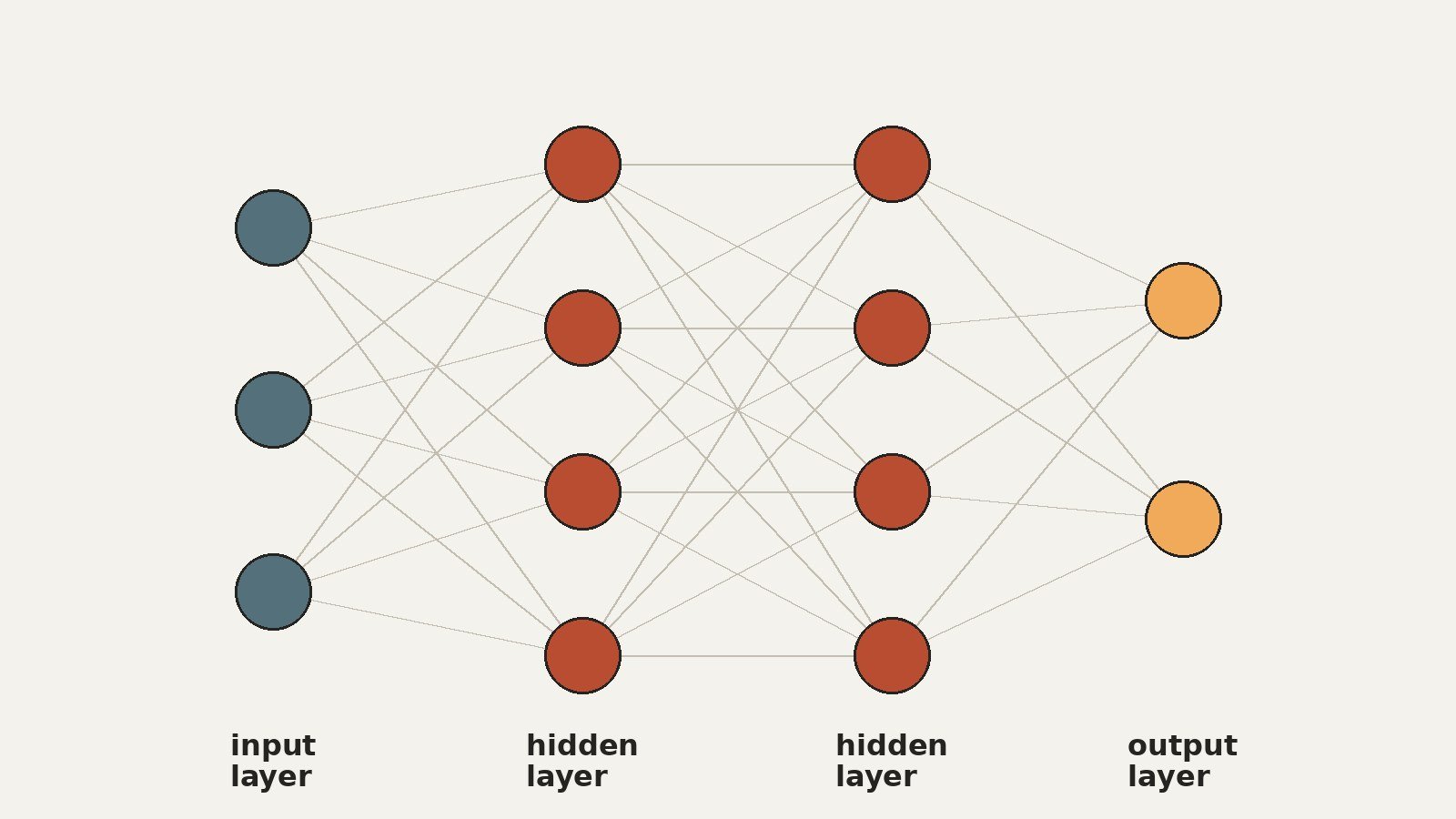
Neurons are organized into layers, and information normally flows in one direction, from first layer to last. NIST’s AI glossary describes this family as feedforward neural networks, and the three kinds of layer are the standard vocabulary for all of them.
The input layer receives the raw data, converted into numbers. For an image, the inputs might be the brightness values of pixels. For a loan application, in Britannica’s example, they are facts from the applicant’s profile.
Hidden layers sit between input and output, with no direct contact with the outside world, and this is where most processing happens. Each hidden unit combines signals from the previous layer in a different weighted mix, so hidden layers gradually build up useful intermediate features: edges and shapes in an image, for instance, before anything as specific as a face.
The output layer produces the answer: a category, a score, or a set of probabilities.
One hidden layer can already do useful work. Stacking several makes the network deep, and deep networks can learn more layered, abstract patterns, at the cost of more data and computing power to train.
A Tiny Worked Example
Small numbers make the mechanics visible. Imagine a single neuron deciding whether you should take an umbrella. It has three inputs and a threshold of 6:
- Rain in the forecast (1 for yes, 0 for no), weight 5
- Cloud cover score (0, 1, or 2), weight 2
- Strong wind (1 for yes, 0 for no), weight minus 1, because wind makes umbrellas miserable
With rain forecast, full cloud cover, and no wind, the sum is (1 × 5) + (2 × 2) + (0 × −1) = 9. That passes the threshold of 6, so the neuron fires: take the umbrella. With no rain, light cloud (score 1), and strong wind, the sum is (0 × 5) + (1 × 2) + (1 × −1) = 1. Below the threshold, so the neuron stays off: leave it at home.
A real network is this same arithmetic repeated across thousands or millions of units and layers, the outputs of early layers feeding later ones. Nothing more mysterious happens inside; the power comes from the scale, and from how the weights are set, which is the subject of training.
How a Neural Network Learns
Training is the process of setting the weights. In the most common setup, supervised learning, the network is shown many examples that already carry the right answers: photos labeled cat or not cat, recordings paired with transcripts.
For each example, the network makes a prediction, software measures the error against the correct answer, and an algorithm adjusts every weight slightly in the direction that would have reduced that error. The process repeats, often many times over the whole set of examples.
The standard adjustment method is called backpropagation, because the error is worked backward through the layers to decide how much each connection contributed to it. Building on earlier work by others, the method was popularized by a 1986 paper in Nature, “Learning representations by back-propagating errors,” by David Rumelhart, Geoffrey Hinton, and Ronald Williams. Its key demonstration was that hidden units, given this training signal, learn useful features of the task on their own, features nobody had to design by hand.
Two consequences follow. A network can only learn patterns its training data contains, so biased or sloppy data produces a biased or sloppy network. And training is computationally expensive, which is why deep networks became practical only as hardware and datasets grew.
A Short History
The idea is older than the modern computer industry. In 1943, Warren McCulloch and Walter Pitts published “A Logical Calculus of the Ideas Immanent in Nervous Activity” in the Bulletin of Mathematical Biophysics: the first mathematical model of a neuron, a unit that sums its inputs and fires if a threshold is met. They showed networks of such units could, in principle, carry out logical operations.
The next step was learning. In 1957 and 1958, psychologist Frank Rosenblatt at the Cornell Aeronautical Laboratory described and built the perceptron, a network whose weights could change with experience. The hardware version, the Mark I Perceptron, read input through a grid of 400 photocells and adjusted its connection strengths with motor-driven potentiometers. The machine is now held by the Smithsonian’s National Museum of American History.
The perceptron also exposed the approach’s limits. A single layer can only separate patterns that are, mathematically, linearly separable, a limitation a 1969 book by Marvin Minsky and Seymour Papert, Perceptrons, laid out in detail. Interest cooled until 1980s training methods, above all backpropagation, made multilayer networks practical to teach. Scaled up with modern data and hardware, those networks became the deep learning systems behind most current AI applications.
Where Neural Networks Are Used
The same basic machinery appears anywhere a pattern has to be recognized in messy data:
- Images: recognizing faces, objects, and scenes in photos, and assisting specialists who review medical scans.
- Speech and language: transcribing spoken words, translating between languages, and powering the language models behind chatbots.
- Handwriting and documents: reading handwritten text and sorting scanned forms, an early commercial use Britannica lists.
- Filtering and recommendations: ranking email as spam or not spam, and suggesting films, music, and products.
- Prediction: scoring applications and transactions for likely risk, using input profiles like Britannica’s loan example.
Limits and Common Misconceptions
It is not a brain. The resemblance is loose inspiration, not equivalence. Artificial neurons are simple arithmetic; real neurons are living cells of far greater complexity, and a trained network has no awareness or understanding of the world.
It does not know facts; it holds patterns. Ask about something absent from its training data and it will still produce an output, sometimes a confidently wrong one. Weak performance outside its trained patterns is a known limitation, not an edge case.
It reflects its training data. Skewed examples produce skewed results. It cannot correct biases it was never shown.
It is hard to inspect. Because what a network has learned is spread across millions of weights, there is usually no single place to look to explain one specific decision. This black box quality is a practical problem for auditing, and one reason bodies such as NIST publish guidance on AI risk and trustworthiness.
More layers are not automatically better. Depth adds cost and data requirements, and more ways to go wrong, including overfitting: memorizing training examples instead of learning patterns that generalize.
Frequently Asked Questions
Is a neural network the same thing as artificial intelligence?
No. A neural network is one technique within machine learning, itself one branch of artificial intelligence. Many AI systems use no neural networks, and many neural networks do narrow jobs, such as flagging spam.
What is the difference between a neural network and deep learning?
Deep learning is the use of neural networks with multiple hidden layers. Every deep learning system is a neural network, but a small network with one hidden layer is a neural network without being deep.
Do neural networks learn on their own, without people?
Not in the way the phrase suggests. People choose the architecture, gather and label the training data, set the goal the error is measured against, and decide when the result is good enough. Training automates the adjustment of weights, not the whole process.
Can a neural network explain its answers?
Usually not in plain language. Its reasoning is encoded as weight values, so researchers use separate probing tools to approximate why an output was produced. Treat any simple explanation of a specific decision with caution.
Conclusion
A neural network is a layered arrangement of simple units, each doing weighted sums and passing results onward, whose behavior comes from its connection weights rather than hand-written rules. Training sets those weights by repeatedly comparing predictions with correct answers and correcting errors, a method practical since backpropagation spread in the 1980s and powerful at modern scale. Its limits are just as consistent: it knows only the patterns in its data, can be confidently wrong outside them, and its decisions are hard to inspect. Understanding the mechanism, one neuron at a time, is the best defense against both the hype and the fear.
Sources & references
- Encyclopaedia Britannica (britannica.com), "Neural network": layered structure of input, hidden, and output neurons; weights and thresholds; knowledge distributed across connections; applications including handwriting recognition and loan decisions.
- National Institute of Standards and Technology, CSRC Glossary (csrc.nist.gov): AI terminology drawn from NIST AI 100-2, including feedforward neural networks and related neural network terms.
- McCulloch, W. S., and Pitts, W. (1943), "A Logical Calculus of the Ideas Immanent in Nervous Activity," Bulletin of Mathematical Biophysics 5: the first mathematical model of a neuron.
- Smithsonian National Museum of American History (americanhistory.si.edu), object record for the Mark I Perceptron: built at the Cornell Aeronautical Laboratory, Buffalo, New York; sensory, association, and response units; funding from the Office of Naval Research and the Rome Air Development Center.
- Rumelhart, D. E., Hinton, G. E., and Williams, R. J. (1986), "Learning representations by back-propagating errors," Nature 323: how backpropagation adjusts weights to reduce error and lets hidden units learn features.