Short answer
- Saturn has 293 confirmed moons as of October 2026, the figure NASA reports from the Jet Propulsion Laboratory's solar system catalogue (stated by NASA as of August 2026).
- The single biggest change came on March 11, 2025, when the International Astronomical Union recognized 128 additional moons found by Edward Ashton and colleagues, lifting the total from 146 to 274.
- The count rose again in 2026: 11 moons announced March 16 (total 285), seven on April 9 (292), and one regular moon on June 17 (293).
- Only 25 of the 293 are regular moons on neat, near-circular orbits. The other 268 are irregulars: small, distant, tilted, often retrograde, and many are fragments of larger moons shattered by collisions.
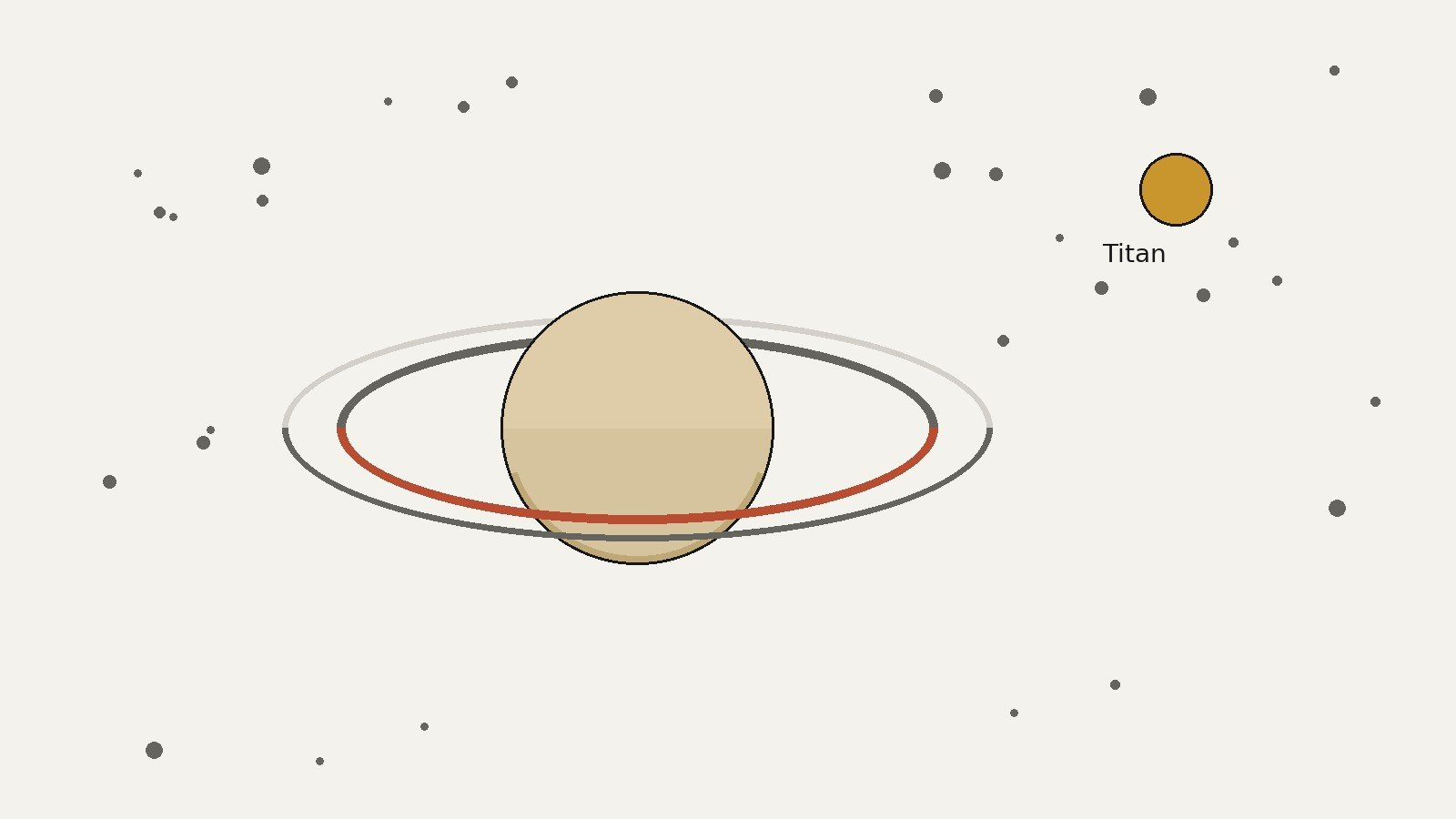
- The giants are Titan, larger than the planet Mercury, with a thick nitrogen atmosphere and lakes of liquid methane, and Enceladus, which sprays water from a buried ocean into space.
- Saturn's rings are not moons and are not counted, and neither are the tiny propeller moonlets embedded in the rings, which have nicknames but no official designations.
Saturn has 293 confirmed moons, as of October 2026. That sentence needs its date, because few numbers in astronomy move the way this one does. As recently as 2019 the official count stood at 82. In May 2023 it jumped to 146. On March 11, 2025, the International Astronomical Union recognized 128 more moons at a stroke, taking the total to 274 and making headlines around the world. Then, while most reference pages were still printing 274, the count quietly moved three more times: 11 further moons announced on March 16, 2026, seven more on April 9, 2026, and a single regular moon on June 17, 2026, bringing the total to the 293 that NASA’s Saturn pages now report. Almost none of these moons is new in any physical sense. They are small, dark, distant rocks that have orbited Saturn for billions of years; what is new is our ability to find them and the patience of the confirmation process. This article gives the current count with its date, explains how a speck in a telescope image becomes an official moon, profiles the famous few, and settles the rings question and the rivalry with Jupiter.
The Dated Answer: 293, as of October 2026
The honest way to answer this question is with a number and a date together. The number is 293 confirmed moons. The date is October 2026, and the source is NASA, whose Saturn moons page states that Saturn has 293 confirmed moons in its orbit as of August 2026, a figure drawn from the catalogue maintained by NASA’s Jet Propulsion Laboratory (JPL) Solar System Dynamics group. “Confirmed” is doing real work in that sentence. It means each of the 293 has been observed often enough, over a long enough span, for its orbit to be computed reliably and checked by the International Astronomical Union’s Minor Planet Center, the clearing house for small bodies in the solar system. Candidate moons that have been spotted once but not yet tracked long enough do not count, and at any given moment there are usually more candidates in the pipeline.
Expect the number to rise again. Every deep survey of the space around Saturn has found more moons than the one before, and astronomers who work on the problem estimate that many small moons remain below the detection limits of completed surveys. When the count changes, it changes in batches, on announcement dates like the ones above, which is why any answer without a date attached starts going stale the day it is published.
| Date | Event | Saturn’s confirmed total |
|---|---|---|
| October 2019 | 20 moons announced by Scott Sheppard’s team | 82 |
| May 2023 | 62 moons announced by Edward Ashton’s team, plus one | 146 |
| March 11, 2025 | 128 moons recognized by the IAU | 274 |
| March 16, 2026 | 11 irregular moons announced | 285 |
| April 9, 2026 | 7 irregular moons announced | 292 |
| June 17, 2026 | 1 regular moon announced | 293 |
How Saturn Got to 293: A Short History of the Count
For most of the telescopic era, Saturn’s family grew one famous moon at a time: Titan in 1655, then Iapetus and Rhea in the 1670s, Tethys and Dione in 1684, Mimas and Enceladus in 1789, Hyperion in 1848, and Phoebe, the ninth, found by William Pickering on photographic plates taken in 1898 and announced in 1899, orbiting backwards, the first hint of the irregular multitude to come. Spacecraft changed the rate. Voyager flybys and then the Cassini mission, which orbited Saturn from 2004 to 2017, pushed the count through the dozens, and by the end of the Cassini era 62 moons were known.
The modern surge is a ground-based story. In October 2019 a team led by Scott Sheppard at the Carnegie Institution announced 20 moons at once, taking Saturn to 82 and past Jupiter’s then total of 79 for the first time. The lead changed hands again in early 2023 when new announcements lifted Jupiter to 95, and then changed back decisively in May 2023, when Edward Ashton’s team announced 62 moons, and one further moon days later, for a total of 146. Saturn became the first planet known to have more than 100 moons, and it has held the lead ever since, extending it with the 128 of March 2025 and the 19 added during 2026. The pattern is not that Saturn suddenly grew moons. It is that telescopes, cameras, and image-processing techniques kept improving, and teams pointed them at Saturn’s outskirts, where a swarm of small moons had always been waiting.
The 2025 Announcement: 128 Moons at Once
The March 11, 2025 recognition remains the largest single addition ever made to any planet’s moon count. The moons were found by a team led by Edward Ashton, a postdoctoral fellow at the Academia Sinica Institute of Astronomy and Astrophysics in Taiwan, working with Brett Gladman of the University of British Columbia, Mike Alexandersen of the Center for Astrophysics | Harvard and Smithsonian, and Jean-Marc Petit of the Observatoire de Besançon in France. The University of British Columbia announced the result publicly on the day the International Astronomical Union recognized the moons, through announcements issued by the Minor Planet Center.
The method is called shift-and-stack. The team first surveyed the fields around Saturn with the Canada-France-Hawaii Telescope on Mauna Kea between 2019 and 2021, the campaign behind the 2023 batch, then returned to the same fields for three months in 2023, digitally shifting each frame to follow Saturn’s motion through the sky before stacking them, so that objects moving with Saturn added up into visible points while stars smeared into trails. The technique reaches objects around 25th to 27th magnitude, far too faint for any single exposure. All 128 of the new moons are irregulars, each only about 2 to 4 kilometers across, and many belong to known families of moons traveling on similar orbits. The team reads those families as the debris of larger moons that were captured by Saturn long ago and later smashed apart by collisions, with some family concentrations suggesting breakups as recent as about 100 million years ago, yesterday by solar system standards. Ashton, who had also led the work behind the 62 moons of 2023, noted that the new finds were the product of patiently re-examining the same fields to fainter limits, and that still fainter moons almost certainly remain to be found.
How a Moon Becomes Official
A moon does not become official when it is first photographed. It becomes official when its orbit is proven. The sequence runs like this. A survey team detects a moving point of light near Saturn. The object is then followed, sometimes for years, and searched for in older archived images, a process called precovery, until observations spanning several oppositions pin down its path around the planet. The evidence goes to the Minor Planet Center, which checks the orbit, links it to any earlier sightings, and publishes the announcement in its Minor Planet Electronic Circulars. At that point the moon receives a provisional designation such as S/2025 S 1, recording the year of the first identified observation, and it joins the confirmed count in catalogues like JPL’s.
Names come later, and by tradition. Since the 1800s, Saturn’s moons have been named for figures from mythology: the classical moons for Titans and giants of Greek and Roman myth, and the irregulars, by IAU convention, from three further traditions matched to their orbital families. Retrograde moons in the Norse group take names from Norse mythology, while the prograde irregulars take Inuit names for the Inuit group and Gallic names for the Gallic group. The discoverers propose the names, sometimes drawing on public contests, as happened for the moons announced in 2019, and the IAU’s Working Group for Planetary System Nomenclature approves them. Fewer than a quarter of the 293 moons have proper names so far. The rest answer to designations, which is one reason the modern count feels abstract next to Titan and Enceladus: most of Saturn’s moons are, for now, entries in a catalogue rather than characters in a story.
The Moons You Can Picture
Of the 293, a handful carry almost all of the fame. These are the large moons, most of them known for centuries, and each was verified against NASA’s Saturn system pages.
Titan is the giant: 5,150 kilometers (3,200 miles) across, the second-largest moon in the solar system and larger than the planet Mercury, which measures about 4,879 kilometers across. Titan is the only moon with a substantial atmosphere, a thick nitrogen-rich blanket with a surface pressure about one and a half times Earth’s, laced with methane that behaves the way water does on Earth: it evaporates, forms clouds, rains, and collects in lakes and seas near the poles, including Kraken Mare, the largest of them. Christiaan Huygens discovered Titan in 1655, and the European Space Agency’s Huygens probe, carried by Cassini, landed on its surface in 2005, still the most distant landing ever made.
Enceladus, only 504 kilometers (313 miles) across, is the surprise of the Cassini era. In 2005 the spacecraft found jets of water vapor and ice grains erupting from four long fractures, the “tiger stripes,” near its south pole. Gravity measurements and the moon’s slight wobble later showed that the jets are fed by a global ocean of liquid water beneath the ice shell, and the spray continuously resupplies Saturn’s faint, wide E ring. Enceladus is now ranked among the most promising places in the solar system to search for the conditions life needs. It was discovered by William Herschel in 1789, the same year he found Mimas.
Iapetus (1,470 kilometers across, discovered by Cassini in 1671) wears two faces: its leading hemisphere is coated in material almost as dark as coal while the trailing hemisphere is bright ice, a contrast noticed in the 1600s because the moon seemed to vanish at one side of its orbit. It also carries a ridge running along much of its equator, rising in places to about 13 kilometers high, taller than Everest, on a body barely a ninth as wide as Earth. Rhea (1,527 kilometers, 1672) is Saturn’s second-largest moon, an icy, heavily cratered body. Dione (1,123 kilometers, 1684) is marked by bright, wispy cliffs of exposed ice where its crust has fractured. Tethys (1,062 kilometers, 1684) is nearly pure water ice and carries Odysseus, a crater 400 kilometers wide, about two fifths of the moon’s own diameter, plus the Ithaca Chasma canyon system. Mimas (396 kilometers, 1789) is dominated by the Herschel crater, 130 kilometers wide, roughly a third of the moon’s diameter, which gives it its famous Death Star profile; recent orbital studies even suggest, surprisingly, that Mimas may hide a young ocean beneath that battered shell.
25 Regulars, 268 Irregulars, and Collisional Families
Twenty-five of the 293 are regular moons: the large classics above, the small moons threaded through and just beyond the rings, and a few mid-sized icy moons, all orbiting close to Saturn’s equatorial plane in orderly, near-circular paths. These formed, astronomers believe, from the same disc of material that built Saturn itself. Everything else, some 268 moons, is an irregular: small, far from the planet, on orbits that are tilted, stretched into ellipses, and in the Norse group’s case backwards, orbiting in the opposite direction to Saturn’s spin.
Irregulars are not native. They are understood to be objects captured by Saturn’s gravity in the distant past, and many have since been broken up. The prototype is Phoebe, announced in 1899 from photographic plates taken the year before, 213 kilometers across, dark and battered, orbiting retrograde at a great distance. The dozens of moons sharing Phoebe-like orbital neighborhoods sort into the Inuit, Gallic, and Norse families, and within those families, subgroups of moons share orbits so similar that they are best explained as fragments of single parent bodies destroyed by impacts. That is why the counts explode when a survey goes deeper: a shattered moon does not leave one target to find, it leaves a trail of dozens, each a few kilometers wide, each waiting to be counted once telescopes can reach it.
Saturn vs Jupiter: The Moon Race
Jupiter is the only planet that has ever rivalled Saturn here, and the lead has swapped repeatedly, always because of announcement dates rather than any change in the planets themselves. Jupiter led for decades. Saturn passed it in October 2019, 82 moons to 79. Jupiter retook the crown in early 2023 at 95. Saturn seized it for good, so far, in May 2023 at 146, and has since stretched the gap to 274 in March 2025 and 293 by June 2026. Jupiter, meanwhile, climbed through 97 to 115 during the spring of 2026 in NASA’s JPL catalogue, so as of October 2026 the standings are Saturn 293, Jupiter 115.
Why the lopsided totals, when the two planets are otherwise so similar? Partly history: Saturn’s outskirts have lately received the deeper, more systematic survey effort, culminating in the Ashton team’s shift-and-stack campaigns. Partly geometry: both teams are fishing at the edge of visibility, and the catch depends on telescope time, sky conditions, and how much of each planet’s Hill sphere, the region where its gravity rules, has been swept to a given depth. Both planets are thought to harbor further hundreds of kilometer-scale moons that no survey has yet confirmed. The race is therefore best understood as a scoreboard of observational effort: Saturn is not necessarily richer in moons than Jupiter, it is currently better searched. When a comparably deep campaign is run at Jupiter, expect its number to lurch upward in the same way.
Are the Rings Moons? And the Moonlets Between
No to the rings, with an interesting boundary case. Saturn’s rings are countless particles of water ice, from centimeters to a few meters across, orbiting as a swarm rather than as individual bodies; none of them is a moon, and none is counted. Some genuine moons live among the rings: Pan, a small moon about 28 kilometers wide, orbits inside the Encke Gap and keeps it clear, while Daphnis does the same for the Keeler Gap, and Prometheus and Pandora help confine the narrow F ring. These shepherd moons have secured orbits and designations, and they are part of the 293.
The boundary case is the propeller moonlets. In the A ring, Cassini photographed hundreds of small objects, tens of meters to around a kilometer across, each sweeping out a distinctive propeller-shaped disturbance in the ring material around it. They are large enough to have informal nicknames, several of them honor pioneers of aviation, Blériot, Earhart, and Santos-Dumont among them, but under IAU practice they are not designated as satellites and do not appear in the count. Their orbits are entangled with the ring itself, they are tracked as features rather than as bodies with published orbital solutions, and the line the IAU draws is exactly there: a moon, for counting purposes, is a body whose orbit around the planet has been established and published. The propellers sit below that line, the shepherds sit above it, and the 293 respects the distinction.
Frequently Asked Questions
How many moons does Saturn have right now?
293 confirmed moons, as of October 2026. NASA’s Saturn moons page gives the figure as of August 2026, drawn from the Jet Propulsion Laboratory’s catalogue of confirmed satellites.
Why does Saturn’s moon count keep changing?
Because “confirmed” requires a proven orbit, and faint moons are found faster than they can be confirmed. Deep telescope surveys keep detecting smaller and more distant moons, often in batches, and each batch raises the official count when the Minor Planet Center recognizes it: 128 at once in March 2025, and 19 more across the spring of 2026.
What is Saturn’s largest moon?
Titan, at 5,150 kilometers (3,200 miles) across. It is the second-largest moon in the solar system, larger than the planet Mercury, and the only moon with a thick atmosphere, a nitrogen-rich sky with lakes of liquid methane at its poles.
Does Jupiter have more moons than Saturn?
No. As of October 2026 Jupiter has 115 confirmed moons in NASA’s JPL catalogue, against Saturn’s 293. Jupiter last led in early 2023, briefly, at 95, before Saturn’s May 2023 jump to 146.
Do Saturn’s rings count as moons?
No. The rings are swarms of ice particles centimeters to meters across, not individual bodies. The small shepherd moons that orbit within gaps in the rings, such as Pan and Daphnis, do count, but the embedded propeller moonlets in the A ring do not, because they have no published orbital solutions or IAU designations.
How small is the smallest counted Saturn moon?
A few of the confirmed irregulars are only about 2 kilometers across, roughly the size of a small town, and they shine at around 26th magnitude. Astronomers expect still smaller moons to exist in large numbers, below the reach of completed surveys.
Conclusion
As of October 2026, Saturn has 293 confirmed moons, and the date matters as much as the number. The count stood at 146 in early 2025, leapt by 128 in a single IAU recognition that March, and crept up three more times during 2026 as the confirmation pipeline worked through the backlog of faint, distant irregulars. Beneath the arithmetic sits a real structure: 25 regular moons that formed with the planet, 268 captured rocks and collision fragments beyond them, giants like Titan and ocean-bearing Enceladus among the regulars, and a clear IAU line that keeps the rings and their propeller moonlets out of the tally. The next deep survey will move the number again. When it does, the right question will not be “how many moons does Saturn have?” but “how many, as of when?”
Keep reading: How Far Is Earth From the Sun? The AU, and Why the Distance Changes
Sources & references
- NASA Science, "Saturn Moons" (science.nasa.gov): "Saturn has 293 confirmed moons in its orbit as of August 2026," with the count linked to the Jet Propulsion Laboratory Solar System Dynamics satellite catalogue; the same page tabulates Saturn's named moons with discovery years, discoverers, and Minor Planet Electronic Circular references, including the March 2025 batch (MPEC 2025-E155) and the 2023 batch (MPEC 2023-J and 2023-K series).
- University of British Columbia news release, March 11, 2025: the International Astronomical Union's recognition of 128 additional moons, the discovery team led by Edward Ashton (Academia Sinica) with Brett Gladman (UBC), Mike Alexandersen, and Jean-Marc Petit, the Canada-France-Hawaii Telescope shift-and-stack surveys of 2019 to 2021 and 2023, and the prior total of 146 from 2023. Corroborated by Smithsonian Magazine's report of March 12, 2025, and by Academia Sinica's own announcement.
- Wikipedia, "Moons of Saturn" (history of discoveries chronology), consulted for the 2026 announcement sequence: 11 irregular moons announced March 16, 2026 (total 285), seven irregulars announced April 9, 2026 (total 292), and one regular moon announced June 17, 2026 (total 293); also the split of 25 regular and 268 irregular moons and the Inuit, Gallic, and Norse naming groups.
- NASA Science, Saturn system and Cassini mission pages: Titan's diameter of 5,150 km, its nitrogen atmosphere and methane lakes including Kraken Mare; Enceladus's 504 km diameter, south polar plumes, global subsurface ocean, and role in supplying the E ring; the discovery years and discoverers of the classical moons (Huygens 1655; Cassini 1671, 1672, 1684; Herschel 1789) and the dimensions of Iapetus's equatorial ridge and Mimas's Herschel crater.
- NASA/JPL reporting via StarWalk and JPL Solar System Dynamics summaries consulted October 2026: Jupiter's confirmed count of 115 as of spring 2026, up from 95 in 2023, used for the moon race comparison with dates attached.
- Encyclopaedia Britannica, "Saturn" (ring system article): the rings as swarms of ice particles, the shepherd moons Pan, Daphnis, Prometheus, and Pandora, and the distinction between ring material and satellites; Cassini results on propeller moonlets in the A ring are described in NASA Cassini mission reporting.


