Short answer
- Earth's average distance from the Sun is about 150 million kilometers (93 million miles). That average is the astronomical unit, or AU.
- Since 2012 the AU has been defined exactly: 1 AU = 149,597,870,700 meters, which is 149,597,870.7 kilometers or 92,955,807 miles.
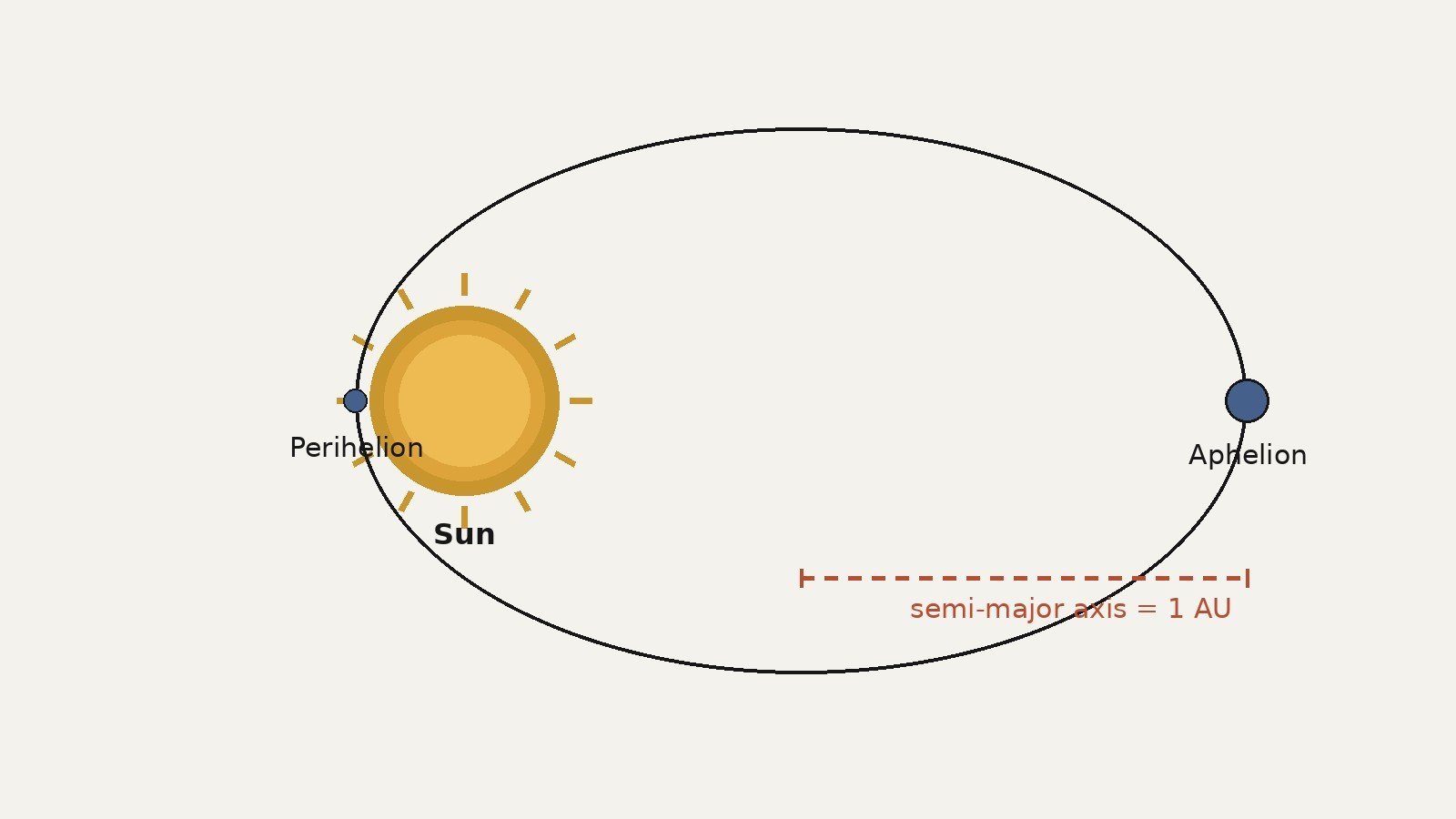
- The distance is not constant. Earth reaches perihelion, its closest point, at about 147.1 million km (91.4 million miles) in early January, and aphelion, its farthest point, at about 152.1 million km (94.5 million miles) in early July.
- Sunlight takes about 8 minutes 20 seconds to cover 1 AU, traveling at 299,792.458 kilometers per second.
- Being closest in January does not make January warm in the Northern Hemisphere. Seasons come from the tilt of Earth's axis, not from the small change in distance.
- The distance was first measured well in 1672, using the parallax of Mars, then refined by timing transits of Venus in 1761 and 1769, and finally pinned down by radar echoes from Venus in the 1960s.
Ask how far Earth is from the Sun and you will get one number: about 93 million miles, or 150 million kilometers. That number is correct, but it hides two things. First, since 2012 the underlying unit has not been an approximation at all. The astronomical unit is defined as exactly 149,597,870,700 meters, a fixed constant of astronomy, like the speed of light. Second, Earth never actually sits at that distance for long. Our orbit is an ellipse, so the planet swings from about 147.1 million kilometers from the Sun in early January to about 152.1 million kilometers in early July, a difference of 5 million kilometers that most people never hear about, and that produces the oddest fact in this whole article: Earth is closest to the Sun in the middle of the northern winter. This article gives the direct answer, defines the unit precisely, explains why the distance changes, and finishes with the three-century detective story of how anyone managed to measure it.
The Short Answer: About 93 Million Miles
Earth’s orbit is very nearly centered on an average distance that astronomers call the semi-major axis of the orbit: 149.6 million kilometers, according to NASA’s Planetary Fact Sheet. Rounded the way most people quote it, that is about 150 million kilometers, or about 93 million miles. It is the number behind the phrase “light takes eight minutes to get here,” and it is the yardstick for the entire solar system: every planet’s distance from the Sun is traditionally expressed as a multiple of it.
The word “average” needs one qualification. Earth does not spend the year circling at a steady 149.6 million kilometers. The semi-major axis is the mean of the closest and farthest points of the orbit, the number you get by adding perihelion and aphelion and halving the result: (147.1 + 152.1) / 2 = 149.6 million kilometers. At any given moment, Earth is somewhere on the stretch between those two extremes, moving slowly outward from January to July and slowly inward again from July to January. There is no date on which the distance is exactly 1 AU and stays there; the planet passes through that value on its way out and again on its way back.
The Astronomical Unit: An Exact Number Since 2012
The astronomical unit began as a measured quantity, the mean distance from Earth to the Sun, and for most of its history it carried an error bar. In August 2012, at its General Assembly in Beijing, the International Astronomical Union (IAU) voted to end that arrangement. Resolution B2 of the 2012 assembly redefined the unit as a fixed number of meters: exactly 149,597,870,700 meters. No measurement can ever revise it again, because it is now a definition rather than a measurement. If future observations show that Earth’s average distance differs slightly from the defined value, it is the orbit’s value that changes in the textbooks, not the unit.
Why freeze a number that astronomers had spent centuries trying to measure? Because by 2012 their measurements had become better than the definition they were measuring against. The older definition, in force from 1976, tied the AU to a mathematical constant used in orbital calculations, and it made the unit depend slightly on where you stood and on the mass of the Sun. Radar and spacecraft tracking had by then fixed the scale of the solar system so precisely that this fuzziness had become the largest source of error in the whole system. Defining the AU as an exact number of meters, in the same spirit as the exact speed of light, removed it.
The defined value converts cleanly. One AU is 149,597,870.7 kilometers, or 92,955,807 miles. The tabulated light travel time for one AU, the time sunlight needs to cross the unit, is 499.0047838061 seconds. Those spare digits are not pedantry: they are what let mission planners aim a spacecraft at a planet that will not be where it is now when the craft arrives.
Why Astronomers Needed a Unit at All
For most of history, nobody knew the size of the solar system, but from the early 1600s they knew its shape with remarkable precision. Kepler’s third law of planetary motion relates each planet’s orbital period to its distance from the Sun, and periods are easy to measure just by watching. Working from periods alone, astronomers could build a complete map of the solar system in relative units: Venus at about 0.72 of Earth’s distance, Mars at about 1.52, Jupiter at about 5.2, Saturn at about 9.5. What the map lacked was a scale bar. Every distance was known as a multiple of the Earth-Sun distance while the Earth-Sun distance itself, in miles or kilometers, was unknown to within a factor of ten or worse.
That single missing number is why the AU mattered so much. Measure it once, anywhere, and the whole map snaps into absolute units: the size of every orbit, the distances spacecraft must travel, and the physical scale of the Sun itself all follow. The unit also became the first rung of the ladder used to measure the stars. The parallax of a nearby star, the tiny annual shift in its position as Earth moves from one side of its orbit to the other, is measured against the AU as a baseline, and the parsec, the standard unit of stellar distance, is defined through it: one parsec is 206,265 AU, about 3.26 light-years. An error in the AU would have echoed all the way up that ladder. Today the work runs the other way: distances to planets are still routinely quoted in AU, exoplanet orbits are compared to Earth’s in AU, and the “habitable zone” around another star is usually described by analogy with our own 1 AU from the Sun.
The Distance Changes: Perihelion and Aphelion
Earth’s orbit is an ellipse with the Sun at one focus, and a slightly stretched one. Its eccentricity, the standard measure of how far an orbit departs from a circle, is about 0.0167. That sounds like nothing, and visually the orbit is close to circular, but stretched across 150 million kilometers even a small eccentricity produces a large absolute swing. NASA’s Planetary Fact Sheet gives the extremes as 147.09 million kilometers at perihelion and 152.10 million kilometers at aphelion.
| Point in orbit | Distance from the Sun | In miles | When it occurs |
|---|---|---|---|
| Perihelion (closest) | 147.1 million km | 91.4 million miles | Early January |
| Mean distance (1 AU) | 149.6 million km | 93.0 million miles | Passed twice a year, outbound and inbound |
| Aphelion (farthest) | 152.1 million km | 94.5 million miles | Early July |
The gap between the two extremes is about 5.0 million kilometers, roughly 3.3 percent of the mean distance. Because the intensity of sunlight falls with the square of the distance, that small percentage is amplified: sunlight at perihelion is about 7 percent stronger than at aphelion. Earth as a whole genuinely receives about 7 percent more solar energy in January than in July. Early January’s perihelion currently falls around January 3 or 4, about two weeks after the December solstice, and early July’s aphelion around July 4 to 6.
So why is the Northern Hemisphere freezing at the very moment its planet is closest to the Sun? Because the distance effect is a minor character in the seasons story. Seasons are driven by the 23.5 degree tilt of Earth’s axis. In January the North Pole is tipped away from the Sun, so northern sunlight arrives at a low angle, spread thin, and the days are short; the extra 7 percent of energy cannot compensate for geometry like that. The Southern Hemisphere, tipped toward the Sun at the same moment, gets its summer at perihelion, which is one reason southern summers receive somewhat more intense sunlight than northern ones, although the south’s vast oceans absorb and soften the difference. The seasons treatment in Amberaisle’s solstice articles works through the tilt geometry in full; the point here is only that the calendar of distance and the calendar of seasons run on different machinery. The alignment is also temporary on astronomical timescales: around the year 1246, perihelion coincided with the December solstice itself, and it has been creeping later in the calendar ever since.
Sunlight Takes About 8 Minutes 20 Seconds
The light travel time follows directly from the defined AU and the speed of light, which is itself exact: 299,792.458 kilometers per second. Divide the distance by the speed: 149,597,870.7 km / 299,792.458 km per second = 499.0 seconds, which is 8 minutes 19 seconds, conventionally rounded to about 8 minutes 20 seconds. The IAU’s own tabulated value for the light time of one AU is 499.0047838061 seconds.
Because the distance changes, the travel time changes with it. At perihelion, sunlight reaches us in about 8 minutes 11 seconds; at aphelion it takes about 8 minutes 27 seconds. Either way, we never see the Sun as it is, only as it was roughly eight and a third minutes ago, and if the Sun somehow vanished, Earth would continue in daylight and in orbit for those eight minutes, unaware, because gravity’s news travels at the same speed as light.
The comparison that makes the AU feel large is the Moon. The Moon orbits at an average of 384,400 kilometers, and its light reaches us in about 1.3 seconds. The Sun is about 389 times farther away than the Moon: divide 149,597,871 by 384,400 and you get 389. Equivalently, the Moon sits about 1/389 of the way to the Sun, barely out of the driveway, and the sunlight that left the Sun eight minutes ago passed the Moon’s orbit only in its final 1.3 seconds of travel. For spacecraft the delays grow quickly. Radio signals to Mars, depending on where the planets are, take anywhere from about 3 minutes to about 22 minutes each way, which is why rovers drive themselves rather than waiting for instructions.
How We Measured It: Parallax, Transits, and Radar
The measurement problem was brutal. The Sun’s parallax, the angle that encodes the distance, is under 9 arcseconds, about the apparent width of a small coin seen from half a kilometer away, and the Sun has no background stars behind it to measure against during the day. Three generations of technique were needed.
The first real measurement came in 1672. The Italian astronomer Giovanni Domenico Cassini, working in Paris, arranged for his colleague Jean Richer to observe Mars from Cayenne in French Guiana, on the coast of South America, while Cassini observed from Paris. Mars was then near a particularly close opposition, less than 60 million kilometers away. Comparing the planet’s position against the background stars from two points roughly 7,000 kilometers apart gave its parallax, and Kepler’s laws converted the distance to Mars into the distance to the Sun. Cassini obtained a solar parallax of about 9.5 arcseconds, corresponding to an AU of roughly 140 million kilometers (about 87 million miles), within about 7 percent of the true value. John Flamsteed in England, working independently by a slightly different method, reached essentially the same figure. After millennia of guesses that were off by factors of ten or twenty, the solar system suddenly had approximately the right size.
The transit method was meant to do better. In 1716 Edmond Halley pointed out that a transit of Venus, when Venus crosses the face of the Sun, could pin down the parallax if observers at widely separated latitudes timed the crossing precisely, and he urged future astronomers to be ready for the transits of 1761 and 1769. They were. Expeditions sailed worldwide in both years, the most famous being James Cook’s voyage to Tahiti aboard Endeavour to observe the 1769 transit. The results were good but messy, scattered between about 8.43 and 8.80 arcseconds of parallax, blurred partly by the “black drop” effect, a visual smearing at the edge of Venus’s silhouette that spoiled the exact moments of contact. In the 1820s the German astronomer Johann Franz Encke combined the 1761 and 1769 data into a single value of 8.5776 arcseconds, an AU of about 153 million kilometers. It was about 2.5 percent too large, but it stood as the accepted figure for decades and shows how hard won every digit was.
Radar ended the argument in a single decade. On March 10, 1961, engineers at NASA’s Jet Propulsion Laboratory turned the Goldstone antenna in California toward Venus and received clear radar echoes; a team at MIT’s Lincoln Laboratory found echoes in its own records from days earlier. Timing the round trip of a radio pulse measures a distance directly, with no angular geometry at all. JPL’s ranging runs of April and May 1961 produced an AU of 149,599,000 kilometers with an uncertainty of only about 1,500 kilometers, an overnight improvement of roughly fifty times over the best classical values, and a correction of more than 100,000 kilometers to the figure then in use. Had NASA flown its 1962 Mariner 2 mission to Venus on the old value, the probe could have missed the planet by more than 100,000 miles. Through the 1960s, radar results from several countries converged on 149.598 million kilometers to within a few kilometers, the IAU adopted 149,597,870 kilometers in 1976, and spacecraft telemetry has since refined the scale of the solar system to meters. The 2012 definition simply acknowledged that the measuring was finished.
Putting One AU in Perspective
Numbers like 149,597,870.7 kilometers defeat intuition, so here are the same distance in units of familiar things, with the arithmetic shown so you can check each one.
- Earth diameters. Earth’s mean diameter is 12,742 kilometers. Dividing gives 149,597,871 / 12,742 = about 11,700 Earths laid side by side between us and the Sun.
- Trips to the Moon. At an average of 384,400 kilometers, the trip to the Moon repeated about 389 times reaches the Sun.
- Driving. At a steady 100 km/h (62 mph), covering 1 AU would take about 1,496,000 hours, which is about 62,300 days, or roughly 170 years of nonstop driving. A passenger jet cruising at 900 km/h would need about 19 years.
- Suns. The Sun’s own diameter is about 1,392,700 kilometers, so about 107 Suns would fit side by side along 1 AU. The unit that measures the gulf between Earth and the Sun is only 107 times the width of the Sun itself, a reminder that the Sun is enormous even by solar system standards.
Frequently Asked Questions
How far is Earth from the Sun in miles?
About 93 million miles on average. Precisely, the astronomical unit is 92,955,807 miles, Earth’s closest approach (perihelion) is about 91.4 million miles, and its farthest point (aphelion) is about 94.5 million miles.
Does the distance between Earth and the Sun change?
Yes. Earth’s orbit is an ellipse, so the distance varies continuously through the year between about 147.1 million kilometers in early January and about 152.1 million kilometers in early July, a swing of about 5 million kilometers, or 3.3 percent.
Why is Earth closest to the Sun in January, during the northern winter?
Because seasons are caused by the tilt of Earth’s axis, not by the distance. In January the Northern Hemisphere is tilted away from the Sun, so its sunlight is weaker per square meter and its days are short, and that geometric effect far outweighs the roughly 7 percent boost in total sunlight that comes from being closer.
What exactly is an astronomical unit?
Since 2012, it is a defined length: exactly 149,597,870,700 meters, set by the International Astronomical Union. Historically it meant Earth’s mean distance from the Sun, and it remains the standard yardstick for distances inside the solar system and the baseline for measuring distances to the stars.
How long does it take for sunlight to reach Earth?
About 8 minutes 20 seconds on average. The tabulated figure for 1 AU is 499.0047838061 seconds, and across the year the actual travel time ranges from about 8 minutes 11 seconds at perihelion to about 8 minutes 27 seconds at aphelion.
Is Earth moving away from the Sun?
Very slowly, in principle. The Sun steadily loses mass as it converts matter into sunlight and blows off a solar wind, so its gravitational grip weakens slightly and the orbits of the planets expand by a tiny amount, on the order of a centimeter or so per year by some estimates, though published estimates of the rate differ and the figure remains model-dependent. The effect is far too small to matter for climate or calendars, and it does not change the AU itself, which is fixed by definition.
Conclusion
The answer to “how far is Earth from the Sun” is three answers wearing one coat. The rounded answer, about 93 million miles or 150 million kilometers, is the one to carry in your head. The exact answer, 149,597,870,700 meters, is a definition the IAU fixed in 2012 once measurement had become better than the thing being measured. And the honest answer is that the distance is a range, 147.1 to 152.1 million kilometers, with Earth closest to the Sun in early January for reasons that have nothing to do with the seasons. Getting from ancient guesses to that exact figure took a Mars parallax measured across an ocean in 1672, global expeditions to watch Venus cross the Sun in 1761 and 1769, and radar pulses bounced off Venus in 1961. The number on the page is short. The three centuries inside it are not.
Keep reading: What Is a Black Hole? (The “Dark Hole” in Space, Explained)
Sources & references
- NASA/NSSDC, Planetary Fact Sheet: Earth's semi-major axis 149.60 x 10^6 km, perihelion 147.09 x 10^6 km, aphelion 152.10 x 10^6 km, orbital eccentricity 0.0167, Earth mean diameter 12,742 km; NASA Earth facts pages give perihelion as about 91.4 million miles and aphelion as about 94.5 million miles.
- International Astronomical Union, Resolution B2 (2012 General Assembly): the astronomical unit is defined as exactly 149,597,870,700 meters, and the light travel time for one AU is 499.0047838061 seconds; EarthSky's summary of the IAU value gives 92,955,807 miles for the AU.
- Butrica, A.J., "To See the Unseen: A History of Planetary Radar Astronomy" (NASA History Office): JPL's Venus radar ranging of April to May 1961 and the resulting AU of 149,599,000 km with an uncertainty of about 1,500 km, an improvement of roughly fifty times over earlier values; corroborated by Smithsonian Magazine's account of the Goldstone March 10, 1961 detections and the more than 100,000 mile miss that the old AU value could have caused for Mariner 2.
- Van Helden, A., "Measuring the Universe" (summary hosted by Tufts University): the 1672 Cassini and Richer Mars parallax campaign, Paris and Cayenne, yielding a solar parallax of 9.5 arcseconds, about 21,600 Earth radii (roughly 140 million km) for the AU, with Flamsteed independently obtaining essentially the same value.
- IMCCE (Paris Observatory) and ESO histories of solar parallax determinations: individual results from the 1761 and 1769 transits of Venus ranged from 8.43 to 8.80 arcseconds; Encke's 1824 combination gave 8.5776 arcseconds; radar-era values settled at 8.79415 arcseconds, equivalent to 149.5978 million km.
- Encyclopaedia Britannica, "Astronomical unit" and "Parallax" articles: the unit's role as the baseline of stellar parallax, one parsec equalling 206,265 AU, and the historical sequence from Kepler's relative distance scale to the 2012 exact definition.


