Short answer
- Flu B is influenza B, one of the two types of influenza virus that cause seasonal flu epidemics in people. Along with influenza A, it circulates each flu season and infects the nose, throat, and sometimes the lungs. Influenza B is not divided into subtypes the way influenza A is. Instead, it is divided into two lineages, B/Victoria and B/Yamagata, named for reference strains. Unlike influenza A, which infects a wide range of animals and is the only influenza type known to have caused pandemics, influenza B circulates mainly in people. That narrower host range is one reason it is not associated with pandemics, but it does not make influenza B harmless. It can cause mild to severe illness, and serious complications occur mainly in groups at higher risk, including young children, older adults, pregnant women, and people with chronic medical conditions or weakened immune systems. This article is general information about a virus. It is a virus explainer, not medical advice, and it does not diagnose or treat any illness.
The Name, in Plain Language
The word “flu” is short for influenza, the illness caused by influenza viruses. The letter in “flu B” is not a grade, a severity rating, or a strain name. It is the virus type. Scientists sort influenza viruses into four types, A, B, C, and D, based on differences in their internal proteins. When a laboratory result, a surveillance report, or a news story says “influenza B,” it means the virus belonged to type B rather than to type A, C, or D.
Only types A and B cause the seasonal epidemics that people call flu season. Type C is detected less often and usually causes mild illness. Type D primarily affects cattle and is not known to infect or cause illness in people. So when people talk about “the flu” in an ordinary winter season, they are almost always talking about influenza A or influenza B, and often about a mix of both circulating at the same time.
It also helps to separate flu B from two common uses of the word “flu” that have nothing to do with influenza B. The first is the common cold, which is caused by different viruses and which the Centers for Disease Control and Prevention (CDC) describes as a different illness from flu. The second is the phrase “stomach flu,” a popular name for illnesses that mainly affect the stomach and intestines. Influenza is a respiratory illness. Vomiting and diarrhea can occur with flu, and the CDC notes that they are more common in children than in adults, but they are not the defining feature of influenza.
Where Influenza B Fits in the Influenza Family
The World Health Organization (WHO) fact sheet on seasonal influenza gives the cleanest map of the family. There are four types of influenza viruses, types A, B, C, and D. Influenza A and B viruses circulate and cause seasonal epidemics of disease. Influenza A viruses are further classified into subtypes according to combinations of proteins on the surface of the virus. The subtypes currently circulating in people are A(H1N1) and A(H3N2). Only influenza type A viruses are known to have caused pandemics. Influenza B viruses are not classified into subtypes but can be broken down into lineages, and they belong to either the B/Yamagata or the B/Victoria lineage. Influenza C is detected less frequently and usually causes mild infections. Influenza D viruses primarily affect cattle and are not known to infect or cause illness in people.
| Type | Main hosts | Seasonal epidemics in people | Divided into |
|---|---|---|---|
| Influenza A | People and many animals | Yes | Subtypes, such as A(H1N1) and A(H3N2) |
| Influenza B | Mainly people | Yes | Lineages: B/Victoria and B/Yamagata |
| Influenza C | People | No, generally mild and sporadic | Not a seasonal epidemic type |
| Influenza D | Mainly cattle | No | Not known to infect people |
Two points deserve emphasis. First, “mainly people” for influenza B is a statement about where the virus circulates and causes seasonal epidemics, not a claim that no other animal has ever carried a related virus. The literature records influenza B infections and related viruses in a small number of other hosts, including seals, but WHO and CDC frame influenza B as a human seasonal virus in contrast to influenza A, which is found in many different animals. Second, the absence of subtypes for influenza B is not a gap in knowledge. It reflects the biology: influenza B is not divided into hemagglutinin and neuraminidase subtypes, so the subtype system used for influenza A does not apply. Lineages are the finer division that does apply.
What the Virus Itself Looks Like
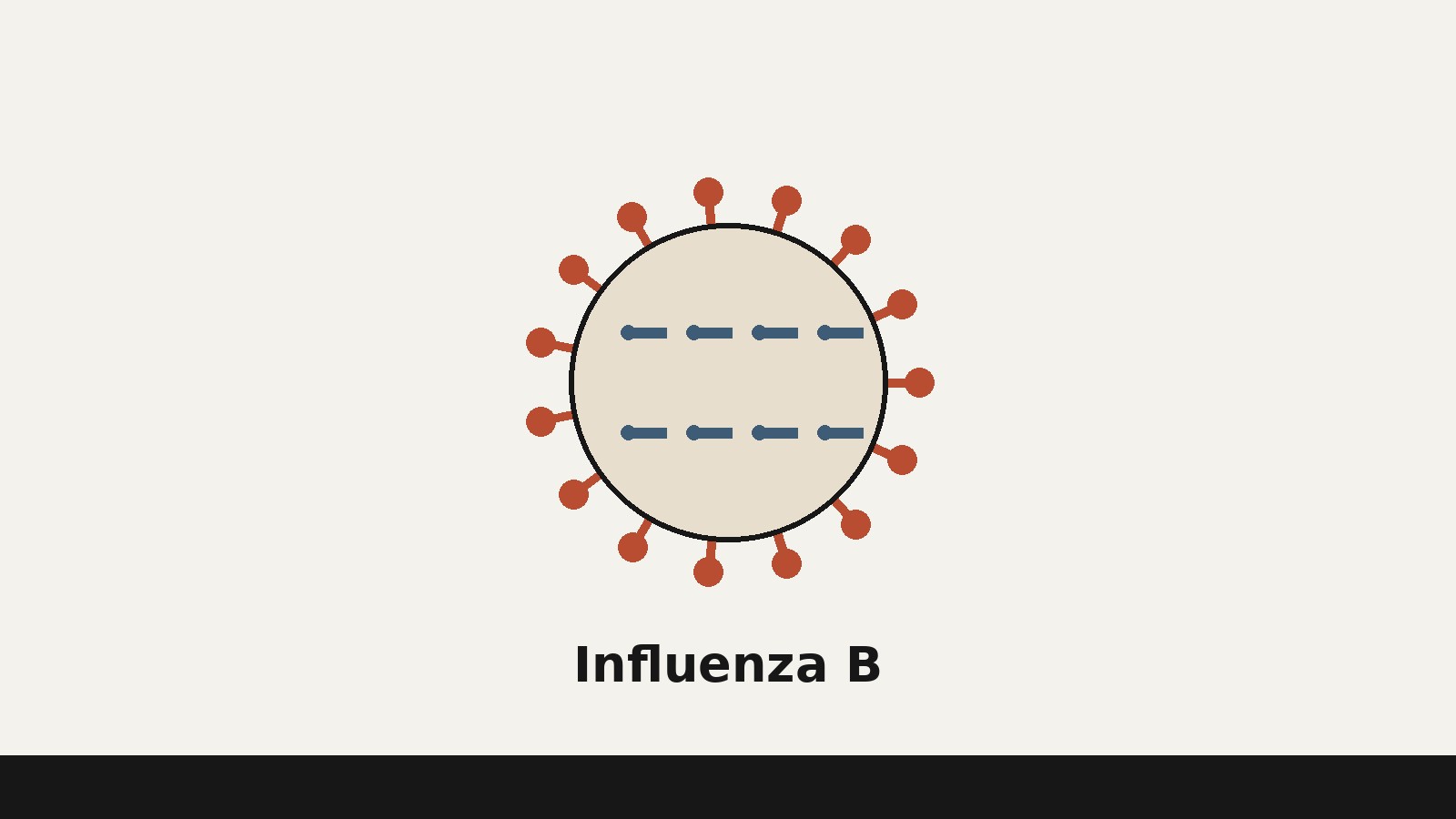
Influenza B belongs to the virus family Orthomyxoviridae. It is an enveloped virus, which means its genetic material is wrapped in a membrane taken from the host cell it infected. Inside that envelope, the genome is not a single strand. It is made of eight separate segments of negative sense, single stranded RNA. Each segment carries instructions for one or more viral proteins, and the segmented design matters for how the virus changes, as explained below.
On the surface of the envelope sit the proteins that give influenza viruses much of their behavior. The two best known are hemagglutinin, shortened to HA, and neuraminidase, shortened to NA. Hemagglutinin helps the virus attach to and enter cells in the respiratory tract. Neuraminidase helps newly made viruses leave an infected cell so they can infect neighboring cells. Influenza B also carries a third surface protein, NB, and internal proteins that include a nucleoprotein, a matrix protein, polymerase proteins that copy the genome, and nonstructural proteins that interfere with host defenses.
Influenza viruses are generally described as roughly spherical or oval particles about 80 to 120 nanometers across, although influenza B particles can also appear filamentous, meaning elongated rather than round. A nanometer is one billionth of a meter.
The Two Lineages: B/Victoria and B/Yamagata
If influenza A is divided into subtypes, influenza B is divided into lineages. A lineage is a branch of the family tree: a group of viruses that share a common ancestor and a distinctive pattern in the hemagglutinin protein. The two influenza B lineages are B/Victoria and B/Yamagata. Their names come from reference strains, B/Victoria/2/1987-like viruses and B/Yamagata/16/1988-like viruses, in the naming used in the peer reviewed literature. A surveillance laboratory does not simply look at a virus and guess its lineage. It compares the genetic sequence, especially the hemagglutinin gene, with reference viruses, and assigns the lineage from that comparison.
Both lineages have circulated in people in the same seasons at different times, and neither lineage is simply “the mild one” or “the severe one” as a fixed rule. The lineages are antigenically distinct, meaning that immunity built up against one lineage gives limited protection against the other. That limited cross protection was one reason seasonal flu vaccines in the United States moved, for a period, from three components to four components: one influenza A(H1N1), one influenza A(H3N2), one B/Victoria, and one B/Yamagata, so that both B lineages were covered.
The recent history of B/Yamagata needs to be told carefully, because it is easy to overstate. The CDC states that influenza B/Yamagata lineage viruses have not been detected by global flu surveillance after March 2020. Reports of B/Yamagata detections after that date, where samples were available, were confirmed as naturally occurring B/Victoria lineage viruses or were identified as the B/Yamagata component of live attenuated vaccines, that is, nasal spray flu vaccines. The CDC also states plainly that it is not known whether influenza B/Yamagata lineage viruses are extinct at this time. Surveillance continues, and if the situation changes, vaccine composition can be adapted.
That finding changed vaccine composition in the United States. Beginning with the 2024 to 2025 flu season, the B/Yamagata component was removed from United States flu vaccines, because B/Yamagata viruses were not actively circulating in people and the risk of infection with them was considered low at that time. All flu vaccines in the United States have been trivalent, meaning three component, since the 2024 to 2025 season: one influenza A(H1N1), one influenza A(H3N2), and one influenza B/Victoria lineage virus. This is a description of vaccine composition as set by public health agencies, not a recommendation for any individual, and composition differs by country, season, and product.
How Influenza B Changes Over Time
Influenza viruses change in two broad ways. The first is antigenic drift: small, gradual changes in the surface proteins, especially hemagglutinin, that accumulate as the virus copies itself. Drift is why a population that was protected against last season’s virus may be less protected against this season’s virus, and why flu vaccine composition is reviewed annually and updated for most seasons. Influenza B undergoes antigenic drift, although the peer reviewed literature describes its evolutionary rate as lower than that of influenza A and higher than that of influenza C.
The second kind of change is antigenic shift: a sudden, major change that produces a virus with a new hemagglutinin subtype against which people have little or no immunity. Shift is closely tied to reassortment, the swapping of whole genome segments when two different influenza viruses infect the same cell. Because influenza B has a single hemagglutinin and neuraminidase type and circulates mainly in people, it does not undergo antigenic shift in the way influenza A does, and it is not associated with pandemics. Reassortment between influenza B viruses of different lineages can still occur and can generate new gene combinations, but that is not the same as the emergence of a new pandemic subtype, which is an influenza A phenomenon.
Think of drift as a slow rewrite of a few words, repeated every season, and shift as swapping in an entirely new chapter. Influenza B does the slow rewrite. The phrase “flu B mutates more slowly than flu A” is broadly correct in direction but should not be pushed into a precise number, because published estimates vary with the gene, period, and method studied.
How Flu B Spreads
The CDC describes how influenza viruses spread in general terms that apply to influenza B as a seasonal influenza virus. Most experts believe that flu viruses spread mainly by droplets made when people with flu cough, sneeze, or talk. These droplets can land in the mouths or noses of people who are nearby. Less often, a person might get flu by touching a surface or object that has influenza virus on it and then touching their own mouth, nose, or possibly their eyes. The WHO fact sheet adds the same picture: when an infected person coughs or sneezes, droplets containing viruses are dispersed into the air and can infect persons in close proximity, and the virus can also be spread by hands contaminated with influenza viruses. Transmission is described as rapid in crowded areas, including schools and nursing homes.
Three qualifications apply. Droplet spread is mainly a close proximity phenomenon, not a claim that every exposure at any distance carries the same risk. Surface spread is less common than droplet spread, not the main route. These are statements about influenza viruses generally, applied here to influenza B because it is a seasonal influenza virus, not B specific measurements.
The incubation period, the time from infection to illness, is about 2 days, ranging from 1 to 4 days, according to both WHO and CDC. The CDC notes that people with flu are most contagious during the first three days of illness, that some otherwise healthy adults may be able to infect others beginning one day before symptoms develop and five to seven days after becoming sick, and that young children and people with weakened immune systems may be contagious for longer. These figures describe influenza generally, not influenza B alone.
Signs Commonly Associated With Flu
The CDC and WHO lists for influenza symptoms overlap closely, and they are lists for influenza generally, not a checklist that identifies influenza B in particular. The CDC states that flu symptoms usually come on suddenly, and that people who have flu often feel some or all of these signs and symptoms: fever or feeling feverish with chills, cough, sore throat, runny or stuffy nose, muscle or body aches, headaches, and fatigue. Some people may have vomiting and diarrhea, though this is more common in children than in adults. The CDC adds that not everyone with flu will have a fever, and some people with influenza virus infections do not develop any symptoms at all. A household study conducted during the 2017 to 2023 flu seasons found that 8 percent of people who tested positive for flu did not have symptoms.
The WHO list is similar: sudden onset of fever, cough, usually dry, headache, muscle and joint pain, severe malaise, meaning feeling unwell, sore throat, and runny nose. The WHO adds that the cough can be severe and can last 2 weeks or more, and that most people recover from fever and other symptoms within a week without requiring medical attention, while influenza can cause severe illness or death, especially in people at high risk.
Symptoms alone do not identify the type. The CDC states that it can be very difficult to tell flu apart from other respiratory illnesses based on symptoms alone. The WHO adds that laboratory testing is required to establish a definitive diagnosis. This article does not describe testing procedures, because that would cross from virus explainer into diagnosis. “Flu B” is a laboratory and surveillance classification, not a symptom pattern a person can reliably recognize at home.
Who Is More Likely to Develop Serious Illness
Anyone can get flu, including healthy people, and serious problems related to flu can happen to anyone. That sentence, from the CDC, is the necessary starting point. Within that general risk, some groups are at higher risk of developing serious flu related complications. The CDC lists people 65 years and older, people of any age with certain chronic medical conditions such as asthma, diabetes, or heart disease, people with a body mass index of 40 or higher, pregnant women, and children younger than 5 years, especially those younger than 2 years.
The WHO list is closely aligned: pregnant women, children under 5, older people, individuals with chronic cardiac, pulmonary, renal, metabolic, neurodevelopmental, liver, or hematologic diseases, and individuals with immunosuppressive conditions or treatments. Complications listed by the CDC include bacterial pneumonia, ear infections, sinus infections, and worsening of chronic conditions such as congestive heart failure, asthma, or diabetes. The WHO adds pneumonia and sepsis in severe cases. These are population level descriptions, not predictions about any individual.
Children deserve a specific note. A 2018 CDC study found median incidence values of 9.3 percent for children 0 to 17 years, 8.8 percent for adults 18 to 64 years, and 3.9 percent for adults 65 years and older. The CDC adds that the likelihood of getting sick with flu is different from the likelihood of getting very sick from flu, so this article does not claim that influenza B is specifically a children’s virus.
When Flu B Circulates
In temperate climates, seasonal epidemics occur mainly during winter, according to the WHO, while in tropical regions influenza may occur throughout the year, causing outbreaks more irregularly. CDC surveillance pages describe influenza A and B viruses causing seasonal epidemics almost every winter in the United States.
Within a season, influenza B often becomes more prominent later. Surveillance reporting has noted, in past seasons, that the proportion of specimens testing positive for influenza B rose as the proportion positive for influenza A fell, and that increases in influenza B activity later in the flu season are not unexpected. This article states the pattern in its qualified form: influenza B activity is often observed to rise later in a season, but the timing varies by season, region, and year, and no single month is claimed as the influenza B peak.
The size of a flu season also varies. The WHO estimates around a billion cases of seasonal influenza annually worldwide, including 3 to 5 million cases of severe illness, and 290,000 to 650,000 respiratory deaths annually. Those are figures for seasonal influenza as a whole, not for influenza B alone, and this article does not split them between types, because no stable, single B specific share holds across seasons.
Flu B Compared With Flu A
| Feature | Influenza A | Influenza B |
|---|---|---|
| Host range | People and many animals | Mainly people |
| Division | Subtypes (H1N1, H3N2 currently circulating) | Lineages (B/Victoria, B/Yamagata) |
| Pandemic association | Only type known to have caused pandemics | Not associated with pandemics |
| Seasonal role | Causes seasonal epidemics | Causes seasonal epidemics |
| Change over time | Drift and shift | Mainly drift |
| Symptoms | Broad influenza symptom set | Same broad influenza symptom set |
| Severity | Mild to severe | Mild to severe |
The last two rows are the most often misunderstood. Symptoms do not reliably distinguish A from B, and severity does not belong to one type as a fixed property. Influenza B is generally associated with less severe epidemics at population level than the most severe influenza A seasons, while still capable of causing serious illness in individuals, particularly in higher risk groups. “Flu B is always mild” would be wrong, and this article does not make that claim.
“type” and “strain” are also often confused. A strain is a specific virus isolate, such as a particular B/Victoria virus in a given season. A type is the broad category, B. A lineage is the branch within the type. A vaccine component is a chosen representative virus, or its proteins, selected for that season’s vaccine.
Flu B, Vaccines, and Surveillance
Seasonal flu vaccines are updated routinely, in the WHO’s words, with new vaccines developed that contain viruses that match those circulating. The CDC states that flu vaccines are updated yearly, and that the composition of United States flu vaccines is reviewed annually and updated for most seasons. The WHO, through its Global Influenza Programme and the Global Influenza Surveillance and Response System, recommends seasonal influenza vaccine compositions twice a year, once for the northern hemisphere season and once for the southern hemisphere season, based on surveillance of which viruses are circulating.
For influenza B, the practical consequence is that the B component of a vaccine is chosen from the lineage expected to circulate. When both lineages circulated, quadrivalent vaccines included both B/Victoria and B/Yamagata, because, as the CDC explains, there was little cross protection between the two lineages. Since the 2024 to 2025 season in the United States, trivalent vaccines have included only the B/Victoria lineage, because B/Yamagata has not been detected after March 2020. The WHO has likewise stopped updating recommendations for the B/Yamagata component, while surveillance for B/Yamagata continues. This section describes how vaccine composition is decided. It does not advise any reader about vaccination, because recommendations, eligibility, and product choices vary by country, age, health status, and season, and are set by national public health agencies.
Surveillance is how almost everything in this article about timing and lineages is known. National influenza centers test respiratory specimens and send selected viruses to collaborating centers for genetic sequencing and antigenic characterization, the laboratory comparison of a virus with reference viruses. This machinery produces statements such as “no B/Yamagata viruses have been detected after March 2020.” A single town may experience a sharp influenza B outbreak while national data show influenza A predominating, or the reverse; local outbreaks do not rewrite the national picture.
Common Misunderstandings, Corrected Briefly
“Flu B is just a cold.” It is not. The cold and influenza are caused by different viruses, and influenza is described by the CDC as a contagious respiratory illness that can cause mild to severe illness and at times can lead to death.
“Flu B cannot be serious because it does not cause pandemics.” Pandemic potential and individual severity are different properties. A virus can lack pandemic potential and still cause serious illness in individuals, particularly in higher risk groups.
“If you had flu A, you cannot get flu B in the same season.” Infection with one type does not create the same immunity against the other type, because the types are antigenically distinct, and immunity wanes over time as viruses drift.
“Flu B is gone because B/Yamagata disappeared.” Only one lineage is undetected after March 2020, and even for that lineage the CDC says extinction is not known. B/Victoria continues to circulate.
“The letter B means the virus is weaker, newer, or a variant of flu A.” None of those is correct. B is a type designation based on internal proteins, not a ranking, and influenza B is not a variant of influenza A.
Why Flu B Still Matters
First, it causes a substantial share of seasonal illness. In seasons when influenza B circulates widely, it contributes a large number of cases, clinic visits, school absences, and hospitalizations, even if its share is smaller than influenza A’s in most seasons. Second, for influenza generally, children are the age group most likely to get sick, and schools and nursing homes are named by the WHO as settings where transmission is rapid. Third, it can cause severe illness, and the concentration of severe outcomes in higher risk groups makes those outcomes the focus of surveillance and prevention planning. Fourth, it is a moving target: drift means surveillance and vaccine composition must be revisited annually, and the B/Yamagata episode shows that even the lineage structure of influenza B can change in ways that surprise surveillance systems.
Frequently Asked Questions
What is flu B in simple terms? Flu B is influenza B, one of the two influenza types that cause seasonal flu epidemics. It circulates mainly in people and is divided into two lineages, B/Victoria and B/Yamagata.
Is flu B worse than flu A? There is no single answer for every season and every person. At population level, influenza B is generally associated with less severe epidemics than the most severe influenza A seasons, but it can still cause serious illness, especially in higher risk groups.
What are the two types of flu B? They are lineages, not types: B/Victoria and B/Yamagata, named for reference strains and distinguished mainly by differences in the hemagglutinin protein. Immunity against one lineage gives limited protection against the other.
Is flu B still around? Yes. B/Victoria continues to circulate and is the influenza B component of current United States trivalent flu vaccines. B/Yamagata has not been detected after March 2020, but the CDC states that it is not known whether it is extinct.
Can you get flu B twice? In general terms, yes, across seasons and, in principle, with different types in the same season, because immunity is specific to the viruses encountered, wanes over time, and the viruses drift.
How is flu B different from a cold? Influenza and the common cold are caused by different viruses. Symptoms overlap, and symptoms alone do not reliably distinguish flu from other respiratory illnesses, which is why type is a laboratory classification.
Does flu B cause pandemics? No influenza B pandemic is known. Only influenza type A viruses are known to have caused pandemics, according to the WHO. Influenza B causes seasonal epidemics, not pandemics.
Why do flu vaccines change every year? Because influenza viruses drift and the mix of circulating viruses changes from season to season. The WHO recommends vaccine compositions twice a year, and the CDC reviews United States vaccine composition annually.
Sources & references
- World Health Organization, "Influenza (seasonal)" fact sheet, (four types; A and B cause seasonal epidemics; B divided into B/Yamagata and B/Victoria lineages, not subtypes; only type A known to have caused pandemics; symptoms, incubation period of about 2 days ranging from 1 to 4 days, transmission by droplets and contaminated hands, higher risk groups, vaccine composition recommended twice a year, around a billion cases annually with 3 to 5 million severe cases and 290,000 to 650,000 respiratory deaths for seasonal influenza as a whole)
- Centers for Disease Control and Prevention, "About Influenza," (contagious respiratory illness infecting nose, throat, and sometimes lungs; symptom list including fever, cough, sore throat, runny or stuffy nose, muscle or body aches, headaches, fatigue, and vomiting and diarrhea more common in children; not everyone has fever; some infections asymptomatic, 8 percent in a 2017 to 2023 household study; incubation about two days ranging from one to four days; most contagious in first three days, infecting others from one day before symptoms to five to seven days after in some healthy adults; higher risk groups; droplet spread with surface spread less often; difficulty telling flu apart from other respiratory illnesses by symptoms alone; children most likely to get sick, median incidence 9.3 percent ages 0 to 17, 8.8 percent ages 18 to 64, 3.9 percent ages 65 and older)
- Centers for Disease Control and Prevention, "Trivalent Influenza Vaccines," (all United States flu vaccines trivalent since the 2024 to 2025 season, containing one A(H1N1), one A(H3N2), and one B/Victoria lineage virus; quadrivalent to trivalent transition and little cross protection between B lineages; B/Yamagata not detected after March 2020; later reports explained as B/Victoria or vaccine component; extinction not known; surveillance continues)
- CDC Museum, "Influenza Virus Basics," (four types based on genetic material; A and B cause annual epidemics; hemagglutinin helps the virus bind to and enter respiratory tract cells)
- "A comprehensive review of influenza B virus, its biological and clinical aspects," PMC, (influenza B genome: segmented, negative sense, single stranded RNA in eight segments; surface glycoproteins HA, NA, and NB; BM2 ion channel, matrix protein, nucleoprotein, polymerase proteins PB1, PB2, and PA, nonstructural proteins; Orthomyxoviridae family; two lineages B/Yamagata/16/1988-like and B/Victoria/2/1987-like)
- "Detection and Characterization of New Influenza B Virus Variants in 2002," PMC, (eight negative stranded RNA segments, six coding for internal proteins and two for HA and NA; HA binding to sialic acid containing host cell receptor, NA cleaving sialic acid to promote release; HA antigenic variation mainly in HA1 domain; influenza B HA drift at lower rate than influenza A; reassortment and insertion or deletion as sources of diversity; lineages B/Victoria/2/87 and B/Yamagata/16/88)


