Short answer
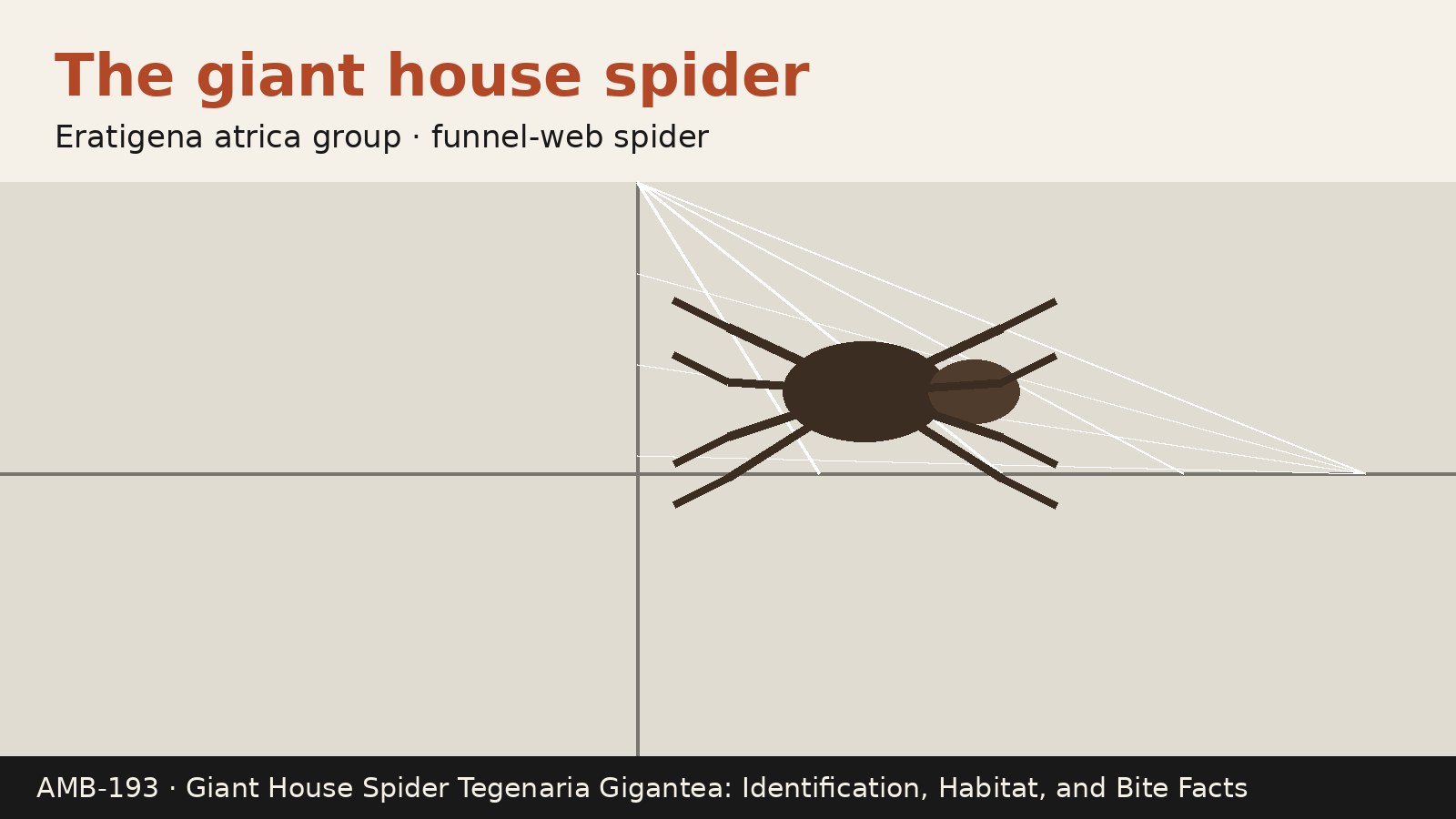
- The giant house spider is a large, brown, hairy funnel-web spider that lives in and around buildings in Europe and in the Pacific Northwest of North America. Its older scientific name, Tegenaria gigantea, is still widely searched, but current taxonomy places the giant house spider group in the genus Eratigena, most often as Eratigena atrica in the broad sense or as three close relatives: Eratigena atrica, Eratigena duellica, and Eratigena saeva. It is not a dangerous spider to people. Washington State University Extension states that its bite is not known to pose any threat to humans, that giant house spiders are not aggressive, and that they usually run away very quickly when startled. The spider that dashes across a living room floor in late summer or autumn is usually a wandering male looking for a mate, not a spider hunting people. The spider trapped in a bathtub is usually stuck on a smooth surface it cannot climb, not a spider that came up through the drain.
Why the name changed
If you search for Tegenaria gigantea, you will find pages that use that name, pages that use Eratigena duellica, and pages that use Eratigena atrica. All three can be talking about the same kind of spider, and the confusion is real taxonomy, not sloppy writing. The British Arachnological Society treats Eratigena atrica, Eratigena duellica, and Eratigena saeva as separate species that are identical in appearance, web, and biology to a casual observer. BugGuide, the identification guide hosted by Iowa State University, explains the sequence. The group was previously placed in the genus Tegenaria and was transferred to Eratigena in August 2013. In that revision, Tegenaria duellica, which includes the former Tegenaria gigantea, and Tegenaria saeva were synonymized with Tegenaria atrica, now Eratigena atrica. In 2018, Oxford and Bolzern restored the three as separate species based on small but consistent differences in morphology.
For a reader, the practical points are simple. Tegenaria gigantea is best read as an older name for part of this group, not as a separate spider living alongside Eratigena duellica. BugGuide states the synonymy directly: Tegenaria duellica equals Tegenaria gigantea. When a source says Eratigena atrica in the broad sense, it may be covering all three close relatives at once. Exact identification to species often needs an expert and close examination. This article therefore uses the label Eratigena atrica group when a statement applies to the group as a whole, and names a single species where a source does so.
What it looks like
The giant house spider is a brown to grayish brown spider with a somewhat hairy body and legs that are not shiny in appearance. Washington State University Extension stresses that color and markings vary widely, from light to dark and from barely visible to very distinct, and that because of this variability, none of these features is reliable for identification on its own. For this spider, size, shape, web, behavior, and location together give a much better identification than color alone. The legs are long in proportion to the body, which is a large part of why the spider looks so much bigger than its body length suggests. The spider is hairy rather than smooth, which separates it at a glance from glossy, dark false widow spiders that sometimes share the same buildings, although hairiness alone never proves an identification.
The Encyclopedia of Life page for the giant house spider, which reproduces the Wikipedia article on the species, describes a mainly dark brown coloration, earthy tones of brown and muddy red or yellow, and conspicuously hairy legs, palps, and abdomen. It reacts to vibration, air movement, and changes in light, and it runs for cover when a large animal approaches. Females are larger bodied and more sedentary, spending most of their lives in or near a web. Males are smaller bodied with proportionally longer legs, and they leave their webs in late summer and autumn to search for females.
How big is it, really
Size figures vary by source, by sex, and by which member of the group is being measured, so this article gives ranges rather than a single headline number. Washington State University Extension gives a practical field range for the giant house spider in Washington: a body typically around one half inch to one inch in length, not including the legs, with a leg span for large adults reaching up to four inches. In metric terms, that is roughly 13 to 25 millimeters of body and up to about 100 millimeters of leg span. BugGuide gives a narrower range for Eratigena duellica: females approximately 16 to 18 millimeters in body length, males smaller at approximately 10 to 12 millimeters, with the note that all measurements are for the body only and do not include the legs. The British Arachnological Society gives body size up to 18 millimeters for Eratigena atrica, Eratigena duellica, and Eratigena saeva alike.
Read together, these figures tell a consistent story. A female has a body roughly the length of a thumbnail, and with legs extended she can span several inches. A male has a smaller body but can have a leg span as wide as a female, which is why wandering males look so large on a wall or floor. A leg span of four inches is the upper end of the range, not the average spider in a house. The group is among the largest spiders of Central and Northern Europe, and it is often described as the largest spider commonly found in homes in Britain. That is a statement about house spiders in a region, not a claim that it is the largest spider in the world.
Where it lives
The giant house spider is native to Europe, and in its original habitat it lives in caves and in dry forests under rocks, according to the Encyclopedia of Life account. Buildings, in ecological terms, are artificial caves: dark, sheltered, relatively stable in temperature, and full of corners, crevices, and undisturbed spaces. In Britain, the British Arachnological Society maps the group as follows. Eratigena atrica in the narrow sense is very localized, occurring only in the greater Newcastle upon Tyne area and around Perth and Dundee. Eratigena duellica is common and widespread across the east of England and the Midlands, giving way to Eratigena saeva in the west. In northern England and Scotland, duellica and saeva co-occur. All three use houses and outbuildings, and duellica is also found in crevices, under stones and logs, and in holes in banks.
In North America, the story is one of introduction and establishment. BugGuide records that the species was imported from Europe into the ports of the Pacific Northwest, with the first known North American record from Vancouver Island in 1929, and arrival in Seattle not until 1960. The Electronic Atlas of the Fauna of British Columbia, published by the University of British Columbia, describes it as a harmless introduced spider in southern British Columbia, frequently found around human habitation. Washington State University Extension places it commonly in and around Washington homes west of the Cascade Mountains, with a range that also includes parts of coastal Canada and Oregon, and states that it is not found east of the Cascades in Washington. A reader in Texas, Florida, or New York who finds a large brown spider in a house is unlikely to be looking at a giant house spider. Location is therefore a real identification clue.
The funnel web
The giant house spider is a funnel weaver, a member of the family Agelenidae, and its web is its most reliable field sign. The British Arachnological Society describes the web for the house spider group in one sentence: these large, long legged, brown spiders produce a sheet web that leads to a tubular retreat. Washington State University Extension adds that giant house spiders build sheets of webbing with a funnel-like hole in the center, where the spider sits waiting for prey. Picture a flat, somewhat messy sheet of silk stretched across a corner, behind a cupboard, between boxes in a basement, or across a gap in a garage. At one end or in the middle, the sheet narrows into a tubular retreat, a silk tunnel where the spider hides. Strands of silk extend beyond the main platform, forming a tangle of lines.
The web does not contain sticky threads, according to the Encyclopedia of Life account. Instead, it works as a vibration detector. When a small invertebrate blunders onto the sheet, vibrations travel through the silk to the spider in its retreat, and the spider runs out and attacks. That design explains where webs appear and why they look untidy: a funnel web needs a sheltered, rarely disturbed space with an anchor at each side. It also explains the spider’s reputation for speed. The spider does not chase prey across open ground. It waits, detects vibration, and then makes a short, very fast dash across its own sheet.
What it eats
The giant house spider is a generalist predator of small invertebrates. BugGuide lists its food simply as insects, possibly other spiders. Washington State University Extension describes spiders in general as beneficial because they are predators. Flies, moths, woodlice, silverfish, and other small creatures that wander onto its web become food. The spider subdues prey with venom and then feeds on the softened tissues. It does not eat human food, damage wood or fabric, or contaminate stored goods in the way that pantry pests do. Its main defenses are concealment in its retreat, sensitivity to vibration, and flight. Biting a large animal is a last resort, not a hunting strategy.
One interaction deserves a careful note. BugGuide notes that giant house spiders outcompete and displace hobo spiders indoors, and that male giant house spiders often kill male hobo spiders without necessarily eating them. The Encyclopedia of Life account makes the same point more cautiously, saying that a population of giant house spiders is popularly thought to deter the establishment of Eratigena agrestis, the hobo spider. A single giant house spider is not a pest control service.
Life cycle and the autumn males
Males can be found from July to October, and adult females occur all year, according to the Encyclopedia of Life account. Males leave their webs in late summer and early autumn to search for females. Washington State University Extension puts the peak of this behavior in mid-summer to early fall, when males in particular are highly mobile. The British Arachnological Society adds that females can live for several years, while males live for a few weeks with the female after mating and die after mating, sometimes being consumed by the female. That asymmetry explains the autumn phenomenon completely. The spiders are not invading from outside because the weather turned cold. The males were already in the building, in webs in walls, basements, and outbuildings, and they have simply started walking in search of a mate.
Females produce egg sacs, and the Encyclopedia of Life account reports at least 60 spiderlings emerging from an egg sac. Unusually for spiders, the young are subsocial at this stage: they remain together for about a month, but they do not cooperate in prey capture, and the amount of cannibalism among them correlates with the amount of available food. The young molt seven or eight times before reaching the immature adult state, and after a final molt they reach maturity. Lifespan is reported as normally two or three years, with lifetimes of up to six years observed. These life history figures come from the Encyclopedia of Life page, which reproduces secondary material, so they are presented here as reported figures for the group, and a careful reader should not treat a single maximum lifespan as typical.
Why it ends up in the bathtub
Washington State University Extension notes that the giant house spider is not an extremely active climber and that indoors it is usually found on the floor or trapped in sinks or bathtubs where it has ventured in search of water. A bathtub or a smooth sink is a trap for a spider whose feet are adapted to grip silk, rough stone, wood, and fabric, not polished enamel or porcelain. The spider walks in, often at night while wandering or searching for water, and then cannot climb the smooth, steep sides to get out. It did not swim up through the drain. The humane solution is simple: drape a towel over the edge so that one end hangs into the bath and the other lies outside it, giving the spider a textured bridge to climb, or place a glass over the spider, slide a card underneath, and carry it outside to a shed, garage, or sheltered corner. The same glass and card method works for a spider on a wall or floor.
Bite and venom: general information only
This section is general information about a spider, not personal medical advice. Anyone who is bitten and is worried, who has a spreading rash, swelling that worsens, difficulty breathing, or any symptom that feels serious, should seek medical attention promptly and, if possible, bring a photo or a safely contained specimen for identification. That guidance follows Washington State University Extension, which advises that if you are bitten by a spider, you should bring the spider to an expert for correct identification and you may wish to seek medical attention.
The specific facts are reassuring. Washington State University Extension states that the bite of the giant house spider is not known to pose any threat to humans, and that these spiders are not aggressive and usually run away very quickly when startled. The British Arachnological Society states that Tegenaria and Eratigena species very rarely bite, and if they do, the bite is painless. BugGuide, drawing on the experience of Rod Crawford, curator of arachnids at the Burke Museum, reports that the greater European house spider, Eratigena duellica, is not dangerous to people, and that Crawford has never known one to bite a human, although the spider certainly could bite if it tried, because it is so docile that he uses it as a hands-on demonstrator for school children. Like most spiders, the giant house spider possesses venom to subdue its prey, and since its bites can penetrate human skin on occasion, the effects of agatoxin, a venom component, might be felt by a bite victim, although these spiders will not bite unless provoked, according to the Encyclopedia of Life account. That does not contradict the reassuring statements: almost all spiders have venom for prey, and the question that matters is whether the venom is medically significant. The institutional sources opened for this article answer consistently that it is not known to pose a threat to humans. If a pet shows swelling, limping, or distress after contact with any spider, a veterinarian is the right contact.
How fast is it
The giant house spider is genuinely fast over a short distance, but the record has changed, and popular articles often mix up the old and new records. The Encyclopedia of Life account reports speeds clocked at 0.53 meters per second, which is 1.9 kilometers per hour, 1.2 miles per hour, or 1.7 feet per second, and states that the giant house spider held the Guinness Book of World Records title for top spider speed until 1987, when it was displaced by solifugids, although solifugids are not true spiders. A peer reviewed review of spider records, summarized in search results for this article, reports a closely similar figure of 0.52 meters per second, or 1.9 kilometers per hour, for the giant house spider in the Guinness World Records 2017 edition. These small differences reflect different editions, measurement methods, and rounding, not a dispute about whether the spider is fast.
The current Guinness World Records page for the fastest spider names a different animal: the desert dwelling Moroccan flic-flac spider, Cebrennus rechenbergi, which can reach speeds of up to 1.7 meters per second, or 6.12 kilometers per hour, when escaping predators, using a unique rolling movement called flic-flac. The current record holder is therefore not the giant house spider, and it is not even a running spider in the ordinary sense. It rolls. For the giant house spider itself, half a meter per second is about walking pace for a person, sustained for only a second or two. It sprints across its web or across a floor, then stops, often to hide. That is why it seems to teleport from the middle of a room to behind a sofa: it makes one fast dash and then freezes in cover. It cannot outrun a person.
Telling it apart from lookalikes
Identification to the group is usually possible from size, web, and location. Identification to species is harder, and this section states the limits honestly. The domestic house spider, Tegenaria domestica, is the most common confusion in Britain. The British Arachnological Society gives its body size as up to 10 millimeters, much smaller than the up to 18 millimeters of the giant house spider group, and describes it as the smallest of the house spiders, found throughout Britain and virtually reliant on people’s houses. Its web is a sheet leading to a tubular retreat, like the giant house spider’s web, but smaller.
The hobo spider, Eratigena agrestis, is the most common confusion in the Pacific Northwest. BugGuide notes that giant house spiders have no banding on the legs, but proportionally longer legs than Eratigena agrestis and Tegenaria domestica, while very young giant house spiders may have faint banding. The British Arachnological Society gives the hobo spider a body size up to 15 millimeters and places it mainly on waste ground and open grassland, although it does enter buildings. The cardinal spider, Tegenaria parietina, is larger bodied still, up to 20 millimeters, with a larger sheet web, occurring in the south of England but not in the extreme southwest. Wolf spiders are a different family: they do not build a funnel sheet web in the same way, and many are active hunters on open ground. Behavior and web, taken together, separate the groups more reliably than color.
Living with a giant house spider
Most readers do not need to remove a giant house spider at all. Washington State University Extension describes giant house spiders as beneficial organisms that should be left alone as much as reasonably possible, and it recommends limiting indoor control measures to mechanical means if tolerance is not an option. When removal is preferred, place a glass over the spider, slide a stiff card underneath, lift the whole assembly, and release the spider in a shed, garage, log pile, or sheltered corner outside, close to cover rather than in open lawn. For a spider in a bathtub, the towel bridge method described above gives the animal a way out without handling.
Prevention is mostly a matter of sealing entry points and reducing undisturbed harborages, not of spraying. Washington State University Extension recommends sealing or screening openings, keeping window and door screens intact and tight fitting, reducing gaps at door thresholds, and caulking cracks around pipes, wiring, and frames. It also recommends inspecting firewood before bringing it indoors. Pesticide applications are a temporary fix unless entry is prevented, and outdoor spraying is not usually advised.
Frequently asked questions
Is the giant house spider dangerous?
No, not in the sense that matters for people or pets. Washington State University Extension states that its bite is not known to pose any threat to humans, and the British Arachnological Society states that the house spider group very rarely bites, and if it does, the bite is painless. If you are bitten and worried, seek medical attention and, if possible, keep a photo for identification. That is general information, not personal medical advice.
Is Tegenaria gigantea the same as Eratigena atrica?
Partly. Tegenaria gigantea is an older name that BugGuide equates with Tegenaria duellica, now Eratigena duellica. Eratigena atrica in the broad sense has been used to cover the whole group, including duellica and saeva, while the current three species view treats atrica, duellica, and saeva as separate but very similar species.
How big do giant house spiders get?
Females have a body up to about 18 millimeters, or roughly three quarters of an inch, and males are smaller bodied, around 10 to 15 millimeters depending on the source and species. Leg span is much larger: Washington State University Extension reports up to four inches for large adults. Most individuals are smaller than the maximum.
Why do I see them in autumn?
Because males leave their webs in late summer and early autumn to find females. Washington State University Extension places peak male mobility in mid-summer to early fall, and the Encyclopedia of Life account records males from July to October, with adult females present all year. The spiders were already in the building.
Why is there a giant house spider in my bathtub?
Because it walked in, usually at night while searching for water or wandering, and then could not climb the smooth sides to get out. Washington State University Extension notes that the spider is not a strong climber and is often found trapped in sinks or bathtubs. It did not come up through the drain.
Do giant house spiders bite?
Very rarely, and only in self defense if provoked or trapped against skin, according to the British Arachnological Society. BugGuide reports that an experienced arachnologist has never known one to bite a human, despite handling them with school children. The spider’s first response is to run or hide.
What do giant house spiders eat?
Small invertebrates, especially insects and other spiders that wander onto the funnel web. Flies, moths, woodlice, and silverfish are typical prey in and around houses. The spider waits in its funnel retreat, detects vibration through the silk, dashes out, subdues the prey with venom, and feeds.
How long do giant house spiders live?
Females are long lived for a spider. The Encyclopedia of Life account reports a normal lifespan of two or three years, with lifetimes of up to six years observed, while the British Arachnological Society states more generally that females can live for several years. Males die after the autumn mating season. Treat the six year figure as an observed maximum, not a typical lifespan.
Are giant house spiders the fastest spiders in the world?
Not anymore. Older Guinness listings reported the giant house spider at around 0.53 meters per second. The current Guinness World Records page names the Moroccan flic-flac spider, Cebrennus rechenbergi, at up to 1.7 meters per second using a rolling movement. The giant house spider is fast in a short burst, at roughly walking pace for a second or two, but it cannot outrun a person.
How do I get rid of giant house spiders?
Use a glass and stiff card to catch it and release it in a shed, garage, or sheltered outdoor corner. To reduce future visitors, seal gaps around doors, windows, pipes, and wiring, keep screens intact, inspect firewood before bringing it inside, and reduce undisturbed clutter where webs can persist. Washington State University Extension advises that outdoor spraying is not recommended.
Do giant house spiders keep hobo spiders away?
They may compete with hobo spiders for the same indoor habitat, and BugGuide reports that giant house spiders outcompete and displace hobo spiders indoors in the Pacific Northwest. That is a statement about competition between two species in shared buildings, not a guarantee for any single house, and it should not be relied on as pest control.
Can I identify a giant house spider from a photograph?
To the group, often yes, if the photograph shows size, web, and location together. To the exact species, often no. Eratigena atrica, Eratigena duellica, and Eratigena saeva are identical in appearance, web, and biology to a casual observer, according to the British Arachnological Society, and exact identification needs expert examination.
Keep reading: The Sydney Funnel-Web Spider, Explained
Sources & references
- Washington State University Extension, Pestsense, Giant house spider fact sheet. Biology, size, range west of the Cascades, web, behavior, bite, and management sections.
- BugGuide, Iowa State University, Species Eratigena duellica, Giant House Spider. Classification, synonymy, size, range, habitat, hobo spider confusion, and Burke Museum curator observations.
- University of British Columbia, E-Fauna BC, Electronic Atlas of the Fauna of British Columbia, Eratigena atrica atlas page. Introduced status in southern British Columbia, distribution, and habitat association.
- British Arachnological Society, Tegenaria species page, House Spiders Tegenaria and Eratigena species. Species list, body sizes, distributions in Britain, web description, lifespan contrast, and bite frequency.
- Encyclopedia of Life, Giant House Spider page, provided by Wikipedia EN. Taxonomy history, description, distribution, web and biology, lifespan, spiderling behavior, molting, venom note, and historical speed figure. Used as a secondary source for life history and speed details, and flagged as such in the writer ledger.
- Guinness World Records, Fastest spider. Current record holder Cebrennus rechenbergi, speed, rolling movement, and measurement notes.


