Short answer
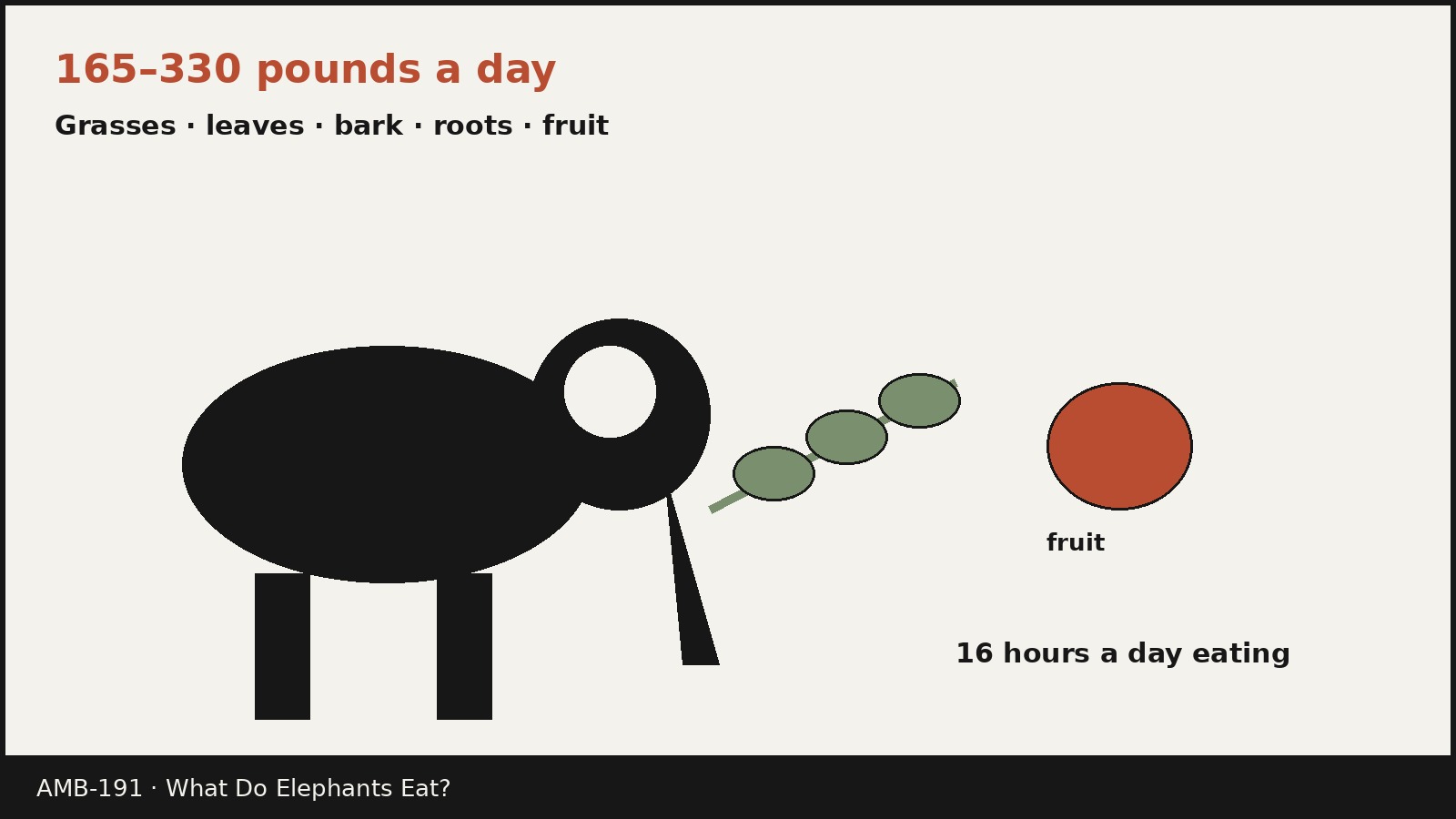
- Elephants are herbivores. They eat only plants: grasses, leaves, twigs, bark, roots, fruit, flowers, and seeds. An adult typically eats about 165 to 330 pounds (75 to 150 kilograms) of vegetation a day, roughly 4 to 6 percent of its body weight, and spends an average of 16 hours a day eating, according to San Diego Zoo Wildlife Alliance. The exact mix changes with the species, the habitat, and the season. Savanna elephants graze on grass when it is green and browse on trees and shrubs when it is dry. Forest elephants eat far more fruit. Asian elephants switch between grazing and browsing as the seasons turn. Feeding an elephant is close to a full time occupation.
The menu at a glance
An elephant’s diet can be summed up in one sentence: almost any plant, in large quantities, chosen with care. Elephants are generalist herbivores, not tied to a single food plant. San Diego Zoo Wildlife Alliance’s library fact sheet on African elephants describes them as generalist herbivores and frugivores able to eat a vast array of plant life, with the diet varying by season, habitat, region, and the individual animal’s nutritional needs.
The main food groups are:
- Grasses and sedges, the staple of the wet season for savanna and Asian elephants.
- Leaves, twigs, and shoots, collectively called browse, the backbone of the diet for much of the year.
- Bark, a tough, fibrous food that matters most in the dry season.
- Roots and tubers, dug up when surface food is scarce.
- Fruit and seeds, prized for energy and central to the forest elephant’s diet.
- Flowers and other soft plant parts, eaten when available.
Elephants also need minerals that plants alone do not always supply, and they need a great deal of water, both covered in their own sections below.
Grasses: the wet season staple
Grass is the first food most people picture when they think of an elephant eating, and for good reason. When rain has fallen and grass is green and growing, savanna elephants graze heavily, and Asian elephants graze during the first part of the wet season. Fresh grass is relatively soft, easy to gather in bulk, and rich in nutrients compared with the dry, woody food of the lean months.
The switch is seasonal rather than absolute. San Diego Zoo Wildlife Alliance’s library fact sheet records that savanna elephants primarily eat browse but switch to growing grasses when they are seasonally available, with a higher proportion of grasses in the wet season and woody plants in the dry season. Asian elephants browse on shrubs and trees during the dry season and after heavy rains, and graze on grass during the first part of the wet season.
Elephants gather grass with the trunk, wrapping it around a tuft and pulling it up, then sometimes beating the bundle against a leg or the body to shake off soil before eating it. Grass may look like a humble food, but for an elephant in the wet season it is the main fuel, and herds will move to follow the freshest growth as rains shift across the landscape.
Leaves, twigs, and browse
Browse is the word ecologists use for the leaves, twigs, shoots, and small branches of trees and shrubs, and it is the largest single category in the elephant diet over the full year. San Diego Zoo Wildlife Alliance describes African elephants as grazer-browsers that eat grasses, including sedges, flowering plants, leaves, shrubs, and small to medium size trees. The library fact sheet lists the plant tissues savanna elephants eat as leaves, twigs, bark, forbs, herbs, roots, leaf-bearing shoots, and fruits.
Elephants strip leaves from branches with the trunk, sometimes pulling a whole branch down to reach the foliage at its tip. They are selective about which plants they browse: some savanna plants carry spines, thorns, or dense branches that make browsing harder, and elephants use their excellent sense of smell to detect plant odors and avoid parts they recognize as containing toxic compounds. The fact sheet also notes that elephants have saliva proteins thought to reduce the toxicity of tannins, plant compounds that could be harmful in large amounts.
Browse matters most when grass is gone. In the dry season, leaves and twigs from trees and shrubs keep elephants fed after the grass has dried and lost its nutrition. Some trees hold their leaves through the dry season, and elephants know which ones, which is one reason herds led by experienced matriarchs tend to do better in hard years.
Bark: tough food for tough seasons
Bark is the food that surprises people most. It looks like packaging, not lunch, yet elephants strip it from trees deliberately and in quantity, especially in the dry season when softer foods are scarce. San Diego Zoo Wildlife Alliance lists bark among the foods of all three elephant species, and the library fact sheet records that forest elephants switch to leaves and bark when fruit is out of season, while savanna elephants eat a higher proportion of woody plants, including bark, in the dry season.
Elephants use their tusks to loosen bark and their trunk to peel it away in strips. The inner bark is the prize, softer and more nutritious than the rough outer layer. Heavy bark stripping can kill a tree, and over a season a herd can visibly change a woodland, opening gaps in the canopy that let light reach the ground and give smaller plants room to grow. Bark eating is a normal seasonal food, eaten most when the menu narrows, and it is one of the clearest examples of how an elephant’s diet shapes its habitat.
Roots: food from underground
When surface food runs short, elephants dig. They use their tusks and their feet to break ground and expose roots and tubers, which provide starch and energy, and they also dig for water in dry riverbeds, a habit that benefits other animals as well as themselves. San Diego Zoo Wildlife Alliance includes roots in the core list of elephant foods, and the library fact sheet lists roots among the plant tissues savanna elephants eat.
Digging is hard work, and elephants do not dig where food is plentiful. It is a dry season strategy, used when grass has withered and browse is thin, and it is also a learned behavior: young elephants watch older herd members dig and copy them. The same animal that delicately plucks a single fruit with the tip of its trunk will lever up a tree, strip its bark, and dig for its roots.
Fruit, flowers, and seeds
Fruit is the food elephants seem to enjoy most, and for forest elephants it is close to a staple. San Diego Zoo Wildlife Alliance describes African forest elephants as browser-frugivores that eat leaves, fruits, seeds, branches, and bark, and the library fact sheet records that forest elephants eat mainly fruits, leaves, and bark, plus seeds, branches, and roots, with usually little grass in the diet because grasses are uncommon in dense forest.
Fruit matters for a second reason beyond nutrition: elephants are seed dispersers. Many seeds pass through an elephant’s gut intact and are deposited, wrapped in dung, far from the parent tree, which can help them germinate and carry plant species into new ground. Forest elephants in particular, with a diet built around fruit, are gardeners of the forest they live in.
Flowers, seedpods, and other soft plant parts round out the menu when they are available. They are seasonal bonuses rather than staples, but elephants take them eagerly.
How much elephants eat, and how long it takes
The numbers are the part of the story that most people remember, and they are worth stating carefully because different sources count differently. San Diego Zoo Wildlife Alliance gives the headline figure for elephants in general: about 165 to 330 pounds (75 to 150 kilograms) of vegetation each day, about 4 to 6 percent of body weight, with an average of 16 hours per day spent eating. The library fact sheet gives a different measure, dry mass, for African elephants: about 90 to 180 pounds (40 to 80 kilograms) of dry mass per day for savanna elephants, and 100 to 120 pounds (45 to 55 kilograms) for forest elephants, with the forest figure changing seasonally. The two measures differ because fresh vegetation is mostly water. Both are correct, and the difference explains why published daily totals vary so much from source to source.
What does not vary is the time budget. Sixteen hours a day is an average, not an exaggeration, and it follows from the food itself: elephant food is bulky and fibrous, and the digestive system extracts only part of its energy. The library fact sheet states that about 60 percent of food passes through the gut undigested, with hindgut microbes fermenting cellulose to break it down. An elephant therefore has to eat almost constantly to take in enough usable energy.
Mothers producing milk and sexually active males have higher nutritional needs than other adults, the fact sheet notes, and they eat a higher amount of browse. Very old elephants, whose last set of molars has worn down, may prefer softer food. The daily total is therefore a range, not a fixed ration, and it moves with the animal’s age, sex, reproductive state, and season.
The feeding toolkit: trunk, tusks, and teeth
An elephant eats with three tools working together, and each one deserves a brief description because together they explain how one animal can handle foods as different as soft grass and hard bark.
The trunk is the most versatile. San Diego Zoo Wildlife Alliance describes it as both an upper lip and a nose, with no bones or cartilage, strong enough to pick up large tree trunks and agile enough to pick up a single piece of straw. African elephants have two fingerlike projections at the tip of the trunk, while Asian elephants have one, and those fingers pluck small items with precision. For drinking, the elephant sucks water partway up the trunk, curls it toward the mouth, and pours it in, rather than drinking through the trunk like a straw. The library fact sheet adds that an adult trunk can hold about 1 to 2.5 gallons of water.
Tusks are the elephant’s incisor teeth, and they are tools as well as weapons, used for digging for water and food, for loosening bark, and for lifting things. Not all elephants have large visible tusks: both male and female African elephants usually do, while among Asian elephants usually only males have visible tusks, with females carrying small tushes.
Teeth do the grinding. Elephants have four molars, one on the top and one on the bottom on each side, each about the size of a brick. Smithsonian’s National Zoo describes them the same way, noting the grooves that help grind vegetation, and San Diego Zoo Wildlife Alliance notes that an elephant can go through up to six sets of molars in a lifetime, with new teeth growing in from behind and pushing old ones forward and out.
How the three species differ
Three living elephant species are usually recognized, and their diets differ in ways that follow directly from where they live.
African savanna elephants (Loxodonta africana) live in eastern, central, and southern Africa, in woodland, savanna, flood plains, and forests. They are grazer-browsers, eating grasses, including sedges, flowering plants, leaves, shrubs, and small to medium size trees, switching toward grass in the wet season and toward woody plants in the dry season.
African forest elephants (Loxodonta cyclotis) live in the moist, semi-deciduous rainforests of the Congo basin and western Africa. They are browser-frugivores: leaves, fruits, seeds, branches, and bark, with little grass, because grass is uncommon in dense forest except in clearings. One study cited in the library fact sheet found forest elephants feeding on more than 350 plant species. Fruit is the defining difference: where the savanna elephant is a grazer in the rains, the forest elephant is a fruit eater year round, switching to leaves and bark when fruit is out of season.
Asian elephants (Elephas maximus) live in scrub forests and rainforests in India, Nepal, and parts of Southeast Asia, often near rivers in the dry months. They are browsers in the dry season and after heavy rains, and grazers during the first part of the wet season, eating many plant types including twigs and bark.
How the seasons change the menu
Season is the single biggest variable in an elephant’s diet, and it operates on a simple principle: eat what is greenest, softest, and most nutritious now, and fall back on tougher foods when that is gone.
In the wet season, grass grows fast and is rich in nutrients. Savanna elephants graze, Asian elephants graze in the first part of the wet season, and herds move to follow fresh growth. Leaves are plentiful, fruit may be in season, and water is easy to find, so the diet is at its most varied and its most nutritious.
As the dry season takes hold, grass dries, hardens, and loses nutrition. Elephants shift to browse: leaves that persist on trees and shrubs, twigs, and then bark, stems, and roots. The library fact sheet records this shift for savanna elephants as a higher proportion of woody plants in the dry season, and for forest elephants as a switch to leaves and bark when fruit is out of season. Asian elephants browse on shrubs and trees through the dry season.
Water follows the same seasonal logic, and it constrains where elephants can feed. Elephants need to drink regularly, and in the dry season they stay closer to reliable water, sometimes digging in dry riverbeds to reach it. When the rains return, the herd can spread out again, and the menu widens with it.
Drinking: the other half of the diet
Elephants at the San Diego Zoo and San Diego Zoo Safari Park drink about 20 to 50 gallons (75 to 190 liters) of water each day, according to San Diego Zoo Wildlife Alliance. The library fact sheet gives a similar range for savanna elephants in the wild, roughly 40 to 50 gallons (150 to 200 liters) per day, and notes that elephants will drink once a day when water is available, though intervals of every one to two days, or three to five days, are also reported in drier country.
Drinking is a skill in itself. The elephant sucks water partway up the trunk and pours it into the mouth, and it can also store several liters in a pouch at the base of the tongue. Bathing and spraying are not separate from feeding behavior: wet skin, mud, and dust protect against sun and biting insects.
In the wild, elephants remember water. San Diego Zoo Wildlife Alliance notes that the herd matriarch is responsible for remembering where and how to find food and water, and Smithsonian’s National Zoo makes the same point about older females teaching the young where to go, what to eat, and what to avoid. In dry country, that memory is a matter of survival.
Digestion, dung, and the seeds elephants plant
Elephants are famously inefficient digesters, and that inefficiency turns out to be ecologically useful. The library fact sheet states that about 60 percent of food passes through the gut undigested, with hindgut microbes fermenting cellulose, a strategy similar to that of rhinos and horses. Digestion takes about 24 hours in savanna elephants and about 40 hours in adult female forest elephants, and elephants defecate as many as 10 to 20 times a day.
The result is a great deal of dung, and that dung is a resource. Seeds eaten with fruit pass through intact and are deposited far from the parent tree, wrapped in nutrient rich material that helps them germinate. Insects, birds, and small mammals feed on dung and on the seeds within it. The International Fund for Animal Welfare describes this plainly for savanna elephants: as herbivores with large appetites, they consume huge quantities of vegetation, including seeds that they then distribute widely through their feces, providing high quality fertilizer in the process.
Minerals and salt: the hidden hunger
Plants provide energy and fiber, but they do not always provide enough minerals, and elephants actively seek out what their forage lacks. The library fact sheet records that elephants seek out minerals such as sodium, potassium, and calcium in water, soil, and even from cave walls, licking soil near water sources, digging into banks and under trees, and in some locations ingesting minerals from termite mounds.
Sodium is the best known case. In some regions, plants and natural sources of salt provide enough sodium, while in others sodium is scarce, and research reported by the University of Zurich in 2025 found that in many places large herbivores, including elephants, have limited access to sodium. That scarcity can influence where elephants settle and how far they travel to find natural salt licks.
Keepers in zoos supply this need directly, with mineral supplements and formulated pellets, which is one reason a zoo diet can meet 100 percent of an elephant’s daily nutritional values while wild counterparts, in Smithsonian’s National Zoo’s phrasing, typically reach only 60 to 75 percent.
How calves learn to eat
No elephant is born knowing how to eat like an elephant. Calves begin life on milk, drinking with the mouth because the trunk is still too short and clumsy for feeding. San Diego Zoo Wildlife Alliance notes that calves nurse frequently and gain on average 2 to 3 pounds (1 to 1.3 kilograms) a day in their first year, that they are clumsy with the trunk at first and learn to use it as they grow older, and that by two to three years old they no longer need to nurse. Smithsonian’s National Zoo adds that young elephants learn what to eat and what to avoid by observing and mimicking their mothers, aunties, and grandmothers.
The learning is hands on. Calves mouth solid food within their first months and copy the feeding actions of older herd members, from stripping leaves to digging. They also gain the gut microbes they need to digest plants: calves are born without the plant digesting microbes that adults carry, and one route by which they acquire them is eating the dung of their mother or other herd members, a behavior called coprophagia. Baby elephants are reported to practice coprophagia to obtain gut bacteria they lack, and the principle is illustrated by Smithsonian’s National Zoo’s account of a hand reared calf whose recovery depended on fecal transfers to establish gut bacteria.
By the time a calf is weaned, it has had years of supervised practice, and it keeps learning long after weaning. An elephant’s diet is partly a cultural inheritance: the plants a herd eats, the places it digs, and the water sources it trusts are passed from one generation to the next by watching, copying, and following.
Captive elephants: the same appetite, a different menu
Elephants in zoos and sanctuaries eat the same kinds of food as wild elephants, but the menu is managed, measured, and supplemented. At the San Diego Zoo and San Diego Zoo Safari Park, elephants eat over fifty different types of plants, including browse and grasses, and drink about 20 to 50 gallons of water a day. At Smithsonian’s National Zoo, the female Asian elephant Bozie eats an impressive 130 pounds of food a day: 1.5 bales of hay, 40 pounds of fresh fruits and vegetables, 15 pounds of grain, and 50 to 100 pounds of fresh branches, leaves, and bamboo.
The difference is not that captive elephants eat better food. It is that their food is chosen, balanced, and delivered, with hay standing in for grass, grain and pellets supplying concentrated nutrition, and produce supplying variety. Wild elephants must find their food across a changing landscape, accept seasonal shortfalls, and spend most of their waking hours doing it.
What elephants do not eat
Elephants eat only plants, and the exceptions prove the rule rather than breaking it. They do not hunt, they do not eat meat, and they do not scavenge carcasses. An elephant that picks up a bone or mouths an unfamiliar object is investigating, not feeding. The herbivore label is absolute in practice, and it is what makes the elephant’s size so remarkable: the largest land animal alive is built entirely from grass, leaves, bark, and fruit.
There is one gray area worth naming honestly: crops. Elephants raid farms, eating maize, sorghum, millet, bananas, mangoes, peanuts, beans, sweet potatoes, and pumpkins, among other crops, and the library fact sheet lists these as cultivated foods that elephants seek out, sometimes for their high energy content or possibly for minerals. Crop raiding is a leading cause of conflict between people and elephants, because a herd can destroy a season’s crop in a night.
Elephants also do not eat everything green. They avoid plants they recognize as toxic, they are selective within their range, and they can be choosy about ripeness, cleanliness, and plant part.
Frequently asked questions
Do elephants eat meat?
No. Elephants are strict herbivores and eat only plants. They do not hunt or scavenge, and meat plays no part in their diet in the wild or in captivity.
How much does an elephant eat per day?
About 165 to 330 pounds (75 to 150 kilograms) of fresh vegetation per day, according to San Diego Zoo Wildlife Alliance, or about 4 to 6 percent of body weight. Measured as dry mass, with water removed, the figure is lower: about 90 to 180 pounds (40 to 80 kilograms) per day for savanna elephants.
How many hours a day do elephants spend eating?
An average of 16 hours per day, according to San Diego Zoo Wildlife Alliance. Because elephant food is fibrous and only partly digested, elephants must feed almost constantly to take in enough usable energy.
What is an elephant’s favorite food?
There is no single favorite food across all elephants, because the diet varies by species and season. Grass is the staple in the wet season for savanna and Asian elephants, fruit is central for forest elephants, and bark is a key dry season food. Individual elephants also show preferences: Smithsonian’s National Zoo reports that its elephant Bozie has a sweet tooth for watermelon and apples, and even enjoys onions.
Do elephants eat bark?
Yes. Elephants strip bark from trees, especially in the dry season when softer foods are scarce, using their tusks to loosen it and their trunk to peel it away. The inner bark is the most nutritious part, and bark eating is a normal seasonal behavior, not a sign of starvation.
What do baby elephants eat?
Calves drink their mother’s milk and nurse frequently in their first year, gaining on average 2 to 3 pounds (1 to 1.3 kilograms) a day, according to San Diego Zoo Wildlife Alliance. They begin mouthing solid food within their first months, learn feeding skills by copying older herd members, and no longer need to nurse by two to three years old. Calves also eat the dung of adults, which helps establish the gut microbes needed to digest plants.
Do elephants drink a lot of water?
Yes. Elephants at the San Diego Zoo and San Diego Zoo Safari Park drink about 20 to 50 gallons (75 to 190 liters) per day, and wild savanna elephants drink roughly 40 to 50 gallons (150 to 200 liters) per day. In dry country, elephants may go one to five days between drinks.
Why do elephants eat soil?
Elephants lick soil and visit mineral deposits to obtain minerals, including sodium, potassium, and calcium, that their plant food may not supply in sufficient amounts. The behavior is called geophagy, and in some places elephants dig into banks, termite mounds, or cave walls to reach mineral rich earth.
Sources & references
- San Diego Zoo Wildlife Alliance, "Elephant," San Diego Zoo Animals and Plants. Opened and read 24 October 2026.
- San Diego Zoo Wildlife Alliance Library, "African Elephants (Loxodonta africana and L. cyclotis) Fact Sheet: Diet and Feeding." Opened and read 24 October 2026.
- Smithsonian's National Zoo and Conservation Biology Institute, "Happy Asian Elephant Awareness Month." Opened and read 24 October 2026.
- International Fund for Animal Welfare, "Meet the African savannah elephant (African bush elephant)." Opened and read 24 October 2026.


