Short answer
- The law of independent assortment, also called Mendel's second law, states that alleles for different genes sort into gametes independently of one another. Knowing which allele a gamete receives for one gene tells you nothing about which allele it receives for another gene, provided the genes meet the conditions explained below.
- The classic demonstration is a dihybrid cross. Two true breeding pea parents differing in seed shape and seed color produce first generation offspring that are all round and yellow. When those offspring are self fertilized, the second generation shows four phenotypes in the ratio 9 round yellow : 3 round green : 3 wrinkled yellow : 1 wrinkled green.
- The physical reason is meiosis. During metaphase I, each pair of homologous chromosomes lines up at the center of the cell in a random orientation, and each pair lines up independently of the other pairs. That random orientation decides which combination of maternal and paternal chromosomes goes into each gamete.
- The law is not universal. Genes that lie close together on the same chromosome tend to be inherited together, a pattern called linkage. Crossing over during meiosis can separate linked genes, and genes far apart on the same chromosome can behave as if they were unlinked.
- Independent assortment creates new combinations of traits, but it does not guarantee any particular outcome in a small family. Its ratios are probabilities that show up clearly only in large numbers of offspring.
What the Law Says, in Plain Language
Gregor Mendel studied inheritance by crossing garden pea plants and counting their offspring. His first law, the law of segregation, concerns one gene at a time: the two alleles of a gene separate during gamete formation, so each gamete carries only one allele for that gene. His second law concerns two or more genes at a time: the alleles of different genes assort, or sort, independently into gametes.
Take the pea example used throughout this article. Let R stand for the dominant round seed allele and r for the recessive wrinkled seed allele. Let Y stand for the dominant yellow seed allele and y for the recessive green seed allele. A plant with genotype RrYy carries one allele of each kind for both genes. Under independent assortment, it produces four gamete types, RY, Ry, rY, and ry, each in about one quarter of its gametes. That equal four way split is the core prediction of the law, and everything else in this article follows from it.
Three points of wording matter. First, the law is about genes, not whole organisms: it does not say a round seeded parent will always have round seeded children. Second, it is about assortment into gametes, not about which gametes happen to fuse at fertilization. Fertilization adds a second round of randomness. Third, the law describes a pattern that holds when its conditions are met. When genes are linked, when dominance is incomplete, or when two genes interact to shape one trait, the visible ratios change, even though the underlying chromosome behavior remains orderly. Those exceptions are covered later, because they are where most misunderstandings begin.
The Words You Need Before the Cross
A gene is a sequence of DNA at a particular location, or locus, on a chromosome that influences a trait. An allele is one version of a gene. In peas, the seed shape gene has a round allele and a wrinkled allele. A genotype is the allele combination an individual carries, such as RrYy. A phenotype is the observable trait that results, such as round yellow seeds.
Homozygous means carrying two copies of the same allele, such as RR or rr. Heterozygous means carrying two different alleles, such as Rr. Dominant means that one copy is enough for the trait to show: Rr seeds are round, just like RR seeds. Recessive means that two copies are needed for the trait to show: only rr seeds are wrinkled. A true breeding line, also called a pure line, produces the same phenotype generation after generation when self fertilized, because it is homozygous for the genes in question.
Generations in a cross are labeled P, F1, and F2. P stands for the parental generation, the true breeding parents that start the cross. F1 stands for the first filial generation, their offspring. F2 stands for the second filial generation, the offspring produced when F1 individuals are crossed with each other or self fertilized. In Mendel’s pea work, self fertilization of the F1 plants produced the F2 generation, and it is the F2 ratio that reveals independent assortment.
A monohybrid cross follows one gene. A dihybrid cross follows two genes. A trihybrid cross follows three. The prefixes mono, di, and tri count genes, not parents.
Mendel and the Pea Plants
Mendel, an Augustinian friar working in Brno, in what is now the Czech Republic, crossed varieties of the garden pea, Pisum sativum, between 1856 and 1863. He presented his results in 1865 and published them in 1866 in a paper titled “Experiments on Plant Hybridization.” His work was not widely recognized during his lifetime. It was rediscovered around 1900, after which its importance became clear.
Mendel succeeded where earlier plant breeders had struggled because he started with true breeding lines, followed one trait at a time first to establish the 3:1 monohybrid pattern, and counted large numbers of offspring as ratios. That counting habit turned a gardening observation into a law.
For the dihybrid work, the two traits that textbooks return to again and again are seed shape and seed color. Round seeds are dominant to wrinkled seeds, and yellow seeds are dominant to green seeds. Those dominance relationships are essential to the 9:3:3:1 ratio. If dominance were incomplete, so that heterozygotes looked intermediate, the F2 phenotypes would be more numerous and the ratio would look different, even though assortment itself was still independent. The ratio is therefore a joint product of independent assortment and complete dominance, not of assortment alone.
The Dihybrid Cross, Step by Step
Start with two true breeding parents. One has round yellow seeds, genotype RRYY. The other has wrinkled green seeds, genotype rryy. Each parent is homozygous for both genes, so the law of segregation tells us what gametes each parent can make. The RRYY parent can make only RY gametes, because it has no r or y allele to pass on. The rryy parent can make only ry gametes. Every F1 offspring therefore receives RY from one parent and ry from the other, giving genotype RrYy. Because R and Y are dominant, every F1 plant has round yellow seeds. So far, nothing distinguishes independent assortment from any other pattern, because the F1 generation is uniform.
The test comes in the F2 generation. Self fertilize the RrYy plants. Each F1 plant now makes gametes, and under independent assortment it makes four kinds in equal proportions: RY, Ry, rY, and ry. A gamete that receives R is equally likely to receive Y or y, and a gamete that receives r is equally likely to receive Y or y. That equal likelihood is the law in action.
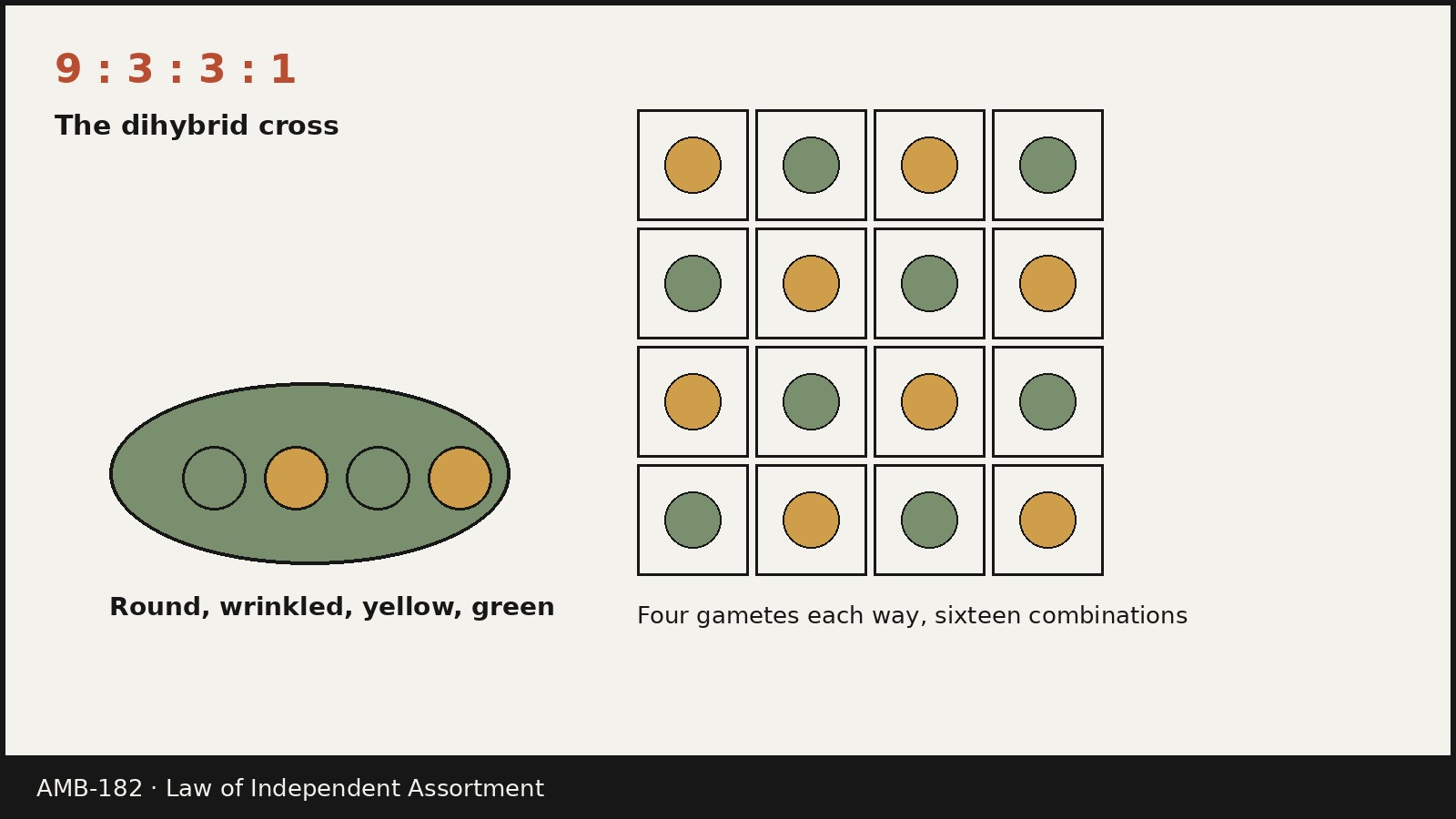
Now combine one gamete from each parent plant in a 4 by 4 Punnett square, giving 16 equally likely genotype combinations. Counting phenotypes, not genotypes, gives the famous result:
- 9 out of 16 are round and yellow. These have at least one R allele and at least one Y allele, written R_Y_.
- 3 out of 16 are round and green. These have at least one R allele and are homozygous recessive for color, written R_yy.
- 3 out of 16 are wrinkled and yellow. These are homozygous recessive for shape and have at least one Y allele, written rrY_.
- 1 out of 16 is wrinkled and green. This is homozygous recessive for both genes, written rryy.
The underscore in R_Y_ is a useful shorthand. It means “any allele,” so R_Y_ covers RRYY, RRYy, RrYY, and RrYy. Counting distinct genotypes in that way explains why the first class has nine members while the last class has only one: four distinct genotypes look round and yellow, RRYY, RRYy, RrYY, and RrYy, and those four genotypes account for 1, 2, 2, and 4 of the 16 Punnett square cells respectively, giving 9 cells in total, while only one genotype, rryy, looks wrinkled and green.
Two of the four F2 phenotype classes are new combinations that neither parent showed: round green and wrinkled yellow. Those recombinant phenotypes are visible proof that the two traits were not inherited as a fixed package. If seed shape and seed color had been locked together, the F2 generation would have shown only the two parental phenotypes.
The Product Rule and the Forked Line Method
A 4 by 4 Punnett square works well for two genes, but it becomes unwieldy for three or more. Two shortcuts give the same answers with less drawing, and both rest on the same idea: when events are independent, their probabilities multiply.
The product rule states that the probability of two independent events both occurring is the product of their separate probabilities. Applied to the dihybrid cross, the probability of a round seed in the F2 generation is 3/4, from the monohybrid 3:1 ratio, and the probability of a yellow seed is also 3/4. Multiply them: 3/4 times 3/4 equals 9/16, the round yellow class. Round and green is 3/4 times 1/4, which equals 3/16. Wrinkled and yellow is 1/4 times 3/4, which equals 3/16. Wrinkled and green is 1/4 times 1/4, which equals 1/16. The four fractions add to 16/16, as they must.
The forked line method, also called the branch diagram, organizes the same multiplication visually. Draw the first trait as a fork with two branches, round at 3/4 and wrinkled at 1/4. From the end of each branch, draw a second fork for the second trait, yellow at 3/4 and green at 1/4. Multiply along each path to get the four phenotype probabilities. For genotypes, the same method works with 1/4, 1/2, and 1/4 branches for each gene, since a monohybrid cross of two heterozygotes gives genotypes in the ratio 1 homozygous dominant : 2 heterozygous : 1 homozygous recessive.
The product rule also extends the pattern to three genes. A trihybrid cross between two triple heterozygotes, such as AaBbCc crossed with AaBbCc, gives a phenotypic ratio of 27:9:9:9:3:3:3:1. That eight class pattern is simply the expansion of three independent 3:1 ratios multiplied together: 27/64 show all three dominant traits, 9/64 show two dominant traits and one recessive trait in each of three arrangements, 3/64 show one dominant trait and two recessive traits in each of three arrangements, and 1/64 shows all three recessive traits.
A test cross is a related tool that uses independent assortment in reverse, to reveal an unknown genotype. Cross an individual showing dominant traits with a homozygous recessive individual, such as RrYy crossed with rryy. The recessive parent can contribute only ry gametes, so the phenotypes of the offspring directly reveal the gametes of the unknown parent. Under independent assortment, the offspring appear in four equal classes: round yellow, round green, wrinkled yellow, and wrinkled green, each about one quarter. If instead the offspring show mainly the two parental classes and few recombinant classes, that is evidence that the genes are linked, a topic covered below.
Why Chromosomes Explain the Law
Mendel knew nothing about chromosomes. He described hereditary “factors” without knowing what they were physically. The physical explanation arrived decades later, with the chromosome theory of inheritance, proposed independently by Walter Sutton and Theodor Boveri in 1902 and 1903. Sutton studied grasshopper chromosomes, Boveri studied sea urchin embryos, and both noticed that chromosomes behave exactly the way Mendel’s factors should behave: they come in pairs, they separate during gamete formation, and different pairs sort independently.
The key event is meiosis, the cell division that produces gametes. A diploid cell, one with two sets of chromosomes, first duplicates its chromosomes and then divides twice to produce four haploid cells, each with one set. During prophase I, homologous chromosomes, the maternal and paternal members of each pair, come together. During metaphase I, the pairs line up at the center of the cell, the metaphase plate. The orientation of each pair is random: for any given pair, either the maternal or the paternal chromosome may face a given pole of the cell. Crucially, the orientation of one pair does not influence the orientation of another pair. During anaphase I, the homologous chromosomes are pulled to opposite poles, so each daughter cell receives one member of each pair, but which member it receives for each pair is an independent random outcome.
That is the physical basis of independent assortment. Genes on different, nonhomologous chromosomes assort independently because the chromosomes carrying them assort independently. Genes on the same chromosome do not automatically share that independence, because they travel together unless crossing over separates them. The distinction between “different chromosomes” and “same chromosome” is therefore the single most important qualification to Mendel’s second law, and it explains both why the law works so often and why it sometimes fails.
Humans illustrate the scale of the effect. A human cell has 23 pairs of chromosomes, 22 pairs of autosomes plus one pair of sex chromosomes. For each pair, a gamete receives either the maternal or the paternal member, giving 2 raised to the power of 23 possible chromosome combinations per gamete, which equals 8,388,608. That figure counts only the assortment of whole chromosomes, before crossing over shuffles alleles within chromosomes. When two gametes fuse at fertilization, the number of possible combinations from assortment alone is 2 to the power of 23 times 2 to the power of 23, which is more than 70 trillion. Crossing over makes the true number of possible genetic combinations far larger still. Independent assortment is thus one of the main reasons siblings from the same parents are genetically different from each other, except in the case of identical twins, who arise from a single fertilized egg.
Independent assortment does not create new alleles; new alleles arise by mutation. It does not by itself change allele frequencies in a population, and it does not guarantee that any two siblings will differ in a particular trait. The law describes probabilities across many gametes and offspring, not certainties for any one child.
When the Law Breaks Down: Linkage
All of Mendel’s seven pea traits behaved as if they assorted independently in the crosses he reported. Later work showed why he was fortunate: the traits he combined in his dihybrid crosses happened to lie on different chromosomes, or far enough apart that they behaved as if unlinked. Genes do not always enjoy that freedom.
Genes located on the same chromosome are linked. Because a chromosome is a single physical molecule of DNA, alleles on the same chromosome tend to travel together into the same gamete. The closer together two genes lie on a chromosome, the more likely they are to be inherited as a pair. The farther apart they lie, the more likely it is that crossing over will separate them.
Thomas Hunt Morgan’s work with fruit flies, Drosophila melanogaster, provided the decisive evidence. When he test crossed flies heterozygous for two linked traits to homozygous recessive flies, the offspring did not appear in four equal classes. Instead, the two parental classes greatly outnumbered the two recombinant classes produced by crossing over. In textbook illustrations of such an experiment, a strongly linked pair might give about 950 parental offspring and about 50 recombinant offspring out of 1,000, though the exact numbers depend on how close the genes lie. The key point is the imbalance: linkage bends the ratio away from equality, and the degree of bending measures the distance between the genes.
Crossing over is the process that rescues linked genes from permanent lockstep. During prophase I of meiosis, homologous chromosomes exchange segments of DNA. If a crossover happens between two linked genes, the alleles on the resulting chromatids are recombined. Only two of the four chromatids in a paired set are involved in any single crossover, so a single crossover produces two recombinant chromatids and two parental chromatids. Recombination frequency, the percentage of recombinant gametes, therefore ranges from 0 percent for genes so close together that crossing over between them is vanishingly rare, up to 50 percent for genes so far apart that they behave as if unlinked. A recombination frequency of 50 percent is the maximum, because even with frequent crossing over, only half the chromatids in a tetrad can be recombinant from a single crossover event, and multiple crossovers randomize the outcome further.
Geneticists turned that relationship into a mapping tool. One map unit, also called a centimorgan, is defined as a recombination frequency of 1 percent. Measuring recombination frequencies between gene pairs let researchers map gene order along chromosomes long before DNA sequencing. The test for linkage is therefore a recombination frequency significantly below 50 percent.
The practical rule that follows is simple to state and easy to apply. The law of independent assortment applies fully to genes on different, nonhomologous chromosomes. It applies approximately to genes far apart on the same chromosome, because crossing over between them is frequent enough to randomize their combinations. It does not apply to genes close together on the same chromosome, which show linkage and produce mainly parental combinations. Modern genetics therefore treats independent assortment as a special case of chromosome behavior, not as a law of nature that overrides the physical arrangement of genes.
Other Reasons a Dihybrid Ratio Can Deviate
Linkage is the most important exception, but not the only one. Incomplete dominance and codominance change the phenotype count: heterozygotes have their own phenotype, so a dihybrid cross can produce up to nine phenotype classes instead of four, even though the alleles still assort independently. Epistasis, where one gene masks or modifies another, can collapse the phenotype ratio into fewer classes, such as 9:3:4 or 12:3:1. Sex linkage, pleiotropy (one gene affecting several traits), and polygenic traits (many genes each contributing a small effect, such as human height) also change the visible pattern. Finally, small sample size is a common cause of a “wrong” ratio in classroom experiments: a 9:3:3:1 ratio is an expectation over many offspring, and a sample of 16 seeds may deviate by chance alone. Statistical tests, such as the chi square test, judge whether a deviation is larger than chance would plausibly produce.
Common Mistakes and Exam Traps
Several errors recur so often that they are worth naming directly. The first is confusing independent assortment with segregation. Segregation separates the two alleles of one gene. Independent assortment concerns the relationship between two different genes. A question that asks about the gametes of a heterozygote for one gene is testing segregation. A question that asks about the gametes of a double heterozygote is testing independent assortment.
The second error is assuming that independent assortment means offspring show all combinations equally. It means gametes show all combinations equally, under the law’s conditions. Offspring phenotypes follow from combining two gametes, which is why the F2 phenotypic ratio is 9:3:3:1 rather than 1:1:1:1. A test cross, where one parent contributes only recessive gametes, does give a 1:1:1:1 offspring ratio, and confusing the two crosses is a classic trap.
The third error is applying the law to genes on the same chromosome without checking for linkage. The correct first question for any two genes is where they lie. Different chromosomes: independent assortment applies. Same chromosome, far apart: approximately independent. Same chromosome, close together: linked, and parental combinations predominate.
Frequently Asked Questions
What is the law of independent assortment in simple terms?
It is the principle that alleles for different genes are sorted into gametes independently of each other. If a parent is heterozygous for two genes, it produces four gamete types in equal proportions, and knowing the allele for one gene in a gamete gives no information about the allele for the other gene, when the genes are unlinked.
What is the difference between the law of segregation and the law of independent assortment?
The law of segregation concerns one gene: its two alleles separate so each gamete gets one. The law of independent assortment concerns two or more genes: the alleles of different genes sort independently. Segregation is about separation within a gene pair. Independent assortment is about the lack of coordination between different gene pairs.
What is a dihybrid cross?
A dihybrid cross is a cross between parents that differ in two genes. In Mendel’s classic example, true breeding round yellow peas are crossed with true breeding wrinkled green peas. The F1 generation is all round yellow and double heterozygous, and self fertilizing the F1 generation gives an F2 phenotypic ratio of 9:3:3:1.
Why is the dihybrid ratio 9:3:3:1?
Because each trait separately shows a 3:1 dominant to recessive ratio in the F2 generation, and the traits combine independently. Multiplying the probabilities gives 9/16 both dominant, 3/16 first dominant and second recessive, 3/16 first recessive and second dominant, and 1/16 both recessive. The Punnett square for two double heterozygotes has 16 equally likely combinations that fall into those four phenotype classes.
Does independent assortment happen in meiosis I or meiosis II?
Its basis is metaphase I of meiosis, when homologous chromosome pairs line up at the center of the cell in random, independent orientations. Anaphase I then separates the homologous chromosomes into different daughter cells. Meiosis II separates sister chromatids, which is a different step and does not itself produce independent assortment between genes.
Do linked genes violate the law of independent assortment?
Linked genes do not follow it, because they lie close together on the same chromosome and tend to be inherited together. That is an exception to the law, not a refutation of chromosome theory. Crossing over can separate linked genes, and genes far apart on the same chromosome behave as if they were unlinked. The law therefore applies fully to genes on different chromosomes and approximately to genes far apart on the same chromosome.
What is the difference between parental and recombinant offspring?
Parental offspring show allele combinations present in the parents of the heterozygous individual. Recombinant offspring show new combinations produced by independent assortment or by crossing over. In a test cross of linked genes, parental classes greatly outnumber recombinant classes, and the recombinant frequency measures how far apart the genes lie.
How many chromosome combinations does independent assortment produce in humans?
For whole chromosome assortment alone, a human gamete can receive 2 to the power of 23 combinations of maternal and paternal chromosomes, which equals 8,388,608, because humans have 23 chromosome pairs. Crossing over within chromosomes increases the number of possible genetic combinations far beyond that figure, and random fertilization multiplies it again.
Can independent assortment predict the traits of a particular child?
No, not with certainty. It gives probabilities for each possible outcome, such as a 9 in 16 chance of a particular phenotype class in a dihybrid cross of two double heterozygotes. Any individual child is a single random outcome, and small families will often deviate from the expected ratios by chance. Predictions become reliable only across large numbers of offspring.
Is Mendel’s second law still accepted today?
Yes, with its modern qualification. It correctly describes how unlinked genes assort, and its basis in the random orientation of homologous chromosomes at metaphase I is well established. Modern genetics adds that linked genes assort together more often than chance, and that crossing over, epistasis, and incomplete dominance modify the visible ratios.
Sources & references
- OpenStax Biology, "Laws of Inheritance" (via Biology LibreTexts): statement of the law of independent assortment, the RRYY by rryy dihybrid cross, the four equally likely gametes YR, Yr, yR, and yr, the 9:3:3:1 F2 phenotypic ratio, the physical basis in random orientation of homologous pairs in meiosis I, and linkage with crossover.
- University of Massachusetts Boston, Biology LibreTexts, "Dihybrid Crosses and Independent Assortment": product rule derivation of 9:3:3:1, the assumptions behind the ratio (independent assortment, complete dominance, distinguishable phenotypes), and the extension of the product rule to three genes.
- OpenStax Biology, "Chromosomal Theory and Genetic Linkage" (via Biology LibreTexts): Morgan's test cross results showing parental and recombinant classes, linkage, crossing over, and the use of recombinant proportions to map genes.
- Genetics Society of America, "Experiments on Plant Hybrids by Gregor Mendel" (Genetics, 2016 translation, PMC 5068836): Mendel's 1866 paper, presented 1865, as the source of the pea hybridization experiments.
- OpenStax Biology, "Chromosomal Theory and Genetic Linkage" and Boveri Sutton chromosome theory summaries (via Biology LibreTexts and university course material): Sutton's 1902 and 1903 work and Boveri's independent work linking chromosome behavior to Mendel's laws.


