Short answer
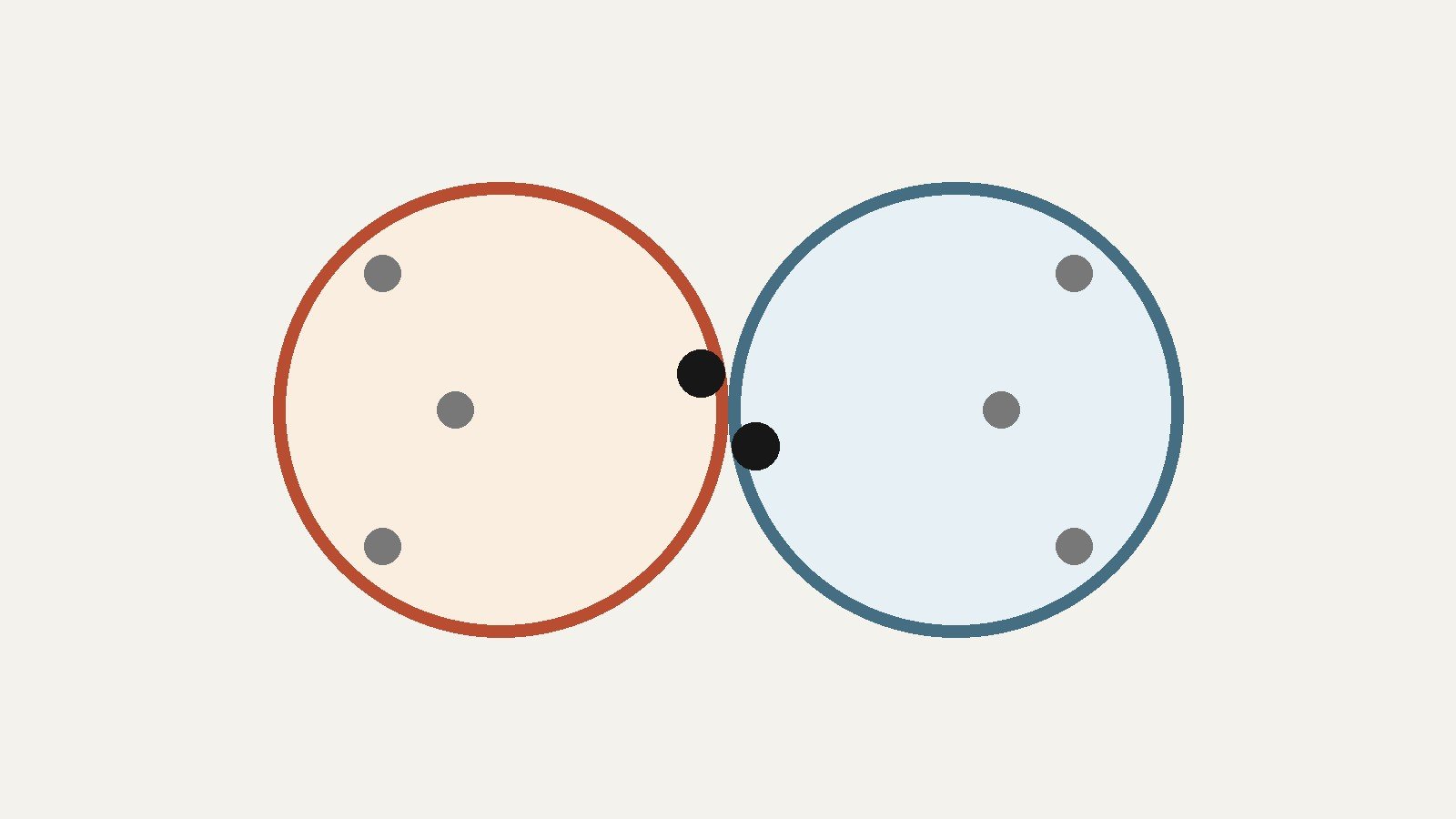
- A covalent bond is a chemical bond formed when two atoms share one or more pairs of electrons, with the shared pair attracted to the nuclei of both atoms.
- Sharing lets each atom count the shared electrons toward a full outer shell, the stable arrangement described by the octet rule (two electrons for hydrogen).
- One shared pair is a single bond, two pairs a double bond, three pairs a triple bond. More shared pairs make the bond shorter and stronger: the triple bond in nitrogen gas is among the strongest bonds in chemistry.
- Sharing can be equal or unequal. Equal sharing gives a nonpolar covalent bond; unequal sharing, driven by a difference in electronegativity, gives a polar covalent bond. There is no sharp line between covalent and ionic bonding, only a continuum.
- In a coordinate (dative) bond, both shared electrons come from one atom, as when ammonia binds a hydrogen ion to form ammonium.
- Covalent compounds are usually gases, liquids, or soft solids with low melting points, and they do not conduct electricity, because they consist of neutral molecules rather than ions.
Introduction
Almost everything you can touch that is not a metal or a salt is held together by covalent bonds: the water in a glass, the oxygen in the air, the sugar in your tea, the plastic of the cup, and the DNA in every cell reading these words. Yet the idea itself fits in one sentence: a covalent bond is what forms when two atoms share a pair of electrons.
This article builds that sentence into the full picture. It covers what sharing means at the level of the atom, how Lewis structures draw it, why some pairs of atoms share one pair of electrons and others share two or three, how unequal sharing produces polar bonds, the special case where one atom donates both electrons, the well-documented exceptions to the octet rule, and how covalently bonded substances behave differently from ionic ones. It closes with the idea’s origin in G. N. Lewis’s 1916 paper, because the shared pair is one of the most productive simple ideas in the history of chemistry.
What a Covalent Bond Is
OpenStax’s Chemistry 2e states the definition and the mechanism together: covalent bonds form when electrons are shared between atoms and are attracted by the nuclei of both atoms. Every part of that sentence is doing work.
Take the simplest case, hydrogen. A single hydrogen atom has one electron and an incomplete outer shell; a full shell for hydrogen means two electrons, the arrangement of helium. When two hydrogen atoms approach, each one’s electron is attracted not only to its own nucleus but to the other nucleus as well. The two electrons settle into the space between the nuclei, where they are pulled on by both. Each hydrogen now has, in effect, two electrons around it: its shell is full, and the pair of atoms is lower in energy than the two atoms were apart. That shared pair, held between two nuclei, is the bond, and the result is the hydrogen molecule, H₂.
The driving force is stability. Atoms bond covalently when sharing brings each of them to a full valence (outer) shell, most often eight electrons, the configuration of the noble gases. This is the octet rule, and it explains the cast of characters: covalent bonds form mainly between nonmetal atoms, which are a few electrons short of a full shell and can complete it by pooling, rather than by the give-and-take of electrons that produces ionic bonding. Carbon, nitrogen, oxygen, and the halogens are the great sharers, which is why the chemistry of life and of the air is covalent chemistry.
One more distinction matters from the start. The shared pair in a bond is called a bonding pair. Atoms in molecules usually also carry lone pairs, valence electrons that sit on one atom and take no part in bonding. Lone pairs are not spare parts: they shape molecules, they explain water’s bent geometry and ammonia’s reactivity, and one of them stars in the coordinate bond section below.
Drawing It: Lewis Structures and the Octet Rule
Chemists draw covalent bonding with Lewis structures, named for G. N. Lewis, in which each valence electron is a dot and a shared pair is drawn as a line. Hydrogen is H:H as dots, or H–H as a line; the line is one bond, two electrons, counted by both atoms.
Water shows the method on a real molecule. Oxygen has six valence electrons; each hydrogen has one, for a total of eight. Oxygen shares one pair with each hydrogen, giving two single bonds. Each hydrogen counts its shared pair and reaches two electrons, a full shell. Oxygen counts both shared pairs (four electrons) plus its two lone pairs (four more) and reaches eight, an octet. The structure H–O–H with two lone pairs on oxygen satisfies every atom at once, which is why water is a stable molecule rather than a brief encounter.
Methane, CH₄, extends the pattern: carbon’s four valence electrons pair with one electron from each of four hydrogens, making four single bonds and giving carbon an octet and each hydrogen its pair. The rules for drawing such structures are systematic (count the valence electrons, connect the atoms, distribute the rest as lone pairs, and form multiple bonds if atoms still lack octets), and they work for the great majority of ordinary molecules. “Most structures,” as OpenStax puts it, “especially those containing second row elements, obey the octet rule.” The exceptions are real, catalogued, and covered in their own section below.
Single, Double, and Triple Bonds
Atoms that still lack an octet after single bonding can share more. Two shared pairs between the same two atoms make a double bond; three pairs make a triple bond. The number of shared pairs is the bond’s order, and order controls two measurable properties in a regular way. OpenStax states the rule directly: the strength of a bond between two atoms increases as the number of electron pairs in the bond increases, and as the bond strength increases, the bond length decreases; triple bonds are stronger and shorter than double bonds between the same two atoms, and double bonds are stronger and shorter than single bonds.
The three diatomic molecules from the article’s brief show the staircase cleanly:
| Molecule | Bond | Shared pairs | Bond length | Bond energy |
|---|---|---|---|---|
| Hydrogen, H₂ | Single (H–H) | 1 | 74 pm | 436 kJ/mol |
| Oxygen, O₂ | Double (O=O) | 2 | 121 pm | 498 kJ/mol |
| Nitrogen, N₂ | Triple (N≡N) | 3 | 110 pm | 946 kJ/mol |
Carbon’s bonds to itself trace the same pattern at fixed atoms, from OpenStax’s table of average bond lengths and energies: C–C is 1.54 Å and 345 kJ/mol, C=C is 1.34 Å and 611 kJ/mol, and C≡C is 1.20 Å and 837 kJ/mol. Each added pair pulls the nuclei closer and makes the bond harder to break.
Two honest qualifications belong with these numbers. First, more pairs help, but not proportionally: a double bond is not twice as strong as a single bond (compare 611 with 2 × 345 = 690 for carbon), because the second and third pairs are held less directly between the nuclei than the first. Second, the values are averages across many molecules, useful for comparing bonds rather than as exact constants for any one compound.
The nitrogen row deserves a second look, because its consequence is planetary. The N≡N triple bond, at 946 kJ/mol in OpenStax’s table, is one of the strongest bonds a common molecule can have, and nitrogen gas is about 78 percent of the air. Breaking that bond is the hard step in turning air into fertilizer, which is why nitrogen fixation, natural or industrial, is energy-hungry, and why N₂ itself is so unreactive that it serves as an inert blanket gas. Bond order is not a bookkeeping detail; in this case it shapes agriculture.
Polar and Nonpolar Covalent Bonds: Sharing Unequally
Sharing implies a partnership, but partnerships are not always equal. Whether the shared pair spends its time evenly between the two nuclei or leans toward one of them depends on electronegativity, an atom’s ability to attract the electrons of a chemical bond toward itself. Linus Pauling built the standard scale, on which fluorine, the most electronegative element, sits at the top with a value of about 4.0, and values fall across the periodic table from there.
OpenStax summarizes the logic: in pure covalent bonds the electrons are shared equally; in polar covalent bonds they are shared unequally, because one atom exerts a stronger pull than the other; and the difference in electronegativity between the two atoms determines how polar the bond will be. Three cases:
- Nonpolar covalent. Two identical atoms have identical pull, so the pair is shared exactly evenly. H–H, O=O, and N≡N are the pure cases, and bonds between atoms of very similar electronegativity, like C–H, are close behind them.
- Polar covalent. A moderate difference in pull moves the shared pair toward the stronger atom, which gains a slight negative charge (written δ−), leaving its partner slightly positive (δ+). Water’s O–H bonds and hydrogen chloride’s H–Cl bond are the standard examples. The molecule gains a positive end and a negative end, and that polarity drives much of water’s behavior as a solvent.
- The road to ionic. As the difference grows, the sharing becomes so lopsided that describing it as transfer is more honest than describing it as sharing. OpenStax: when the electronegativity difference is very large, as between metals and nonmetals, “the bonding is characterized as ionic.”
Textbooks often attach rough numbers to those cases, treating differences below about 0.4 as nonpolar, the broad middle (about 0.4 to 1.7) as polar covalent, and differences above about 1.7 as mainly ionic. Treat those figures as conventions, not physics: Pauling himself framed the 1.7 mark as the point where a bond has roughly half ionic character. The honest summary is that covalent and ionic are the two ends of a continuum of electron sharing, most real bonds sit somewhere between the ends, and the labels mark regions of the spectrum rather than separate species of bond. The companion explainer on ionic bonding takes up the far end of that spectrum; this article stays with the sharing end.
Coordinate Bonds: When One Atom Supplies Both Electrons
The definition so far has each atom contributing one electron to the shared pair. There is a systematic exception. In a coordinate covalent bond, also called a dative bond, both electrons of the shared pair come from the same atom.
Chemistry LibreTexts gives the standard example. Ammonia, NH₃, carries a lone pair on its nitrogen. A hydrogen ion, H⁺, is a bare proton with no electrons at all and an empty shell to fill. When the two meet, nitrogen’s lone pair becomes a shared pair between nitrogen and the hydrogen ion, and the result is the ammonium ion, NH₄⁺. The new N–H bond is a coordinate bond by birth. The elegant part, as LibreTexts notes, is that once formed it is indistinguishable from the other three N–H bonds: all four are ordinary covalent bonds, and no measurement on the finished ion can tell which one arrived by donation. “Coordinate” describes how a bond formed, not a weaker kind of bond.
The same donation explains why a hydrogen ion in water is never really alone: it binds to a water molecule through the oxygen’s lone pair, forming the hydronium ion, H₃O⁺. Coordinate bonds recur throughout chemistry wherever a lone pair meets an electron-poor partner, and they are the working mechanism behind many metal complexes, where ligands donate pairs to a central metal ion.
When the Octet Rule Breaks
The octet rule is a powerful pattern, not a law, and OpenStax lists its exceptions in three named categories. Knowing them prevents the common student error of forcing every molecule into an octet and mangling the structure.
Odd-electron molecules. Some molecules simply contain an odd number of valence electrons, so pairing everything is arithmetically impossible. Nitric oxide, NO, has eleven valence electrons and one unpaired electron; such species are called free radicals. NO is produced in engines when nitrogen and oxygen react at high temperatures, and odd-electron species are typically reactive precisely because of the unpaired electron. Nitrogen dioxide, NO₂, is another.
Electron-deficient molecules. Some central atoms settle for fewer than eight electrons. Boron is the recurring case: in boron trifluoride, BF₃, boron forms three bonds and carries six electrons, and beryllium in BeCl₂ carries four. These molecules are stable enough to bottle, though their incompleteness makes them eager acceptors of lone pairs, which is why BF₃ forms coordinate bonds so readily.
Hypervalent molecules. Atoms in the third period and below can hold more than eight electrons in their valence shell. Phosphorus in PCl₅ carries ten; sulfur in SF₆ carries twelve. This is the “expanded octet,” available to elements like phosphorus, sulfur, and chlorine but not to second-period elements such as carbon, nitrogen, and oxygen, whose shells cannot expand. Many important structures, including the sulfate and phosphate ions as conventionally drawn, use the expanded pattern.
The pattern in the exceptions is worth stating: the octet rule works best exactly where OpenStax says it does, for the second-period elements that dominate organic and biological chemistry, and relaxes in known directions elsewhere.
Covalent and Ionic Substances Behave Differently
Bonding type predicts behavior, which is the practical payoff of the concept. OpenStax and LibreTexts draw the contrast in the same terms.
A covalent compound consists of discrete, electrically neutral molecules. The forces between molecules are far weaker than the forces between ions in a crystal lattice, so covalent compounds generally have much lower melting and boiling points than ionic compounds; many are gases or liquids at room temperature (oxygen, methane, water), and those that are solids, like sugar or wax, are typically soft. And because there are no ions and no mobile charged particles, most covalent compounds are poor conductors of electricity in any state: solid, liquid, or dissolved.
An ionic compound is the mirror image. It is an extended lattice of positive and negative ions rather than a collection of molecules, which is why ionic solids like table salt are hard, brittle, and high-melting (sodium chloride melts at 801 °C). The solid cannot conduct, because its ions are locked in place, but melt it or dissolve it in water and the freed ions carry current readily, so ionic compounds are good conductors in the molten state or in solution.
One sentence of caution keeps the contrast honest: these are tendencies of two families, and individual substances can surprise you. Diamond is a covalent substance and one of the hardest, highest-melting materials known, because its “molecules” are a single bonded network rather than separate small units. The family rules describe molecular covalent compounds, and network solids are their own case.
Where the Idea Came From
The shared electron pair was proposed in 1916 by the American chemist G. N. Lewis, in his paper “The Atom and the Molecule.” Lewis pictured atoms as cubes with electrons at the corners and argued that a bond forms when two atoms hold a pair of electrons in common, the pair occupying an edge shared between the two cubes. The cubical atom did not survive, but the shared pair did: it explained at a stroke why atoms form the numbers of bonds they do, and it is why the dot-and-line drawings above carry Lewis’s name. Three years later, in 1919, Irving Langmuir took up Lewis’s idea, developed it, and gave it the word we still use, introducing the term “covalence” for bonding by shared pairs. The phrase “covalent bond” itself came into print later, but the concept readers meet in every textbook is the Lewis pair of 1916 wearing Langmuir’s name for it.
Glossary
- Bond energy: the energy required to break one mole of a given bond in gaseous molecules; the standard measure of bond strength.
- Bond length: the distance between the nuclei of two bonded atoms at the molecule’s most stable arrangement.
- Bond order: the number of shared electron pairs between two atoms: 1, 2, or 3 for single, double, and triple bonds.
- Bonding pair: the pair of electrons shared between two atoms in a covalent bond.
- Coordinate (dative) bond: a covalent bond in which both shared electrons are supplied by one atom.
- Electronegativity: a measure of an atom’s ability to attract the electrons of a chemical bond toward itself; the Pauling scale puts fluorine highest, at about 4.0.
- Lewis structure: a drawing that shows a molecule’s valence electrons as dots and shared pairs as lines.
- Lone pair: a pair of valence electrons on one atom that is not shared in a bond.
- Molecule: a discrete group of atoms held together by covalent bonds.
- Octet rule: the pattern that atoms in molecules tend to arrange themselves to be surrounded by eight valence electrons (two for hydrogen).
- Polar covalent bond: a covalent bond in which the shared electrons are pulled more strongly by one atom, giving slight opposite charges (δ+ and δ−) at the two ends.
Frequently Asked Questions
What is a covalent bond in simple terms?
A link between two atoms that share a pair of electrons. Each atom contributes electrons to a common pool between them, and because both nuclei attract the shared pair, the atoms are held together as a molecule.
What is the difference between a covalent bond and an ionic bond?
In a covalent bond, atoms share electrons; in an ionic bond, one atom transfers electrons to another and the resulting oppositely charged ions attract. The two are ends of a continuum set by the difference in electronegativity: similar atoms share evenly, somewhat different atoms share unevenly (polar covalent), and very different atoms, typically a metal and a nonmetal, are best described by transfer.
Which is stronger, a single, double, or triple bond?
Between the same two atoms, the triple bond is strongest and shortest, the double bond next, and the single bond weakest and longest. Nitrogen’s triple bond (946 kJ/mol) versus oxygen’s double bond (498 kJ/mol) versus hydrogen’s single bond (436 kJ/mol) shows the pattern, though a double bond is not twice as strong as a single one.
What is a coordinate covalent bond?
A covalent bond in which both shared electrons were donated by one atom. The textbook example is ammonia’s lone pair binding a hydrogen ion to form the ammonium ion, NH₄⁺. Once formed, a coordinate bond is indistinguishable from any other covalent bond.
Do covalent compounds conduct electricity?
Generally, no. Covalent compounds consist of neutral molecules with no ions and no free charged particles, so they are poor conductors as solids, liquids, and usually in solution. Ionic compounds conduct when molten or dissolved in water, because then their ions can move.
Why do atoms form covalent bonds?
Because sharing lets each atom reach a full outer shell of electrons, the stable noble-gas arrangement described by the octet rule, at a lower energy than the atoms have when separate. The shared electrons are attracted by both nuclei, and that attraction is the bond.
Conclusion
A covalent bond is a shared pair of electrons held between two nuclei, and nearly everything else in this topic is a consequence of that one arrangement. Sharing one, two, or three pairs produces single, double, and triple bonds in a regular staircase of length and strength, from hydrogen’s modest single bond to the triple bond that makes nitrogen gas nearly inert. Sharing equally or unequally produces the nonpolar-to-polar spectrum, with ionic bonding as the far shore rather than a separate country. The bookkeeping of Lewis structures and the octet rule organizes the whole family, complete with three named classes of exceptions, and the contrast between neutral molecules and ionic lattices explains why covalent substances melt low and refuse to conduct. Lewis proposed the shared pair in 1916 with a cubical atom that chemistry discarded; the pair itself has now organized a century of chemistry, and it is still the first model that works.
Sources & references
- OpenStax, Chemistry 2e, §7.2 "Covalent Bonding" and Chapter 7 summary: the definition of covalent bonding (electrons shared between atoms, attracted by the nuclei of both), pure versus polar covalent bonds, electronegativity as the determinant of bond polarity, and the characterization of bonding as ionic when the electronegativity difference is very large.
- OpenStax, Chemistry 2e, §7.3 "Lewis Symbols and Structures": Lewis symbols and structures, lone pairs, the octet rule and its scope, and the three categories of exceptions (odd-electron molecules such as NO, electron-deficient molecules, and hypervalent molecules).
- OpenStax, Chemistry 2e, §7.5 "Strengths of Ionic and Covalent Bonds": bond energy defined; the rule that bond strength increases and bond length decreases as the number of shared pairs increases; Table 7.2 average bond energies (H–H 436, O=O 498, N≡N 946, C–C 345 kJ/mol) and Table 7.3 average bond lengths and energies (C–C 1.54 Å, C=C 1.34 Å, C≡C 1.20 Å).
- Chemistry LibreTexts, "Covalent Bonding" (§8.3, OpenStax-based): covalent compounds versus ionic compounds, lower melting and boiling points, soft solids, and poor electrical conductivity in any state versus ionic conductivity in solution.
- Chemistry LibreTexts, "Predicting Formulas of Covalently Bound Compounds" (§4.7): coordinate covalent (dative) bonds, the formation of NH₄⁺ from NH₃ and H⁺ with both electrons contributed by nitrogen, the indistinguishability of the coordinate bond once formed, and the hydronium ion as a further example.
- Wikipedia, "Covalent bond" and standard bond-length tables: the shared-pair definition; Irving Langmuir's introduction of the term "covalence" in 1919; corroborating bond lengths and energies (H–H 74 pm and 436 kJ/mol; O=O 121 pm; N≡N 110 pm and 945 kJ/mol). G. N. Lewis's 1916 paper "The Atom and the Molecule" is cited for the origin of the shared-pair model.


