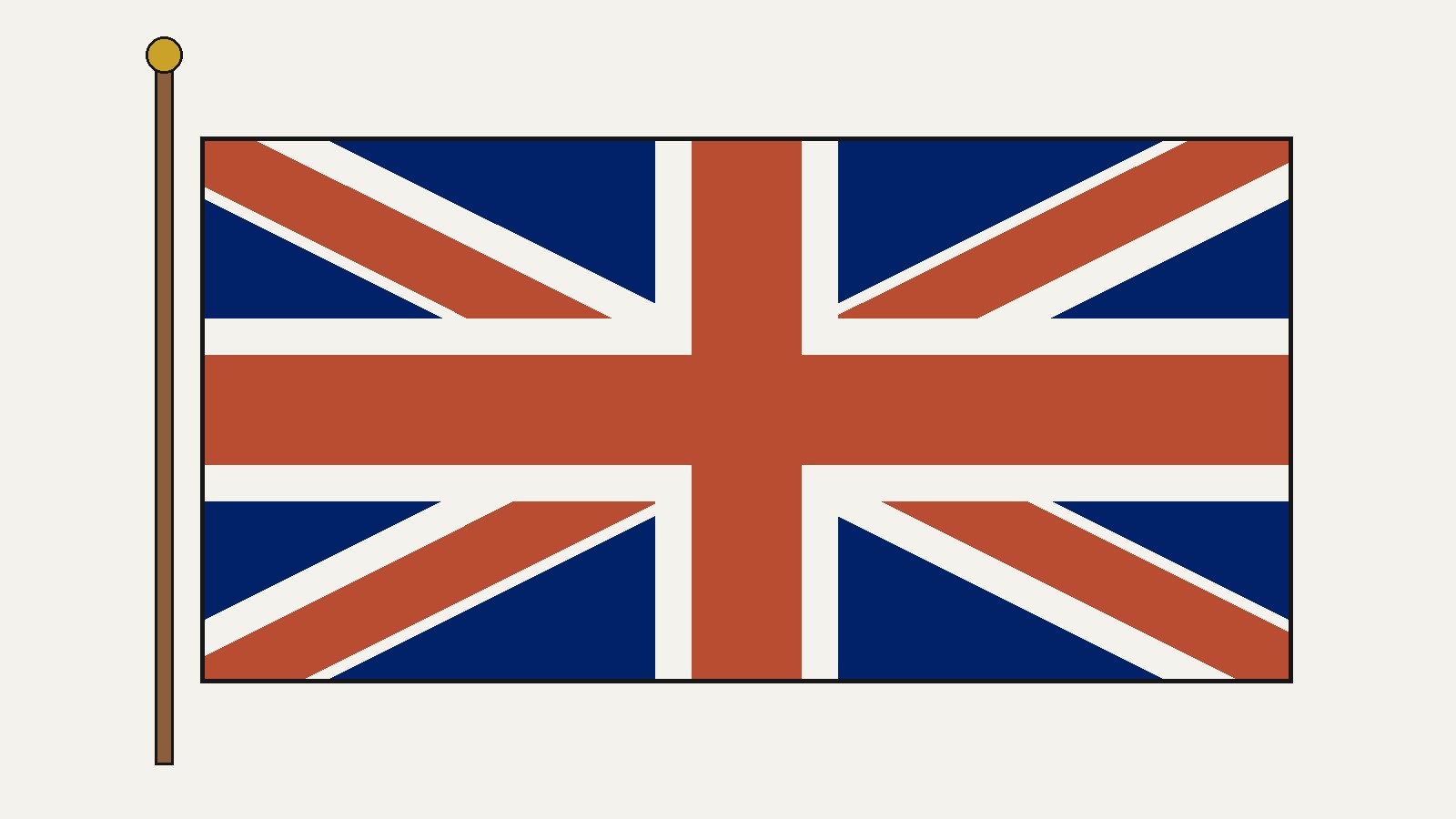
Short answer: The flag of the United Kingdom is the Union Flag, commonly called the Union Jack. It is a blue flag that combines three crosses: the red cross of St George for England, the white diagonal cross of St Andrew for Scotland, and the red diagonal cross of St Patrick for Ireland. Its present design dates from 1801, when the cross of St Patrick was added to the earlier 1606 flag that combined only England and Scotland. Wales has no cross in the design because, when the first Union Flag was created, Wales was already united with England and was not treated as a separate kingdom. If you remember one visual test, remember this: on the side nearest the flagpole, the broad white diagonal stripe sits above the thin red diagonal stripe. If it does not, the flag is upside down.
Reading the flag at a glance
At first glance the Union Flag seems simple: red, white, and blue, with crosses running straight and diagonally. Look again and the diagonal pattern is not symmetrical. In the top corner nearest the flagpole, the white diagonal band is broad above the red diagonal band; in the top corner farthest from the pole, the arrangement is reversed. That asymmetry is not a printing error. It is how two diagonal crosses share one flag without one erasing the other.
The flag is built in layers, read from the back to the front:
- The field is blue, the field of the Scottish flag.
- On that blue field sits the white diagonal cross of St Andrew, the patron saint of Scotland.
- Over that sits the red diagonal cross of St Patrick, the patron saint of Ireland, edged in white so that red does not touch blue directly.
- Over everything sits the red upright cross of St George, the patron saint of England, also edged in white.
That layering is why the flag has so much white in it: the white of St Andrew’s cross itself, plus the white edging that keeps each red cross separated from the color beneath it. In heraldry, that narrow border is called fimbriation, and it is why both red crosses look as if they have a white outline.
| Element | Saint and country | Appearance |
|---|---|---|
| Cross of St George | St George, England | Red upright cross on white |
| Cross of St Andrew | St Andrew, Scotland | White diagonal cross on blue |
| Cross of St Patrick | St Patrick, Ireland | Red diagonal cross on white |
One misunderstanding should be cleared up at the start. The Union Flag is not the flag of England. It is the national flag of the whole United Kingdom of Great Britain and Northern Ireland. England, Scotland, and Wales each have their own flag, described later in this article.
Why it has two names
Both names are in everyday use, and both are accepted. The formal name most often used in official writing is the Union Flag. The popular name is the Union Jack. For a long time, a rule was repeated that the flag should only be called a Union Jack when it was flown at sea, because a jack is a small flag flown at the bow of a ship. That rule has been disputed, and the Flag Institute’s research, reported in 2013, found that either name is valid whatever the purpose. Britannica puts it the same way: the flag was called a jack only when flown at the bowsprit of naval vessels at first, it was commonly called the Union Jack by the late 17th century, and now either name is acceptable.
The origin of the word jack itself is uncertain. The Royal Family’s official site lists several possibilities, including Queen Anne’s reign, soldiers’ jackets, a proclamation by Charles II about naval jacks, and the name of James I, and commits to none of them. What is certain is that the name is old, widely used, and not a mistake. If you call it the Union Jack on land, you are not getting it wrong.
The 1606 flag: two crosses, one king
The story starts with a person, not a parliament. In 1603, James VI of Scotland inherited the English and Irish thrones and became James I of England. The crowns of England, Scotland, and Ireland were now held by one monarch, in a personal union, but the kingdoms remained separate states. There was no single kingdom of Great Britain yet, and no single parliament for the whole island.
The practical problem was at sea: English and Scottish ships now sailed under the same king, and arguments arose about which flag a ship should fly. On April 12, 1606, a royal proclamation ordered a new flag for ships, the red cross of St George and the white cross of St Andrew joined together, in a form made by the heralds and sent to the Admiral. On land, English and Scottish towns largely kept flying their own crosses.
The 1606 design was symmetrical in a way the modern flag is not. It had only two crosses to combine, so there was no need for the offset diagonal trick that defines the modern flag. The red upright cross of St George, edged in white, sat over the white diagonal cross of St Andrew on its blue field. That was the flag of Great Britain in its first form, and it is the flag you will see in paintings of 17th century ships.
One later chapter interrupted that design but did not replace it permanently. During the Commonwealth and Protectorate period, from 1649 to 1660, the Irish harp was incorporated into the flag. On the Restoration of Charles II in 1660, the flag resumed its original 1606 form.
1707: from a royal flag to a national flag
In 1707, the Acts of Union joined England and Scotland into a single Kingdom of Great Britain, with one parliament. The Union Flag, which had begun as a royal flag for ships under a shared monarch, now became the flag of a single united kingdom, chosen by Queen Anne as the flag of the new kingdom.
So the dates 1606 and 1707 mark different steps: 1606 is when the combined design was first ordered, and 1707 is when the union became a full political union of England and Scotland.
The 1801 flag: adding the third cross
On January 1, 1801, the legislative union of Great Britain and Ireland took effect, creating the United Kingdom of Great Britain and Ireland. The flag had to change, because Ireland was now part of the same kingdom and its emblem had to be included. The solution was to add the red diagonal cross of St Patrick to the existing design.
The problem the heraldic advisers faced was a visual one. If the red diagonal cross of St Patrick had simply been laid centered over the white diagonal cross of St Andrew, the white cross would have been reduced to a thin border around the red one. Scotland’s cross would have looked subordinate, as if it were only edging for Ireland’s cross. That would not do, because Scotland was the senior kingdom in the union.
The solution was counterchanging: dividing each diagonal stripe lengthwise so that the two crosses share it. Britannica describes the result precisely: the white cross of St Andrew was divided diagonally, with the red appearing below the white on the hoist half of the flag and above it on the fly half. A white fimbriation was added to the red cross so that red did not touch blue, and in the center a white fimbriation also separated the cross of St Patrick from the red cross of St George.
The practical result is the asymmetry you can see today. Stand facing the flag with the flagpole on your left: in the upper corner nearest the pole, the broad white stripe of St Andrew is on top, and in the upper corner farthest from the pole, the red stripe of St Patrick is on top. Turn the flag upside down and those positions swap.
The 1801 design has remained unchanged ever since, surviving the partition of Ireland, two world wars, the end of empire, and devolution without a redesign. When the Irish Free State was established in 1922 and most of Ireland left the United Kingdom, the flag stayed exactly as it was. Northern Ireland remained in the United Kingdom, and the cross of St Patrick continued to represent the Irish part of the union’s history.
Why Wales has no cross in the flag
This is the most asked question about the Union Flag, and the answer is historical rather than symbolic. The Royal Family’s official site states it plainly: the Welsh dragon does not appear on the Union Flag because, when the first Union Flag was created in 1606, the Principality of Wales by that time was already united with England and was no longer a separate principality.
In other words, the flag was built from kingdoms. England, Scotland, and Ireland were kingdoms with their own patron saints and their own crosses. Wales was not a kingdom in that sense when the flag was designed. It was part of the Kingdom of England, so its emblem was not added as a fourth layer. The red cross of St George was understood, in the flag’s logic, to cover England and Wales together.
That explanation satisfies the history, but it does not satisfy everyone today, and some people argue the flag should be redesigned to include a Welsh element. This article takes no position in that debate. What matters here is why the flag looks the way it does.
Wales’s own flag is often confused with the cross of St David. The flag of Wales is a red dragon on a horizontal field of white over green. It is called Y Ddraig Goch, meaning the red dragon, and it was officially recognized as the Welsh national flag in 1959. The exact drawing of the dragon is not standardized in law. The flag of St David, a yellow cross on a black field, is a different flag and does not appear in the Union Flag either.
The Northern Ireland nuance
The third cross in the Union Flag raises a fair question: if most of Ireland is no longer in the United Kingdom, why does the cross of St Patrick remain? The short answer is that the flag was never redesigned after partition, and the cross now represents Northern Ireland’s place in the union as well as the historical Irish contribution to it.
Northern Ireland itself has no separate official flag of its own. The only official flag for Northern Ireland is the Union Flag of the United Kingdom as a whole. A previous flag, the Ulster Banner, was used by the Government of Northern Ireland from 1953 until that government and parliament were abolished in 1973. Since then it has had no official status, although it continues to be used in some sporting and community contexts. The cross of St Patrick is sometimes flown in Northern Ireland, including at St Patrick’s Day parades and at some royal events, but it is not Northern Ireland’s official flag.
In Northern Ireland, flags carry community associations beyond design: the Union Flag is flown by unionists, while the Irish tricolor, the green, white, and orange flag of the Republic of Ireland, is flown by nationalists. The key point for a reader outside Northern Ireland is simple: do not assume that the Ulster Banner is Northern Ireland’s current official flag, and do not assume that the Irish tricolor represents Northern Ireland. The official flag is the Union Flag.
Proportions and colors: what is fixed and what is not
The Union Flag’s proportions confuse many people, because two ratios are both in common use. Britannica gives the width to length ratio as 1 to 2. The College of Arms, the Crown body responsible for heraldic matters in England, Wales, and Northern Ireland, approves designs in both 1 to 2 and 3 to 5 ratios. In practice, the 1 to 2 ratio is the longer, narrower flag most often seen at sea and in official use, while the 3 to 5 ratio is the squarer flag often seen on land. Neither ratio is a mistake. If you buy a flag, check which ratio it uses rather than assuming every Union Flag has the same shape.
The colors are dark blue, red, and white. No official symbolic meaning is assigned to the colors themselves in the primary sources for this article; the meaning lives in the crosses, not in a color code. Claims that red stands for bravery, white for peace, and blue for loyalty are popular in general flag writing, but they are not part of the official account of this flag’s design, and this article does not present them as fact.
Because shades vary between manufacturers, a flag from a market stall may look lighter or darker than one made by a registered flagmaker following an approved pattern. If accuracy matters, use a pattern from a reputable source rather than copying colors from a random image online.
How to fly it the right way up
The Union Flag has a correct way up, and flying it upside down is considered improper. The test takes five seconds once you know what to look for.
Stand so that you are facing the flag and the flagpole, or the hoist edge, is on your left. Look at the top corner nearest the pole. The broad white diagonal stripe should be above the thin red diagonal stripe. Now look at the top corner farthest from the pole. There, the red diagonal stripe should be above the white diagonal stripe. If the arrangement is reversed, the flag is upside down. Turn it over and the broad white stripe returns to the top on the pole side.
You will sometimes read that an upside down Union Flag is a distress signal. Treat that claim with care: an upside down Union Flag is only subtly different from a correct one, so it is a poor distress signal in practice. Flying it upside down is improper and is often described as a distress signal, but it should not be relied on as one. In ordinary use it simply signals that the person who hoisted it did not check the diagonals.
Protocol: when it flies, and at half-mast
The Union Flag began as a royal flag: when the present design was made official in 1801, it was ordered to be flown on all the King’s forts and castles, but not elsewhere. That restriction has long gone, and Britannica notes that the general public now uses it unofficially as a civil flag.
For UK government buildings in England, Scotland, and Wales, the government publishes designated days for flying the Union Flag. The 2026 list includes the patron saints’ days, Commonwealth Day, Coronation Day, the official birthday of the King, and Remembrance Day, along with royal birthdays and anniversaries and the opening and prorogation of Parliament. In 2021, the government also announced that the Union Flag would be flown every day on UK government buildings unless another flag was being flown. In Northern Ireland, designated flag flying for government buildings is governed by legislation rather than by the same guidance.
Half-mast means the flag is flown two-thirds of the way up the flagpole. The procedure is to raise it fully to the top first, then lower it to the half-mast position, and at the end of the day to raise it to the top again before lowering it completely. The Union Flag is flown at half-mast from the announcement of the death of the Sovereign until the funeral, except on Proclamation Day, when flags are flown at full mast from 11 a.m. until sunset. It is also flown at half-mast for the funerals of members of the Royal Family, foreign rulers, and prime ministers and former prime ministers, on the command of the Sovereign. The Royal Standard, the personal flag of the monarch, is never flown at half-mast, because the new monarch succeeds immediately.
The Union Flag should also take the position of honor when flown with other flags, and no flag should be flown higher than it on the same pole. It should be kept clean, untorn, and unfaded, and it should not be allowed to touch the ground.
Common mistakes, and how to avoid them
Calling it the flag of England. The flag of England is the red cross of St George on white, alone. The Union Flag contains that cross, but it is not that flag. If you want to represent England specifically, for example at a sporting event where England competes separately, use the St George’s cross, not the Union Flag.
Flying it upside down. This is the most common physical mistake, and it is covered in full above. The fix is the broad white stripe test on the pole side.
Mirroring the design in artwork. Because the flag is not symmetrical, a mirrored image is wrong: flipping a photograph horizontally swaps the diagonals. Designers should check the hoist side, not just the overall look, before publishing. No element of the flag secretly represents Wales; the dragon does not appear in any form.
Assuming the flag changed after 1922. It did not. The 1801 design remains the design in use today, even though the United Kingdom’s territory and name changed after most of Ireland left. The cross of St Patrick stayed.
Using the Ulster Banner as Northern Ireland’s official flag. As explained above, the Ulster Banner has had no official status since 1973. It appears in sporting and community contexts, but it is not the official flag of Northern Ireland.
How it differs from the England, Scotland, and Wales flags
The four flags of the United Kingdom’s constituent countries are easy to confuse at a distance, because three of them are crosses and all of them share colors with the Union Flag. This table separates them.
| Flag | Design | What it is |
|---|---|---|
| England | Red upright cross of St George on white | The flag of England alone |
| Scotland | White diagonal cross of St Andrew on blue | The flag of Scotland alone, also called the Saltire |
| Wales | Red dragon on white over green | The flag of Wales alone, called Y Ddraig Goch |
| Northern Ireland | No separate official flag; the Union Flag is the official flag | Do not substitute the Ulster Banner or the Irish tricolor |
| United Kingdom | All three crosses combined, as described in this article | The Union Flag, the national flag |
Where else the Union Flag appears
The Union Flag is one of the most widely reused flag designs in the world, because it sits in the top corner, the canton, of other flags. Britannica lists the national flags of Australia, New Zealand, and Tuvalu, the flag of the US state of Hawaii, the flags of six Australian states, and the flags of the Canadian provinces of British Columbia, Manitoba, and Ontario. In each case, the Union Flag in the canton records a historical connection to Britain, not a current political union with the United Kingdom.
The Union Flag also forms the canton of the British Red Ensign, a red field with the Union Flag in the corner, and the British Blue Ensign, a blue field with the Union Flag in the corner. If you see a flag that looks like a Union Flag shrunk into the corner of a larger flag, you are looking at an ensign or a flag derived from one, not at the Union Flag itself.
In Canada, by parliamentary resolution, it is an official flag known as the Royal Union Flag. That does not make Canada part of the United Kingdom.
The flag in everyday life
Beyond government buildings and ships, the Union Flag is one of the most recognizable symbols in popular culture, appearing on clothing, album covers, and merchandise around the world. That popular use is part of why mistakes about it spread so easily: a Union Flag printed upside down on a T-shirt is a design error thousands of people may wear without noticing, because the difference is subtle. The flag is flown at royal events, at Remembrance Day commemorations, and at sporting events where the United Kingdom competes as one team. At events where England, Scotland, Wales, or Northern Ireland compete separately, their own flags are used instead. Like any national symbol, it carries different associations for different people, and a factual article cannot resolve those feelings. What it can do is get the facts right: what the flag is, how it was made, why it looks the way it does, and how to use it correctly.
Frequently asked questions
What is the flag of the United Kingdom called?
It is called the Union Flag, and commonly called the Union Jack. Both names are accepted, and the older rule that it should only be called a Union Jack at sea has been disputed.
What do the crosses on the Union Flag mean?
The red upright cross is St George’s cross for England. The white diagonal cross is St Andrew’s cross for Scotland. The red diagonal cross is St Patrick’s cross for Ireland. Together they represent the union of the kingdoms that formed the United Kingdom.
When was the Union Flag created?
The first Union Flag was ordered in 1606, combining England and Scotland. The present design, with the cross of St Patrick added, dates from January 1, 1801. The flag has not been redesigned since 1801.
Why is Wales not on the Union Flag?
When the first Union Flag was created in 1606, Wales was already united with England and was no longer a separate principality, so it was not treated as a separate kingdom with its own cross to add.
Is the Union Flag the same as the flag of England?
No. The flag of England is the red cross of St George on a white field, alone. The Union Flag contains that cross plus the crosses of St Andrew and St Patrick.
How can I tell if a Union Flag is upside down?
Face the flag with the pole on your left. In the top corner nearest the pole, the broad white diagonal stripe should be above the thin red diagonal stripe. If the red stripe is above the white stripe on the pole side, the flag is upside down.
Does an upside down Union Flag mean distress?
It is often described that way, but treat the claim with care: an upside down Union Flag is only subtly different from a correct one, so it is a poor distress signal in practice. In ordinary use it usually means the flag was hoisted without checking the diagonals.
What are the proportions of the Union Flag?
The common ratio is 1 to 2, meaning the flag is twice as long as it is tall. The College of Arms also approves a 3 to 5 ratio, which is squarer and often used on land. Both ratios are in legitimate use.
Does Northern Ireland have its own flag?
No. Northern Ireland has no separate official flag; the Union Flag is its official flag. The Ulster Banner, used by the former Government of Northern Ireland until 1973, has had no official status since then.
Is the Union Flag still used in other countries’ flags?
Yes. It appears in the canton of the flags of Australia, New Zealand, and Tuvalu, the US state of Hawaii, several Australian states, and three Canadian provinces. In Canada it is known by parliamentary resolution as the Royal Union Flag.
Sources & references
- The Royal Family, official site, "Union Jack": the national flag of the United Kingdom; the three crosses; the 1606 combination; the January 1, 1801 design; the Welsh dragon explanation; the originally royal character of the flag; the uncertain origin of the name Union Jack.
- Encyclopaedia Britannica, "Flag of the United Kingdom": the three crosses combined; jack usage at the bowsprit and common use by the late 17th century; the 1 to 2 ratio; the 1606 to 1801 design; the Commonwealth and Protectorate harp and the 1660 Restoration; the counterchanging solution of 1801; the Red and Blue Ensigns; Australia, New Zealand, Tuvalu, Hawaii, Australian states, and Canadian provinces.
- GOV.UK, "Union Flag flying guidance for UK government buildings": the 2026 designated days list; the College of Arms as the Crown body for heraldic matters; Northern Ireland government buildings governed by legislation rather than this guidance.
- UK Parliament written statement, March 24, 2021, on flying the Union Flag on UK government buildings: daily flying unless another flag is flown; the Union Flag in the superior position.
- Flag Institute guidance as reported in flag protocol summaries: the correct way up test, broad white diagonal stripe above the red diagonal stripe on the hoist side; flying upside down considered improper; the distress signal claim disputed for the Union Flag itself.
- Flag of Northern Ireland summaries based on official and encyclopedic sources: no separate official flag for Northern Ireland; the Ulster Banner used from 1953 until the government and parliament were abolished in 1973 and without official status since then; the cross of St Patrick sometimes flown at St Patrick's Day parades and royal events.
- Flag of Wales summaries based on encyclopedic sources: the red dragon on white over green; Y Ddraig Goch; officially recognized as the Welsh national flag in 1959; the dragon's exact drawing not standardized in law.


