Short answer
- Calculating tax incidence means working out how the real cost of a tax is divided between buyers and sellers. The person or business that hands the money to the government is not always the party that ends up worse off by the full amount. A tax on sellers can push up the price buyers pay, and a tax on buyers can push down the price sellers receive. The split depends mainly on how strongly buyers and sellers react to price changes, which economists call price elasticity. There are two standard ways to do the calculation. The price method compares prices before and after the tax: the buyer burden per unit is the new price buyers pay minus the old equilibrium price, and the seller burden per unit is the old equilibrium price minus the new price sellers receive. The elasticity method uses the price elasticities of demand and supply to estimate each side's percentage share. In both methods, the two burdens add up to the tax per unit. This article explains both methods, works through numerical examples, and sets out the limits of a simple calculation. It is an economics explainer only, and gives no personal tax advice.
By Emma Hudson
What tax incidence means
Tax incidence is the distribution of the economic burden of a tax between buyers and sellers. It answers the question of who really bears the cost once prices and quantities have adjusted, not simply who writes the check to the tax authority. That distinction is the whole point of the subject, and it is where most casual discussion goes wrong.
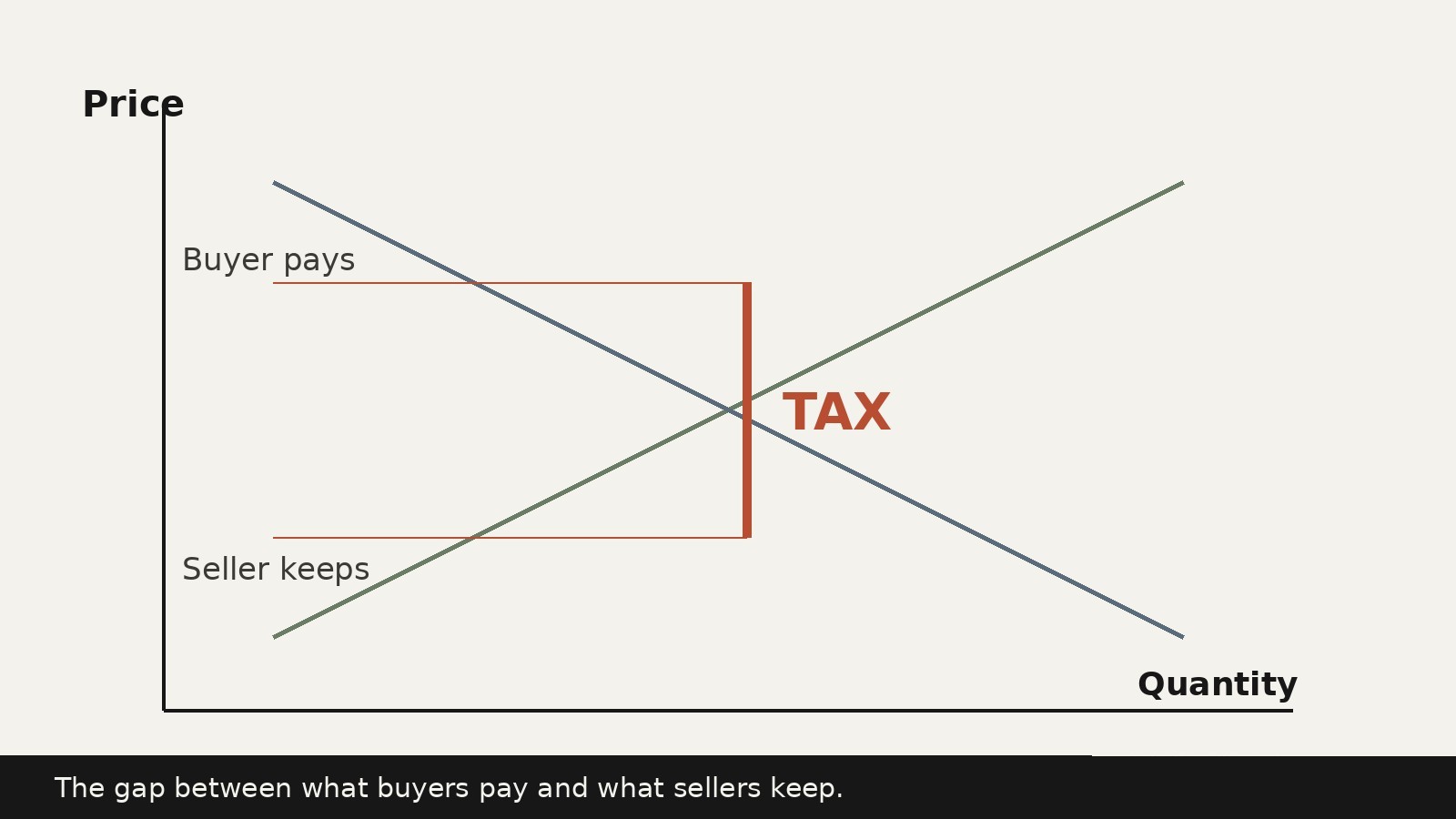
Before the tax, buyers and sellers trade at one equilibrium price, where the quantity buyers want to buy equals the quantity sellers want to sell. After a per unit tax, buyers pay one price and sellers receive a lower price, and the gap between those two prices equals the tax per unit. The quantity traded usually falls, because some trades worthwhile before the tax are no longer worthwhile once the wedge is inserted. The burden is measured by how much worse off each side is per unit traded, compared with before the tax. Keep three amounts separate: the tax per unit, set by law; the tax revenue, which equals the tax per unit multiplied by the new quantity traded; and the incidence, which is how the tax per unit is divided between buyers and sellers.
The question is older than modern economics: Adam Smith took up who really bears a tax in The Wealth of Nations, published in 1776.
Statutory incidence vs economic incidence
Statutory incidence is the legal answer to the question of who must remit the tax. If the law places a tax on sellers, sellers are statutorily liable: they file the return and pay the government. If the law places a tax on buyers, buyers are statutorily liable. Economic incidence is the separate question of who ends up bearing the cost after prices adjust. In a competitive market, the standard result is that economic incidence does not depend on statutory incidence. Whether the tax is legally imposed on buyers or on sellers, the new prices, the new quantity, and the division of the burden are the same, provided the size of the tax is the same and the market is otherwise unchanged.
The reason is straightforward. A tax creates a wedge between the price buyers pay and the price sellers receive, whatever side is legally charged. If sellers are taxed, they need a higher buyer price to supply the same quantity, so the supply curve shifts up by the tax amount. If buyers are taxed, they are willing to pay sellers less for the same quantity, so the demand curve shifts down by the tax amount. Both shifts produce the same wedge and quantity. Only the curve drawn as shifting differs. This holds in the simple competitive model with no evasion or administrative costs. In real systems, the remitting side still bears compliance costs and penalties for nonpayment, so legal design can matter for administration even when the price result is the same.
The tax wedge in plain terms
Three prices do all the work in a tax incidence calculation. The first is Pe, the equilibrium price before the tax. The second is Pc, the price buyers pay after the tax. The third is Ps, the price sellers receive after the tax, after the tax itself has been taken out. By definition, Pc minus Ps equals the tax per unit, written as T. The quantity traded after the tax, often written as Qt, is lower than the quantity traded before the tax in the standard case, because the tax discourages some trades.
With those symbols, the two burdens follow directly. The consumer burden per unit equals Pc minus Pe: the extra amount buyers pay per unit compared with before the tax. The producer burden per unit equals Pe minus Ps: the amount less that sellers receive per unit compared with before the tax. Add the two burdens together and the result is T, because (Pc minus Pe) plus (Pe minus Ps) equals Pc minus Ps. That identity is a useful check on any calculation. If the two shares do not add up to the tax, something has gone wrong. Percentage shares are then simple: divide each burden per unit by T and multiply by 100. The two percentages add up to 100 percent.
Method 1: the price method, step by step
The price method is the most direct way to calculate tax incidence when prices before and after the tax are known or can be estimated. It needs no elasticity estimates. Step 1: record the equilibrium price before the tax, Pe, and the quantity traded before the tax if revenue matters. Step 2: record the price buyers pay after the tax, Pc, and the price sellers receive after the tax, Ps, and confirm that Pc minus Ps equals the tax per unit T. If it does not, check whether another price change has occurred at the same time, or whether the figures come from different markets or periods. Step 3: calculate the consumer burden per unit as Pc minus Pe. Step 4: calculate the producer burden per unit as Pe minus Ps. Step 5: convert each burden to a percentage share by dividing by T. Step 6: if the new quantity Qt is known, calculate tax revenue as T multiplied by Qt.
The main difficulty in practice is isolating the effect of the tax. Prices move for many reasons: costs, incomes, and competing products all change. A comparison that ignores those movements will attribute them to the tax by mistake. Careful studies therefore compare the taxed market with a similar untaxed market, or control for other changes. A simple before and after comparison is a starting point, not a finished estimate, when other factors are moving.
Worked example A: a 2 dollar tax split evenly
Suppose a product trades at 10 dollars per unit before any tax. The government imposes a tax of 2 dollars per unit. After the tax, buyers pay 11 dollars per unit and sellers receive 9 dollars per unit. The gap between 11 dollars and 9 dollars is 2 dollars, which matches the tax, so the figures are consistent. Consumer burden per unit: 11 dollars minus 10 dollars equals 1 dollar. Producer burden per unit: 10 dollars minus 9 dollars equals 1 dollar. Consumer share: 1 dollar divided by 2 dollars equals 50 percent. Producer share: 50 percent. This even split is a result of the particular prices chosen for illustration. It is not a general rule.
If the quantity traded after the tax is 900 units per week, tax revenue equals 2 dollars multiplied by 900, which is 1,800 dollars per week, split evenly between buyers in higher prices and sellers in lower net receipts.
Worked example B: a 4 dollar tax with quantity and revenue
Suppose a product trades at 20 dollars per unit and 1,000 units per week before the tax. The government imposes a tax of 4 dollars per unit. After the tax, buyers pay 23 dollars per unit, sellers receive 19 dollars per unit, and the quantity traded falls to 800 units per week. The gap between 23 dollars and 19 dollars is 4 dollars, matching the tax. Consumer burden per unit: 23 dollars minus 20 dollars equals 3 dollars. Producer burden per unit: 20 dollars minus 19 dollars equals 1 dollar. Consumer share: 3 dollars divided by 4 dollars equals 75 percent. Producer share: 25 percent. Tax revenue: 4 dollars multiplied by 800 units equals 3,200 dollars per week, split as 2,400 dollars borne by buyers and 800 dollars borne by sellers.
Note what revenue leaves out. The 200 units per week no longer traded represent lost trades, and the gains those trades would have created are lost to both sides. That loss is not counted in tax revenue or in the per unit incidence split. It is the deadweight loss discussed later. Reporting only revenue therefore understates the full economic cost of the tax, even when the split itself is correct.
Method 2: the elasticity formula
When prices after the tax are not yet known, economists often estimate the split from elasticities. Price elasticity of demand measures how much the quantity demanded changes in percentage terms when price changes by 1 percent. Price elasticity of supply does the same for the quantity supplied. Demand elasticity is usually negative, because a higher price reduces quantity demanded, so calculations use its absolute value. Supply elasticity is usually positive.
For a per unit tax, let Ed stand for the absolute value of the price elasticity of demand, and let Es stand for the price elasticity of supply. Then the consumer share equals Es divided by (Ed plus Es), and the producer share equals Ed divided by (Ed plus Es). Multiply each share by the tax per unit T for the dollar burden per unit. The logic is the rule stated throughout this article: the less elastic side bears more. If supply is very elastic, the consumer share is close to 100 percent, because elastic sellers can cut supply rather than accept a lower net price. If demand is very elastic, the producer share is close to 100 percent, because elastic buyers can walk away.
Two warnings apply. First, these formulas are approximations for small taxes and for linear or locally linear demand and supply. For large taxes, or for curves that bend sharply, the exact split can differ. Second, the formulas need credible elasticity estimates for the market in question. An elasticity taken from a different product, time period, or country may not describe it. A precise looking percentage built on a borrowed elasticity is less reliable than a rough range built on elasticities estimated for that market.
Worked example C: inelastic demand, elastic supply
Suppose the price elasticity of demand is 0.5 in absolute value, which is inelastic, and the price elasticity of supply is 2.0, which is elastic. The tax is 1 dollar per unit. The sum of the elasticities is 2.5. Consumer share: 2.0 divided by 2.5 equals 80 percent, so the consumer burden per unit is 0.80 dollars. Producer share: 0.5 divided by 2.5 equals 20 percent, so the producer burden per unit is 0.20 dollars. The two burdens add to 1 dollar, matching the tax. Buyers bear most of the tax because they react little to price, while sellers react strongly and can adjust supply instead of accepting a much lower net price.
Worked example D: elastic demand, inelastic supply
Now reverse the pattern. The price elasticity of demand is 2.0 in absolute value, which is elastic, and the price elasticity of supply is 0.5, which is inelastic. The tax is again 1 dollar per unit, and the sum of the elasticities is again 2.5. Consumer share: 0.5 divided by 2.5 equals 20 percent, so the consumer burden per unit is 0.20 dollars. Producer share: 2.0 divided by 2.5 equals 80 percent, so the producer burden per unit is 0.80 dollars. The split has flipped. Sellers now bear most of the tax because they cannot easily adjust supply, while buyers can easily switch away, so sellers must accept a lower net price to keep selling. The tax is the same size in both examples. What changes the outcome is the relative responsiveness of buyers and sellers.
Why the less elastic side bears more
The intuition is about alternatives. A buyer with many close substitutes, or with the option to postpone purchase, can respond to a higher price by buying less or buying something else. That buyer is elastic, and a seller who tries to pass the full tax to that buyer will lose sales. To keep the sale, the seller absorbs more of the tax. A buyer with few substitutes, or with an urgent need, cannot easily walk away. That buyer is inelastic, and the seller can pass more of the tax on in a higher price without losing the sale.
The same logic applies on the supply side. A seller who can easily shift production to another product or market is elastic, and will cut supply rather than accept a much lower net price. A seller who cannot easily redeploy resources, for example the owner of a fixed beachfront hotel site, is inelastic, and must accept a lower net price. Time horizon matters, because elasticity usually rises over time: in the short run, habits and capacity are fixed, while over a longer period buyers find substitutes and sellers adjust capacity, so the split can shift even if the tax does not change.
Extreme cases: when one side bears the whole tax
If demand is perfectly inelastic, buyers bear the entire tax, because sellers can raise the price by the full amount without losing sales. If supply is perfectly elastic, buyers again bear the entire tax, because sellers will not accept a lower net price. If demand is perfectly elastic, sellers bear the entire tax, because any price rise loses all sales. If supply is perfectly inelastic, sellers again bear the entire tax, because they cannot cut supply to force buyers to pay more. Real markets rarely sit at these extremes, which is why most real cases involve sharing.
Taxes that are not per unit
So far this article has used per unit taxes, also called specific taxes: a fixed amount per unit sold. Many real taxes are instead ad valorem taxes, a percentage of price, as with a percentage sales tax. The incidence logic is the same: the less elastic side bears more. The calculation differs in one respect. With a percentage tax, the tax per unit changes when the price changes, so the wedge is not fixed. The analyst must first work out the tax per unit at the new price, and must state the tax base, since some laws apply the percentage to the seller price and others to the buyer price. A lump sum tax, which does not vary with quantity or price, does not create the same per unit wedge. A tax on labor or capital works through factor markets, so the single market formulas should not be applied directly without adapting the model.
Payroll taxes: a classic statutory vs economic case
Payroll taxes provide the most widely discussed example of the gap between statutory and economic incidence. In the United States, payroll taxes for social insurance are typically split in law between employer and employee shares. A reader who looked only at the statute might conclude that each side bears its own share. Tax Policy Center material notes the key insight that taxes are not always borne by the individual or business that writes the check to the tax authority, and gives the employer portion of payroll taxes as an example: most economists believe that portion translates into lower wages and is thus ultimately borne by workers. That describes a widely held view about the long run tendency, not a law for every labor market at every moment. If labor supply is very inelastic, employers can pass the tax to workers through lower wages with little loss of employment. If labor demand is very inelastic, employers bear more of it. Wage rigidities, minimum wage floors, collective bargaining, and the time horizon all affect how quickly and fully shifting occurs.
Corporate income tax: where the burden is genuinely debated
The corporate income tax raises the hardest incidence question in this field, because a corporation is a legal entity, not a person. A corporation may remit the tax, but the economic burden must ultimately fall on people: shareholders through lower returns, workers through lower wages, consumers through higher prices, or some combination of those groups. Economists disagree about the proportions, and the disagreement is honest, not a sign that one side has missed a simple formula.
The Tax Policy Center, in a discussion of who pays corporate taxes, reports that the Congressional Budget Office, the Joint Committee on Taxation, the Treasury Department, the Penn-Wharton Budget Model, and the Tax Policy Center itself assume that three quarters or more of the burden falls on shareholders and other recipients of capital income, with the rest on workers. The Tax Policy Center’s own long run assumption is 60 percent on shareholders, 20 percent on all owners of capital, and 20 percent on labor. The Congressional Budget Office allocation is 75 percent to capital income and 25 percent to labor income. These are modeling assumptions for distributional tables, not direct measurements, and other analysts differ: the same discussion notes that the Tax Foundation divides the burden equally between workers and owners of capital. Why do the estimates differ? In the short run, shareholders likely bear most of the burden, because capital is already invested and cannot instantly leave. Over a longer period, capital can move between sectors and countries, investment can fall, and workers can become less productive and earn lower wages than they otherwise would. A single product market statement with estimated elasticities is a calculation. A corporate tax statement is a modeling choice built on contested assumptions, and the two do not carry the same weight.
Deadweight loss, revenue, and welfare
Tax incidence measures the split of the tax burden. It does not, by itself, measure the total cost of the tax to society. That total cost includes deadweight loss, also called excess burden: the value of trades that no longer happen because the tax wedge makes them unprofitable for buyer, seller, or both. Those trades disappear, and the surplus they would have created is lost to everyone. It is not transferred to the government as revenue, or to the other side of the market. It is simply gone. Deadweight loss grows with elasticity and with the size of the tax. When demand or supply is elastic, quantity falls a lot, so many trades are lost. When demand or supply is inelastic, quantity falls little, so deadweight loss is smaller, even though the burden on the inelastic side may be large. This explains a tension in tax design: taxes on inelastic bases raise revenue with relatively little deadweight loss, but place a heavy burden on the inelastic side, which may raise fairness concerns. In the single market model, revenue equals the tax per unit multiplied by the new quantity Qt. As the tax rate rises from zero, revenue first rises, then eventually falls if quantity collapses. That single market relationship should not be used on its own to predict total government revenue.
Spending responses run through the marginal propensity to consume: the share of each extra dollar that households spend rather than save.
Common mistakes and limits
Several errors recur in popular discussion. First, equating remittance with burden: the side that sends the payment is the statutory bearer, not necessarily the economic bearer. Always check prices, not only the payment. Second, assuming full pass through to buyers or to sellers. Full shifting happens only at the extremes described earlier. Third, confusing a price rise with the full burden. If a price rises by 3 dollars after a 4 dollar tax, buyers bear 3 dollars per unit, but sellers still bear 1 dollar in lower net receipts. Always report both sides and check that they sum to the tax. Fourth, using elasticities from the wrong market or time horizon. Fifth, treating a modeling assumption as a measurement. Sixth, ignoring quantity: a tax that raises little revenue because quantity collapses has still imposed a burden and a deadweight loss.
The simple calculation also rests on the competitive market model: many buyers and sellers, no single party able to set price, full information, and no externalities. A seller with market power may absorb a tax partly through lower markups rather than passing it on as the competitive model predicts. Evasion and avoidance also change the picture: cross border shopping, informal markets, and substitution toward untaxed close substitutes all reduce the effective base. A tax on one product can also affect wages and prices in other markets, especially when the taxed sector is large. The single market calculation captures the first ripple only. Finally, incidence here is about money prices and quantities. It does not by itself answer fairness questions, which need distributional information about income, wealth, and need as well.
Frequently asked questions
What is tax incidence in simple terms?
Tax incidence is the way the real cost of a tax is divided between buyers and sellers once prices have adjusted. It is not the same as who sends the payment to the government.
How do you calculate tax incidence from prices?
Find the price before the tax (Pe), the price buyers pay after the tax (Pc), and the price sellers receive after the tax (Ps). Buyer burden is Pc minus Pe. Seller burden is Pe minus Ps. Divide each by the tax per unit for percentage shares.
How do you calculate tax incidence from elasticities?
Use the absolute value of demand elasticity (Ed) and supply elasticity (Es). Consumer share is Es divided by (Ed plus Es). Producer share is Ed divided by (Ed plus Es). Multiply by the tax per unit for dollar burdens. This is an approximation for small taxes.
Does it matter whether a tax is imposed on buyers or sellers?
In the standard competitive model, no. Buyer price, seller net price, quantity, and burden split are the same for a tax of the same size. Only the remitter changes. Compliance and evasion differences can still matter outside that model.
Who bears more of a tax, buyers or sellers?
The less elastic side bears more. If demand is more inelastic than supply, buyers bear most of it. If supply is more inelastic, sellers bear most of it.
What is the difference between tax incidence and tax revenue?
Incidence is the split of the tax per unit between buyers and sellers. Revenue is the tax per unit multiplied by the quantity traded after the tax. Neither includes deadweight loss.
Do corporations really pay corporate taxes?
Corporations remit them, but the burden falls on people: shareholders, workers, consumers, or a combination. Major models assign roughly three quarters or more to capital income and the rest to labor, but those are modeling assumptions, not direct measurements.
Why can the same tax have a different incidence in the short run and the long run?
Because elasticities change over time. Buyers find substitutes, sellers adjust capacity, and capital moves between sectors, so the split can shift.
Can a tax be fully passed on to consumers?
Only in limiting cases: when demand is perfectly inelastic, or when supply is perfectly elastic. In ordinary markets, part of the burden stays with sellers.
Is calculating tax incidence the same as judging whether a tax is fair?
No. Incidence shows who bears the cost in money terms. Fairness also depends on incomes, needs, and whether the taxed product is a necessity or a luxury.
Keep reading: Net Investment Income Tax
Sources & references
- Lumen Learning, Microeconomics, section 7.7 Tax Incidence, via Business LibreTexts: defines tax incidence as the analysis of how a tax burden is divided between consumers and producers, states that incidence depends on the price elasticities of supply and demand, states that the burden falls on the most inelastic side of the market, and gives the price formulas Pc minus Pe for consumers and Pe minus Pp for producers, with Pc minus Pp equal to the tax per unit.
- Tax Policy Center, "Are Billionaire Taxes Falling? That Depends On Who You Think Pays Corporate Taxes": states that nearly all economists agree the burden of corporate taxes does not fall on businesses themselves but on a mix of workers and owners of capital; reports that the Congressional Budget Office, the Joint Committee on Taxation, the Treasury Department, the Penn-Wharton Budget Model, and the Tax Policy Center assume three quarters or more of the corporate tax burden falls on shareholders and other recipients of capital income, with the rest on workers; reports the Tax Policy Center long run assumption of 60 percent on shareholders, 20 percent on all owners of capital, and 20 percent on labor; and reports the Congressional Budget Office allocation of 75 percent to capital income and 25 percent to labor income.
- Tax Policy Center, "Current Law Distribution of Taxes" material, as summarized in the Tax Policy Center discussion of incidence assumptions: states the key insight that taxes are not always borne by the individual or business that writes the check to the tax authority, and that most economists believe the employer portion of payroll taxes translates into lower wages and is thus ultimately borne by workers.
- Congressional Budget Office, "The Distribution of Household Income and Federal Taxes, 2008 and 2009," pages on corporate tax incidence, as summarized in the sources above: states that the incidence of the corporate income tax is uncertain, that shareholders likely bear most of the burden in the very short term, and that over the longer term some portion falls on workers as reduced investment lowers productivity and wages.


