Short answer
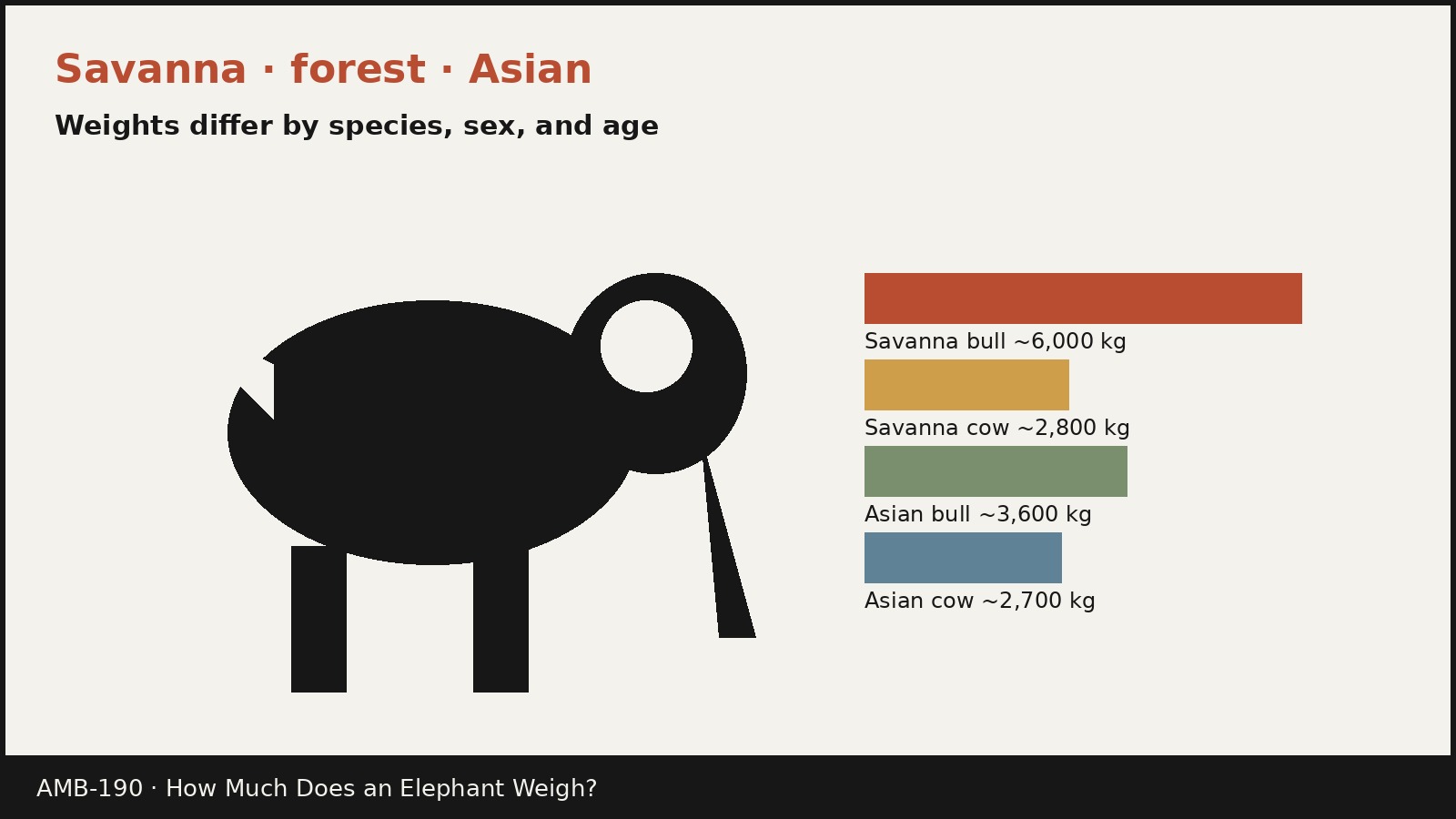
- There is no single answer to how much an elephant weighs, because the answer depends on the species, the sex, and the age of the animal. An adult African savanna elephant bull averages about 6,000 kilograms (about 13,000 pounds), while an adult cow of the same species averages about 2,800 kilograms (about 6,100 pounds), according to the San Diego Zoo Wildlife Alliance Library fact sheet for African elephants. An adult Asian elephant bull averages about 3,600 kilograms (about 7,900 pounds) and an adult Asian cow about 2,700 kilograms (about 6,000 pounds), on the same library's Asian elephant fact sheet, with large Asian bulls reaching up to about 6,000 kilograms. African forest elephants are the smallest of the three living species and are usually put at about 2,000 to 4,000 kilograms (about 4,400 to 8,800 pounds) for adults, although published ranges for this species vary more than for the other two, for reasons explained below. A newborn calf, by contrast, weighs only about 90 to 120 kilograms (about 200 to 270 pounds) for an African savanna elephant, and about 110 kilograms (about 240 pounds) on average for an Asian elephant. So the honest short answer is a range: a grown elephant weighs roughly 2,000 to 6,000 kilograms, and the biggest bulls go beyond that.
Why there is no single elephant weight
Ask how much a dog weighs and you will get the same problem in miniature: a Chihuahua and a Great Dane are both dogs, and no one figure covers both. Elephants are the same, with three living species, two sexes that differ greatly in size, and a lifespan of growth over decades. Any page giving one number for “an elephant” without saying which species, sex, and age it means is hiding the most important information.
That is also why online numbers disagree. Different sources measure different populations, round differently, and sometimes mix up averages with maximums. A figure labeled “up to” is not an average, and an average is not typical for every adult. This article keeps those separate throughout, and states disagreements rather than smoothing them over.
Two more cautions apply. First, most weights for wild elephants are estimates, not scale readings, because weighing a free living elephant is rarely practical. Second, weight changes through the year with food and water supply, and through a lifetime as the animal grows. A single weighing is a snapshot, not a fixed property of the species.
The three living elephant species at a glance
There are three living species of elephant: the African savanna elephant, also called the African bush elephant (Loxodonta africana); the African forest elephant (Loxodonta cyclotis); and the Asian elephant (Elephas maximus). Britannica describes elephants as the largest living land animal, and the African savanna elephant is the largest of the three. The table below gives the headline figures used in this article, all from the San Diego Zoo Wildlife Alliance Library fact sheets except for the forest elephant range, which is discussed separately because the fact sheet range for that species is unusually wide.
| Species | Adult male | Adult female | What to notice |
|---|---|---|---|
| African savanna elephant | About 6,000 kg (about 13,000 lb) on average | About 2,800 kg (about 6,100 lb) on average | Largest species; bulls more than twice the average cow |
| Asian elephant | About 3,600 kg (about 7,900 lb) on average, up to about 6,000 kg (about 13,000 lb) | About 2,700 kg (about 6,000 lb) on average, up to about 4,200 kg (about 9,000 lb) | Smaller than the savanna elephant; large bulls overlap small savanna bulls |
| African forest elephant | About 2,000 to 4,000 kg (about 4,400 to 8,800 lb) for adults in commonly cited ranges | Smaller than forest bulls, within the same broad range | Smallest species; the least settled figures of the three |
Read the table as a map, not as exact weights for any one animal: a young savanna bull may weigh less than a large Asian bull, and individual animals overlap. The sections that follow take each species in turn, including shoulder height, because height and weight together give a better sense of size than either figure alone.
African savanna elephants: the heaviest land animal
The African savanna elephant lives in eastern, central, and southern Africa, in habitats ranging from grasslands and woodlands to lowland and montane forests, floodplains, and some arid deserts, according to the San Diego Zoo Wildlife Alliance Library. It is the species most people picture when they hear the word elephant: very large ears, a swayed back, and tusks in both males and females.
For this species, the San Diego Zoo Wildlife Alliance Library fact sheet gives clear sex specific averages: males about 6,000 kilograms (about 13,000 pounds) on average, and females about 2,800 kilograms (about 6,100 pounds) on average. An average bull is therefore more than twice as heavy as an average cow, a gap of about 3,200 kilograms, heavier than a whole adult Asian elephant cow.
Britannica gives a higher ceiling for the species, stating that the African savanna elephant weighs up to 8,000 kilograms and stands 3 to 4 meters (10 to 13 feet) at the shoulder. That ceiling and the San Diego average are not in conflict: an average of 6,000 kilograms leaves room for exceptional bulls above it, and the San Diego Zoo’s own animal page notes that a male African elephant can weigh up to 7.5 tons (6.8 metric tons). The lesson is to check whether a figure you are reading is an average, a typical range, or a maximum. All three are useful, but they answer different questions.
Height is measured at the shoulder, the standard point for elephants. Savanna elephants also keep growing for a long time: males begin producing sperm at about 10 to 14 years old but generally do not compete successfully for mating until their 20s, and females mature by about 12 years and first give birth at about 14 years in the Amboseli and Addo populations cited by the fact sheet. Growth slows after maturity but does not stop abruptly, which is one reason the oldest bulls are usually the heaviest animals in a population.
African forest elephants: the smallest species, and the hardest to weigh
The African forest elephant lives in the tropical rainforests of western and central Africa, especially the Congo Basin. Recognized as a separate species in 2000, Britannica notes, it is smaller than the savanna elephant, with straighter, more slender, downward pointing tusks, smaller ears, and a straighter back. Its forest home is what makes it hard to study: dense vegetation hides the animals, and researchers cannot easily approach a wild forest elephant with a scale.
That difficulty shows up directly in the published weights. Commonly cited summaries put adult forest elephants at about 2,000 to 4,000 kilograms (about 4,400 to 8,800 pounds). The San Diego Zoo Wildlife Alliance Library fact sheet, however, gives a much wider range for forest elephants, 2,700 to 6,000 kilograms (6,000 to 13,000 pounds), without splitting that range by sex in the summary consulted for this article. Those two ranges overlap but are not the same, and the wider range reaches the average weight of a savanna bull, which would make the “smallest species” label hard to defend if it were taken as typical.
This article therefore treats the forest elephant figures as the least settled in the article. The 2,000 to 4,000 kilogram range is the commonly cited adult range, and the wider San Diego range is reported alongside it as evidence that sources disagree, not hidden. What is secure is the direction: forest elephants are smaller than savanna elephants on average, and their compact size suits dense forest. Shoulder height is also lower in commonly cited summaries, with bulls put at about 2.4 to 3.0 meters (about 7.9 to 9.8 feet) and females at about 1.8 to 2.4 meters (about 5.9 to 7.9 feet); the San Diego fact sheet’s Dzanga sample averages lower, about 2.3 meters for bulls and about 2.0 meters for cows. Because the species was only recently recognized, older sources may mix forest and savanna animals under a single “African elephant” heading.
The forest elephant is listed as Critically Endangered on the International Union for Conservation of Nature Red List, against Endangered for the savanna elephant. A rare animal in dense forest is weighed less often than a common animal on open savanna, and that data gap is part of why forest elephant weights vary so much.
Asian elephants: smaller on average, with wide variation by population
The Asian elephant (Elephas maximus) lives in scrub forests and rainforests in India, Nepal, and parts of Southeast Asia, according to the San Diego Zoo animal page, often near rivers during dry months. It has smaller ears than African elephants, a dome shaped back, one fingerlike projection at the tip of the trunk rather than two, and usually only the males have visible tusks, with females having small tushes or none at all.
The San Diego Zoo Wildlife Alliance Library Asian elephant fact sheet gives the most detailed sex specific figures for this species: males about 3,600 kilograms (about 7,900 pounds) on average, up to about 6,000 kilograms (about 13,000 pounds); females about 2,700 kilograms (about 6,000 pounds) on average, up to about 4,200 kilograms (about 9,000 pounds). Shoulder height follows the same pattern: males about 2.7 meters (about 8.9 feet) on average, up to about 3.4 meters (about 11 feet); females about 2.4 meters (about 7.9 feet) on average, and able to reach over 2.5 meters (about 8.2 feet).
Two qualifications matter. First, most fact sheet measurements are based on populations in India, and elephants farther east and in Borneo are smaller, so a Sumatran or Bornean elephant should not be expected to match an Indian average. The fact sheet lists the Sri Lankan, Bornean, mainland Asian, and Sumatran subspecies. Second, Britannica’s single figure for the Asian elephant, about 5,500 kilograms with a shoulder height of up to 3.5 meters, sits near the upper end of the San Diego range rather than near its average. On its own it would overstate a typical Asian elephant; beside the fact sheet averages, it is consistent with a large bull.
The sex gap is proportionally smaller than in savanna elephants but still large: an average Asian bull outweighs an average Asian cow by about 900 kilograms. And a large Asian bull at up to about 6,000 kilograms matches the average savanna bull, so “African elephants are bigger than Asian elephants” is true on average but not for every pair of animals.
Baby elephants: from about 100 kilograms to several tons
A newborn elephant is already a large animal by the standards of most mammals, and it is tiny by elephant standards. That contrast is one of the most useful ways to grasp adult weight, because the calf to adult ratio is so extreme.
For African savanna elephants, the San Diego Zoo Wildlife Alliance Library gives a birth weight of about 90 to 120 kilograms (about 200 to 270 pounds) on average. For Asian elephants, the same library’s fact sheet gives about 110 kilograms (about 240 pounds) on average. The San Diego Zoo animal page adds that a calf may stand about 3 feet (about 1 meter) tall at birth, and that calves gain on average 2 to 3 pounds (1 to 1.3 kilograms) a day in their first year. At that rate, a yearling is already several hundred kilograms, and a 5 year old is likely well over a ton.
Real births illustrate the average rather than replacing it. A female Asian elephant calf born at the Smithsonian’s National Zoo in Washington, DC, in February 2026 weighed 308 pounds (140 kilograms) and stood 38.5 inches (98 centimeters) tall, according to reporting of the zoo’s announcement, heavier than the 240 pound Asian average. Individual births fall on either side of an average. The calf’s mother had a 21 month pregnancy, within Britannica’s 18 to 22 month range for elephant gestation and the San Diego Asian fact sheet’s 20 to 23 month average range.
The arithmetic puts adult weight in perspective: a 100 kilogram calf growing to a 6,000 kilogram bull has multiplied its birth weight 60 times, and a 110 kilogram Asian calf growing to a 3,600 kilogram average bull about 33 times. Calves depend on milk for about two years in savanna elephants while also eating plants, and in human care calf weights are studied as a measure of health.
What makes one elephant heavier than another
Species and sex set the broad range, but several other factors move an individual within it, and sometimes outside it.
Age is the largest factor after species and sex. Elephants grow for decades, and older bulls in particular keep adding mass: a 15 year old bull and a 45 year old bull of the same species are not the same weight. At the other end of life, very old elephants may lose weight when their last set of molars wears down. Elephants go through up to six sets of molars, the San Diego Zoo notes, with new teeth growing in from behind and pushing worn teeth forward and out. When the last set is worn, an old elephant may struggle with tough vegetation, so weight can fall late in life even in an animal once among the heaviest in its herd.
Food and water supply is the next factor, varying by season and year. The San Diego Zoo animal page puts daily intake at about 165 to 330 pounds (75 to 150 kilograms) of vegetation, about 4 to 6 percent of body weight, over an average of 16 hours a day eating. Britannica gives a lower central figure, about 100 kilograms of food and 100 liters (about 26 gallons) of water per day for an adult, noting that amounts can double for a hungry and thirsty individual. The sources describe different populations, seasons, and methods, so daily intake itself varies by tens of kilograms. An elephant in a drought year will weigh less than the same animal in a good year, and that variation is normal biology, not measurement error.
Body condition also depends on reproductive state and health, which published averages smooth over. A vet weighing an individual elephant compares that animal with its own previous weights, not with a textbook average. Population and habitat matter for the same reason: regional averages differ, so when two reputable sources give different weights for the “same” species, the first question to ask is whether they measured the same population.
Tons and metric tons: how to read elephant weights without being misled
Much of the confusion about elephant weight is not biology at all. It is units: three different “tons” are in common use, and a page that says “6 tons” without saying which ton it means has not given a complete weight.
In the United States, the customary ton, often called the short ton, is 2,000 pounds. A metric ton is 1,000 kilograms, about 2,205 pounds. The older British long ton is 2,240 pounds and is now rare, but still appears in older books. The gap between a short ton and a metric ton is about 10 percent, which on a 6,000 kilogram elephant is the difference between about 6.6 short tons and 6.0 metric tons. That is large enough to explain many apparent disagreements between sources.
This article therefore gives kilograms first, with pounds in parentheses, because 1 kilogram is about 2.20462 pounds. Rounded guides: 1,000 kilograms is about 2,205 pounds, or about 1.10 short tons; 2,000 pounds is about 907 kilograms; and 5,000 pounds is about 2,268 kilograms. Small differences of a few dozen pounds between sources are rounding, not real disagreement. A headline ton figure without kilograms or pounds in the body should not be quoted as exact, and this article avoids vehicle comparisons for the same reason: unless the comparison object is weighed and specified, it adds color but not precision.
The largest elephant on record, and why records mislead
The largest elephant on record, according to the San Diego Zoo animal page, was an adult male African savanna elephant who weighed about 24,000 pounds (10,886 kilograms) and was 13 feet (3.96 meters) tall at the shoulder. That is about 1.8 times the average savanna bull weight of about 6,000 kilograms, and about 3.9 times the average savanna cow weight of about 2,800 kilograms. It is a genuine record, and it is also a warning: records describe the extreme tail of a distribution, not the middle of it. Quoting the record as “how much an elephant weighs” would overstate a typical savanna bull by about 1.8 times and a typical savanna cow by about 3.9 times.
The Smithsonian’s famous Henry, the African bush elephant mount in the rotunda of the National Museum of Natural History since 1959, illustrates the trap. Smithsonian sources describe Henry as an 11-ton, 13-foot-tall mount: a museum mount prepared from a donated hide, not a scale weight of a living animal. The heaviest Asian and forest elephants on record are not given as headline figures here, because no primary source consulted states them with the same clarity as the San Diego savanna record, and inventing a record figure would be worse than omitting one.
How elephants are actually weighed, and what the weight is for
In human care, weighing an elephant is straightforward in principle, even if it needs very strong equipment: the animal is trained to walk onto a large platform scale, often built into the floor of its enclosure, and to stand still while the reading is taken. At the San Diego Zoo, calf weights are recorded as part of health monitoring. Repeated weighings of the same animal give a growth curve far more useful than any single published average.
Weighing a wild elephant is a different problem. A wild elephant cannot be asked to stand on a scale, so researchers estimate weight from body measurements, such as shoulder height, chest girth, body length, and foot circumference, using relationships calibrated on animals whose weight is known from scales. Formulas vary by species, population, and study, so this article states the method in general terms. The key point is the direction of uncertainty: an estimated wild weight is less precise than a scale weight, and published wild ranges are wider partly for that reason.
Newer noninvasive methods, including photogrammetry from photographs or drones, measure shape from images and convert it to an estimated mass or condition score using calibration data from animals measured directly. They are promising for monitoring herds over time, even if any single estimate carries uncertainty. The distinction remains: scale weights are measurements, and field estimates are estimates, and a responsible weight table should not pretend otherwise.
Weight is tied to how the animal lives. A large gut can process large amounts of low quality vegetation, and size is defense: the San Diego Zoo notes that a healthy adult elephant’s only real threat is people, with calves and juveniles facing lions, hyenas, leopards, or crocodiles. The costs are real too: a heavy animal needs strong, columnar legs and large, padded feet, and must move for miles a day to find food and water. Eight elephants at the Safari Park walked an average of 3 to 7 miles (5 to 11 kilometers) per day in a San Diego Zoo movement study, comparable with observations from Africa. The trunk shows the same trade off: Britannica puts an adult male trunk at about 130 kilograms (about 290 pounds), able to lift about 250 kilograms, heavier than a newborn calf yet delicate enough to pick up a single leaf. A 5 percent loss in a 6,000 kilogram bull is 300 kilograms, more than twice a newborn calf, which is why keepers track weight over time rather than comparing an animal once to a species average.
FAQ
How much does an elephant weigh on average?
It depends on species and sex. San Diego averages: savanna bull about 6,000 kilograms (about 13,000 pounds), savanna cow about 2,800 kilograms (about 6,100 pounds); Asian bull about 3,600 kilograms (about 7,900 pounds), Asian cow about 2,700 kilograms (about 6,000 pounds). Forest elephants are usually put at about 2,000 to 4,000 kilograms for adults. There is no single average covering all three species and both sexes.
How much does an African elephant weigh?
Savanna elephants average about 6,000 kilograms for bulls and about 2,800 kilograms for cows, with exceptional bulls up to about 8,000 kilograms on Britannica’s ceiling. Forest elephants are smaller, commonly cited at about 2,000 to 4,000 kilograms for adults. Always check which African species a figure refers to, because older sources may combine the two.
How much does an Asian elephant weigh?
On the San Diego fact sheet, Asian bulls average about 3,600 kilograms (about 7,900 pounds), up to about 6,000 kilograms, and cows average about 2,700 kilograms (about 6,000 pounds), up to about 4,200 kilograms. Elephants from India, on which most measurements are based, are larger on average than elephants farther east or in Borneo.
How much does a baby elephant weigh?
A savanna calf weighs about 90 to 120 kilograms (about 200 to 270 pounds) at birth on average, and an Asian calf about 110 kilograms (about 240 pounds), according to the San Diego fact sheets. Individual births vary: a female Asian calf born at the Smithsonian’s National Zoo in February 2026 weighed 308 pounds (140 kilograms). Calves gain about 2 to 3 pounds (1 to 1.3 kilograms) a day in their first year, according to the San Diego Zoo.
What is the heaviest elephant ever recorded?
The largest elephant on record, according to the San Diego Zoo, was an adult male African savanna elephant who weighed about 24,000 pounds (10,886 kilograms) and stood 13 feet (3.96 meters) at the shoulder. That record is about 1.8 times the average savanna bull weight, so it should not be used as a typical weight.
How much does an elephant weigh in tons?
It depends on which ton is meant. A 6,000 kilogram savanna bull is 6.0 metric tons, and about 6.6 US short tons (each short ton is 2,000 pounds). A 2,800 kilogram savanna cow is 2.8 metric tons, and about 3.1 short tons. Always check whether a source means short tons, metric tons, or long tons before quoting a ton figure.
How much does an elephant weigh in pounds?
From the San Diego averages: savanna bull about 13,000 pounds, savanna cow about 6,100 pounds, Asian bull about 7,900 pounds, Asian cow about 6,000 pounds. Large Asian bulls reach about 13,000 pounds, the record savanna bull about 24,000 pounds, and newborn calves about 200 to 270 pounds.
How much does an elephant’s trunk weigh?
Britannica puts the trunk of an adult male at about 130 kilograms (about 290 pounds), able to lift about 250 kilograms. That is heavier than a newborn calf, yet the trunk must combine great strength with fine control.
Do elephants keep growing their whole lives?
Growth slows greatly after maturity but does not stop abruptly, especially in bulls, which is why older bulls are often the heaviest in a population. Females mature by about 12 years and first give birth at about 14 years in the savanna populations cited by the San Diego fact sheet, while males may not compete successfully until their 20s. Very old elephants may lose weight when their last molars wear down.
Why do different websites give different elephant weights?
Because they may quote different species, sexes, ages, populations, averages versus maximums, or tons, and because many wild weights are estimates rather than scale readings. Forest elephant weights vary most: that species lives in dense forest, was recognized as separate only in 2000, and is rarely weighed. When figures disagree, check species, sex, age, population, and average versus maximum before concluding that one source is wrong.
Sources & references
- San Diego Zoo Wildlife Alliance Library, African Elephants (Loxodonta africana and L. cyclotis) Fact Sheet: Summary. Opened and read 24 October 2026. Savanna averages, forest range, habitats, conservation status, gestation, birth weight, maturity, and calf care figures used in this article.
- San Diego Zoo Wildlife Alliance Library, Asian Elephant (Elephas maximus) Fact Sheet: Summary. Opened and read 24 October 2026. Asian averages and maximums, shoulder heights, subspecies, birth weight, gestation, and population notes used in this article.
- San Diego Zoo Animals and Plants, Elephant. Opened and read 24 October 2026. Record savanna bull weight and height, daily food and water intake, calf height and daily gain, molar sets, trunk description, and movement figures used in this article.
- Encyclopaedia Britannica, Elephant. Opened and read 24 October 2026. Three living species, savanna ceiling weight and shoulder height, Asian single figure, forest recognition in 2000, trunk weight and lifting load, gestation range, and daily food and water figures used in this article.
- Smithsonian Magazine reporting of the Smithsonian's National Zoo and Conservation Biology Institute statement, 3 February 2026, opened and read at QA on 24 October 2026. Single calf birth weight, height, and pregnancy length used only as an individual example beside the averages, not as an average itself.
- Smithsonian National Museum of Natural History, African Bush Elephant exhibit page. Henry (Fénykövi elephant) described as the museum's 11-ton, 13-foot-tall African elephant in the Rotunda since 1959. Opened and read at QA on 24 October 2026.


