Short answer
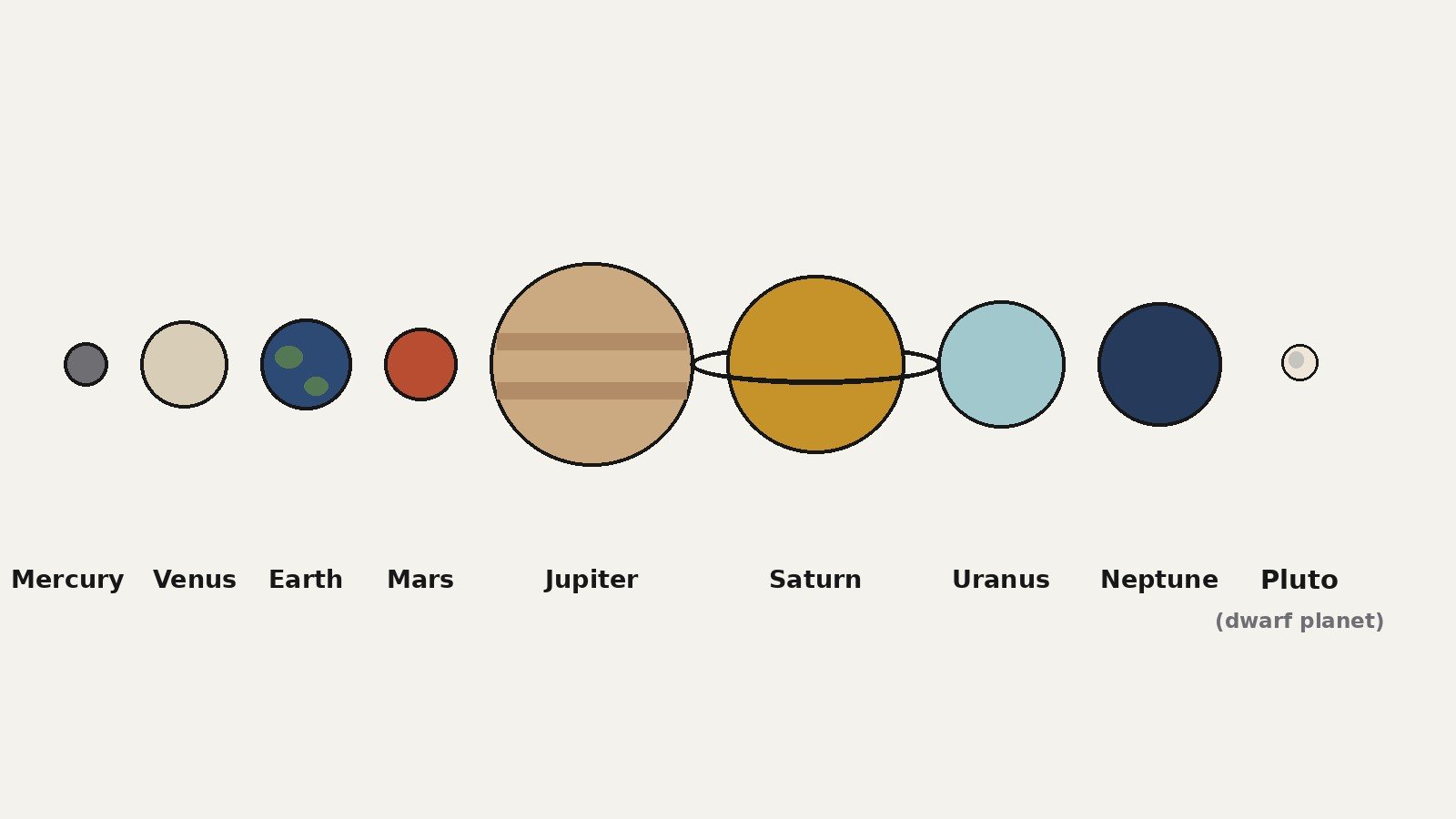
- Our solar system has 8 planets: Mercury, Venus, Earth, Mars, Jupiter, Saturn, Uranus and Neptune, in order from the Sun.
- It also has 5 officially recognized dwarf planets: Ceres, Pluto, Haumea, Makemake and Eris.
- Pluto has not counted as a planet since the International Astronomical Union redefined the term in August 2006.
- Beyond our solar system, NASA has confirmed more than 6,000 exoplanets, and says there are more planets than stars in our galaxy.
- Nobody can count the planets in the entire universe. The honest answer is that the total is unknowable with current knowledge.
There are eight planets in our solar system. That is the official count, and it has held since August 2006, when the International Astronomical Union (IAU) adopted the first formal scientific definition of the word “planet” and, in the same decision, moved Pluto into a new category called dwarf planets. The eight, in order outward from the Sun, are Mercury, Venus, Earth, Mars, Jupiter, Saturn, Uranus and Neptune. But eight only answers the narrow version of the question. Our solar system also holds five officially recognized dwarf planets, hundreds of moons and thousands of smaller bodies, and beyond the Sun’s reach astronomers have now confirmed more than 6,000 planets orbiting other stars. This article gives the full count at every level, explains the definition that fixes the number at eight, tells the story of how the count changed over the centuries, and looks at whether it could ever change again. Every count below is dated October 2026.
The eight planets, in order
Here they are, in order from the Sun, with the grouping astronomers use:
| # | Planet | Type |
|---|---|---|
| 1 | Mercury | Terrestrial (rocky) |
| 2 | Venus | Terrestrial (rocky) |
| 3 | Earth | Terrestrial (rocky) |
| 4 | Mars | Terrestrial (rocky) |
| 5 | Jupiter | Gas giant |
| 6 | Saturn | Gas giant |
| 7 | Uranus | Ice giant |
| 8 | Neptune | Ice giant |
NASA divides the eight into three groups. The first four, Mercury through Mars, are the terrestrial planets: small worlds with solid, rocky surfaces. Then come the gas giants, Jupiter and Saturn, built mostly from the light materials of the young solar system. Finally, Uranus and Neptune are the ice giants, rich in water, ammonia and methane. A handy way to remember the order is the mnemonic “My Very Excellent Mother Just Served Us Nachos.” Older versions of that sentence ended with “Pluto,” which tells you how recently the list changed.
A few of the eight carry famous distinctions. Mercury is the smallest of the eight planets and the closest to the Sun. Venus, wrapped in thick clouds, is the hottest planet, despite not being the closest to the Sun. Earth is the only planet known to harbor life. Mars is the Red Planet, named for its rusty color. Jupiter is the largest planet in the solar system. Saturn is famous for its spectacular ring system, although NASA notes that all four giant planets have rings. Uranus is the sideways world, tilted so far that it effectively rolls around the Sun on its side. Neptune, the eighth planet, is the farthest from the Sun.
Two quick facts about moons help complete the picture. Of the eight planets, Mercury and Venus are the only ones with no moons at all, according to NASA. At the other extreme, the giant planets each preside over large families of moons, and even Pluto, far smaller than any planet, has five moons of its own.
What makes a planet a planet?
For most of history, nobody needed a formal definition. Everybody knew what the planets were because there were only a handful of them. That changed in the early 2000s, when telescopes began turning up large, round, Pluto-sized worlds beyond Neptune. If Pluto was a planet, then these newcomers arguably were too, and the count threatened to grow without limit. Astronomers realized they needed a rule, so the IAU spent two years drafting one and put it to a vote at its 2006 General Assembly in Prague.
The definition that passed, known as Resolution 5A, says a planet is a celestial body that:
- is in orbit around the Sun,
- has sufficient mass for its self-gravity to overcome rigid body forces so that it assumes a hydrostatic equilibrium (nearly round) shape, and
- has cleared the neighbourhood around its orbit.
(The IAU’s original text uses the British spelling “neighbourhood”; the meaning is “neighborhood.”)
The third rule is the one that does the work. “Clearing the neighborhood” means a planet gravitationally dominates its orbit: it has either absorbed, captured or flung away most of the other sizable objects sharing its path around the Sun. All eight planets pass this test. Pluto fails it, because it orbits inside the crowded Kuiper Belt, a ring of icy bodies beyond Neptune, where thousands of similar objects cross or share its orbital zone.
The same resolution created two more categories. A “dwarf planet” meets the first two tests but not the third: it orbits the Sun and is massive enough to be nearly round, but it has not cleared its neighborhood, and it is not a satellite. Everything else orbiting the Sun, from asteroids to comets, was grouped as “small Solar System bodies.” One point the IAU stresses: planets and dwarf planets are two distinct classes of objects. A dwarf planet is not a kind of planet that happens to be small. It is a different category entirely.
How the official count changed over time
The number of known planets has changed several times, and each change tells a story about how astronomy advanced.
Six, then seven, then eight. The five planets visible to the naked eye, Mercury, Venus, Mars, Jupiter and Saturn, have been known since ancient times. Once astronomers accepted that Earth itself is a planet circling the Sun, the roster stood at six. It stayed there until 1781, when William Herschel, sweeping the sky with the best telescope of his day, found a new world he first mistook for a comet. That world was Uranus, and its discovery instantly doubled the width of the known solar system. The count was seven.
Eight, by mathematics. Uranus did not move quite the way Newton’s laws said it should, and astronomers suspected an unseen world was tugging on it. Working independently, Urbain Le Verrier in France and John Couch Adams in England calculated where that world should be. In 1846, Johann Galle of the Berlin Observatory pointed his telescope at Le Verrier’s predicted position and found Neptune on his first night of searching. Neptune was the first planet found with mathematics before it was seen, and the count reached eight.
A rehearsal for Pluto: the curious case of Ceres. When Ceres was discovered in 1801, orbiting between Mars and Jupiter, astronomers called it a planet. But as more and more bodies turned up in the same region, the “planet” label stopped making sense, and Ceres was demoted to the first of the asteroids. The IAU itself tells this story as the precedent for Pluto: a round world in a crowded zone, reclassified when its neighborhood filled up with similar objects. More than two centuries later, Ceres was promoted again, this time to dwarf planet.
Nine, then eight again. In early 1930, Clyde Tombaugh, an observing assistant at Lowell Observatory in Arizona, was photographing the sky in search of a hypothetical “Planet X.” Comparing photographic plates taken on different nights, he noticed one tiny speck had shifted position near the constellation Gemini. That speck was Pluto. For 76 years, schoolchildren learned nine planets. Then the Kuiper Belt discoveries of the 1990s and 2000s forced the question the IAU finally answered in Prague: with round, Pluto-sized worlds turning up beyond Neptune, what actually counts as a planet? On 24 August 2006, the vote settled it. Pluto became the prototype of the new dwarf planet class, and the count returned to eight, where it stands today.
Why Pluto is not a planet anymore
The short version is the third rule: Pluto has not cleared its neighborhood. The longer version is more interesting, because it shows science working the way it is supposed to.
In 1992, astronomers David Jewitt and Jane Luu of the University of Hawaii confirmed the existence of the Kuiper Belt, a vast ring of icy bodies past Neptune’s orbit that had been predicted for decades. The floodgates opened. Today the IAU notes that more than a thousand objects are known in the trans-Neptunian region, and Pluto turned out to be simply one of the largest members of this population rather than a lonely outpost.
The discovery that forced the issue came from images taken in 2003 at Palomar Observatory by Mike Brown of Caltech, Chad Trujillo and David Rabinowitz. Their analysis revealed a distant, frigid world initially catalogued as 2003 UB313 and later named Eris, after the Greek goddess of discord. Early measurements suggested Eris was slightly larger than Pluto, and later work showed it is nearly 30 percent more massive, with its own small moon, Dysnomia. The IAU puts the dilemma plainly: here was a world comparable to Pluto in every way that had never been called a planet. Either the solar system had ten planets and counting, or the word “planet” needed a definition.
Prague supplied the definition, and Pluto failed the neighborhood test. Pluto orbits the Sun inside the Kuiper Belt, sharing its orbital zone with a swarm of similar icy bodies, so under Resolution 5A it became a dwarf planet. The IAU additionally recognizes Pluto as the prototype of the trans-Neptunian dwarf planets, a subgroup officially named “plutoids.” Pluto’s demotion changed its label, not its nature: when NASA’s New Horizons spacecraft flew past it on 14 July 2015, it revealed nitrogen ice plains, water-ice mountains and a thin hazy atmosphere, and the IAU notes that the images established Pluto as wider than Eris, making it the largest known trans-Neptunian object. Dwarf planets, the IAU concludes, can be every bit as scientifically interesting as planets.
The five dwarf planets
As of October 2026, the IAU officially recognizes five dwarf planets. Here they are, with what makes each one notable:
- Ceres. The only dwarf planet in the asteroid belt between Mars and Jupiter. Called a planet when it was discovered in 1801, demoted as the asteroid discoveries piled up, and designated a dwarf planet in 2006. The IAU describes it as a bit less than half the size of Pluto, but massive enough for its own gravity to pull it into a nearly round shape.
- Pluto. The most famous dwarf planet, in the Kuiper Belt. It has five moons: Charon, discovered in 1978 and more than half Pluto’s size, plus the smaller Nix, Hydra, Kerberos and Styx, found with the Hubble Space Telescope between 2005 and 2012. Visited by New Horizons in 2015, the only dwarf planet explored up close.
- Haumea. A distant, ice-covered world the IAU describes as oblong rather than neatly spherical, with two moons, Hi’iaka and Namaka, and its own ring.
- Makemake. A round, reddish world named for the creator god of the Rapa Nui people of Easter Island. It has a single known moon, and the IAU calls it the second brightest and second largest Kuiper Belt object after Pluto.
- Eris. The heavyweight of the group: almost 30 percent more massive than Pluto, with the moon Dysnomia. It was the discovery of Eris that finally forced astronomers to define the word “planet.”
Five is the official list, but it is unlikely to be the final one. The IAU expects more dwarf planets to be announced as observations improve, and says dozens, perhaps more than a hundred, may be waiting to be discovered in the outer solar system. Astronomers who study these distant objects already discuss several likely candidates, including Quaoar, Sedna, Orcus and Gonggong, though none has been formally designated. Any object added in the future would join the dwarf planet list. The planet count of eight would not change.
Could the count ever change again?
Yes, but it would take something dramatic. Because the number eight comes from a definition rather than a census, it only changes if a newly found world meets all three of the IAU’s tests, or if the IAU rewrites the definition.
The most serious candidate for a ninth planet is still hypothetical. On 20 January 2016, Caltech researchers Konstantin Batygin and Mike Brown, the same Mike Brown whose team found Eris, announced evidence for a giant planet far beyond Neptune. Working from mathematical models and computer simulations of strangely clustered Kuiper Belt orbits, they proposed a world about ten times the mass of Earth, orbiting on average about twenty times farther from the Sun than Neptune, taking between 10,000 and 20,000 years to complete one orbit. Brown noted that such a world would gravitationally dominate its neighborhood so thoroughly that no one would dispute its planethood. But the evidence came from equations, not a telescope image, and a direct sighting remains the missing piece. If “Planet Nine” is ever found and confirmed to rule its orbit, the count becomes nine. As of October 2026, the search continues.
A far more likely change is growth in the dwarf planet list, as above. New full planets, by contrast, would be an enormous surprise: the region where the eight planets live has been thoroughly surveyed, and any undiscovered world big enough to clear its orbit would have betrayed itself gravitationally long ago.
Beyond the Sun: how many planets are in the galaxy and the universe?
Everything so far has been about our own solar system. Zoom out, and the numbers explode.
A planet orbiting any star other than the Sun is called an exoplanet. The first planet around a Sun-like star was confirmed in 1995, just over 30 years ago. In September 2025, NASA announced that its official tally of confirmed exoplanets had passed 6,000, a milestone it said marked an accelerating rate of discovery, and the count has kept climbing since. Thousands more candidate planets are still awaiting confirmation. NASA sorts the confirmed worlds into types, gas giants, Neptunians, super-Earths and terrestrials, and notes that most of the discoveries so far lie within a few thousand light-years of us. Even the closest known exoplanet, Proxima Centauri b, is about four light-years away.
How many planets does the whole Milky Way hold? NASA’s own statement is striking: there are more planets than stars in our galaxy. One widely cited estimate puts the galaxy’s planet population at around 100 billion, though estimates vary enormously and every such figure rests on extrapolating from a small surveyed patch of sky. For the entire universe, with its hundreds of billions of galaxies, no honest total exists. The true number is uncountable with current knowledge, and any article that gives you one is guessing.
Clearing up common mix-ups
Is the Sun a planet? No. The Sun is the solar system’s star, the massive ball of hot gas everything else orbits. The IAU’s definition requires a planet to orbit the Sun, so the Sun itself cannot qualify.
Is the Moon a planet? No. The Moon is a natural satellite, and satellites are explicitly excluded from both the planet and dwarf planet categories. The same goes for the hundreds of other moons in the solar system.
So are dwarf planets just small planets? Not in the official system. The IAU defines planets and dwarf planets as two distinct classes. “Dwarf planet” is its own category for round worlds that share their orbital neighborhood with similar bodies, not a junior version of planethood.
Why do some sources still say nine? Usually one of three reasons: the source was written before August 2006, it is counting Pluto out of habit or affection, or it is folding the five dwarf planets into the total. Under the current scientific definition, the answer is eight planets plus five dwarf planets.
Frequently asked questions
How many planets are there in the solar system? Eight: Mercury, Venus, Earth, Mars, Jupiter, Saturn, Uranus and Neptune. That has been the official count since the IAU defined the term “planet” in August 2006.
Is Pluto a planet? Not since 24 August 2006, when the IAU reclassified it as a dwarf planet. It was considered the ninth planet from its discovery in 1930 until that vote, a run of 76 years.
Why was Pluto demoted? Pluto meets two of the IAU’s three planet tests: it orbits the Sun and is massive enough to be nearly round. It fails the third, because it has not cleared its orbital neighborhood. It travels inside the crowded Kuiper Belt, sharing its zone with thousands of similar icy bodies.
How many dwarf planets are there? Five are officially recognized by the IAU as of October 2026: Ceres, Pluto, Haumea, Makemake and Eris. The IAU expects more to be designated, and says dozens or even more than a hundred may be waiting to be discovered.
Who decides what counts as a planet? The International Astronomical Union, the global authority for naming and classifying celestial objects. Its 2006 General Assembly in Prague voted the definition into place, and the IAU maintains a review process for classifying newly discovered objects.
Could there be a ninth planet? Possibly. In 2016, Caltech researchers presented evidence for a large unseen world far beyond Neptune, nicknamed Planet Nine, based on the clustered orbits of distant Kuiper Belt objects. It has not been directly observed. If it exists and dominates its orbit, it would qualify as the ninth planet.
How many planets are there in the universe? No one knows, and no honest count exists. Astronomers have confirmed more than 6,000 planets around other stars, NASA says planets outnumber stars in our galaxy, and estimates for the Milky Way alone run around 100 billion. Beyond that, the total is unknowable with current knowledge.
Keep reading: What Causes the Northern Lights? The Science of the Aurora Explained
Sources & references
- International Astronomical Union, "Pluto and the Solar System": the IAU's own account of Pluto's discovery, the 2006 definition, the five recognized dwarf planets and the New Horizons findings.
- NASA Jet Propulsion Laboratory, "What Is a Planet?": the full text of the IAU's 2006 resolutions, including the three planet criteria and the dwarf planet definition.
- NASA Science, "Solar System: Facts": the Sun, eight planets, five officially named dwarf planets, hundreds of moons and thousands of asteroids and comets; terrestrial, gas giant and ice giant groupings.
- NASA Science, "Pluto": Pluto's reclassification as a dwarf planet in 2006 and the New Horizons flyby in 2015.
- NASA Science, "Exoplanets": more than 6,000 confirmed exoplanets and counting, thousands of candidates awaiting confirmation, more planets than stars in the galaxy, and the closest known exoplanet Proxima Centauri b.


