Short answer
- A paragraph with verb tenses is a paragraph in which one main verb tense carries the writing and every other tense appears only to show a genuine change in time. Pick a primary tense (usually simple past or simple present), keep it consistent from sentence to sentence, and shift tenses only when the time frame genuinely changes. That single rule solves most tense problems in student and professional writing.
The past tense deserves its own study: English has four past forms, and choosing among them is the most common tense problem in a paragraph.
What a Verb Tense Actually Does
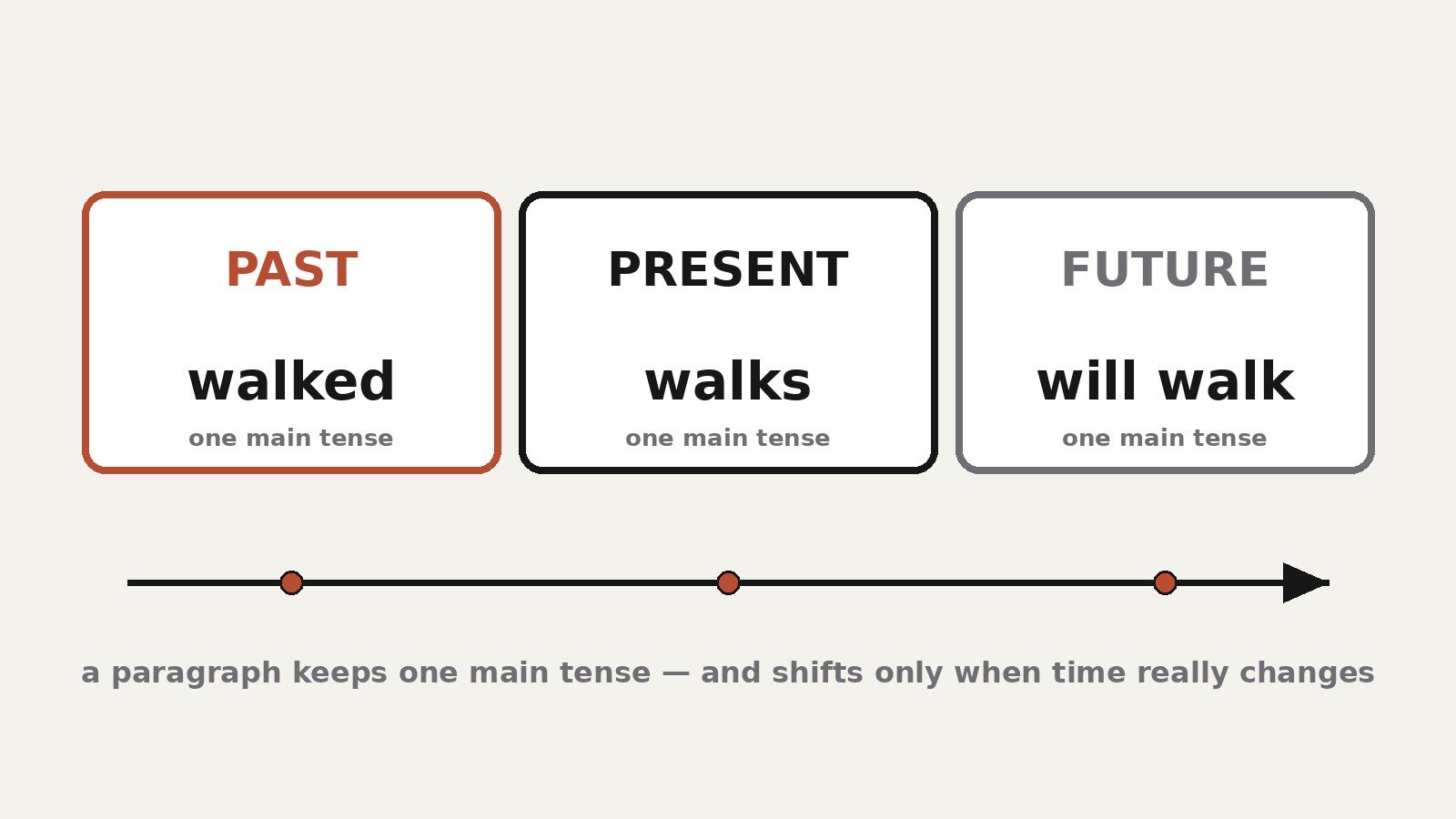
Every verb in a paragraph is a small time marker. When you write “walked,” you place the action in the past; when you write “walks,” you place it in the present; when you write “will walk,” you place it in the future. Readers use those markers, mostly unconsciously, to build a timeline of what you describe. If the markers keep contradicting each other, the timeline breaks and the writing feels confusing, even when every sentence is individually grammatical.
Only two tenses are shown by the verb word itself: present (“sing”) and past (“sang”). Every other English tense is built with helpers called auxiliaries, such as “has,” “had,” “will,” “is,” and “was,” combined with the main verb. The Purdue OWL notes that understanding six basic tenses lets writers recreate much of the reality of time in their writing. Those six are worth learning before anything else:
| Tense | Example | What it marks |
|---|---|---|
| Simple present | They walk. | Action happening now, habitually, or always |
| Simple past | They walked. | A finished action in the past |
| Future | They will walk. | An action that will happen |
| Present perfect | They have walked. | Action that began in the past and continues or matters now |
| Past perfect | They had walked. | An action completed before another past action |
| Future perfect | They will have walked. | An action that will be finished before a future point |
The three perfect tenses look harder than they are because they all share one construction. Every perfect tense is formed by adding an auxiliary (or auxiliaries) to the past participle of the verb, which is its third principal part. For “walk” the three principal parts are walk, walked, walked; for “ring” they are ring, rang, rung. Once you know the third principal part of a verb, you can build all three perfect tenses: “has walked,” “had walked,” “will have walked.”
Beyond the six basics sit the progressive (or continuous) tenses, which show ongoing action: “is walking,” “was walking,” “will be walking,” “has been walking.” These also appear in paragraphs, and they follow the same consistency logic as everything else in this guide.
Which Tenses Paragraphs Actually Use
A single paragraph rarely needs all six basic tenses. In practice, most paragraphs are carried by one of three workhorses, with other tenses called in for supporting jobs:
Simple past carries narratives. When you retell something that happened, describe an event, or summarize a completed process, the past tense is the natural primary tense. History writing, stories, memoirs, lab writeups of completed experiments, and most homework paragraphs about past events all live here.
Simple present carries statements of fact, habitual action, and general truth. Scientific facts, definitions, instructions (“the engine starts when you turn the key”), routines, opinions, and the events of stories or films discussed as literary objects (“in the film, the detective discovers the letter”) all sit in the present. The present is also the conventional tense for talking about the action in a book, play, or movie.
Future tense carries plans, predictions, schedules, and promises. It appears less often as the carrier of a whole paragraph, but any paragraph about what will happen depends on it: “the team will board the train at noon, and they will arrive before dark.”
The perfect tenses do supporting work inside paragraphs whose main tense is one of the three above. They exist to handle before-and-after relationships: the past perfect reaches back from a past narration (“she had already left when he arrived”), the present perfect reaches back from present commentary (“the policy has changed three times this year”), and the future perfect reaches back from a future point (“by Friday, she will have finished the report”).
The Core Rule: Tense Consistency
Here is the single most important guideline, stated by the Purdue OWL: “Generally, writers maintain one tense for the main discourse and indicate changes in time frame by changing tense relative to that primary tense, which is usually either simple past or simple present.”
In plain terms: establish a primary tense for your paragraph and keep it. Shift to another tense only when the time frame genuinely changes. Two paired rules from the same source make the mechanics precise:
- “Do not shift from one tense to another if the time frame for each action or state is the same.”
- “Do shift tense to indicate a change in time frame from one action or state to another.”
Shifts are not forbidden; they are tools. A paragraph that describes the past often needs the present to state a still-true fact, the past perfect to reach back further, and the future to state a consequence. The mistake is not shifting, but shifting accidentally: changing tense because the sentence at hand drifted from the time frame of the rest of the paragraph.
Choosing Your Paragraph’s Primary Tense
Before writing, decide which time frame the paragraph belongs to:
- Narrating something that happened? Use past tense as the primary tense. This includes events, experiences, biographical facts, and completed processes.
- Stating facts, explaining a process in general, describing something that happens repeatedly, or discussing your own ideas? Use present tense as the primary tense.
- Describing action in a story, book, film, or play? Use present tense; fictional action is conventionally treated as happening now.
- Describing what will happen? Use future tense as the primary tense, expressed with “will,” “shall,” “going to,” “about to,” time words like “tomorrow,” or other context clues.
If your assignment or teacher specifies a tense, that instruction wins. Otherwise, pick the tense that matches the paragraph’s time frame and hold it.
Worked Example 1: A Past-Tense Paragraph
This paragraph describes a morning commute. Its primary tense is simple past, and the annotation explains every supporting tense choice.
The train arrived at six forty-five, and Maya boarded with the rest of the tired crowd. She found a seat by the window and opened her notebook. Before she had written a single line, the announcement came: the line ahead was closed for repairs. She sighed, packed her notebook away, and waited. Commuters around her checked their phones, called their offices, and pretended this delay had been scheduled weeks in advance. By the time the train moved again, forty minutes had passed.
Why the tense choices work:
- “Arrived,” “boarded,” “found,” “opened” are simple past: the whole paragraph narrates completed events.
- “Had written” and “had passed” are past perfect: each reaches back from the past narration to something earlier, the not-yet-written line and the elapsed minutes.
- “Had been scheduled” is past perfect passive: the imagined scheduling happened before the current past scene.
- “Pretended” stays in simple past even though the pretending happened during the delay: it belongs to the same time frame as everything else, so no shift is needed.
Worked Example 2: A Present-Tense Paragraph
This paragraph explains how a community garden works. Its primary tense is simple present, which fits because the facts are still true and the actions repeat every season.
The community garden runs on a simple rotation. Each spring, members clear the raised beds and turn fresh compost into the soil. By early May, the first seedlings have gone in, and the water schedule starts. Volunteers take turns weeding through the summer, and the harvest belongs to everyone who helped. Nothing from the garden is sold. The rules stay the same year after year, because the routine works.
Why the tense choices work:
- “Runs,” “clear,” “turn,” “starts,” “take,” “belongs,” “is,” “stay” are simple present: the garden operates this way now and in general.
- “Have gone” is present perfect: the seedlings were planted before the current season’s routine, and the result still holds now. This matches the Purdue OWL’s account of the present perfect, which it says designates action that began in the past but continues into the present or whose effect still continues.
- No past tense is needed anywhere, because nothing in the paragraph describes a finished, one-time past event.
Worked Example 3: A Future-Tense Paragraph
This paragraph lays out plans for a school science fair. Its primary tense is the future.
The science fair will open on the first Friday of March. Students will set up their displays the evening before, and the judges will tour the exhibits at nine o’clock sharp. Each team will have submitted its project summary two days earlier, so judging can begin on time. Parents will be able to visit after the awards ceremony, which will take place at three.
Why the tense choices work:
- “Will open,” “will set,” “will tour,” “will have,” “will be,” “will take” are simple future: every action is expected.
- “Will have submitted” is future perfect: the submission happens before the future judging, so the perfect tense marks it as completed ahead of a future reference point.
- “Can begin” stays in present form after the modal “can”: modals are followed by the base form of the verb, so no extra tense marking appears.
Worked Example 4: A Paragraph That Shifts on Purpose
Now look at a paragraph that deliberately moves between tenses to serve its time frame. Each shift below exists because the time genuinely changes.
Electric scooters changed the daily commute in Riverside almost overnight. Before 2022, few residents owned any kind of micro vehicle; today the rental docks stand on nearly every corner. The city had resisted permits for two years, but the pilot program convinced the council, and now the docks are permanent. By next spring, the fleet will have doubled, and riders will be able to unlock a scooter from their phones before they reach the platform.
Why each shift is correct:
- “Changed” is simple past: the transformation is a completed event.
- “Owned” is simple past: resident ownership belongs to the same before-2022 time frame.
- “Stand” and “are” are simple present: the docks exist now; this is the current time frame, so the shift is required.
- “Had resisted” is past perfect: the resistance ended before the pilot program convinced the council, reaching back from the past narration.
- “Will have doubled” is future perfect: the doubling completes before next spring.
- “Will be able” is simple future: the unlocking ability starts in that future scene.
This paragraph uses five tenses, and all of them are correct, because each one marks a real change in time frame. That is the difference between an inconsistent paragraph and a skilled one: the skilled paragraph shifts with a reason every time.
A Five-Step Method for Writing a Tense-Clean Paragraph
- Name the time frame. Is the paragraph about something that happened, something that is true, or something that will happen? Write the answer in one phrase.
- Set the primary tense. Match the tense to the time frame: past for finished events, present for facts and routines, future for plans. Write one model sentence in that tense before you begin.
- Draft the paragraph. Let every verb default to the primary tense. When a sentence needs a different time frame, reach for the perfect tense that corresponds to your primary tense: past narration pairs with past perfect (“had” plus the past participle), present narration pairs with present perfect (“has” or “have” plus the past participle), and future narration pairs with future perfect (“will have” plus the past participle).
- Hunt for accidental shifts. Read the paragraph and ask of every verb: does the action belong to a different time frame than the paragraph’s primary tense? If yes, keep the shift and confirm it uses the right tense. If no, change it back to the primary tense.
- Read it aloud. Shifts that survived step four usually sound fine when spoken. Awkward or invisible-to-the-eye shifts often reveal themselves when you hear the timeline stumble.
The same paragraph discipline scales up: learn how to write an essay step by step, from thesis to conclusion.
Common Mistakes
Mistake 1: Drifting into the present during a past narrative. Writers often slip into present tense when an event feels vivid, as if reliving it. The reader’s timeline, however, is anchored in the past.
- Incorrect: “The team arrived at the stadium, and the crowd goes wild.”
- Correct: “The team arrived at the stadium, and the crowd went wild.”
- The cheering belongs to the same past time frame as the arrival, so the Purdue OWL guideline applies: do not shift when the time frame is the same.
Mistake 2: Mixing “walk” and “walked” in instructions. Steps in a process paragraph should stay in the imperative or the present, never alternate with the past.
- Incorrect: “First, we mixed the ingredients. Then we heat the oven.”
- Correct: “First, we mixed the ingredients. Then we heated the oven.” (past) or “First, mix the ingredients. Then heat the oven.” (imperative instructions)
Mistake 3: Using the simple past where the past perfect is needed. When one past event happened before another past event, the earlier one often needs “had” plus the past participle to show the order clearly.
- Unclear: “She finished her essay before the deadline arrived.”
- Clearer: “She had finished her essay before the deadline arrived.”
- The OWL notes that time words like “before,” “after,” and “by the time” are good indicators that a perfect-tense verb may be needed.
Mistake 4: Shifting tense inside a single sentence for no time change. Consistency applies within sentences as well as between them.
- Incorrect: “While Barbara put in her contact lenses, the telephone rang.”
- Correct: “While Barbara was putting in her contact lenses, the telephone rang.”
- The putting and the ringing overlap in time, so the progressive past keeps them in one time frame.
Mistake 5: Treating the present perfect and simple past as interchangeable. “I have lived here for five years” implies you still live there; “I lived here for five years” implies you no longer do. Purdue OWL’s own example makes this sharp: “Betty taught for ten years” means she no longer teaches, while “Betty has taught for ten years” means she still does. Choose the one whose meaning you intend.
Before-and-After Revision
Watch the consistency rules repair a flawed paragraph. Here is a student’s draft about a school trip:
Before: The class went to the science museum last Friday. Everyone is excited when we enter the main hall. The guide shows us the dinosaur skeleton, and we learned that it was seventy feet long. Then she had explained how the fossils were found before we arrived. We took photos and will eat lunch in the park.
Three tense problems hide here. “Is excited” and “enter” drift into the present even though the whole paragraph narrates a finished Friday visit. “Had explained” uses the past perfect where the explaining followed the guide’s showing, so simple past is correct. “Will eat” claims a future action for a completed trip; the lunch belongs to the same past time frame as everything else.
After: The class went to the science museum last Friday. Everyone was excited when we entered the main hall. The guide showed us the dinosaur skeleton, and we learned that it was seventy feet long. Then she explained how the fossils had been found before we arrived. We took photos and ate lunch in the park.
The revision keeps the primary tense, simple past, and shifts exactly once: “had been found” is past perfect because the fossil discovery happened before the past narration. Every other verb stays in the time frame of the trip. Compare the two versions and notice how the timeline stops stumbling the moment every verb earns its place.
Practice Checklist
Before you submit any paragraph, run through these questions:
- Can I name my primary tense? Is it the tense that matches the paragraph’s time frame?
- Does every verb sit in the primary tense unless the time frame changes? Mark any verb that does not.
- For each marked verb, can I explain the time change it signals? If not, change it back.
- Do I use “had,” “has,” “have,” or “will have” anywhere I describe one action finishing before another reference point? If a before-and-after relationship lacks one of these helpers, consider adding it.
- Have I read the paragraph aloud and confirmed the timeline flows without stumbles?
If you can answer yes to all five, the paragraph’s tenses are under control.
Frequently Asked Questions
What are the 12 verb tenses in English? The full English tense system combines three time frames (past, present, future) with four aspects (simple, progressive, perfect, perfect progressive), producing twelve tenses. Common examples use “walk”: simple present “walks,” simple past “walked,” simple future “will walk,” present progressive “is walking,” past progressive “was walking,” future progressive “will be walking,” present perfect “has walked,” past perfect “had walked,” future perfect “will have walked,” present perfect progressive “has been walking,” past perfect progressive “had been walking,” and future perfect progressive “will have been walking.” College writing centers such as BMCC’s publish this twelve-tense chart with one-sentence examples for each. For most paragraphs, however, the six basic tenses are enough.
Can a paragraph have more than one verb tense? Yes. The consistency rule is not “use only one tense”; it is “shift tenses only when the time frame changes.” A paragraph about the past will routinely use the past perfect to reach back to earlier events and the present to state still-true facts. Worked Example 4 above uses five tenses, all correctly, because each shift marks a real change in time.
Is it wrong to switch from past tense to present tense in one paragraph? Only when the time frame stays the same. “About noon the sky darkened, a breeze sprang up, and a low rumble announces the approaching storm” is wrong, because the rumble belongs to the same noon time frame and should be “announced.” But “Electric scooters changed the commute; today the docks stand on every corner” is right, because “today” genuinely changes the time frame.
Which tense should I use when writing about a book or movie? Present tense is the convention. Action in a specific literary work, film, or play is treated as always present: “In the film, the detective discovers the letter.” This holds even though the film was made years ago; the discussion of the work’s own events stays present.
What is the difference between the past perfect and the simple past? The simple past places an action in the past (“John raised vegetables”). The past perfect places an action before another past action (“John sold the vegetables that he had raised”), showing which of two past events came first. Use the past perfect whenever a before-and-after relationship in the past would otherwise be unclear.
Do progressive tenses follow the same rules? Yes. The progressive (or continuous) tenses add “ongoing action” information, but they obey the same consistency logic. In a past narrative, use “was walking”; in a present one, “is walking”; in a future one, “will be walking.” And to describe action underway before the primary narration’s time frame, use the matching progressive perfect: “had been walking,” “has been walking,” or “will have been walking.”
Sources & references
- Purdue University Online Writing Lab (OWL). "Introduction to Verb Tenses." Six basic tenses (simple present, present perfect, simple past, past perfect, future, future perfect); the rule that only two tenses are conveyed by the verb alone; auxiliaries; the three principal parts; perfect-tense construction; present perfect, past perfect, and future perfect definitions and examples.
- Purdue University Online Writing Lab (OWL). "Verb Tense Consistency." The primary-tense guideline; "do not shift when the time frame is the same" and "do shift when the time frame changes" guidelines; tense hints for past, present, and future narration; the simple-present example with perfect and progressive elements and the simple-past example; the rule that a primary narration in simple past pairs with past perfect for earlier time frames, simple present with present perfect, and simple future with future perfect; time-orienting words ("before," "after," "by the time") as indicators of perfect-tense need; the two sample paragraphs on inappropriate and appropriate shifts.
- Borough of Manhattan Community College (CUNY), Writing Center. "The Twelve Verb Tenses of English." The twelve-tense chart with one-sentence examples (simple, progressive, perfect, and perfect progressive across past, present, and future).
- Towson University Online Writing Support. "Tense Consistency." Sentence-level and paragraph-level consistency guidance: establish a primary tense and keep tenses consistent from sentence to sentence, shifting only when a time change must be shown.


