Short answer
- pH measures how acidic or basic a solution is. It is defined as the negative base-10 logarithm of the hydrogen-ion concentration: pH = −log₁₀[H⁺].
- The notation was introduced by the Danish chemist S. P. L. Sørensen in 1909 at the Carlsberg Laboratory in Copenhagen.
- What the "p" originally stood for is genuinely uncertain. Sørensen never explained it. Encyclopaedia Britannica notes that his measurements used two electrodes designated p and q, so the p most directly labels the measuring electrode. Other historians suggest words meaning "power" or "potential" in French, German, or Danish.
- "Potential of hydrogen" is a popular later explanation, not a documented fact. The Latin phrases sometimes quoted for it, pondus hydrogenii or potentia hydrogenii, do not appear in Sørensen's writings.
- The scale is logarithmic. Each whole pH unit is a tenfold change in hydrogen-ion concentration, so pH 3 is 1,000 times as acidic as pH 6.
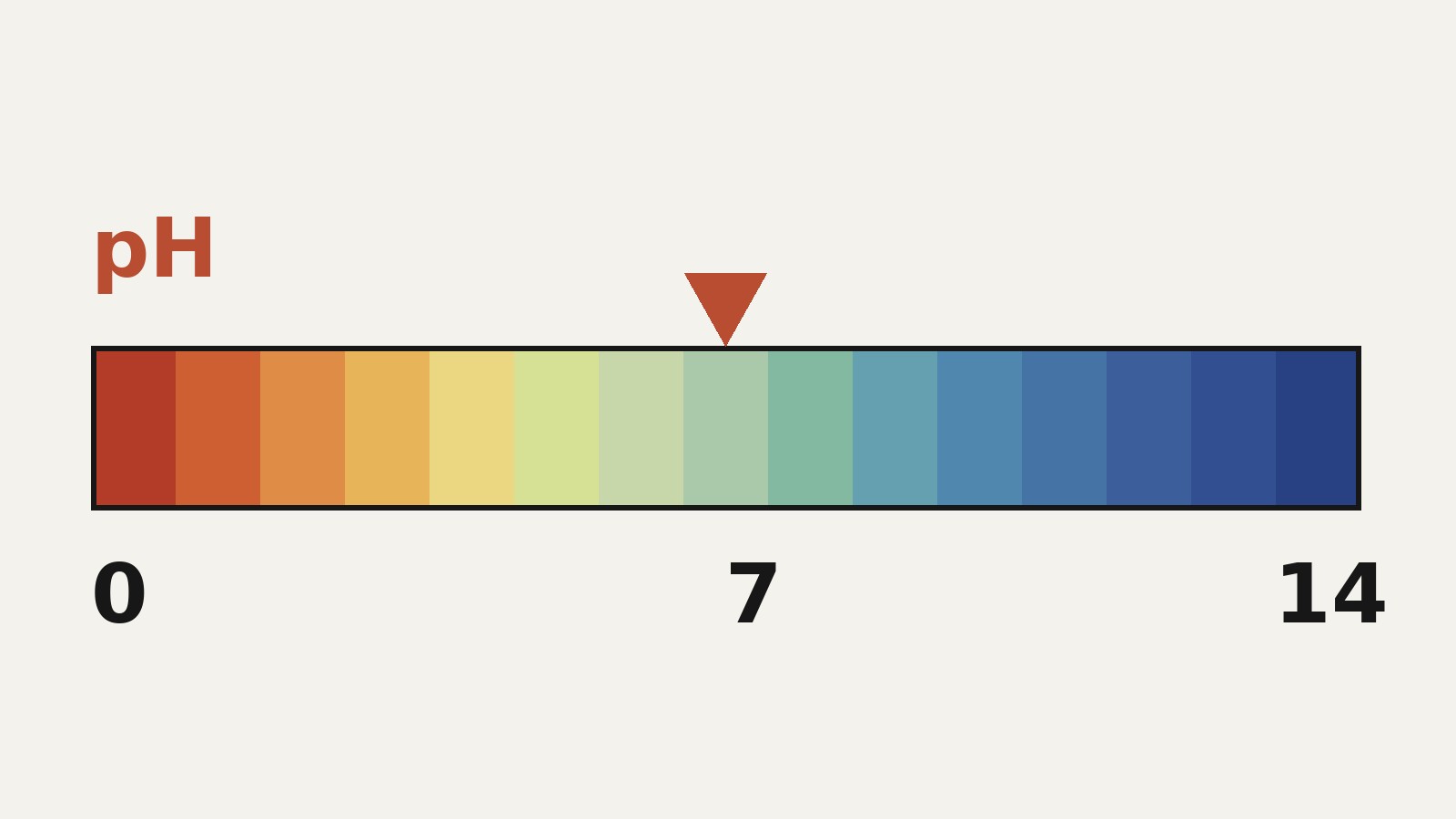
- Most everyday liquids fall between 0 and 14, but the scale has no hard ends: very concentrated strong acids and bases go below 0 and above 14.
Introduction
Ask a room of adults what pH stands for and most will answer confidently: “potential of hydrogen.” It is printed in textbooks, repeated on websites, and taught in classrooms. It is also, on the best historical evidence, probably not what the letters originally meant, because the chemist who invented the notation in 1909 never explained them, and historians of chemistry who have gone back to his papers have failed to find the phrase in them.
That makes this small question an unusually good one. The honest answer has two parts: what the letters most likely signified in Sørensen’s laboratory, and what pH actually measures, which is the part that matters every time someone tests soil, checks an aquarium, or reads a blood result. This article gives both. It covers the disputed origin of the name, the definition (pH is the negative logarithm of the hydrogen-ion concentration), worked examples showing why each step on the scale is a tenfold change, a table of everyday values, how pH is measured, and why the number matters in soil, water, and the body.
The Direct Answer: Nobody Knows for Certain
Start with what is documented. The H is not in doubt: it is the chemical symbol for hydrogen, and pH is a statement about hydrogen ions. The p is the mystery. Sørensen introduced the symbol in 1909, writing it as pH with the H as a subscript, and called the quantity the “hydrogen ion exponent.” Nowhere in his papers did he spell out what the letter p was short for.
That silence has invited a century of guessing, and the guesses fall into a few families, covered in detail below. The most quoted guess in classrooms, that pH stands for “potential of hydrogen” or “power of hydrogen,” may even be right in spirit, but it cannot be confirmed from anything Sørensen wrote, and the more elaborate Latin versions of the claim are documented inventions. The entry on pH in Encyclopaedia Britannica gives the most concrete account available: in Sørensen’s method, pH was worked out from measurements at two electrodes, which he designated p and q, so the p in pH identifies the electrode at which the hydrogen-ion concentration was measured. On that reading, the letter was a laboratory label first, and everything else is back-formation.
So the accurate short answer is: pH is Sørensen’s 1909 notation for the hydrogen-ion exponent of a solution; the H is hydrogen, and the p was most plausibly a label from his measuring setup that later generations expanded into phrases like “potential of hydrogen.” Anyone who gives you the expansion as settled fact is repeating a tradition, not a document.
What Sørensen Was Doing in 1909
S. P. L. Sørensen (1868 to 1939) was a Danish chemist who directed the chemical department of the Carlsberg Laboratory in Copenhagen, the research institute funded by the Carlsberg brewery. His research concerned proteins and enzymes, and he had found that hydrogen-ion concentration had an outsized effect on both: small changes in acidity could change how proteins behaved and whether enzymes worked at all. The problem was expressing the numbers. Hydrogen-ion concentrations in his solutions were tiny and spanned an enormous range, quantities like 0.0000001 moles per liter, which are miserable to write, compare, and plot.
His solution, published in 1909, was to compress the range with a logarithm. Instead of reporting the concentration itself, he reported its negative base-10 logarithm and called it the hydrogen ion exponent, pH. A concentration of 10⁻⁷ moles per liter became simply “7.” In the same work he set out a practical method for measuring the quantity electrically, using electrodes, which is where the p and q labels of the Britannica account appear, and he prepared standard solutions and color indicators so other laboratories could reproduce the scale.
Two refinements followed. In 1924 the definition was revised into its modern form, resting on the activity of the hydrogen ion and on measurements in electrochemical cells rather than on raw concentration alone. And because the quantity is defined by how it is measured, modern pH is what metrologists call an operational definition: the U.S. National Institute of Standards and Technology defines standard pH values through the electromotive force measured between specified electrodes in specified solutions. None of this changes everyday use. It explains why pH is a measurement with a method attached, not just a formula, and why the “p” question has no archival answer: the symbol began as working notation in a methods paper, and its author never treated its expansion as a question worth answering.
The Competing Explanations for the Letter p
Historians of chemistry, most thoroughly Jens Nørby in a 2000 analysis of Sørensen’s papers, have laid out the candidates. They are worth separating, because they do not have equal support.
The electrode labels. Sørensen’s electrometric method compared two solutions through two electrodes, which he designated p and q. Britannica’s account adopts this as the explanation: the p in pH is the p of electrode p, at which the sample’s hydrogen-ion concentration was determined. Letters used as labels for apparatus were routine in the physics and chemistry of the period, and p and q are a natural pair.
A word for “power.” Sørensen described his quantity in terms of powers of ten: the concentration written as 10 raised to a negative power. The word for “power” begins with p in all three languages he worked in: puissance in French (the Carlsberg Laboratory’s working language for much of its publication), Potenz in German (then the dominant language of chemistry), and potens in Danish. On this reading, pH is “the power of hydrogen,” the exponent to which 10 is raised.
“Potential.” Sørensen measured pH through potential differences between electrodes, and “potential” is the other common expansion. It has the same weakness as “power”: plausible, consistent with his methods, and nowhere stated by him.
The Latin phrases. Reference works and websites have proposed pondus hydrogenii (“weight” or “quantity of hydrogen”) and potentia hydrogenii (“power of hydrogen”). Nørby’s examination found no support for either in Sørensen’s writings; they appear to be later inventions, constructed to give the symbol a classical pedigree it never had.
The modern reading. Whatever Sørensen intended, chemists now use the letter p as an operator in its own right: p means “take the negative base-10 logarithm of.” That is why the same p appears in pOH (the negative logarithm of the hydroxide-ion concentration) and pKa (the negative logarithm of an acid’s dissociation constant). On the modern reading, pH simply says: the negative logarithm of H⁺. It needs no expansion, and it is the only reading of the letter that is actually standardized.
The verdict to carry away is layered. As history, the p is unexplained, with the electrode label and the “power” family the best-supported candidates. As classroom tradition, “potential of hydrogen” is a serviceable memory aid. As chemistry, p is the logarithm operator. A careful article, like a careful teacher, should not present the second as if it were the first.
What pH Actually Measures
Strip away the name and the definition is exact. A solution’s pH is the negative base-10 logarithm of its hydrogen-ion concentration, written pH = −log₁₀[H⁺], where [H⁺] is the concentration in moles per liter. (Strictly, modern pH uses the hydrogen ion’s activity, roughly its effective concentration, which is why it is defined through a measurement method; at the concentrations of everyday liquids the two give nearly the same number.)
Two features of the definition do all the practical work.
The negative sign flips the direction. High hydrogen-ion concentration means a very acidic solution and a very small logarithm, so the minus sign turns it into a small pH. Acidity up, pH down. Lemon juice, rich in hydrogen ions, sits near pH 2; bleach, with very few free hydrogen ions, sits near pH 13.
The logarithm compresses the range. Hydrogen-ion concentrations run from about 1 mole per liter in a strong acid down to 10⁻¹⁴ in a strong base, a span no linear scale could display readably. The logarithm turns that span into the familiar 0 to 14. The cost of compression is that each step is multiplicative, which the next section works through.
Pure water is the reference point. In pure water at 25 °C, a tiny fraction of molecules is split into hydrogen ions and hydroxide ions, giving [H⁺] = 10⁻⁷ moles per liter, and −log₁₀(10⁻⁷) = 7. Equal numbers of hydrogen and hydroxide ions means the water is neither acidic nor basic, so 7 is neutral. One honest footnote: “neutral is 7” is exact at 25 °C. The splitting of water increases slightly with temperature, so the neutral point drifts down a little in hot water and up a little in cold, while the water stays neutral throughout, because the two ion concentrations remain equal. What never changes is the comparison: below the neutral point is acidic, above it is basic.
Why Each Step Is a Tenfold Change
The U.S. Geological Survey puts the key fact plainly: pH is reported in logarithmic units, and “each number represents a 10-fold change in the acidity/basicness of the water. Water with a pH of five is ten times more acidic than water having a pH of six.”
Worked examples make the arithmetic concrete. Read each line as: concentration, then the pH it produces.
| Hydrogen-ion concentration [H⁺] | Calculation | pH | Reading |
|---|---|---|---|
| 1 mol/L (10⁰) | −log₁₀(1) | 0 | Strong acid territory |
| 0.1 mol/L (10⁻¹) | −log₁₀(0.1) | 1 | Ten times weaker |
| 0.001 mol/L (10⁻³) | −log₁₀(0.001) | 3 | Lemon-juice acidity |
| 0.000001 mol/L (10⁻⁶) | −log₁₀(10⁻⁶) | 6 | Slightly acidic water |
| 0.0000001 mol/L (10⁻⁷) | −log₁₀(10⁻⁷) | 7 | Pure water, neutral at 25 °C |
Now compare two rows. A solution at pH 3 has a hydrogen-ion concentration of 10⁻³; a solution at pH 6 has 10⁻⁶. The ratio is 10⁻³ ÷ 10⁻⁶ = 10³ = 1,000, so the pH 3 solution is one thousand times as acidic as the pH 6 solution, from a difference of just three scale points. This is why small pH changes in the real world are not small events: a lake dropping from pH 6 to pH 5 has become ten times as acidic, and the stomach, at around pH 1.5 to 2, is roughly a hundred thousand times as acidic as blood at 7.4. When a report says a soil or a waterway changed by “only” half a pH unit, the concentration of hydrogen ions has roughly tripled.
The Scale in Everyday Life
Most liquids people actually handle fall between 0 and 14, which is why the scale is drawn that way. Values are typical figures, and real samples vary with ripeness, recipe, brand, and dilution, so read them as neighborhoods rather than constants.
| Substance | Typical pH | Class |
|---|---|---|
| Stomach (gastric) acid | about 1.5 to 2 | Strongly acidic |
| Lemon juice | about 2 | Acidic |
| Vinegar | about 2.5 to 3 | Acidic |
| Orange juice | about 3.5 | Acidic |
| Black coffee | about 5 | Mildly acidic |
| Milk | about 6.5 | Slightly acidic |
| Pure water | 7 | Neutral |
| Human blood | 7.35 to 7.45 | Very slightly basic |
| Seawater | about 8 | Slightly basic |
| Baking soda solution | about 8 to 9 | Basic |
| Soapy water | about 11 to 12 | Basic |
| Household bleach | about 13 | Strongly basic |
| Oven cleaner | about 13 to 14 | Strongly basic |
And the ends are not walls. Because pH is just a logarithm of concentration, a solution more concentrated than 1 mole per liter of hydrogen ions gives a negative pH: concentrated hydrochloric acid reaches about pH −1. At the other end, a concentrated strong base can exceed 14. These extremes need unusually concentrated solutions, which is why textbooks present 0 to 14 as the working range; it is a description of ordinary experience, not a law of the scale.
How pH Is Measured
Three families of methods cover nearly all pH measurement, in rising order of precision.
Indicators are dyes that change color at characteristic pH values because their own molecules change structure when they gain or lose a hydrogen ion. Litmus is the oldest and simplest: it turns red in acid and blue in base, answering “which side of neutral?” but little more. Universal indicator is a mixture of dyes blended to show a rainbow of colors across the whole scale, giving an estimate to within about one pH unit. Indicator solutions and the paper strips impregnated with them trade precision for speed and cost, and they are the right tool for gardens, pools, and classrooms.
pH meters measure electrically, following Sørensen’s original approach. A meter pairs a glass electrode, which develops an electrical potential directly related to the hydrogen-ion activity of the sample, with a reference electrode of unvarying potential; the instrument reads the voltage between them and converts it to pH. Britannica’s description is the standard one: immersed in the solution, the two electrodes act as a battery, and the voltmeter measures their potential difference. Portable battery-powered meters are standard equipment for field testing of soils and water. Meters are calibrated against standard buffer solutions of known pH, which is where the operational, standards-based definition of pH becomes practical: the meter is set by the standard, then trusted on the sample.
Laboratories and field scientists use the same electrical principle for monitoring work; the U.S. Geological Survey, for example, treats pH as a basic field measurement wherever it tracks water quality. The method changes; the quantity does not.
Why the Number Matters
In soil, pH controls which nutrients plants can reach. Britannica calls soil pH “probably the most important single property of the moisture associated with a soil,” because it reveals which crops will grow readily and what adjustments a soil needs. As soil grows more acidic, aluminum and manganese dissolve more freely and can reach levels many plants cannot tolerate, while key nutrients become less available; farmers correct acidic soil with lime, a process called sweetening. Acid-loving plants such as blueberries and conifers reverse the preference, which is why a single number guides so much gardening and farming practice.
In water, pH is a health indicator for the whole system. The U.S. Geological Survey notes that pH is an important indicator of water that is changing chemically, and aquatic organisms are adapted to the pH range of their home waters; sustained shifts stress or kill fish and other aquatic life, and acidic water also dissolves metals from pipes and sediments more readily, which is one reason water suppliers monitor and adjust it.
In the body, the same logarithmic sensitivity is managed tightly. Human blood is held between pH 7.35 and 7.45 by continuous regulation, a range barely a tenth of a unit wide, because the proteins and enzymes that run body chemistry are built to work at that acidity and lose their shape or function outside narrow limits. That is a fact about physiology, stated here as background to the scale; the body’s regulation of its own pH is automatic, and nothing in diet marketing about “alkalizing” changes the number in healthy blood.
In industry and food, pH governs processes from cheese making to canning safety and water treatment. Anywhere a reaction’s speed or a microbe’s growth depends on acidity, pH is the control dial.
Common Misunderstandings
“pH stands for potential of hydrogen.” Unproven. It is a traditional expansion with no documentary support in Sørensen’s papers; the letter’s origin is disputed, as the sections above set out.
“pH is a percentage.” No. Percentages occasionally attach themselves to the folk etymology (“percentage of hydrogen”), but pH is a logarithm of a concentration, unitless, and can be negative.
“The scale runs from 0 to 14.” As a working range for everyday liquids, yes; as a limit, no. Concentrated strong acids fall below 0 and concentrated strong bases rise above 14.
“Neutral is always 7.” Neutral means hydrogen and hydroxide ions are equal. In pure water that equality sits at pH 7 at 25 °C and drifts slightly with temperature.
“A difference of 1 is small.” On a logarithmic scale, 1 is a factor of ten. Two pH units is a hundredfold; three is a thousandfold.
Glossary
- Acidic: having a pH below the neutral point (below 7 at 25 °C); relatively rich in hydrogen ions.
- Basic (alkaline): having a pH above the neutral point; relatively poor in hydrogen ions, rich in hydroxide ions.
- Hydrogen ion (H⁺): a hydrogen atom that has lost its electron; in water it attaches to a water molecule, forming hydronium, H₃O⁺. Its concentration is what pH measures.
- Indicator: a dye that changes color at a characteristic pH, used to estimate acidity.
- Logarithm (base 10): the power to which 10 must be raised to give a number; log₁₀(0.001) = −3. pH uses it to compress a huge concentration range into a small scale.
- Neutral: neither acidic nor basic; hydrogen-ion and hydroxide-ion concentrations are equal.
- pOH: the companion scale for hydroxide ions, defined the same way: pOH = −log₁₀[OH⁻]. At 25 °C, pH + pOH = 14.
Frequently Asked Questions
What does pH stand for, in one line?
Officially, nothing that can be documented. The H is hydrogen; the p came from Sørensen’s 1909 notation and was never expanded by him. “Potential of hydrogen” is the traditional classroom expansion, and the p equally plausibly came from his electrode labels or from a word meaning “power” in French, German, or Danish.
Who invented the pH scale?
The Danish chemist S. P. L. Sørensen, at the Carlsberg Laboratory in Copenhagen, in 1909. He called the quantity the hydrogen ion exponent and devised electrical and color-based methods to measure it. The definition was revised to its modern, activity-based form in 1924.
What is the pH of pure water?
Seven, at 25 °C. Pure water contains hydrogen ions at a concentration of 10⁻⁷ moles per liter, and −log₁₀ of that is 7. Because the ions it contains are balanced between hydrogen and hydroxide, it is neutral; the exact neutral value shifts slightly with temperature.
Can pH be negative or above 14?
Yes. pH is a logarithm, not a bounded dial. A solution with more than 1 mole per liter of hydrogen ions, such as concentrated hydrochloric acid, has a negative pH, and a sufficiently concentrated strong base exceeds 14. Ordinary liquids almost never reach these regions.
Why is the pH scale logarithmic instead of linear?
Because hydrogen-ion concentrations span about fourteen powers of ten between strong acids and strong bases. A linear scale would need numbers like 0.0000001 for everyday solutions; the logarithm compresses them into the manageable 0 to 14 range, at the price of making each step a tenfold change.
Is a lower pH more acidic or less?
More acidic. The minus sign in the definition inverts the scale: the more hydrogen ions a solution has, the lower its pH. Lemon juice at pH 2 is far more acidic than coffee at pH 5, by a factor of about a thousand.
Conclusion
The question “what does pH stand for?” turns out to have an honest answer and a useful answer, and they are different. The honest answer is that the p was never explained by its inventor: Britannica traces it to the electrodes labeled p and q in Sørensen’s 1909 method, historians add the candidate words for “power” and “potential” in his three working languages, and the famous Latin expansions are later inventions. The useful answer is what the symbol does: pH = −log₁₀[H⁺], a logarithmic compression of hydrogen-ion concentration that makes acidity readable at a glance, with each step a tenfold change, neutral water at 7, and real consequences in soil, water, blood, and brewing riding on differences of a single point. Keep both answers and you know more about pH than the confident one-liner ever contained.
Sources & references
- Encyclopaedia Britannica, "pH": definition as the negative logarithm of hydrogen-ion concentration; pure water at 10⁻⁷ gram-equivalents per liter and pH 7; the operational definition and the role of the U.S. National Institute of Standards and Technology; the pH meter's glass and reference electrodes; soil pH as the most important single property of soil moisture, lime sweetening, and aluminum and manganese solubility; and the FAQ attributing the p to Sørensen's two electrodes designated p and q.
- U.S. Geological Survey (USGS), Water Science School, "pH and Water" and "pH Scale": pH as a measure of how acidic or basic water is, range 0 to 14 with 7 neutral; pH reported in logarithmic units, each number a 10-fold change ("water with a pH of five is ten times more acidic than water having a pH of six"); pH as an important indicator of water changing chemically.
- OpenStax, Chemistry 2e: the definition pH = −log[H₃O⁺] and the standard treatment of the scale, neutral water, and pH calculations used in general chemistry.
- Wikipedia, "pH" (history and etymology sections, summarizing the scholarship of Jens Nørby and others): Sørensen's 1909 introduction at the Carlsberg Laboratory with the original subscript notation; the 1924 revision to the modern definition; the disputed meaning of the letter p, including the puissance / Potenz / potens "power" candidates, the p and q labeling, and the lack of support for pondus hydrogenii and potentia hydrogenii in Sørensen's writings; the modern use of p as the negative-logarithm operator in pKa and pOH.
- Science Notes, "The pH Scale of Common Chemicals": corroborating typical values for common substances (lemon juice 2.0, blood 7.4, milk about 6.5, seawater about 8, lye 13), presented in this article as ranges because values vary by sample.


