Short answer
- There is no single fixed length for an eon. In geology, an eon is the largest division of geologic time, and the four eons of Earth history vary enormously in length. The longest, the Proterozoic Eon, lasted about 1.96 billion years. The shortest so far, the Hadean Eon, lasted about 536 million years. The eon we live in, the Phanerozoic, began about 538.8 million years ago and is still running. In everyday speech, "eon" simply means a very long, indefinite time, and dictionaries also record a loose usage in which one eon equals one billion years. That round figure is a handy shorthand, not a rule that real eons follow.
How long is an eon, really?
Ask how long a century is and the answer is simple: 100 years. Ask how long an eon is and the answer is a small lecture, because the question has two different meanings, and even in its strict scientific sense, eons do not come in a standard size.
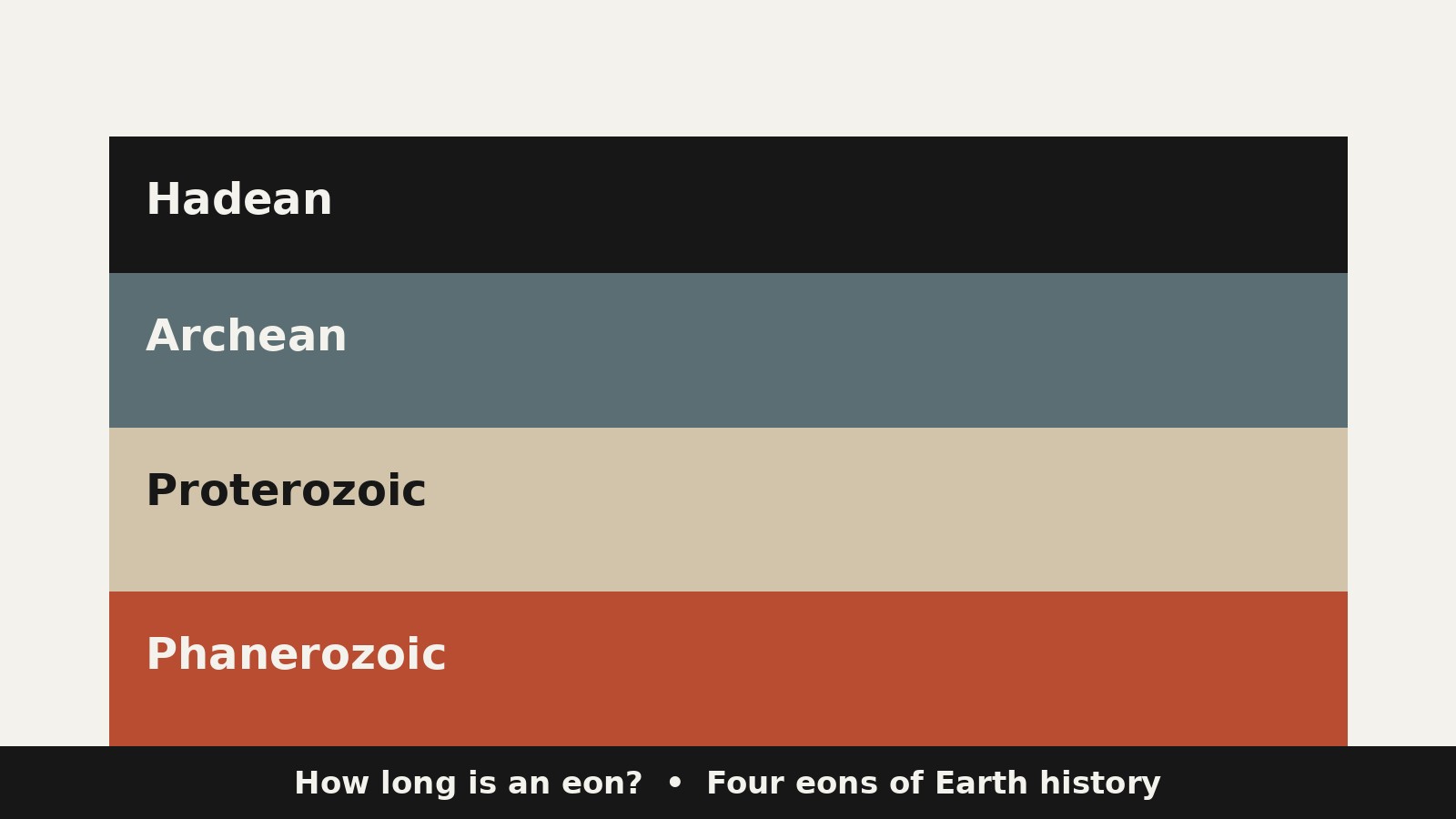
The short version is this. Geologists divide all of Earth history into four eons: the Hadean, the Archean, the Proterozoic, and the Phanerozoic. Together they cover about 4.57 billion years, from Earth’s formation to today. But the divisions were not cut into equal slices. They were drawn where the rock record and the story of life show major turning points, so each eon lasts as long as the chapter of history it contains. One chapter runs for nearly 2 billion years. Another runs for just over half a billion. The current chapter is still being written.
This article answers the question in full. It gives the length of each eon with dates from the International Chronostratigraphic Chart, explains where the popular “one billion years” answer comes from, shows how an eon differs from an era, a period, and an epoch, and explains how scientists measure stretches of time so vast that no human calendar can hold them.
Where the “one billion years” answer comes from
If you search for the length of an eon, many pages will tell you flatly that one eon equals one billion years. That figure is not invented. Merriam-Webster lists it as a secondary sense of the word: “a unit of geologic time equal to one billion years.” Encyclopaedia Britannica puts it the same way, noting that “less formally, eon often refers to a span of one billion years.”
The trouble is that this loose usage sits next to the formal one, and the two do not agree. In formal usage, an eon is simply the largest division of geologic time, and its length is whatever the boundaries of that division turn out to be. Compare the four real eons and the mismatch is obvious: none of them is exactly one billion years long. The Proterozoic is nearly twice that figure. The Hadean and the Phanerozoic are each roughly half of it. The Archean, at about 1.53 billion years, is the only one in the same neighborhood, and even it overshoots by more than 500 million years.
So the billion year figure works as a rough sense of scale. If someone says an event happened “eons ago,” they mean a time so distant that a billion years is the right order of magnitude. But if you want the length of a particular eon, the only honest answer is to name it and give its dates. The rest of this article does exactly that.
The four eons of Earth history
The International Commission on Stratigraphy, the body that maintains the official geologic time scale, publishes its divisions in the International Chronostratigraphic Chart. The current version, v2024/12, gives the following boundaries. Ages are given in millions of years ago (Ma) and billions of years ago (Ga), and the chart itself warns that numerical ages are subject to revision as dating improves. Rounded figures are used in the text; the table gives the chart values.
| Eon | From (million years ago) | To (million years ago) | Duration |
|---|---|---|---|
| Hadean | 4,567.3 | 4,031 | About 536 million years |
| Archean | 4,031 | 2,500 | About 1,531 million years |
| Proterozoic | 2,500 | 538.8 | About 1,961 million years |
| Phanerozoic | 538.8 | Present | About 539 million years so far |
Two things stand out immediately. First, the spread is huge: the longest eon is nearly four times the length of the shortest. Second, the Phanerozoic, the eon containing every fossil most people have ever seen, from trilobites to tyrannosaurs to humans, is one of the shortest. It accounts for only about 12 percent of Earth history. The other three eons together, often grouped under the informal name Precambrian, account for the remaining 88 percent.
The Precambrian is not itself an eon. It is an informal umbrella term for everything before the Phanerozoic, and geologists use it as a convenience, not as a formal division. When you read that the Precambrian lasted about 4 billion years, that figure is the sum of the Hadean, Archean, and Proterozoic eons, not a fifth eon in its own right.
The Hadean Eon: about 536 million years
The Hadean Eon runs from Earth’s formation, about 4,567 million years ago, to about 4,031 million years ago. It is the shortest eon, and also the one we know least about, because almost no rocks survive from it. Its name comes from Hades, the underworld of Greek myth, a reference to the hellish conditions of the young planet: a surface of molten rock, constant bombardment by asteroids, and an atmosphere very different from the one we breathe today.
Two events define the Hadean. The first is the formation of Earth itself, as dust and rock in the early solar system clumped together under gravity. The second, early in the eon, is the giant impact widely thought to have formed the Moon, when a Mars sized body struck the young Earth and threw debris into orbit that later coalesced into our satellite. By the end of the Hadean, the surface had cooled enough for a solid crust to form and for oceans to begin to gather, setting the stage for everything that followed.
It is worth noting that older reference works treated the Hadean differently. Britannica’s eon entry, for example, names only three eons, the Phanerozoic, Proterozoic, and Archean, and describes formal geologic time as beginning with the Archean. The modern International Chronostratigraphic Chart, however, lists the Hadean as a full eon in its own right. If you meet a source that counts three eons instead of four, that is why: it is using the older convention, not describing a different planet.
The Archean Eon: about 1,531 million years
The Archean Eon runs from about 4,031 million years ago to 2,500 million years ago, a span of roughly 1.53 billion years. Its name comes from the Greek word arche, meaning beginning or origin, and it is the eon in which Earth first became recognizably a living planet.
The early Archean saw the formation of the first stable continents, as crust thickened and cooled into landmasses that could survive over geological time. More importantly, life appeared. The earliest widely accepted direct evidence of life comes from stromatolites, layered structures built by microbial communities, dated to about 3.5 billion years ago, while chemical signatures in even older rocks, around 3.8 billion years old, are interpreted by many researchers as traces of early life. These first organisms were single celled microbes, bacteria-like cells without a nucleus, living in shallow seas.
By the later Archean, some of these microbes had developed photosynthesis, the ability to capture sunlight and release oxygen as a byproduct. At first, that oxygen went almost entirely into chemical reactions with iron and other elements in the oceans, so the atmosphere stayed nearly oxygen free. The stage was set, though, for the greatest atmospheric change in Earth history, which would arrive in the next eon.
The Proterozoic Eon: about 1,961 million years
The Proterozoic Eon, from 2,500 million years ago to 538.8 million years ago, is the longest eon by a wide margin: about 1.96 billion years, or nearly 43 percent of all Earth history on its own. Its name means “earlier life,” from the Greek proteros (earlier) and zoe (life), because it contains the first evidence of complex life, though nothing yet that would be visible to the naked eye as an animal.
The defining event of the Proterozoic is the Great Oxidation Event, which began about 2.4 billion years ago. Over hundreds of millions of years, oxygen produced by photosynthetic cyanobacteria finally overwhelmed the chemical sinks that had absorbed it, and free oxygen began to accumulate in the atmosphere and shallow seas. Oxygen was poisonous to many of the microbes that had thrived without it, and it reshaped the chemistry of the oceans, producing the banded iron formations, layered iron rich rocks that are now mined as iron ore. But it also made possible a new kind of cell: the eukaryote, a cell with a nucleus and internal compartments, which appeared during the Proterozoic and eventually gave rise to all plants, animals, and fungi.
The later Proterozoic brought further milestones. Multicellular organisms appear in the fossil record, including the soft bodied Ediacaran biota of the final Proterozoic period, strange frond-like and disc-like creatures that lived on the seafloor just before the Phanerozoic began. The eon also saw extreme climate swings, including episodes of global glaciation so severe that ice may have reached the equator, sometimes called Snowball Earth events. When the Proterozoic ended, the oceans held the raw material for an explosion of animal life. That explosion is where the next eon begins.
The Phanerozoic Eon: about 539 million years and counting
The Phanerozoic Eon began 538.8 million years ago and continues to the present day. Its name means “visible life,” from the Greek phaneros (visible) and zoe (life), because from this point on, organisms with hard shells, skeletons, and other structures that fossilize readily fill the rock record. It is the eon of everything familiar: fish, forests, dinosaurs, mammals, and humans.
The Phanerozoic is divided into three eras, each defined by a distinct chapter in the history of life:
The Paleozoic Era (538.8 to 252 million years ago, about 287 million years) opens with the Cambrian explosion, a relatively rapid diversification of animal body plans in the seas. Over the Paleozoic, life colonized the land: plants, then insects, then amphibians and reptiles. It ends with the largest mass extinction known, at the close of the Permian Period, which wiped out a large majority of marine species.
The Mesozoic Era (252 to 66 million years ago, about 186 million years) is the age of dinosaurs, along with the first birds and mammals and the rise of flowering plants. It ends with the asteroid impact at the close of the Cretaceous Period, which ended the reign of the non-avian dinosaurs.
The Cenozoic Era (66 million years ago to the present) is the age of mammals, and the era in which humans evolved. We live in the Cenozoic Era, in the Quaternary Period, in the Holocene Epoch.
Note that the Phanerozoic’s duration is still growing. Every year adds another year to it, and it will keep growing until geologists of some unimaginably distant future draw a boundary that ends it. That is one more reason why a fixed figure for “an eon” cannot work: one of the four eons is unfinished.
Eon, era, period, epoch: how the divisions fit together
An eon is the top level of the geologic time hierarchy, but it is only the first step down a ladder of ever finer divisions. Each eon is divided into eras, each era into periods, each period into epochs, and each epoch into ages. The table below shows the hierarchy with the units we live in today.
| Rank | What it is | Example (today) |
|---|---|---|
| Eon | The largest division of geologic time | Phanerozoic |
| Era | A subdivision of an eon | Cenozoic |
| Period | A subdivision of an era | Quaternary |
| Epoch | A subdivision of a period | Holocene |
| Age | The smallest formal division | Meghalayan |
The difference between ranks is not just size. Each level is defined by different kinds of evidence. Eon boundaries mark the grandest shifts, such as the appearance of abundant visible life at the start of the Phanerozoic. Era boundaries often coincide with mass extinctions, such as the end Permian and end Cretaceous events that close the Paleozoic and Mesozoic. Period and epoch boundaries are typically marked by changes in fossil assemblages, the particular groups of organisms found in rocks of that age.
One useful comparison: the entire Phanerozoic Eon, about 539 million years, is divided into three eras, but the shortest of those eras, the Cenozoic, is still 66 million years long. That is as long as the whole time since the non-avian dinosaurs died out, and it is still only one era inside one eon. Meanwhile, a single period such as the Jurassic lasted about 56 million years, roughly the same span as the whole of primate evolution so far. The hierarchy exists precisely because no single unit can capture both the sweep of 4.5 billion years and the detail of a few million.
A related pair of terms is worth clearing up. Geologists use “eon” for the time unit and “eonothem” for the corresponding body of rock deposited during that time, just as they pair “era” with “erathem” and “period” with “system.” You will rarely meet eonothem outside technical writing, but if you do, it means the rocks, not the years.
How do scientists know how long an eon lasted?
Nobody was present with a stopwatch, so eon lengths are measured, not observed directly. Two kinds of evidence combine to produce them.
The first is relative dating: the order of rock layers. In undisturbed sequences, younger rocks lie on top of older rocks, and particular fossil species appear in particular layers. By matching the same sequence of fossils in rocks around the world, geologists can correlate layers across continents and establish the order of events, even before they know any absolute dates.
The second is absolute dating, principally radiometric dating. Certain atoms, such as uranium and potassium, decay into other elements at a steady, measurable rate. By measuring the ratio of parent atoms to daughter atoms in a mineral such as zircon, scientists can calculate how long ago that mineral crystallized. These dates anchor the relative sequence to real numbers of years.
Eon boundaries are formalized in two ways. Boundaries in the Phanerozoic are defined by a specific rock layer at a specific place, called a Global Boundary Stratotype Section and Point, which marks the agreed lower boundary of each unit. Boundaries in the Archean and Proterozoic, where the fossil record is too sparse to define such points, have long been set by agreed numerical ages, called Global Standard Stratigraphic Ages. The International Commission on Stratigraphy is gradually working toward stratotype definitions for those older boundaries as well, which is one reason the chart’s numerical ages are revised from time to time. When you see a boundary quoted as 538.8 million years in one source and 541 million in another, that is usually the difference between the newest chart and an older rounding, not a disagreement about what happened.
The everyday meaning: “I haven’t seen you in eons”
Outside geology, “eon” has a much looser job. Merriam-Webster’s first definition is simply “an immeasurably or indefinitely long period of time,” as in “I haven’t seen him in eons.” Used this way, an eon has no length at all. It is an exaggeration, a way of saying that a wait felt endless, not a measurement.
The word itself comes from the Greek aion, meaning a lifetime, an age, or a long period of time, which passed through Latin into English. The spelling “aeon” is a variant of the same word, more common in British writing and in older texts, and it carries the same meanings. If you meet “aeon” in a geology book, it is the same unit; if you meet it in a poem, it is the same exaggeration.
The everyday meaning also explains why the question “how long is an eon” is so popular. Most people meet the word first in conversation or fiction, where it means “forever,” and only later discover that geologists use it as a technical term with real boundaries. Both meanings are correct in their own context. The mistake is to carry one context’s answer into the other: to say that a geological eon is “forever,” or to say that a friend you last saw in 2019 has been absent for a billion years.
Getting a feel for the scale
Numbers in the billions defeat human intuition, so it helps to shrink Earth history to a scale the mind can hold. Imagine Earth’s entire 4.57 billion year history compressed into a single 24 hour day. On that clock, Earth forms just after midnight. The first life appears in the early morning, around 4am. Oxygen begins to fill the atmosphere in the late morning. Complex multicellular life does not show up until the evening, around 9pm. Dinosaurs appear at about 11pm and vanish a few minutes before midnight. All of recorded human history, roughly the last 5,000 years, fits into far less than the final second before midnight.
Another way to grasp it: a single eon, even the shortest, dwarfs everything humans have done. The Hadean, at 536 million years, is more than 100,000 times longer than the whole of recorded human history. The Proterozoic alone lasted about 390,000 times as long. When geologists call these spans “deep time,” the word deep is doing real work. It marks a difference not just of degree but of kind: a scale on which mountains rise and erode away, continents drift across the globe, and the atmosphere itself changes composition, all more than once.
How long is an eon? The answer in one paragraph
An eon has no single length. In formal geology it is the largest division of geologic time, and Earth’s four eons last 536 million years (Hadean), 1,531 million years (Archean), 1,961 million years (Proterozoic), and 539 million years so far (Phanerozoic), measured on the International Chronostratigraphic Chart v2024/12. The popular shorthand of one billion years is a useful sense of scale, recorded by dictionaries as a loose usage, but it describes no actual eon. And in everyday speech, an eon is simply a very long, indefinite time, with no number attached at all. The right answer depends on which eon you mean, and on whether you are speaking as a geologist or as someone who has been waiting a very long time for a friend to call back.
Frequently asked questions
How many years are in an eon?
There is no fixed number. In loose usage, one eon is often taken as one billion years. In formal geology, eons are the largest divisions of geologic time and their lengths vary: the Hadean lasted about 536 million years, the Archean about 1,531 million years, the Proterozoic about 1,961 million years, and the Phanerozoic has lasted about 539 million years so far.
What is the longest eon?
The Proterozoic Eon, at about 1,961 million years (roughly 1.96 billion years), from 2,500 million years ago to 538.8 million years ago. It alone covers about 43 percent of Earth history.
What is the shortest eon?
The Hadean Eon, at about 536 million years, from Earth’s formation about 4,567 million years ago to about 4,031 million years ago. It is also the eon with the least surviving rock record.
What eon are we in now?
We live in the Phanerozoic Eon, which began 538.8 million years ago. Within it, we are in the Cenozoic Era, the Quaternary Period, and the Holocene Epoch.
Is an eon longer than an era?
Yes. An eon is the largest division of geologic time, and eras are its subdivisions. For example, the Phanerozoic Eon contains three eras: the Paleozoic, the Mesozoic, and the Cenozoic.
What is the Precambrian?
The Precambrian is an informal term for all of Earth history before the Phanerozoic Eon, covering the Hadean, Archean, and Proterozoic eons together, about 4.03 billion years or roughly 88 percent of Earth history. It is not itself an eon.
Is “aeon” the same as “eon”?
Yes. Aeon is a spelling variant of eon, from the same Greek root, aion. In geology it denotes the same unit of time, and in everyday language the same indefinite long period.
How do scientists date eons?
They combine relative dating, the order of rock layers and fossil sequences, with absolute radiometric dating, which measures the decay of radioactive atoms in minerals to calculate numerical ages. Eon boundaries are formalized by the International Commission on Stratigraphy in the International Chronostratigraphic Chart.
Sources & references
- International Commission on Stratigraphy, International Chronostratigraphic Chart v2024/12 (Cohen, Finney, Gibbard and Fan), stratigraphy.org: eon boundaries and numerical ages, including the 538.8 million year base of the Phanerozoic and the 2,500 and 4,031 million year boundaries of the Proterozoic and Archean. Numerical ages on the chart are subject to revision.
- U.S. Geological Survey, "Introduction" (Trek Through Time), usgs.gov: Earth about 4.6 billion years old; the Phanerozoic as the most recent 541 million years (older rounding); its division into the Paleozoic, Mesozoic, and Cenozoic eras; relative and absolute dating methods.
- Encyclopaedia Britannica, "Eon," britannica.com: formal definition of eons as the longest portions of geologic time, eras second longest; the loose usage of one billion years; the older three eon convention.
- Merriam-Webster, "Eon," merriam-webster.com: definitions covering an indefinitely long period, the largest division of geologic time, and the loose unit of one billion years.
- Catling, D. C., "The Great Oxidation Event Transition," Treatise on Geochemistry (Elsevier, 2014): the Great Oxidation Event as a rise in atmospheric oxygen from less than 1 part per million to 0.2 to 2 percent by volume about 2.4 to 2.2 billion years ago.


