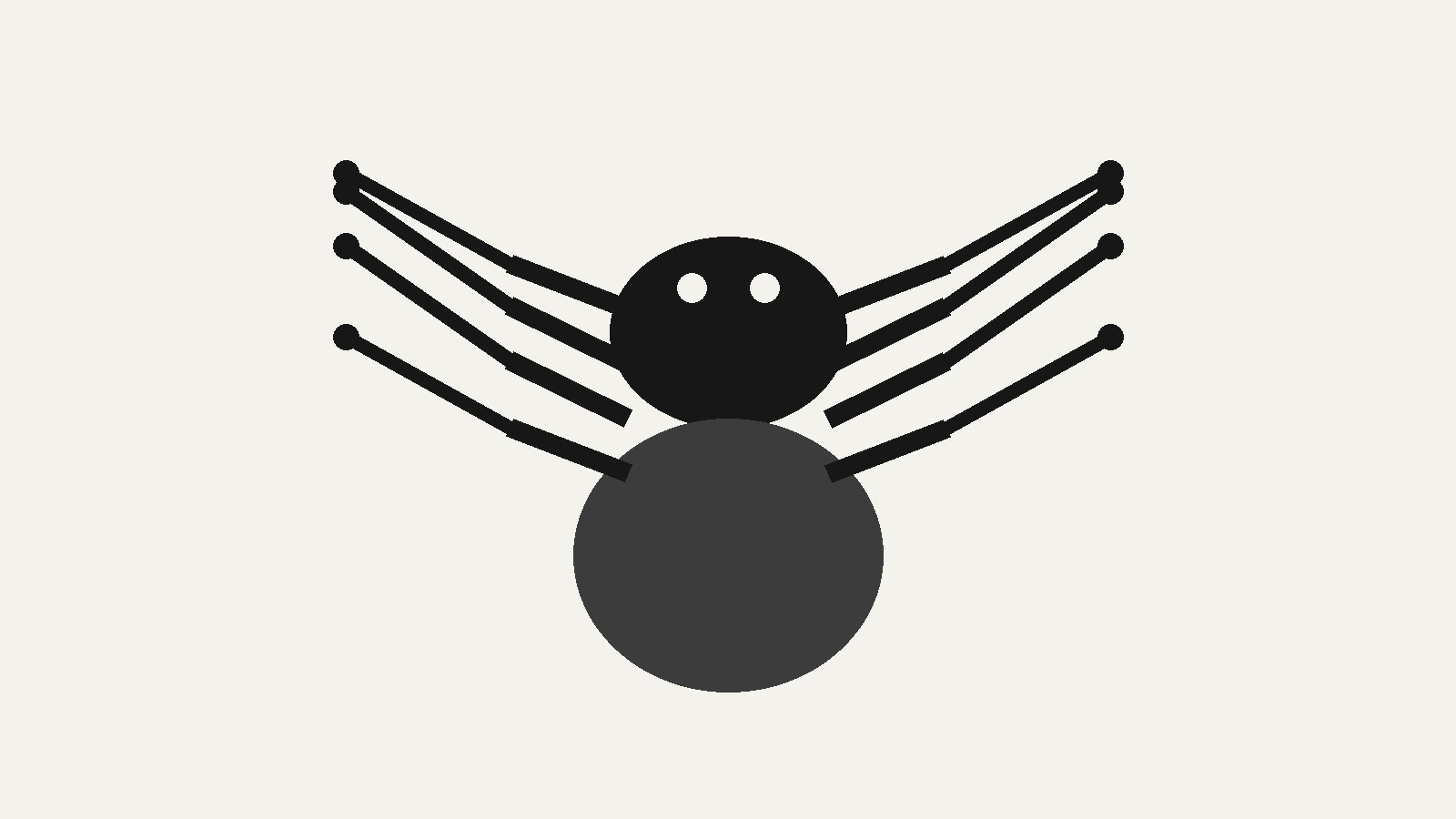
The short answer: A spider has eight legs, arranged in four pairs, and every one of them is attached to the front section of its body, the cephalothorax. No healthy spider of any species has more or fewer. If you count seven legs on a spider, you are not looking at a seven-legged species. You are looking at a spider that has lost one.
Eight is the famous number, but it is really just the entry point. A spider’s legs are not simple walking sticks. They are hydraulic machines that straighten by fluid pressure rather than by muscle alone, they are covered in sensors that let the spider feel vibrations, air movements and even tastes through its feet, and in a young spider they can be torn off in an escape and quietly grown back at the next molt. This article covers the count, the comparison with insects that settles most arguments, and the surprising engineering underneath.
Eight legs, four pairs, one address
A spider’s body has two main sections. The front section, the cephalothorax (also called the prosoma), is a fused head and thorax covered by a hard plate called the carapace. The rear section is the abdomen (or opisthosoma), the softer sac that holds the gut, the silk glands and the reproductive organs. The two sections are joined by a narrow stalk, and that narrow waist is one of the quick ways to recognize a true spider.
All eight legs attach to the cephalothorax, four on each side. The abdomen never carries legs. This arrangement makes mechanical sense once you know how the legs are powered, because the pumping machinery that helps move them sits in the cephalothorax too.
The four pairs are not interchangeable. In many hunting spiders the front pairs are stouter and do much of the seizing, while the rear pairs provide the push. In web-building spiders the legs are often longer and more delicate, built for tiptoeing across silk without sticking to it or shaking the web apart. Leg length and posture vary enormously across the more than 40,000 described spider species, but the count does not. Whether the spider is a pinhead-sized dwarf or a tarantula the size of a dinner plate, the answer to the question on this page is eight.
A few species even use the first pair of legs as feelers, holding them up and waving them to test the surroundings rather than walking on them, a habit that can make a spider look, at a glance, as though it has six walking legs and two antennae. It does not. The legs are still there, doing a different job.
Spider or insect? The leg count settles it
The eight-leg rule exists because spiders are not insects. They are arachnids, members of the class Arachnida, alongside scorpions, ticks, mites and harvestmen. Insects belong to a different class entirely, and the two body plans differ in almost every detail you can check with the naked eye:
| Feature | Spider | Insect |
|---|---|---|
| Legs | 8, in four pairs | 6, in three pairs |
| Main body parts | 2 (cephalothorax and abdomen) | 3 (head, thorax and abdomen) |
| Where the legs attach | Cephalothorax | Thorax (the middle section) |
| Antennae | None | One pair |
| Wings | None | Often present in adults |
| Eyes | Usually six to eight simple eyes | Large compound eyes, often plus simple eyes |
| Scientific class | Arachnida | Insecta |
That table is the whole identification toolkit. Count the legs and you have usually settled the question before you need anything else: six legs means an insect, eight legs means an arachnid, and if the arachnid also has the narrow-waisted two-part body and no antennae, it is a spider.
Notice the pattern the table reveals. In both animals, the legs are attached to the middle machinery of the body, the part packed with muscle (and, in spiders, with the hydraulic pump). What differs is how many segments that machinery carries. The arachnid body plan runs on four pairs of walking legs, and every adult arachnid follows it: the scorpion stalking at night, the tick waiting on a grass stem, the mite in the soil, and the spider on your ceiling all walk on eight.
Why eight legs?
Eight legs is not a spider invention. It is the inherited ground plan of the arachnids, a body layout that has been stable for hundreds of millions of years. Spiders did not choose eight legs for a task; they inherited four pairs from their arachnid ancestors, the way humans inherited five fingers. When scientists explain the number, they are really explaining a family resemblance.
That said, the arrangement has practical payoffs that help explain why it has endured. Four pairs give a wide, stable base, so a spider stays balanced while grappling with struggling prey or working upside down under a web. Extra legs also provide redundancy: a spider that loses a leg to a predator can still walk, climb and hunt on seven, and most can manage on six. An insect that loses two of its six legs is in far more trouble. The spare capacity matters, because leg loss in the wild is not rare, as we will see below.
The front of the cephalothorax also carries two other pairs of appendages, the fanged chelicerae and the smaller pedipalps, which are covered later in this article. Count every jointed appendage on a spider and you reach twelve. But only the four rear pairs are legs, built for walking. The rest are tools for feeding, sensing and mating.
Inside a leg: seven segments
A spider leg looks like a single bent rod, but it is a chain of seven segments, named from the body outward:
- Coxa: the short base segment that anchors the leg to the cephalothorax.
- Trochanter: a small segment that acts as a hinge link.
- Femur: the long, strong upper segment, the thigh of the leg.
- Patella: a short segment that works like a kneecap joint.
- Tibia: the long lower segment, the shin.
- Metatarsus: a further long segment, part of the spider’s extended “foot” region.
- Tarsus: the tip, the foot itself, ending in claws.
The names borrow from the anatomy of vertebrate limbs, but the machinery is the spider’s own. There is no bone inside a spider leg. The segments are hollow tubes of exoskeleton, moved by muscles that pull from within and by fluid pressure from the body, which is where things get genuinely strange.
At the very tip, the tarsus carries small claws: typically three in web-building spiders, where the middle claw helps handle silk threads, and typically two in hunting spiders. Between and around the claws, many spiders also have tufts of fine hairs that grip smooth surfaces, which is part of how a spider can walk across a ceiling or up a pane of glass.
How the legs move: muscle plus water pressure
Here is the fact that surprises almost everyone. A spider leg has muscles that pull it inward, the flexor muscles, but at the leg’s main joints it has no opposing extensor muscles to push it back out. Your arm works with paired muscles, biceps to bend and triceps to straighten. A spider straightens its legs a completely different way: by hydraulics.
The spider’s body fluid, called hemolymph, does the work of blood. To extend a leg, the spider increases pressure in the cephalothorax and forces hemolymph into the leg, and the fluid pressure pushes the leg straight, the way pressurized fluid extends the arm of an excavator. Flexor muscles then curl the leg back in. Movement is a partnership: pressure pushes out, muscle pulls in.
Rice University mechanical engineer Faye Yap, whose team studied the system, put it plainly in remarks reported by Smithsonian Magazine: spiders “only have flexor muscles, which allow their legs to curl in, and they extend them outward by hydraulic pressure.” The same mechanism explains a familiar sight: a dead spider with all its legs curled tightly underneath it. Death removes the pressure, the flexors win unopposed, and the legs fold in. The Rice team demonstrated the principle vividly by using the hydraulic system of deceased wolf spiders as tiny robotic grippers, extending and closing the legs with puffs of air.
Hydraulics also power the most athletic spider movement of all. Jumping spiders have no special jumping muscles; studies of their leaps describe a semi-hydraulic system in which a sudden surge of hemolymph pressure into the legs helps launch the spider into the air. The trade-off of the design is vulnerability: a spider that loses too much fluid, through injury or dehydration, can no longer pressurize its legs properly, which is one reason an injured spider may drag its limbs or curl up and die.
Legs that feel, listen and taste
For most spiders, the legs are sense organs first and transport second. Eyesight is often modest (most spiders have six or eight simple eyes, and many rely on them only to tell light from dark, with jumping spiders the sharp-eyed exception). The legs make up for it. They are covered in hairs called setae, and most of those hairs are sensory:
- Touch and vibration hairs. Ordinary setae register contact and vibration. A web-building spider reads its web largely through its legs, detecting the tremor of a trapped fly and judging where it is and how big it is from the pattern of vibrations arriving at its feet.
- Trichobothria. These are extra-long, fine hairs mounted in socket-like cups, and they are sensitive to the faintest air movements: the displaced air of an approaching predator, or of prey passing close in the dark. They function like an early-warning radar made of hair.
- Slit sensilla. Tiny strain gauges embedded in the exoskeleton, especially in organs near the leg joints, flex as the cuticle bends and report on vibration and on the forces running through each leg. Through them, the spider effectively hears with its skeleton.
- Chemoreceptors. Chemical-sensing hairs, concentrated on the tarsi and especially on the front legs, let a spider taste and smell what it stands on. A walking spider is continuously sampling the surface chemically through its feet, which is one way males follow the chemical trails left by females.
Put together, a spider standing still in the middle of its web or on a wall is running a full surveillance system through its eight legs: feeling the ground, listening for vibration, sniffing the air’s movement and tasting the surface, all at once.
The pedipalps are not legs
Just in front of the first pair of legs sits a pair of shorter, leg-like appendages called pedipalps, or palps. They cause most of the miscounts. A spider with prominent palps can look as though it has ten legs, and a spider holding its front legs up as feelers can look as though it has only six legs and a pair of antennae. Neither impression is right.
Pedipalps are built differently from legs: they have six segments instead of seven, and they are not used for walking. Their everyday jobs are sensory and culinary. They test and taste objects in front of the spider, and their bases, called endites or maxillae, form part of the mouthparts, helping to mash and handle food against the mouth. Colorado State University’s spider guide notes the other easy field mark: in male spiders the pedipalps are enlarged and rounded at the tip, often compared to a pair of boxing gloves.
The reason is reproduction. An adult male spider spins a small sperm web, deposits a drop of sperm on it, and draws the sperm up into a storage structure in the tip of each palp, the palpal bulb. During mating he inserts the bulb into the female’s genital opening to transfer the sperm. So the male’s palps are, in effect, carried syringes as well as feelers. Impressive as they are, they never touch the ground for walking, and they are never counted as legs.
In front of the palps sits one more pair of appendages, the chelicerae, the jaws that carry the fangs. Legs, palps, chelicerae: four pairs, one pair, one pair. That is the full inventory.
Losing a leg, and growing it back
Legs are lost constantly. A bird strikes and grabs a leg, and the spider escapes minus one. A leg gets trapped in an old exoskeleton during a molt. A rival or a mate bites one off. Studies of wild spiders regularly find a share of adults walking around with a leg missing; field research on wolf spiders, for example, has found missing or regrowing legs in roughly one in five to one in ten individuals examined.
Spiders have a built-in response: autotomy, deliberate self-amputation. A leg under attack can be shed at a predetermined weak point near its base, and the stump seals quickly to limit the loss of precious hemolymph, the spider’s hydraulic fluid. Trading a leg for a life is a good bargain, and spiders appear to manage remarkably well on the remainder. They adjust their gait to compensate, and laboratory studies of young spiders show them recovering near-normal running performance quickly after a loss.
Better still, a young spider can replace the leg. Regeneration happens through molting, the process by which a growing spider sheds its exoskeleton. At the first molt after a loss, a small replacement leg emerges; over the following molts it grows, until after a few molts it is close to indistinguishable from the originals. There is a hard limit: regeneration is tied to molting, so a spider that has reached adulthood and finished molting for life cannot regrow a leg. An adult that loses one keeps the gap permanently, and gets by.
This is also why the leg count is a definition rather than an average. “Eight legs” describes how a spider is built. A seven-legged spider is an eight-legged spider with a history.
The daddy longlegs confusion
No discussion of spider legs escapes the daddy longlegs problem, because the name is used for three different animals.
The true daddy longlegs of most gardens are the harvestmen, order Opiliones. Harvestmen are arachnids, so they do have eight legs, and absurdly long ones compared with their small bodies. But they are not spiders. Look closely and the giveaway is the body: in a harvestman, the cephalothorax and abdomen are broadly joined, so the whole body reads as a single oval lump, with no narrow spider waist. Harvestmen also have no silk glands, so they build no webs, and no venom glands, so the enduring myth that they carry the world’s most potent venom but cannot bite is doubly wrong: there is no venom there at all. Their second pair of legs doubles as feelers, waved ahead like antennae as they walk.
The same nickname sticks to cellar spiders (family Pholcidae), the spindly spiders that hang in webs in basements and corners. Those are true spiders: eight legs, two-part body, waist and all. And in some regions “daddy longlegs” means the crane fly, a gangly true fly, which is an insect with six legs and a pair of wings. One name, three animals, two different leg counts. The count, as always, sorts it out.
Frequently asked questions
Do all spiders have eight legs?
Yes. Every described spider species is built with eight legs in four pairs. Individuals are sometimes found with fewer, but those spiders have lost legs to predators, accidents or bad molts. No species naturally has six, seven, nine or ten legs.
Why do spiders have eight legs but insects have six?
Because they are built to different inherited body plans. Spiders are arachnids, and all adult arachnids, including scorpions, ticks, mites and harvestmen, have four pairs of walking legs. Insects are a separate arthropod lineage built on three pairs. The difference is one of ancestry, not of one design being a corrected version of the other.
Can a spider survive with seven legs?
Comfortably. A spider that loses a leg adjusts its gait and can still walk, climb, build webs and hunt. Many wild spiders live out their lives a leg short. Young spiders often do better than survive it: at the next molt they start growing the leg back.
Do spider legs grow back?
Yes, if the spider is still growing. Regrowth happens at a molt: a smaller replacement leg appears, and it catches up over later molts. Adult spiders, which no longer molt, cannot regenerate a lost leg.
Are the pedipalps legs?
No. Pedipalps are a separate pair of appendages in front of the legs, with six segments instead of seven. They are used for sensing, handling food and, in adult males, for transferring sperm. A spider has eight legs plus two pedipalps, plus two fanged chelicerae: twelve appendages in all.
Why do dead spiders curl up?
Because of hydraulics. Spiders extend their legs with fluid pressure and pull them in with flexor muscles. When a spider dies, the pressure is lost, the flexors pull unopposed, and the legs fold inward. A curled spider in a corner is a spider whose pump has stopped.
Is a daddy longlegs a spider?
It depends which animal you mean. A harvestman is not a spider: it is a separate arachnid order with a one-piece oval body, no silk and no venom. A cellar spider, which shares the nickname, is a true spider. Counting to eight will not separate those two, but looking for the narrow waist will.
Keep reading: The Sydney Funnel-Web Spider, Explained
Sources & references
- Colorado State University, Agricultural Biology (Integrated Pest Management), "Spiders": "All spiders have two body segments, eight legs, and lack antennae. They typically have six to eight eyes arranged in two rows and modified mouthparts called pedipalps, which are spherical and enlarged on male spiders."
- Smithsonian Magazine, Margaret Osborne, "Scientists Use Dead Spiders as Claw Machines" (August 1, 2022), reporting the Rice University necrobotics study and quoting mechanical engineer Faye Yap: "Spiders do not have antagonistic muscle pairs, like biceps and triceps in humans. They only have flexor muscles, which allow their legs to curl in, and they extend them outward by hydraulic pressure. When they die, they lose the ability to actively pressurize their bodies. That's why they curl up."
- Britannica Kids, "Spider": spiders have four pairs of legs attached to the cephalothorax; "A few species use the first pair of legs as feelers to find prey"; spiders are related to scorpions, ticks and mites.
- BioKIDS (University of Michigan), "Araneae: Information": "They have eight legs, all attached to the cephalothorax... two small 'mini-legs' called pedipalps... used to grab prey, and in mating, and are much bigger in male spiders than in females."
- R. S. Fox, Invertebrate Anatomy OnLine (Lander University), "Argiope aurantia" (garden spider anatomy): each walking leg is composed of seven articles, "coxa, trochanter, femur, patella, tibia, metatarsus, and tarsus"; "The legs have abundant setae, most or all of which are sensory receptors, chiefly mechanoreceptors sensitive to vibrations, touch, and air movements. Slit sense organs sensitive to strain in the cuticle are present... Trichobothria, which are special, long, slender setae, are sensitive to very weak air movements. Chemoreceptors are present on the tarsi, especially those of the first legs."
- Arizona-Sonora Desert Museum, "Spiders" (introductory chapter, nhsd): "Arachnids differ from most other arthropods in having no antennae. All adult arachnids have four pairs of legs and have no wings." Also: pedipalps "are not used for locomotion but often assist in touching and maneuvering prey. Each male pedipalp is equipped with a special structure that is used to transfer sperm to the female... often described as resembling a boxing glove."
- JSTOR Daily, "Tiny Splendid Peacock Spiders," summarizing research in the Journal of Experimental Biology: jumping spiders "use a unique semi-hydraulic system. They don't have muscles to extend their legs and power the jumps. Instead, they extend their legs by increasing the pressure of the haemolymph (fluid analogous to blood in invertebrates) in their legs, which triggers the jump."
- Xueqing Li, Xuanda Chen, Zhen Gong and Yu Peng, "Leg Autotomy and Regeneration in Crab Spiders Ebrechtella tricuspidata (Araneae: Thomisidae)," Insects (MDPI) 17(8), 833 (2026): documents autotomy as a defense and regeneration of the lost appendage across a molt; regenerated legs appear smaller at first. Companion research summary on huntsman spider (Heteropoda venatoria) spiderlings: "After one molt, the new legs appeared smaller than the full-grown size and slowly became indistinguishable from the others. However, fully mature H. venatoria were not able to regenerate their lost legs and amputation was permanent."
- Encyclopedia of Life (EOL), "Opiliones" articles, drawing on the standard order description: "The most easily discernible difference between harvestmen and spiders is that in harvestmen, the connection between the cephalothorax and abdomen is broad, so that the body appears to be a single oval structure. Other differences include the fact that Opiliones have no venom glands in their chelicerae, so pose no danger to humans. They also have no silk glands and therefore do not build webs... The second pair of legs are longer than the others and function as antennae or feelers." The name "daddy long legs" is also applied to the unrelated crane fly (Tipulidae) and the cellar spider (Pholcidae), per the University at Buffalo Soil Ecology Wiki's Opiliones page.
- Wikipedia, "Spider anatomy" (standard anatomy references as cited there): "The tip of the tarsus bears claws, which vary in number and size. Spiders that spin webs typically have three claws, the middle one being small; hunting spiders typically have only two claws"; "The pedipalps have only six segments: the metatarsus is missing"; adhesive hair tufts (scopulae) explain how spiders grip smooth surfaces such as glass and ceilings.


