Short answer
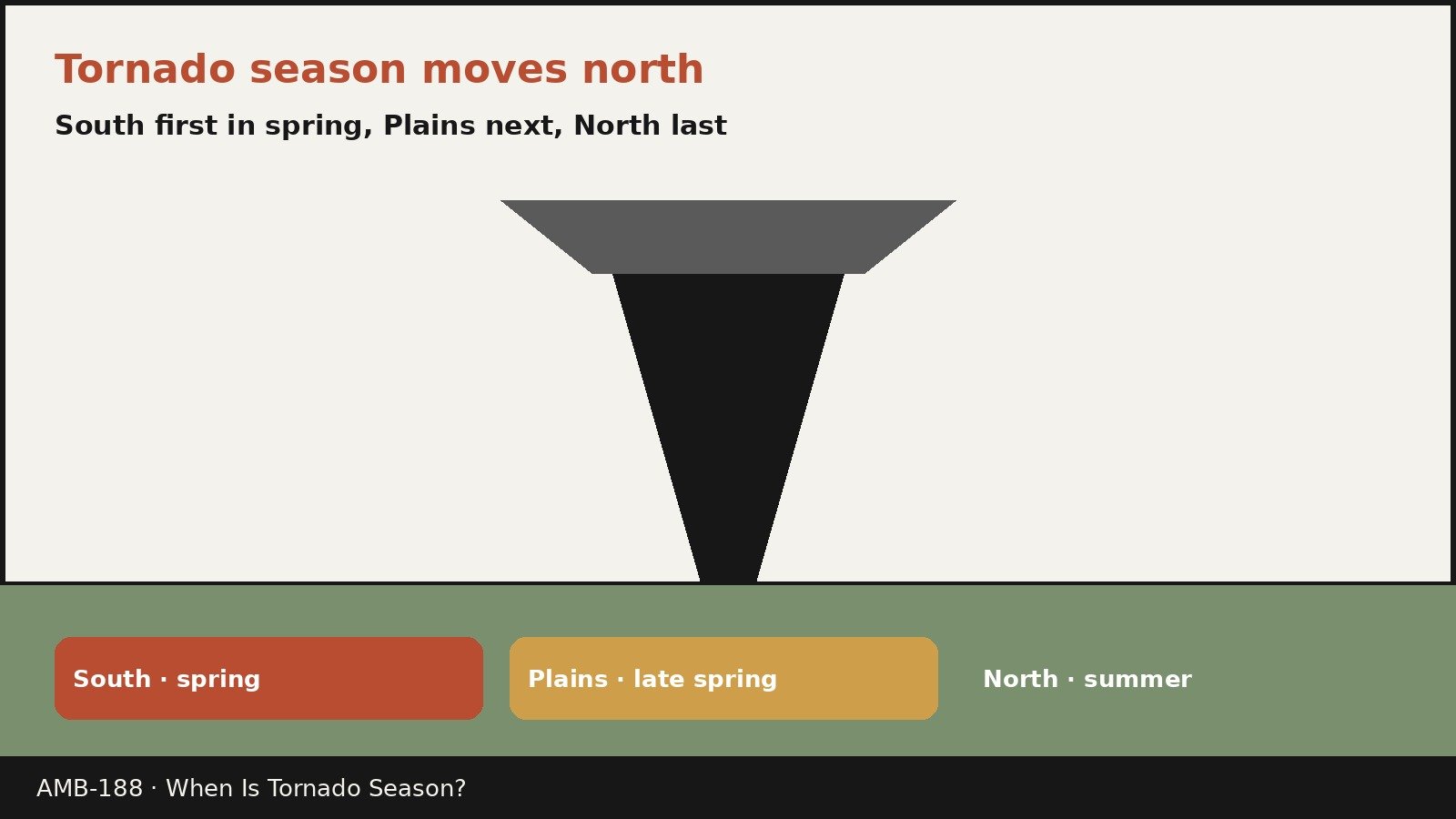
- There is no single national tornado season. The season arrives at different times in different regions, moving from south to north through the spring.
- Nationally, April, May, and June are the busiest months. About 52 percent of United States tornadoes from 2004 to 2023 occurred in those three months, according to Storm Prediction Center data reported by Weather.com, and May alone averaged 260 tornadoes a year.
- The South peaks first. The Gulf Coast and Southeast are most active in spring, roughly March through May, with the National Weather Service offices in Birmingham, Alabama, and Mobile, Alabama, both describing March through May as their primary spring season.
- The Plains peak in late spring. The greatest chance of tornadoes sits over the classic Tornado Alley region in May, then shifts further north in June, according to monthly climatology maps from Storm Prediction Center data.
- The Southeast has a second season. A secondary fall season runs from November through mid-December in the Mobile and Birmingham forecast areas, and NOAA's National Centers for Environmental Information notes a relatively high frequency of tornadoes in the Gulf Coast's Dixie Alley region from October through December.
- Tornadoes can occur in any month. NOAA's National Severe Storms Laboratory notes that tornadoes have been known to occur in every state, on any day of the year, and at any hour.
Introduction
Ask when tornado season is, and the honest answer is that there is no single national date. The United States does not enter and leave tornado season together. Instead, the season rolls across the country like a slow wave, starting in the South, building through the Plains, and reaching the northern states last. The National Severe Storms Laboratory (NSSL) of the National Oceanic and Atmospheric Administration (NOAA) puts the pattern plainly: tornadoes in the United States occur mostly during the spring and summer, and the tornado season comes early in the south and later in the north because spring comes later in the year as one moves northward.
That rolling pattern is the key to the whole subject. A reader in Mississippi and a reader in Minnesota can both ask the same question in April and get different answers, and both answers can be right. Mississippi is already deep into its busiest stretch, while Minnesota is still weeks away from its peak. Add a second, smaller season in the fall across the Southeast, plus the fact that tornadoes have been recorded in every state and in every month of the year, and the picture becomes more useful than any single date could be.
This article lays out that picture region by region, explains why spring produces the national peak, compares the timing of Tornado Alley and Dixie Alley, and covers the fall second season, the winter risk in the South, and the questions readers most often ask next. Every date range below is tied to the region it describes, because a national tornado season, stated without a place attached, would be misleading.
What “Tornado Season” Actually Means
The phrase “tornado season” is a summary of statistics, not an official calendar event: no agency declares a national start or end date. The term describes the stretch of the year when tornadoes are most frequent in a given place, judged from decades of recorded tornadoes, and because the weather patterns that produce tornadoes move with the seasons, that stretch falls at a different time in each region.
It helps to separate three ideas that are often confused: the national peak, the months with the most tornadoes countrywide; the local peak, the months when tornadoes are most frequent in one place; and the possible range, the full span of the year in which tornadoes have occurred there, which is much wider than the peak. May is the busiest month nationally, but a state whose own peak falls in April or June would be poorly served by a May-only answer.
Year-to-year variation is the other reason to treat season dates as patterns rather than promises. Weather.com, reporting Storm Prediction Center data, notes that April 2024 produced 356 tornadoes in the United States while April 2021 produced only 78. The ranges in this article are therefore typical patterns from long-run averages, not forecasts for any particular year.
The National Picture: Month by Month
The United States averages roughly 1,200 tornadoes a year, according to NOAA’s National Severe Storms Laboratory. Using the 2004 to 2023 period, the Storm Prediction Center average is 1,246 a year, and just over half fall in three months. The monthly averages for that period, as reported by Weather.com from Storm Prediction Center data, are:
| Month | Average tornadoes (2004 to 2023) |
|---|---|
| April | 202 |
| May | 260 |
| June | 186 |
| April, May, and June combined | About 52 percent of the annual total |
May is the clear national leader, and April and June sit well ahead of every other month. That ordering is stable across averaging periods, even though exact counts move: the difference between about 1,200 and 1,246 tornadoes a year reflects the years included, not a disagreement about the pattern.
The concentration is even stronger for the most powerful tornadoes: about 58 percent of tornadoes rated F3 or EF3 or stronger between 1950 and 2012 struck in April, May, and June, according to figures compiled by former Weather Channel severe weather expert Dr. Greg Forbes from Storm Prediction Center data, as reported by Weather.com, and for tornadoes rated F4 or EF4 or stronger the share rises to 69 percent. Spring is therefore not only the season with the most tornadoes, but also when the strongest tornadoes are most likely, and about 83 percent of tornado deaths from 2019 through 2023 were from tornadoes rated EF3 or stronger, according to Storm Prediction Center data reported by Weather.com.
Most tornadoes, however, are weak. NOAA’s National Centers for Environmental Information reports that around 77 percent of United States tornadoes are rated EF0 or EF1, and about 95 percent are below EF3 intensity, with only about 0.1 percent reaching EF5. The season matters most because it concentrates both the count and the strength.
Why Spring Produces the Peak
Tornadoes form from thunderstorms, and spring is when the ingredients for the most violent thunderstorms come together over the largest part of the country at once. The National Weather Service describes two key ingredients: instability, warm, moist air near the ground with cooler, drier air above it, which promotes strong updrafts; and wind shear, a change in wind speed or direction with height, which strengthens the updraft and promotes the rotation from which tornadoes are produced.
Spring supplies both ingredients in unusual abundance: warm, moist air from the Gulf of Mexico pushes northward as the sun strengthens, while cold air masses from the north are still strong enough to clash with it, and the jet stream, a fast river of air high in the atmosphere, is still positioned over the middle of the country, providing the wind shear. NOAA’s National Environmental Satellite, Data, and Information Service explains it in the same terms: unstable air, with winds at different altitudes blowing in different directions or speeds, produces a large thunderstorm whose spinning currents can drop to the ground as a tornado.
The type of storm matters as well. All thunderstorms have the potential to produce tornadoes, according to the National Weather Service, but the storm most commonly associated with tornadoes is the supercell: a very severe, long-lived thunderstorm with a rotating circulation aloft called a mesocyclone. Spring is the season when supercells are most frequent over the central and southern United States, which is another reason the national count peaks then.
As spring turns to summer, the setup weakens in the South and strengthens in the North, which is exactly why the season moves. The jet stream retreats northward in the warmer months, taking its wind shear with it. Southern states still have plenty of warm, moist air, but with less shear they produce fewer tornado-producing storms, while northern states finally have both moisture and shear at the same time. The peak follows the jet stream north.
Tornado Season by Region
The table below summarizes the typical pattern. The ranges are approximate, drawn from the sources cited below, and describe when tornadoes are most frequent, not the only months when they occur.
| Region | Typical peak | Notes |
|---|---|---|
| Gulf Coast and Southeast | March through May | Earliest major peak; second season in late fall |
| Southern Plains (Texas, Oklahoma) | Late spring, centered on May | Part of the national May peak |
| Central Plains and Midwest | May into June | Peak shifts north through late spring |
| Northern Plains and Upper Midwest | June and early summer | Latest major peak |
| Northeast and West | Late spring into summer | Less frequent overall; timing follows the northward shift |
| Florida | Year-round thunderstorms; tropical systems add tornadoes | Frequent but usually weaker tornadoes |
The Gulf Coast and Southeast: First and Earliest
The southernmost tier of the country is where the season starts. The National Severe Storms Laboratory states that the tornado season comes early in the south, and the local National Weather Service offices give that statement dates: the Birmingham office describes Alabama’s primary severe weather season as spring, from March through May, noting that tornadoes there can happen in any month and at any time, day or night, and the Mobile and Pensacola office likewise calls March through May its traditional spring severe weather season.
Monthly climatology maps based on Storm Prediction Center data tell the same story for April: the area with the greatest chance of tornadoes sits over parts of Arkansas, Louisiana, Alabama, and Mississippi. By April the heart of tornado activity is still in the Southeast and lower Mississippi Valley, before it moves north, so waiting until May to think about tornado season in the Gulf Coast states means missing the busiest part of it.
The Southern Plains: The Heart of the May Peak
Texas, Oklahoma, and Kansas form the southern half of the region most people picture as Tornado Alley, and late spring is their signature window. In May, the monthly climatology maps show the greatest chance of tornadoes expanding and shifting north into line with the classic Tornado Alley region and parts of central Illinois, and this is when the Plains states contribute the largest share of the national total.
NOAA’s National Centers for Environmental Information describes Tornado Alley as a nickname for an area in the southern plains that consistently experiences a high frequency of tornadoes, typically in late spring and occasionally in early fall. The boundaries are debatable, the center notes, but the region from central Texas northward to northern Iowa, and from central Kansas and Nebraska east to western Ohio, is often collectively known as Tornado Alley, and it is ideally situated for supercell thunderstorms, the producers of violent tornadoes rated EF2 or greater.
The Central Plains and Midwest: May into June
As May gives way to June, the center of activity continues north: the June climatology map places the greatest chance of tornadoes across parts of Iowa, Illinois, Wisconsin, Minnesota, and even parts of South Dakota. The region’s peak therefore straddles the two months, with southern parts peaking in May and northern parts in June, and the progression is gradual rather than abrupt. The useful point is that the season does not end when May ends: June is the second half of the central United States peak, and in the northern Midwest it is the peak itself.
The Northern Plains and Upper Midwest: The Last Major Peak
North Dakota, South Dakota, Nebraska, Minnesota, and Wisconsin reach their greatest tornado chance last, because the warm, moist air and the strong wind shear do not overlap over the northern Plains until later in the year. The June map, with its greatest-chance area reaching into Minnesota and South Dakota, captures the tail end of this progression, and tornado activity continues into the summer in the north after it has faded in the South. Because the northern peak is later and the season there is shorter, a single outbreak can dominate a northern state’s annual total in a way that would be less likely in a southern state with a longer season.
The Northeast and the West: Later, and Less Frequent
The Northeast and the western states see far fewer tornadoes than the central and southern United States, and their timing follows the same northward logic at a lower level of activity. The National Severe Storms Laboratory notes that tornadoes are most common in the central plains east of the Rocky Mountains and west of the Appalachian Mountains, but tornadoes have still been recorded in every state, so “less frequent” never means “never.” In the Northeast, activity tends to cluster in late spring and summer; in the West, tornadoes are rarer still and often tied to specific weather patterns rather than a broad season. Readers in these regions should treat the national April to June peak as background context and look to their local National Weather Service office for their own forecast area.
Florida: A Different Pattern
Florida is a special case, and NOAA’s National Centers for Environmental Information explains why: Florida has numerous tornadoes simply because of the high frequency of almost daily thunderstorms, and several tropical storms or hurricanes often affect the peninsula each year, whose rain bands often produce tornadoes when the systems move ashore. Those tornadoes tend to be weaker than those from non-tropical thunderstorms, the center notes, despite the violence of the parent storm.
The result is a high count of tornadoes with a different seasonal shape: thunderstorm-driven tornadoes can occur through much of the year, and the tropical season adds another window in summer and fall. Florida’s story is less about a single spring peak and more about frequent, usually weaker events spread across a longer season.
Tornado Alley Versus Dixie Alley: Two Regions, Two Timings
Tornado Alley and Dixie Alley are nicknames, not official boundaries, and the distinction between them is one of the most useful ideas in tornado climatology. Tornado Alley covers the southern and central Plains, roughly from central Texas to northern Iowa and east to western Ohio, and its tornadoes typically happen in late spring. Dixie Alley covers the Gulf Coast and Southeast, including parts of Mississippi, Alabama, Georgia, and Tennessee. Its timing differs in two ways: it peaks earlier, and it has a second peak.
The earlier peak follows from geography: the Southeast sits closer to the Gulf of Mexico, so warm, moist air arrives there first and the clash with lingering cold air begins earlier. Its spring peak, in March through May, therefore runs ahead of the Plains peak, and in April the Southeast is already at its busiest while the Plains are still building toward May.
The second difference is the fall season, covered in the next section. The Southeast is one of the few parts of the country with two distinct severe weather seasons, while Tornado Alley has only occasional early fall activity, according to NOAA’s National Centers for Environmental Information. That combination, an earlier spring peak plus a real fall season, is why the Southeast’s calendar looks longer and more spread out than the Plains calendar, even though the Plains has the higher national profile in May.
The Second Season: Fall and Winter in the South
The fall second season is easy to overlook, and that is part of why it matters. As autumn advances, cold air pushes south again and meets the warm, moist air lingering near the Gulf Coast, so the ingredients that separated in summer come back together, this time in the Southeast rather than the Plains.
The Mobile and Pensacola office calls November through mid-December its secondary fall severe weather season, noting that its region is one of the few locations in the world with two distinct severe weather seasons. The Birmingham office gives the same window for central Alabama, and NOAA’s National Centers for Environmental Information notes more broadly a relatively high frequency of tornadoes in the Gulf Coast’s Dixie Alley area in late fall, from October through December.
Winter tornadoes belong in the same discussion. The National Severe Storms Laboratory notes that there is no particular temperature at which tornadoes form: what matters is the surface temperature relative to the temperature higher up, and even if it is cold near the surface, a tornado is possible if it is colder higher up, the winds set up low-level wind shear, and the other ingredients are present. Winter tornadoes in the South are therefore the same ingredients assembled in a colder month, over the region where warm Gulf air is still available.
Tornadoes Outside the Peak Months
The simplest sentence in this article is also the most important: tornadoes can occur in any month. The National Severe Storms Laboratory states that tornadoes have been known to occur in every state, on any day of the year, and at any hour, and the Birmingham office repeats the point for Alabama. The national peak months describe where the risk concentrates, not where it begins and ends.
Two mechanisms extend activity beyond the spring peak: the fall second season in the Southeast, described above, and tropical systems, whose rain bands can produce tornadoes well outside the spring window when a hurricane or tropical storm moves ashore.
Peak season deserves the closest attention, because that is when tornadoes are most frequent and, on average, strongest. But a calendar-based approach that switches off outside the peak months would miss real events, and the Birmingham office writes that staying prepared year-round is imperative even though each season’s severity varies from year to year.
Time of Day and Strength Through the Season
Time of day is another dimension of tornado timing, and it follows the daily heating cycle. The National Severe Storms Laboratory notes that tornadoes usually occur during the late afternoon and early evening, when daytime heating has built the strongest instability. In the South, however, and especially in Mississippi, strong to violent tornadoes occur nearly as often at night as during the day, according to the National Weather Service office in Jackson, Mississippi. Nighttime tornadoes are harder to see and easier to miss, which is one reason the Southeast’s risk profile differs from the Plains profile even when the counts look similar.
Strength is rated after the fact, not measured directly in most cases: the rating scale is based entirely on the damage caused, according to the National Severe Storms Laboratory, and the Enhanced Fujita Scale, implemented by the National Weather Service in 2007, uses 28 damage indicators such as building type, structures, and trees. It runs from EF0, with estimated winds of 65 to 85 miles per hour and light damage, to EF5, with estimated winds of 200 to 230 miles per hour and incredible damage, according to NOAA’s National Environmental Satellite, Data, and Information Service. The strongest wind speed measured above ground level by mobile Doppler radar was 318 miles per hour, recorded on May 3, 1999, near Bridge Creek and Moore, Oklahoma. That figure sits above the EF5 range because the scale is a damage rating, not a direct wind measurement, and instruments rarely survive the strongest tornadoes.
Watches, Warnings, and Staying Informed
The warning language is worth clearing up, because the National Weather Service issues two different products. The National Severe Storms Laboratory defines them as follows: a tornado watch defines an area where tornadoes and other severe weather are possible in the next several hours, meaning residents need to be alert and prepared to go to safe shelter if a warning is issued, while a tornado warning means a tornado has been spotted, or Doppler radar shows a circulation that can spawn one, and safe shelter should be sought immediately. The Storm Prediction Center issues watches; local offices issue warnings.
The Mobile and Pensacola office adds that a warning is typically issued for a portion of counties at a time and usually lasts no more than 45 minutes. Its published guidance describes the generally recommended shelter as a basement or a small interior room, such as a closet, bathroom, or interior hallway without windows on the lowest level, with as many walls as possible between the occupants and the outside; it notes that most injuries from high winds are from flying debris, and that mobile homes should be abandoned for the nearest sturdy building or shelter. This article describes that official guidance for general information only; during an actual event, readers should follow the instructions of their local National Weather Service office and local emergency officials, since local warnings take priority over any general article.
The seasonal pattern and the warning system work together: the peak months are when watches are most frequent in a given region, which is why local National Weather Service offices run severe weather awareness campaigns in spring and, in the Southeast, again in fall. Knowing the local season explains why warnings cluster in certain months, and knowing the watch-warning difference helps a reader respond correctly when they do.
Frequently Asked Questions
When does tornado season start?
It depends on the region. In the Gulf Coast and Southeast, the primary season is under way by March: the National Weather Service offices in Birmingham and Mobile both describe March through May as their spring severe weather season. In the Plains, the season builds toward May, and in the northern Plains and Upper Midwest it peaks later, in June and early summer. There is no single national start date.
When does tornado season end?
It depends on the region. In the southern and central Plains, activity declines sharply after June, and in the northern states after the early summer peak. In the Southeast, a secondary season runs from November through mid-December, so the calendar there has two endings: spring in May and fall in mid-December. And because tornadoes can occur in any month, no end date means the risk has disappeared entirely.
What month has the most tornadoes?
May, nationally. From 2004 to 2023, May averaged 260 tornadoes a year, ahead of April at 202 and June at 186, according to Storm Prediction Center data reported by Weather.com, and May is also in the heart of the period when violent tornadoes are most likely. Local peaks differ: the Southeast peaks earlier and the northern Plains later.
Is there a tornado season in winter?
There is no national winter tornado season, but winter tornadoes do occur, particularly in the South. The National Severe Storms Laboratory notes that there is no particular temperature at which tornadoes form: a tornado is possible in cold surface conditions if the air aloft is colder still and the wind shear and other ingredients are present. The Southeast’s secondary season runs into December, and tornadoes have been recorded in every month of the year.
What is the difference between Tornado Alley and Dixie Alley tornado seasons?
Tornado Alley, in the southern and central Plains, peaks in late spring, centered on May, with occasional early fall activity. Dixie Alley, in the Gulf Coast and Southeast, peaks earlier, in March through May, and has a secondary season in late fall, from October through December. Dixie Alley’s calendar is therefore longer with two peaks, while Tornado Alley’s is more concentrated in late spring.
Does every state have a tornado season?
Every state has recorded tornadoes, according to NOAA’s National Severe Storms Laboratory, but not every state has a well-defined season. Central and southern states have clear, busy seasons, while Northeast and West states have fewer tornadoes spread more thinly across late spring and summer. The local National Weather Service office is the best source for a specific forecast area.
What time of day do tornadoes usually happen?
Most often in the late afternoon and early evening, according to the National Severe Storms Laboratory, when daytime heating has built the strongest instability. In the South, however, strong to violent tornadoes occur nearly as often at night as during the day.
Are fall tornadoes more dangerous than spring tornadoes?
On average, no. Spring produces more tornadoes and a higher share of the strongest tornadoes. Fall tornadoes in the Southeast carry their own concerns, including a higher share of nighttime events and a population that may be less alert outside the well-publicized spring season, but the spring peak remains the period of greatest number and strength nationally. The danger in any season comes from the individual storm, not the month.
How long does tornado season last in Florida?
Florida does not fit the standard pattern. Because thunderstorms occur there almost daily and tropical systems add tornadoes in summer and fall, Florida experiences tornadoes across a much longer stretch of the year than the Plains states, though usually weaker ones. There is no single Florida season comparable to the March through May season in Alabama or the May peak in Oklahoma.
Can tornadoes happen outside tornado season?
Yes. Tornadoes have been recorded in every month of the year, according to NOAA’s National Severe Storms Laboratory, and tropical systems can produce tornadoes well outside the spring peak. The peak months describe when tornadoes are most frequent, not the only time they occur.
Sources & references
- NOAA National Severe Storms Laboratory, Severe Weather 101: Tornado FAQ (season timing, annual count, ingredients context, watch and warning definitions, EF scale, tornado movement and duration, strongest measured wind speed).
- National Weather Service, Peachtree City, About Tornadoes (formation ingredients, supercell description).
- NOAA National Environmental Satellite, Data, and Information Service, What Causes Tornadoes? (wind shear and instability explanation, Enhanced Fujita Scale wind ranges).
- NOAA National Centers for Environmental Information, Tornado Alley (archived NOAA National Climatic Data Center page, captured 18 December 2020 via the University of North Texas web archive; Tornado Alley and Dixie Alley timing, Florida pattern, share of weak and violent tornadoes).
- National Weather Service, Mobile and Pensacola, Severe Weather Awareness: Tornado Safety (March through May spring season, November through mid-December secondary season, warning duration, shelter guidance).
- National Weather Service, Birmingham, Severe Weather Awareness Week (March through May primary season, November to mid-December secondary season, tornadoes in any month and at any time).
- National Weather Service, Jackson, Mississippi, Severe Weather Preparedness Week Day 4: Tornado Safety (Mississippi peak March through May, majority of tornadoes in the afternoon nationally, strong to violent tornadoes nearly equal day vs night in the South and Mississippi).
- National Weather Service, Jackson, Mississippi, Fall Severe Weather Preparedness Week Day 3: Tornado Safety (November tornadoes in Mississippi strongly favor nighttime occurrence; nighttime tornadoes are hard to see and confirm, making people less aware and less likely to act).
- Weather.com, Why April, May, June Are Most Active For Tornadoes, March 26, 2026 (Storm Prediction Center monthly averages for 2004 to 2023, share of tornadoes in April through June, strong and violent tornado shares, monthly climatology map descriptions).


