Short answer
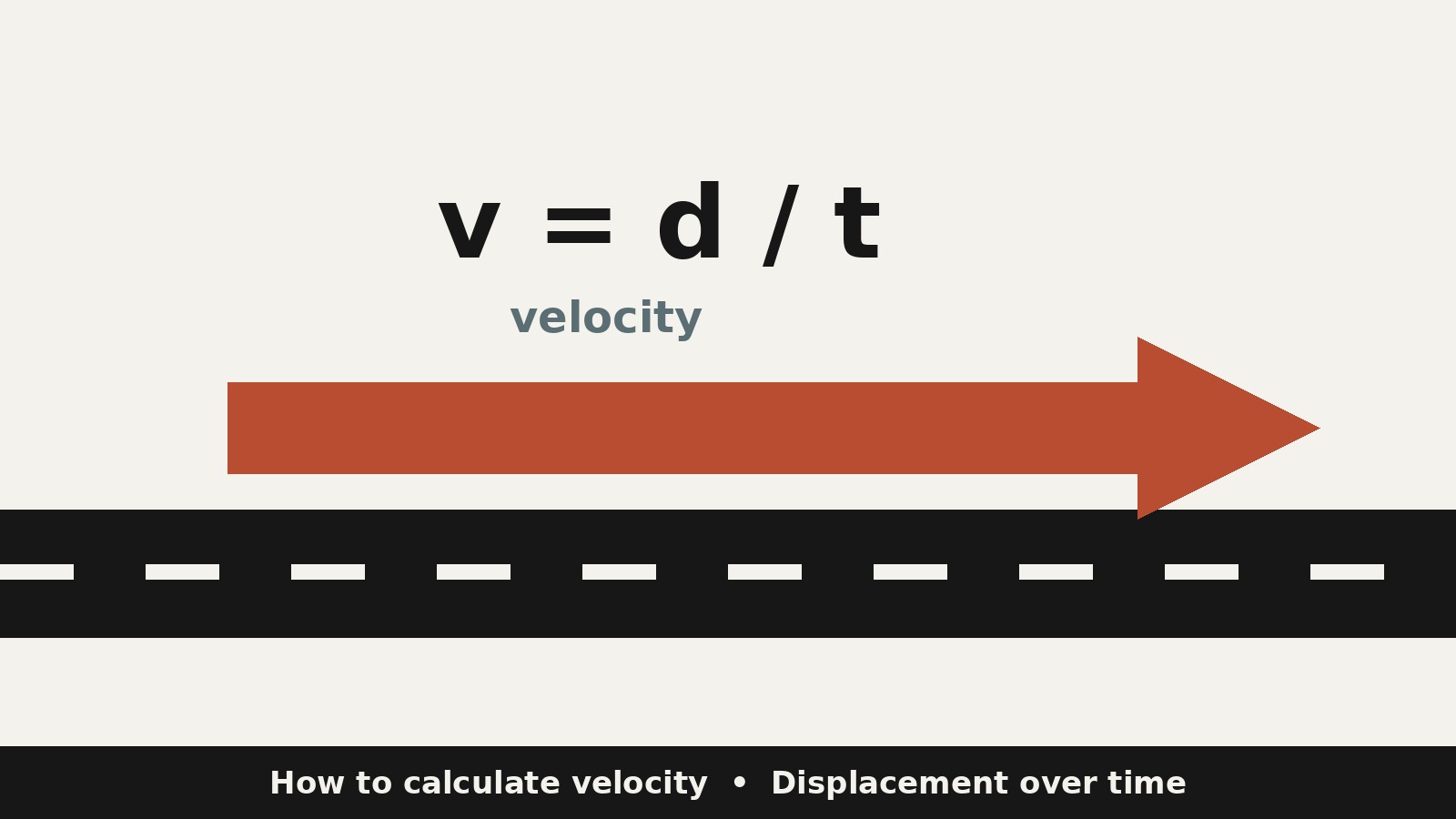
- The core formula is average velocity equals displacement divided by elapsed time: v = Δx / Δt. Displacement is the change in position, final position minus initial position, with direction included. Elapsed time is final time minus initial time.
- Velocity is a vector. A complete answer gives a magnitude, a unit, and a direction or sign, for example 8 meters per second east, or negative 4 meters per second where east is positive.
- Speed is not the same as velocity. Average speed equals total distance divided by elapsed time. Distance counts every meter of the path; displacement counts only the straight line change from start to finish.
- Instantaneous velocity is the velocity at one moment: v(t) = dx/dt, the derivative of position with respect to time, or the slope of the tangent line on a position versus time graph.
- Under constant acceleration, final velocity follows v = v0 + at. If time is unknown but displacement is known, use v squared = v0 squared + 2aΔx.
- The SI unit of velocity is meters per second (m/s). To convert, 1 meter per second equals 3.6 kilometers per hour, and 1 kilometer per hour equals about 0.2778 meters per second.
Introduction
Velocity answers two questions at once: how fast is something moving, and in which direction? That second question separates velocity from speed, and it is the part most often left out of a calculation. A runner moving at 8 meters per second east and one moving at 8 meters per second west have the same speed but different velocities.
This guide covers every common way to calculate velocity: average velocity, instantaneous velocity, velocity from a graph, velocity under constant acceleration, and unit conversions. Each method comes with a worked example showing every arithmetic step. The examples are generic and instructional, showing the method rather than answers to any particular assignment.
What Velocity Means, in Plain Terms
Velocity is the rate at which position changes. OpenStax defines average velocity as displacement divided by elapsed time, and instantaneous velocity as the limit of that average as the time interval shrinks toward zero.
Three words do most of the work in this topic, and keeping them distinct prevents most errors.
Position is where an object is, measured from a chosen origin. On a straight east-west road, position might be recorded as meters east of a starting marker; a position of negative 20 meters then means 20 meters west of it.
Displacement is the change in position: final position minus initial position. It has a magnitude and a direction, and it depends only on the start and end points, not on the path between them. A cyclist who rides 60 meters east and then 60 meters back west ends where she started, so her displacement is zero even though she rode 120 meters.
Distance is the total length of the path traveled. It is always zero or positive and never carries a direction. In the cyclist example, the distance is 120 meters while the displacement is zero, which explains why average velocity and average speed can disagree sharply.
Velocity inherits the vector character of displacement. A vector quantity has both magnitude and direction; a scalar has magnitude only. Velocity is a vector and speed is a scalar, which is why a velocity answer without a direction is incomplete.
The Core Formula: Average Velocity
Average velocity over a time interval is:
v average = Δx / Δt = (x final minus x initial) / (t final minus t initial)
The symbol Δ, the Greek letter delta, means “change in.” So Δx means change in position and Δt means change in time.
Use this method in five steps:
- Choose a positive direction and state it. For motion along a line, pick one direction as positive, for example east or upward. Every sign then refers to this choice.
- Record the initial and final positions in the same unit, with signs relative to your origin and positive direction.
- Find the displacement by subtracting: final position minus initial position. Keep the sign.
- Find the elapsed time by subtracting: final time minus initial time. Elapsed time is always positive for a forward interval.
- Divide displacement by elapsed time and report the result with a unit and a direction or sign.
Worked Example 1: A Straightforward Average Velocity
A cyclist starts at a marker and rides east. After 30 seconds she is 240 meters east of the marker. What is her average velocity?
Take east as positive and set the marker as position zero: x initial = 0 meters, x final = 240 meters, t initial = 0 seconds, t final = 30 seconds.
Displacement Δx = 240 meters minus 0 meters = 240 meters. The positive sign means the displacement points east. Elapsed time Δt = 30 seconds minus 0 seconds = 30 seconds. Average velocity = 240 meters / 30 seconds = 8 meters per second east.
Worked Example 2: Why Subtracting the Start Position Matters
A runner starts at the 10 meter mark of a straight track, measured from the start line, and runs east. After 25 seconds she is at the 210 meter mark. What is her average velocity?
Displacement Δx = 210 meters minus 10 meters = 200 meters east. Elapsed time Δt = 25 seconds. Average velocity = 200 meters / 25 seconds = 8 meters per second east.
She ran 200 meters, not 210, because she started 10 meters ahead of the start line. Using the final position alone would give 8.4 meters per second, which is wrong. Always subtract the starting position first.
Worked Example 3: The Return Trip, Where Average Velocity Is Zero
A walker starts at a gate, walks 60 meters east in 10 seconds, turns around, and walks 60 meters west in 20 seconds, ending back at the gate. What are her average velocity and her average speed for the whole trip?
First, displacement. Final position equals initial position, both at the gate, so Δx = 0 meters. Elapsed time Δt = 10 seconds plus 20 seconds = 30 seconds. Average velocity = 0 meters / 30 seconds = 0 meters per second.
Second, distance. The walker covered 60 meters plus 60 meters = 120 meters of path. Average speed = 120 meters / 30 seconds = 4 meters per second.
The two answers describe the same trip differently. The average velocity of zero says her position did not change at all over the whole trip, while the average speed of 4 meters per second says she was moving at that rate along the path. A problem that asks for velocity and receives only “4 meters per second” has been given the speed, not the velocity.
Velocity vs Speed: The Full Comparison
| Quantity | Definition | Formula | Vector or scalar | Can it be negative? |
|---|---|---|---|---|
| Average velocity | Displacement per unit time | Displacement / elapsed time | Vector | Yes, when motion is in the negative direction |
| Average speed | Distance per unit time | Total distance / elapsed time | Scalar | No, it is zero or positive |
| Instantaneous velocity | Rate of change of position at one moment | dx/dt, or slope of the position versus time graph | Vector | Yes |
| Instantaneous speed | Magnitude of instantaneous velocity | Absolute value of instantaneous velocity | Scalar | No |
A useful check comes from OpenStax: particles moving at positive 7.0 and negative 7.0 meters per second along the same axis have different velocities but the same speed, 7.0 meters per second.
Average speed is not necessarily the same as the magnitude of average velocity. In the return trip example, the magnitude of average velocity is zero while the average speed is 4 meters per second. The two agree only when motion is in a single direction without turning back.
Direction and Sign Conventions
Direction can be reported in words, in signs, or in components. All three are correct, and the right choice depends on the problem.
Words. Use compass directions or everyday words: east, west, north, south, upward, downward. “12 meters per second north” is a complete velocity.
Signs. Choose a positive direction and let the sign carry the direction. If east is positive, a velocity of negative 4 meters per second means 4 meters per second west. If upward is positive, a falling object has negative velocity.
Components. For motion in two dimensions, break the velocity into parts along chosen axes, usually east and north. A velocity of 3 meters per second east and 4 meters per second north has a magnitude of 5 meters per second, since the square root of (3 squared plus 4 squared) is 5. Its direction is about 53 degrees north of east. The magnitude alone is the speed; the full component description is the velocity.
Three sign habits prevent most errors. First, write the positive direction down before calculating and do not change it halfway through. Second, give every position and velocity its correct sign, including a starting position on the negative side of the origin. Third, translate “moves in the negative direction” into a negative sign at the start, not as an afterthought.
One trap is the word “deceleration.” It is clearer to say “acceleration opposite to the velocity.” An object moving east and slowing down has a westward acceleration, negative if east is positive, while an object moving west and speeding up also has a westward acceleration even though it is getting faster. Acceleration describes the change in velocity, not whether the speedometer reading rises or falls.
Instantaneous Velocity: Velocity at One Moment
Average velocity describes an interval; instantaneous velocity describes a moment. Instantaneous velocity is what average velocity approaches as the interval around that moment shrinks toward zero. OpenStax states this as a limit and as a derivative: v(t) equals dx/dt.
You do not always need calculus to estimate an instantaneous velocity. Three practical routes cover most situations:
Route 1: Differentiate a position function. If position is given as a formula in time, differentiate it term by term. The power rule says the derivative of A times t to the power n is A times n times t to the power (n minus 1). A constant term differentiates to zero.
Route 2: Read the slope from a graph. On a position versus time graph, instantaneous velocity at a moment is the slope of the tangent line at that point. For a straight segment, the slope is the velocity throughout that segment.
Route 3: Shrink the interval. If you have position measurements at close together times, compute the average velocity over a very short interval around the moment of interest. As the interval gets shorter, the average gets closer to the instantaneous value.
Worked Example 4: Instantaneous Velocity from a Position Function
Suppose the position of a small cart on a straight track is given by x(t) = 4t + 2t squared, where x is in meters and t is in seconds. What is the instantaneous velocity at t = 3 seconds, and what is the average velocity between t = 1 second and t = 3 seconds?
Differentiate term by term. The derivative of 4t is 4. The derivative of 2t squared is 2 times 2 times t, which is 4t. So v(t) = 4 + 4t meters per second.
At t = 3 seconds: v(3) = 4 + (4 times 3) = 4 + 12 = 16 meters per second, in the positive direction.
For the average velocity, compute the positions: x(1) = (4 times 1) + (2 times 1 squared) = 6 meters; x(3) = (4 times 3) + (2 times 3 squared) = 30 meters. Displacement = 24 meters over 2 seconds, so average velocity = 24 / 2 = 12 meters per second.
The average over the interval, 12 meters per second, is lower than the instantaneous value at the end, 16 meters per second, because the cart is speeding up. As a check, the instantaneous velocity at the middle of the interval, t = 2 seconds, is v(2) = 4 + 8 = 12 meters per second, exactly the average.
Worked Example 5: Velocity from a Position Versus Time Graph
A position versus time graph records these points for a walker: at 0 seconds, position 0 meters; at 2 seconds, position 10 meters; at 5 seconds, position 10 meters; at 8 seconds, position negative 2 meters. The graph is straight between the recorded points. Find the velocity in each interval.
Interval 1, 0 to 2 seconds: slope = (10 minus 0) / (2 minus 0) = 10 / 2 = 5 meters per second, in the positive direction.
Interval 2, 2 to 5 seconds: slope = (10 minus 10) / (5 minus 2) = 0 / 3 = 0 meters per second. The walker is standing still.
Interval 3, 5 to 8 seconds: slope = (negative 2 minus 10) / (8 minus 5) = negative 12 / 3 = negative 4 meters per second.
As a check, the whole trip average velocity is negative 2 meters over 8 seconds, or negative 0.25 meters per second.
Velocity Under Constant Acceleration
Many problems involve acceleration that stays constant over the interval. Gravity near Earth’s surface is the most common example, about 9.81 meters per second squared downward when air resistance is negligible, as OpenStax notes. For constant acceleration, three equations cover most questions:
Final velocity from initial velocity, acceleration, and time: v = v0 + at.
Final velocity from initial velocity, acceleration, and displacement, when time is unknown: v squared = v0 squared + 2aΔx.
Average velocity under constant acceleration: average velocity = (v0 + v) / 2. This works only when acceleration is constant; do not use it for changing acceleration.
The subscript 0 marks the initial value. Signs matter in every term: acceleration and displacement take the sign of their directions under the chosen convention.
Worked Example 6: Final Velocity After Steady Acceleration
A car starts with a velocity of 5 meters per second east and accelerates east at 2 meters per second squared for 6 seconds. What is its final velocity?
Use v = v0 + at. Substituting: v = 5 + (2 times 6) = 5 + 12 = 17 meters per second east.
Check: average velocity = (5 + 17) / 2 = 11 meters per second, displacement = 11 times 6 = 66 meters, and 25 + (2 times 2 times 66) = 289, whose square root is 17. The two routes agree.
Worked Example 7: Final Velocity When Time Is Unknown
An object starts from rest and accelerates at 4 meters per second squared over a displacement of 50 meters. What is its final velocity?
Use v squared = v0 squared + 2aΔx. Initial velocity v0 = 0, so v squared = 0 + (2 times 4 times 50) = 400. Taking the square root gives v = 20 meters per second, in the direction of the acceleration.
Algebra gives two roots, positive 20 and negative 20; the context picks the positive one, since the object accelerates from rest in the positive direction. For a falling object with upward taken as positive, the correct root would be negative.
Worked Example 8: A Falling Object
An object is dropped from rest and falls 20 meters, with air resistance ignored and upward taken as positive. What is its velocity just before it reaches the end of the fall?
Gravity acts downward, so a = negative 9.81 meters per second squared under this convention, and displacement is also downward: Δx = negative 20 meters. Use v squared = v0 squared + 2aΔx = 0 + (2 times negative 9.81 times negative 20) = 392.4. The square root is about 19.8, so the velocity is negative 19.8 meters per second, or 19.8 meters per second downward. Its speed is 19.8 meters per second.
The two negative signs multiplied to a positive number inside the equation, which is correct: gravity and displacement point the same way. The answer ignores air resistance, which in real life would reduce the speed, especially over longer falls.
Finding Initial Velocity, Time, or Displacement by Rearranging
The same equations solve for other unknowns. Rearranging is usually safer than memorizing a separate formula for each case, because it keeps the signs visible.
To find initial velocity from final velocity, acceleration, and time, rearrange v = v0 + at to get v0 = v minus at. Example: an object ends with a velocity of 30 meters per second after accelerating at 5 meters per second squared for 4 seconds. Then v0 = 30 minus (5 times 4) = 30 minus 20 = 10 meters per second.
To find time from velocities and acceleration, use t = (v minus v0) / a. Example: an object accelerates from 10 meters per second to 25 meters per second at 3 meters per second squared. Then t = (25 minus 10) / 3 = 15 / 3 = 5 seconds.
To find displacement, use Δx = (v squared minus v0 squared) / (2a). Example: accelerating from 10 to 26 meters per second at 4 meters per second squared gives Δx = (676 minus 100) / 8 = 72 meters.
Units and Conversions
The SI unit of velocity is meters per second, written m/s: displacement in meters divided by time in seconds, the units OpenStax uses throughout its kinematics chapters.
Road speeds are usually given in kilometers per hour or miles per hour, and some engineering contexts use feet per second.
The conversions below follow from exact definitions: 1 kilometer equals 1000 meters, 1 hour equals 3600 seconds, 1 mile equals 1609.344 meters, and 1 foot equals 0.3048 meters.
| Conversion | Factor |
|---|---|
| Meters per second to kilometers per hour | Multiply by 3.6 |
| Kilometers per hour to meters per second | Multiply by 0.2778, or divide by 3.6 |
| Meters per second to miles per hour | Multiply by 2.2369 |
| Miles per hour to meters per second | Multiply by 0.44704 |
| Meters per second to feet per second | Multiply by 3.2808 |
| Feet per second to meters per second | Multiply by 0.3048 |
Why 3.6? One meter per second means 3600 meters in one hour, and 3600 meters is 3.6 kilometers. A miles per hour value converts to meters per second by multiplying by 1609.344 and dividing by 3600, which gives 0.44704.
Worked Example 9: Converting Road Speeds
Convert 72 kilometers per hour to meters per second: 72 / 3.6 = 20 meters per second (check: 20 times 3.6 = 72).
Convert 60 miles per hour to meters per second: 60 times 0.44704 = 26.8224, about 26.8 meters per second.
Convert 25 meters per second: 25 times 3.6 = 90 kilometers per hour, and 25 times 2.2369 = 55.9225, about 55.9 miles per hour. The same velocity has three different numbers, 25, 90, and 55.9, depending on the unit. Always state the unit, and convert all quantities to one consistent set of units before calculating.
Common Mistakes and How to Avoid Them
Using distance instead of displacement. If the path turns back, distance overstates displacement. Ask first whether the problem wants velocity or speed.
Using the final position instead of the change in position. If the object does not start at zero, subtract the starting position.
Dropping the direction. A velocity without a direction or sign is unfinished. Add the direction word or sign before moving on, and check that it matches the story.
Dividing by the wrong time. Elapsed time is final time minus initial time, and for average velocity it includes pauses.
Using the constant acceleration average formula when acceleration changes. The formula (v0 + v) / 2 holds only for constant acceleration. Otherwise, use displacement divided by elapsed time, or the position function.
Forgetting the square root, or taking the wrong root. In v squared = v0 squared + 2aΔx, the unknown is v squared, so take the square root to find v, and choose the sign from the direction of motion.
Mixing units. Convert kilometers to meters, hours to seconds, and miles to meters before dividing. A quick unit check often catches this: meters divided by hours does not give meters per second.
Confusing a negative velocity with slowing down. A negative velocity means motion in the negative direction. Speeding up or slowing down depends on whether velocity and acceleration point the same way or opposite ways.
Reporting too many digits. If positions were measured to the nearest meter and times to the nearest second, two or three significant figures are usually honest. Work through any formula in the order of operations, parentheses and exponents before multiplication and division, and addition and subtraction last, before rounding the result.
A Five Step Checklist for Any Velocity Problem
- Name the unknown. Average velocity, instantaneous velocity, speed, or a component? Decide before choosing a formula.
- Fix the convention. State the positive direction and the origin, and convert all quantities to consistent units.
- List what is known. Positions, times, initial velocity, acceleration, displacement: each with its sign and unit.
- Pick the formula that uses what is known. Displacement and time point to average velocity; a position function points to differentiation; constant acceleration with time points to v = v0 + at, and without time to v squared = v0 squared + 2aΔx.
- Check the answer. Does the sign match the direction? Does the magnitude look plausible? Does going backward through the calculation reproduce the inputs?
FAQ
How do you calculate velocity in simple terms?
Divide the change in position by the time taken, and include the direction. If an object moves 100 meters east in 10 seconds, its average velocity is 10 meters per second east. If it returns to its starting point, its average velocity for the whole trip is zero.
How do you find velocity if you only know speed?
You cannot recover velocity from speed alone, because speed has no direction. You need the direction of motion as well: 15 meters per second north is a velocity, while 15 meters per second alone is only a speed.
What is the difference between velocity and speed?
Velocity is a vector with magnitude and direction; speed is a scalar with magnitude only. Average velocity equals displacement divided by elapsed time, while average speed equals total distance divided by elapsed time. They agree when motion is in one direction without turning back.
Can velocity be zero while speed is not zero?
Yes, in two senses. Over an interval, average velocity is zero whenever displacement is zero, as in a return trip, even though the object moved throughout and its average speed is positive. At an instant, instantaneous velocity is zero at a turning point, the moment when an object reverses direction.
Can velocity be negative?
Yes. A negative velocity means motion in the direction chosen as negative. If east is positive, 4 meters per second west is written as negative 4 meters per second. It does not mean the object is slowing down.
How do you calculate instantaneous velocity without calculus?
Read the slope of a position versus time graph at the moment of interest, or compute the average velocity over a very short interval around that moment. For a straight graph segment, the slope is the instantaneous velocity throughout the segment.
What is the formula for velocity with acceleration?
Under constant acceleration, final velocity equals initial velocity plus acceleration times time: v = v0 + at. If time is not known, use v squared = v0 squared + 2aΔx, where Δx is displacement. Neither formula applies when acceleration changes during the interval.
How do you convert velocity between units?
Multiply by the conversion factor for the target unit. Meters per second to kilometers per hour uses 3.6; kilometers per hour to meters per second divides by 3.6; meters per second to miles per hour uses 2.2369; miles per hour to meters per second uses 0.44704; feet per second to meters per second uses 0.3048. Convert every quantity to one unit system before calculating.
Why does direction matter so much in velocity problems?
Because velocity describes where an object is heading, not just how fast it is going. Two objects with the same speed but opposite directions have different velocities and will end up in different places. A wind speed without a wind direction cannot tell anyone which way rain will travel.
Sources & references
- OpenStax, University Physics Volume 1, Section 3.2, "Instantaneous Velocity and Speed": definition of instantaneous velocity as the limit of average velocity and as the derivative of position with respect to time; average speed as total distance divided by elapsed time; instantaneous speed as the magnitude of instantaneous velocity; worked examples of velocity from a position function and from a position versus time graph.
- OpenStax, University Physics Volume 1, Chapter 3 Summary: average velocity defined as displacement divided by elapsed time; displacement as change in position with direction; distance traveled as total path length; instantaneous velocity as a vector that can be negative; slope of a position versus time graph giving instantaneous velocity; acceleration due to gravity averaging 9.81 meters per second squared near Earth's surface.
- Unit conversion factors in this article are arithmetic derivations from exact definitions (1 kilometer = 1000 meters, 1 hour = 3600 seconds, 1 mile = 1609.344 meters, 1 foot = 0.3048 meters) and were checked by round trip calculation in the worked examples, not copied from an unverified table. Khan Academy velocity and speed material was consulted only through search result summaries and is therefore not listed as an opened source; no Khan Academy claim is relied on that OpenStax does not independently support.


