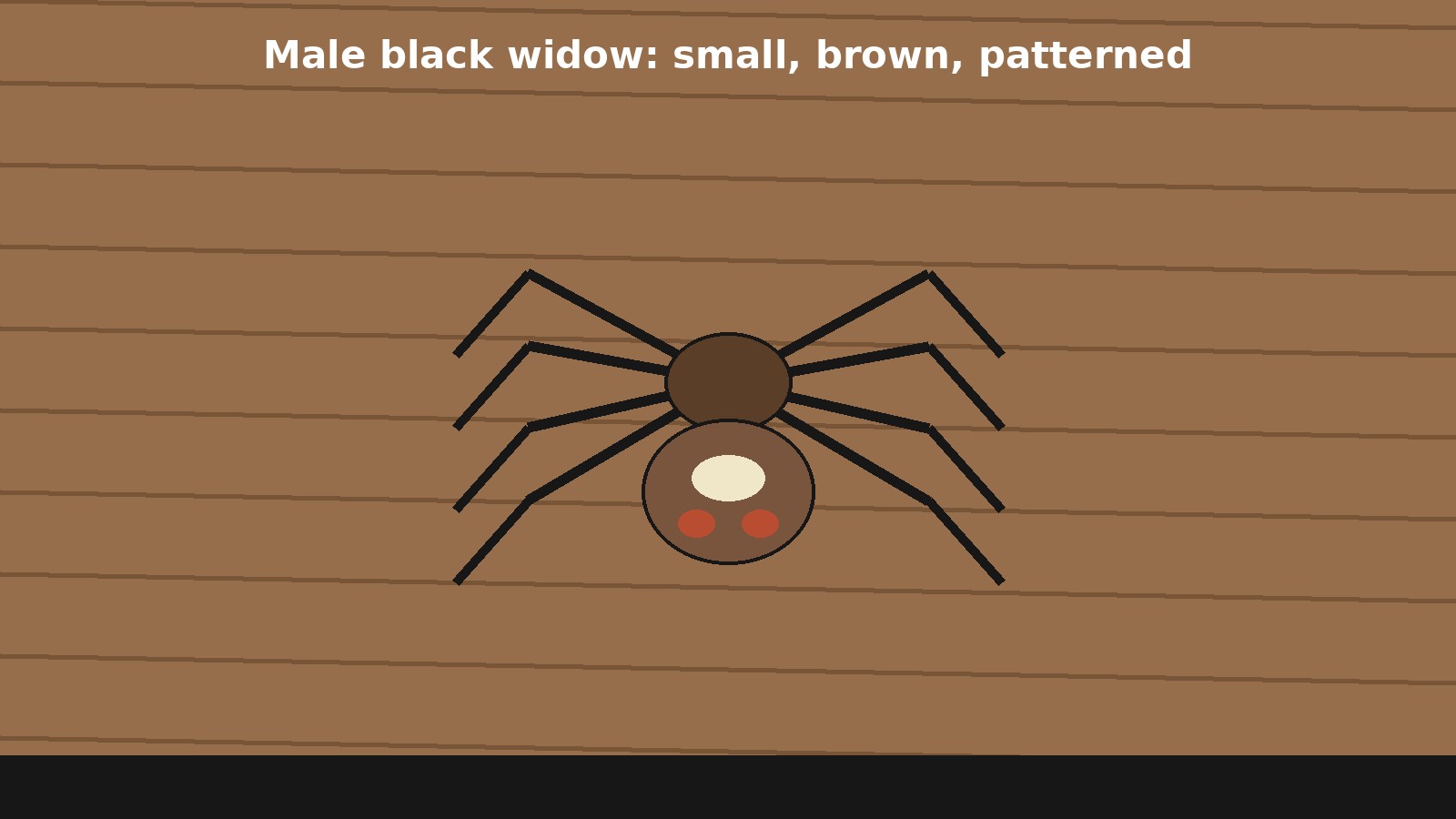
What a male black widow looks like
Like all spiders, a black widow has two main body sections: a front section called the cephalothorax, which carries the legs and mouthparts, and a rear abdomen, which carries the silk glands and reproductive organs. Like all spiders, it has eight legs. The male follows that plan in very different proportions from the female.
An adult male has a small, elongated abdomen rather than the large, round, almost spherical abdomen of an adult female. His legs are long in proportion to his body, giving him a leggy, delicate look. His color is usually brown, gray, or tan rather than glossy black. On the upper side of the abdomen he commonly carries cream or white areas, pale diagonal bands, and small red, orange, or yellow spots.
The underside is a second clue. The female is famous for a red hourglass on the underside of her abdomen, although even in females that mark can vary or split into two marks. In the male, the University of California IPM program describes the underside hourglass mark as typically yellow or yellow-orange and broad in the middle. A male may carry a version of the hourglass shape, but it is usually not the bright red, sharply defined mark people expect.
Adult males also carry one feature that juveniles and females do not share in the same form: enlarged pedipalps. Pedipalps are the pair of short, leg like appendages beside the mouthparts. In an adult male spider they are swollen at the tip into bulb like structures used to transfer sperm. If you can see those swollen tips on a small, patterned widow, you are looking at an adult male, not a juvenile. That detail separates adult males from young females that otherwise look very similar.
Size is the fastest field clue, but it must be used with care, because size varies by species and published numbers do not all agree. Body length here means the body only, not the legs.
| Species and source | Adult male body length | Adult female body length |
|---|---|---|
| Western black widow, University of California IPM program | One half to two thirds of the female | Body excluding legs 5/16 to 5/8 inch |
| Western black widow, Montana State University | About 1/3 inch (about 8 mm) | About 1/2 inch (about 13 mm) |
| Southern black widow, Washington State University | About 1/8 inch (3 to 4 mm) | About 3/8 inch (8 to 10 mm) |
| Northern black widow, Encyclopedia of Life summary | 5.5 to 6 mm | About 9 to 11 mm |
The pattern is consistent even when the numbers differ: the male is roughly half the female or less.
Male vs female black widow at a glance
| Feature | Adult male | Adult female |
|---|---|---|
| Body size | Much smaller, roughly one half of the female or less | Larger, with a large round abdomen |
| Body shape | Narrow, elongated abdomen | Large, rounded, almost spherical abdomen |
| Color | Brown, gray, or tan, with pale and reddish markings | Usually shiny black, sometimes very dark brown |
| Upper abdomen pattern | Cream, white, yellow, or red spots and bands | Usually plain black, sometimes with red spots in northern species |
| Underside hourglass | Often yellow or yellow-orange, broad in the middle | Usually red, sometimes split into two marks in northern species |
| Legs | Long in proportion to the body | Long and slender, but less leggy in proportion |
| Pedipalps | Swollen at the tip in adults | Not swollen in this way |
| Web | No large permanent prey catching web as an adult | Builds a strong, irregular, tangled cobweb and stays with it |
| Behavior | Wanders to find females | Stays at or near her web, guarding egg sacs when present |
| Medical importance | Not regarded as medically important | Medically significant; needs prompt medical attention |
That last row needs careful wording. Some extension pages state bluntly that males do not bite. Other sources are more careful, noting that a few male widow bites have been reported but that only females are considered dangerous. The safest summary is the careful one: male black widows are not regarded as a medical danger to people, and the female is the medically significant sex. That is different from claiming that a male can never bite, or that it has no venom at all.
Why males look so different
Biologists call a large, visible difference between the sexes of one species sexual dimorphism, and black widows show it in an extreme form. The female and male are not simply large and small versions of the same spider. They have different jobs, and their bodies reflect those jobs.
The female is built to stay put, catch prey, and produce eggs. A large abdomen holds silk glands, a gut that can process large meals, and reproductive organs that can produce several egg sacs. The male is built to travel and to mate. A smaller, lighter body with longer legs is easier to move across ground, vegetation, and other spiders webs. He does not need a large abdomen for egg production. He needs to find a female, survive the approach, transfer sperm, and in some species, survive to find another female.
Young spiders of both sexes start out pale and patterned, often white, yellow, or orange with darker markings, and they change pattern with each molt, the shedding of the exoskeleton that lets a spider grow. Young females gradually acquire the dark adult coloring. Males keep much of the patterned look into adulthood. That is why a young female and an adult male can look confusingly alike, and why size and pedipalps, not color alone, are the better checks.
How to tell a male from a juvenile female, and from lookalikes
Identification is a combination of size, shape, pattern, pedipalps, and context. Use this checklist in order.
First, check the abdomen shape. A narrow, elongated abdomen points toward a male or a juvenile. A large, round, swollen abdomen points toward an adult female, especially if the spider is glossy black. Second, check the pedipalps. Swollen, bulb like tips mark an adult male. A juvenile of either sex will not show that form, and a female of any age will not show it either. Third, check color and pattern together, not alone. Brown, gray, or tan with cream or white bands and small red or orange spots fits a male well, but a juvenile female can show the same palette.
Fourth, check context. Is the spider wandering in the open, on the ground, on a wall, or on vegetation, away from a large tangled web? That fits an adult male searching for a mate. Is it sitting in a strong, irregular cobweb, hanging upside down, with a retreat to one side and possibly an egg sac nearby? That fits an adult female. A male may be found on or near a female web during courtship, but he is a visitor, not the owner of the large web.
Fifth, check the underside only if you can do so safely, without handling the spider. A red hourglass strongly suggests a female. A yellow or yellow-orange, broader mark on a small patterned spider fits a male of the western species. Do not pick up a spider to see its underside. That is exactly how defensive bites happen. A photograph from a safe distance is better than handling.
The most common lookalikes are false widows, spiders in the genus Steatoda. False widows belong to the same family, Theridiidae, the cobweb spiders, and they can look superficially similar, especially the dark, round bodied females. They are generally considered much less harmful to people than true black widows, but they deserve their own identification guide. A small brown patterned spider is not automatically a male black widow. When the features do not line up, the honest answer is that the spider is unidentified.
The three black widow species most readers mean
In the United States, “black widow” usually means one of three native species. Their males share the general pattern above, but their details differ, and that is another reason published sizes and markings seem to contradict each other.
The southern black widow, Latrodectus mactans, is the classic black widow of the southeastern and southern United States, ranging as far north as New York and west into Texas, Oklahoma, and Kansas, with populations also in California and the desert Southwest. Its female is glossy black with a connected red hourglass underneath. Its male is small and brownish, with red and white markings.
The northern black widow, Latrodectus variolus, ranges across the eastern United States from northern Florida to southeastern Canada, and is most common in the northern part of that range. Its female differs in a useful way: the underside red mark is usually split into two separate triangles or spots rather than one connected hourglass, and she often carries a row of red spots along the top of the abdomen. Its male is described in the Encyclopedia of Life summary as 5.5 to 6 mm long, with a red-orange stripe bordered by white down the middle of the upper abdomen and several pairs of diagonal white stripes along the sides.
The western black widow, Latrodectus hesperus, ranges from west Texas, Oklahoma, and Kansas westward through the Pacific coast states and into adjacent Canadian provinces. Its female is black with a red hourglass underneath. Its male, as described by the University of California IPM program, is one half to two thirds the length of the female, with a greenish gray upper abdomen patterned with cream colored areas and a light band down the middle, banded legs, and a yellow or yellow-orange underside mark.
From egg sac to wandering adult
A male life begins the same way a female life does, in an egg sac guarded by the mother. The female produces several egg sacs in her lifetime. The University of California IPM program describes the sacs as mostly spherical, about 1/2 inch long and 5/8 inch in diameter, creamy yellow to light tan, opaque, and tough and paperlike on the surface. A single sac can contain hundreds of eggs, commonly reported in the range of 100 to 400 per sac, and a female may produce four to nine sacs in a summer season according to several summaries. Only a fraction of the spiderlings that hatch survive. They may feed on each other inside the sac, and after they disperse, by walking or by ballooning on silk threads in the wind, most face predators, starvation, and harsh weather.
Males generally mature faster than females, reaching adulthood in roughly two to five months in the western species summary from BugGuide, with the exact time depending on temperature and food. Once mature, the male stops building a large prey catching web of his own, and his remaining life is measured in weeks to a few months, not years. BugGuide summarizes the western male post maturity life as about one to two months. Other summaries give a total male lifespan of about three to four months, against one to three years for females, with the University of California IPM program giving a female lifetime of up to two years. The contrast does not vary: the male adult life is short, and the female adult life is long. A male cannot afford to wait. He must find females quickly, while exposed to predators and other males.
Courtship: the sperm web, pheromones, and rival trails
Before a male can mate, he must prepare. A mature male spins a small sperm web, deposits a drop of sperm onto it, and then draws the sperm up into the bulb like tips of his pedipalps. Those charged pedipalps are the delivery tools he will use at mating, inserting a bulb into the female reproductive opening to transfer sperm.
Finding a female begins with chemistry. Female black widows release pheromones, chemical signals, on their silk. A wandering male follows those signals to a female web. He does not simply rush in. He courts, vibrating the web in patterns that signal that he is a mate, not prey. Courtship in black widows can last for hours. A male that misreads the signals, or that arrives when the female is hungry or unreceptive, risks being treated as food.
Research from the University of Toronto Scarborough, reported by EurekAlert, adds a surprising twist. Male western black widows do not only follow female pheromones. They also follow silk trails left by rival males, using them as highways that lead rapidly to a female web, even when they cannot smell the female themselves. The researchers had expected males to avoid rival trails, because competition is fierce. Instead, they found that males follow rather than avoid rivals, apparently because speed matters more than avoiding a contest. If courtship lasts for hours, a male that arrives second may still win a chance to mate.
The same study gives a stark measure of how risky the search is: only about 12 percent of males survive mate searching. That figure comes from field tracking of hundreds of male western black widows on a Vancouver Island beach, and it should not be generalized to every species or habitat as an exact survival rate. But it captures the scale of the risk.
The cannibalism question: myth, variation, and evidence
No part of black widow biology is more famous, or more oversimplified, than the name itself. “Widow” suggests a female that always kills her mate after mating. The reality varies by species, by circumstance, and by whether the observation comes from the wild or from captivity.
Sexual cannibalism, the female eating the male during or after mating, has definitely been observed in black widows. But in the western black widow, Latrodectus hesperus, the behavior is described as rare in the wild, and males of that species may breed several times during their short lives. In captivity, where a male cannot escape, cannibalism is more likely, because the normal escape route is blocked. A laboratory result does not automatically describe a wild result.
Other widow species show a different pattern. In the Australian redback, Latrodectus hasseltii, and in the brown widow, Latrodectus geometricus, males typically facilitate cannibalism and mate only once, according to a 2016 study in Biology Letters on cannibalistic widow spiders. In those species, the single mating may still pay off if it ensures paternity or provides nutrients for egg production.
The southern black widow adds a third pattern. A 1985 study by Breene and Sweet at Texas A and M University, published in the Journal of Arachnology, showed in laboratory matings that Latrodectus mactans males were capable of successfully inseminating at least three females, and that the tip of the male copulatory organ was not required for sperm transfer. The study also described an escape mechanism in which the male may spatially disorient the female in her web during courtship and mating. At least in this species, under laboratory conditions, males are not limited to one mating, and they have behaviors that help them escape.
A related male tactic, also described in the 2016 Biology Letters study, is mating with immature females. In some cannibalistic widows, males can copulate with final stage immature females by piercing the exoskeleton to reach newly developed sperm storage organs. Females retain the sperm through their final molt and show similar fecundity to females mated as adults. For the male, this tactic increases insemination success compared with adult mating, where cannibalism is a greater risk.
Venom and bite risk: why the female is the medical concern
All black widows produce venom, because venom is how these spiders subdue prey. The medical question is narrower: does a bite from a male pose a danger to people, and how does that compare with a bite from a female?
The female answer is well established. Female black widow venom contains a neurotoxin called alpha-latrotoxin, which affects the nervous system and the muscles it controls. The Defense Centers for Public Health at Aberdeen describes the bite as producing pain at the bite site that spreads to the chest, abdomen, or the whole body, with muscle and chest pain or tightness as the most common reactions, and cramping and nausea as the pain spreads to the abdomen. MedlinePlus, the U.S. National Library of Medicine consumer health service, lists a similar pattern: an initial pinprick pain, sometimes unfelt, followed after 15 minutes to an hour by dull muscle pain spreading from the bite area, with chest pain more common if the bite is on the upper body and abdominal pain more common if the bite is on the lower body, plus symptoms that can include anxiety, difficulty breathing, headache, high blood pressure, increased sweating and saliva, muscle cramps and rigidity, nausea and vomiting, numbness, and restlessness. In severe cases, the Aberdeen summary notes breathing and speech difficulty, heart irregularities, and, rarely, death from suffocation. Antivenom is available for bites of the southern black widow, according to the same summary.
The male answer is different in kind, not just in degree. The Defense Centers for Public Health summary states directly that male widow spiders are not venomous and therefore not medically important. That wording is a simplification, and it should be read alongside the more careful wording from the Alabama Cooperative Extension System, which notes that generally only females are considered dangerous, although a few male widow spider bites have been reported. The extension wording is the better guide, because it preserves the practical conclusion, do not treat a male as a medical emergency on the same basis as a female, without overstating the biology into an absolute claim that males cannot bite or have no venom.
Why would a male bite be less dangerous even if it happens? Size is part of the answer. A male has much smaller venom glands and smaller fangs than a female, and several summaries note that male fangs may be too small to penetrate human skin effectively. Dose is another part. Behavior is a third part. Males are wandering searchers, not web defenders guarding egg sacs, and they are described across sources as timid and more likely to escape than to bite. A female guarding an egg sac, or a female trapped against skin in clothing or a woodpile, is in a defensive situation that a wandering male is not.
None of that means a male should be handled. It means that identification changes the risk assessment. If a bite of any kind is suspected, official guidance is to seek medical attention promptly, as described in the next section.
Where males are found, and what to do if you find one
Female black widows are homebodies. They build strong, irregular, tangled cobwebs in dark, undisturbed, low places: woodpiles, under stones, in hollow stumps, in rodent burrows, in sheds, garages, and privies outdoors, and in cluttered basements and crawl spaces indoors. They hang upside down in the web, often in a retreat to one side, and they stay there.
Males do not fit that picture, because adult males do not maintain a large prey catching web. A wandering male may be found almost anywhere a female might be, plus the ground in between: on the ground, on vegetation, on walls, in garages, and occasionally indoors, especially during the mating season when males are actively searching. A male in a house does not necessarily mean a web in the house. It may mean a male passing through on his way to a female elsewhere.
This section describes general information from official and university sources. It is not personal medical advice, and it does not replace professional guidance after a bite. For a spider that has not bitten anyone, the consistent advice is simple: leave it alone, do not handle it, and reduce the chance of accidental contact. The Defense Centers for Public Health summary recommends inspecting and shaking out clothing and shoes before getting dressed in areas where widows are prevalent, and wearing gloves, a long sleeved shirt, long pants, and boots when working in areas where widows may live. The U.S. Occupational Safety and Health Administration fact sheet gives the same protective clothing advice for handling boxes, firewood, lumber, and rocks.
For a suspected bite, official sources are consistent about seeking help promptly. MedlinePlus states that black widow bites are very toxic, that medical help should be sought right away, and that the Poison Control Center should be called for guidance, giving the U.S. number 1-800-222-1222. MedlinePlus also lists steps to follow until medical help is given: clean the area with soap and water, wrap ice in a clean cloth and place it on the bite area for 10 minutes and then off for 10 minutes and repeat, keep the affected area still if possible, and loosen clothing and remove rings and other tight jewelry. The Occupational Safety and Health Administration fact sheet similarly lists cleaning the bite area with soap and water, applying ice to slow absorption, elevating and immobilizing the extremity, capturing the spider if at all possible for identification, and seeking medical attention immediately. None of those steps should be read as a reason to delay seeking care, and none of them involves handling a live spider with bare hands. If you want an identification, a photograph from a safe distance is the safest tool.
Frequently asked questions
What does a male black widow spider look like? A male is small, usually brown, gray, or tan, with a narrow, elongated abdomen, long legs in proportion to his body, and cream, white, yellow, or red spots and bands on the upper abdomen. His underside mark, when present, is often yellow or yellow-orange rather than bright red, and adult males have swollen tips on their pedipalps.
How big is a male black widow? It depends on species. The western male is one half to two thirds the length of the female, about 8 mm against a female of about 13 mm in the Montana State summary. The northern male is about 5.5 to 6 mm against a female of 9 to 11 mm. The southern male is given as about 3 to 4 mm in the Washington State summary, against a female of 8 to 10 mm. Body length excludes legs.
Are male black widows dangerous? Males are not regarded as medically important, and their bites are not considered dangerous to people in the way female bites are. A few male bites have been reported, so the careful wording is “not considered dangerous” rather than “cannot bite.” The female is the medically significant sex.
Do female black widows always eat the male after mating? No. In the western black widow it is rare in the wild, and males may mate several times. In the Australian redback and the brown widow, males typically mate only once and facilitate cannibalism. In the southern black widow, laboratory work shows males can inseminate multiple females. Captivity, where a male cannot escape, increases cannibalism compared with the wild.
Keep reading: How Many Legs Does a Spider Have? Eight, and How They Work
Keep reading: The Sydney Funnel-Web Spider, Explained
Sources & references
- University of California Statewide IPM Program, "Black Widow Spider" (grape pest management guidelines): female and male description, male one half to two thirds of female length, male upper abdomen pattern and yellow or yellow-orange underside mark, egg sac description, female lifetime up to two years.
- Washington State University, Department of Entomology, "Black Widow": male about 1/8 inch (3 to 4 mm), female about 3/8 inch (8 to 10 mm), male elongated abdomen with white and red markings, male legs long in proportion, egg sac size, female rarely leaves web.
- Montana State University, Urban IPM, "Black Widow": western female about 1/2 inch (13 mm), male about 1/3 inch (8 mm), male lighter brown with white stripes, venom neurotoxin alpha-latrotoxin, timid behavior, seek medical attention for suspected bite.
- Alabama Cooperative Extension System, "Black Widow and Recluses: Avoiding Venomous Spiders of the Southeast": male usually half female size or less, brown with red, white, and yellow bands and spots, generally only females considered dangerous although a few male bites reported, female lays eggs in silken sac.
- Defense Centers for Public Health, Aberdeen, "Widow Spiders": male about half female size, elongated abdomen and long legs, male not medically important, species ranges, bite pain pattern, antivenom for southern black widow, protective clothing and shaking out clothing advice.
- MedlinePlus, U.S. National Library of Medicine, "Black widow spider": bite symptoms and timing, chest versus abdominal pain pattern, home care steps listed until medical help is given, Poison Control number 1-800-222-1222.
- U.S. Occupational Safety and Health Administration, "Black Widow Spider" fact sheet: female identification, symptoms and duration, protective clothing, bite area cleaning, ice, elevation and immobilization, capturing spider for identification, seeking medical attention immediately.
- Arizona-Sonora Desert Museum, "Black Widow Spider" (Latrodectus hesperus): female 1/4 to 3/4 inch body length, male less than half female size, medium brown with cream markings, distribution and habitat around man-made structures.
- Encyclopedia of Life, "Northern Black Widow articles": female 9 to 11 mm, male 5.5 to 6 mm, male red-orange dorsal stripe bordered by white with diagonal white side stripes, young females similar to males, irregular web and egg sac description.
- University of Toronto Scarborough study, reported by EurekAlert, "Male black widows piggyback on work of rivals in a desperate attempt to find a mate": males follow rival silk trails, courtship can last hours, only about 12 percent of males survive mate searching, field tracking on Vancouver Island.
- Breene, R. G. and Sweet, M. H. (1985), "Evidence of Insemination of Multiple Females by the Male Black Widow Spider, Latrodectus mactans," Journal of Arachnology 13: 331-335: laboratory males inseminated at least three females, embolus tip not required for sperm transfer, escape mechanism described.
- Biaggio, M. D. et al. (2016), "Copulation with immature females increases male fitness in cannibalistic widow spiders," Biology Letters 12: 20160516: in L. hasselti and L. geometricus males typically facilitate cannibalism and mate only once, immature mating tactic and sperm retention through final molt. Cited via the published record summarized in research listings; no URL is given for this journal record in the article text to avoid an unverified link.


