Short answer
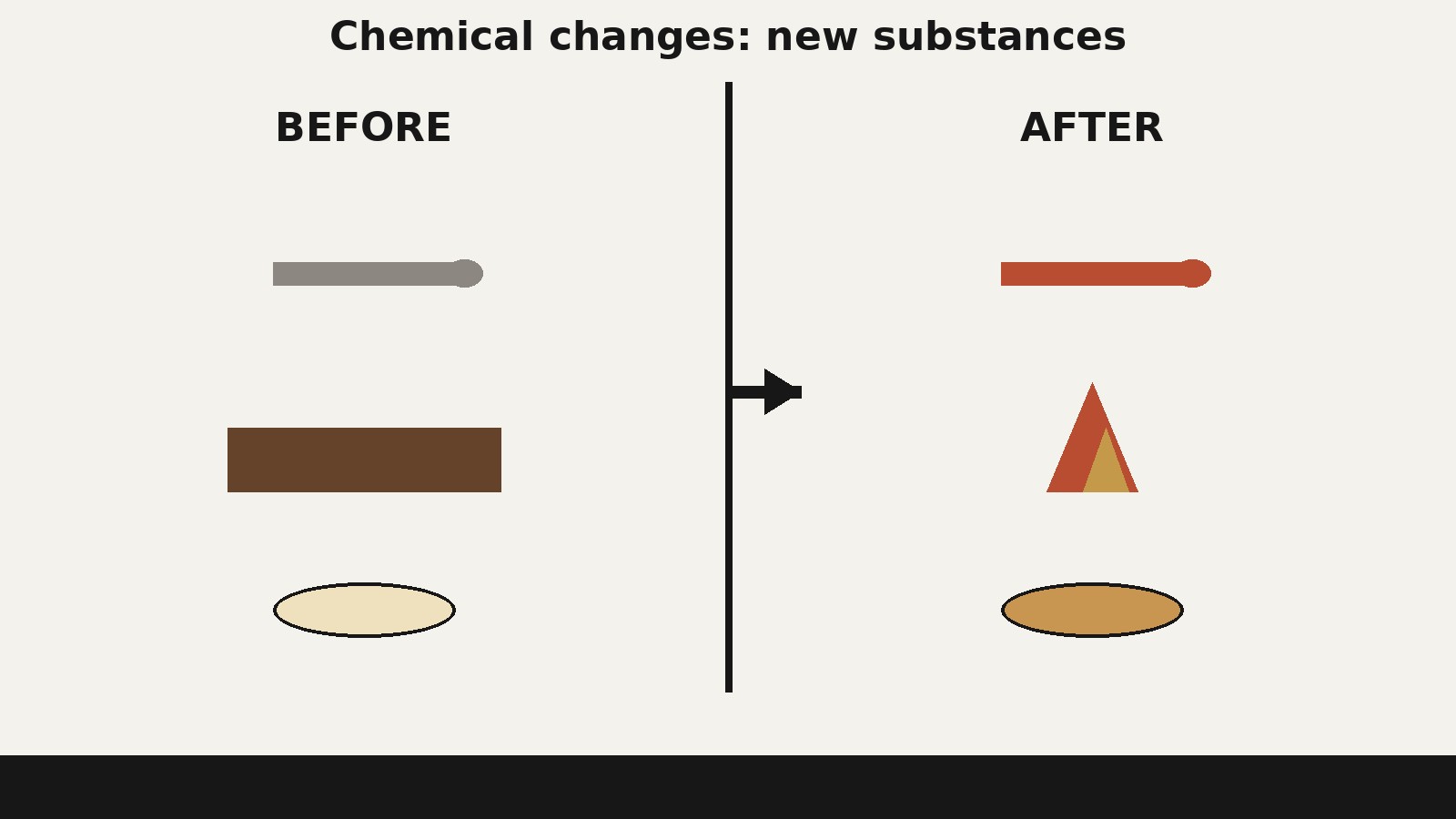
- A chemical change is a change in which one or more new substances are formed because atoms or ions are rearranged. The starting materials, called reactants, are turned into different products with different properties. Burning wood, rusting iron, baking a cake, and digesting food are all chemical changes. Melting ice, tearing paper, and dissolving sugar in water are not: in those cases the substance itself stays the same, even though its appearance changes. The single test that matters is whether a new substance appears. Color change, fizzing, heat, or a new smell are useful clues, but none of them proves a chemical change on its own. --- A nail left out in the rain turns orange and flaky. A log in a fireplace turns to ash, smoke, and heat. Bread dough goes into the oven and comes out as something that no longer tastes, smells, or behaves like dough. These everyday events share one deep feature: the stuff you end up with is not the stuff you started with.
What a Chemical Change Is
The Royal Society of Chemistry (RSC) defines a chemical change, for teaching purposes, as a change that occurs “when atoms (or ions) in reactants are rearranged to form new substances.” Three parts of that sentence deserve attention. First, the change happens at the level of atoms and ions, the tiny particles that make up matter. You cannot see atoms rearranging, but you can see the results: a new color, a gas, a solid appearing in a liquid, or heat coming off a reaction. Second, the starting materials are called reactants, and the materials produced are called products. Third, and most important, the products are new substances with different properties from the reactants. Iron is a strong, shiny metal. Rust is a brittle, reddish brown powder that cannot hold up a bridge. That difference in properties is the visible evidence that the substance itself has changed, not just its shape.
A chemical change is also called a chemical reaction. The two phrases mean the same thing in most school and general science writing: a chemical reaction is the process, and a chemical change is the result.
Chemical Changes vs Physical Changes
A physical change alters the form or appearance of a substance without changing its chemical identity. An introductory chemistry text from the University of Illinois at Chicago, published through LibreTexts, puts it plainly: changes in outward appearance that do not alter the chemical nature of a substance and make no new substance are called physical changes, while a chemical change has occurred when the chemical composition of the material changes and a new substance is produced.
| Physical change | Chemical change | |
|---|---|---|
| What changes | Form, state, size, or shape | Chemical composition and identity |
| New substance? | No | Yes |
| Atoms rearranged into new substances? | No | Yes |
| Easy to reverse? | Often yes, but not always | Often no, but not always |
| Examples | Melting ice, tearing paper, crushing a can, dissolving sugar | Burning wood, rusting iron, baking bread, souring milk |
Two cautions belong with this table. First, “reversible” is a clue, not a rule: you cannot easily uncrush a can, even though no new substance formed, and some chemical changes can be reversed under the right conditions. Reversibility alone never settles the question. The identity test does: ask whether a new substance is present at the end. Second, energy changes do not decide the question either. Melting ice absorbs heat and freezing water releases it, yet both are physical changes. The proof is the new substances: carbon dioxide, water, and ash where wood used to be.
A good habit is to ask three questions about any change. What did you start with? What do you have at the end? Could you get the starting material back by a simple physical step, such as cooling, filtering, or evaporating? If not, and the end material has different chemical properties, you are almost certainly looking at a chemical change.
What Happens to Atoms in a Chemical Change
At the particle level, a chemical change is a rearrangement. Chemical bonds between atoms break, atoms move into new groupings, and new bonds form. The atoms themselves do not change: an iron atom stays an iron atom, and an oxygen atom stays an oxygen atom. What changes is which atoms are bonded to which.
A simple example makes this concrete. Pure carbon, smashed into powder, is still carbon: a physical change. But if pure carbon is heated in the presence of oxygen, the carbon slowly disappears, often in flames, and its atoms now appear in a compound with oxygen: carbon dioxide, CO2. Carbon is a black solid. Carbon dioxide is a colorless gas. The LibreTexts text uses this pair to show why composition, not appearance, is the test.
This rearrangement idea also explains how chemical equations work. An equation lists the reactants on the left of an arrow and the products on the right. Coefficients, the numbers in front of formulas, tell how many units of each substance take part. Consider the burning of methane, the main component of natural gas:
CH4 + 2O2 → CO2 + 2H2O
One methane molecule reacts with two oxygen molecules to make one carbon dioxide molecule and two water molecules. Count the atoms on each side: one carbon, four hydrogen, and four oxygen atoms on the left, and the same numbers on the right. The atoms are rearranged, not created or destroyed. That bookkeeping rule is called the law of conservation of mass, and it is why equations must be balanced. You may change the coefficients to balance an equation, but you may not change the subscripts inside a formula, because that would change the identity of the substance itself.
Five Signs of a Chemical Change
Chemical changes can almost always be detected with the senses, according to the LibreTexts text: look for heat or light, the evolution of a gas, a change in color, or the formation of new solid products from otherwise clear solutions. The RSC gives a similar list: chemical changes are often accompanied by alterations in physical appearance or color, the production of a gas, light, heat, or a cooling effect. Together these give five practical signs:
- Color change. A new color appears that was not there before, such as rust on iron or a cut apple browning in air.
- Gas produced. Bubbles or fizzing appear, such as the fizz when vinegar meets baking soda or the gas that raises bread dough.
- Heat or light given out or taken in. A flame, a glow, warming, or unexpected cooling can signal a reaction. Magnesium burning in air, for example, gives a bright white flame and turns shiny metal into a crumbly white powder, magnesium oxide.
- A new solid forms in a liquid. A precipitate, a solid that appears in a solution, is strong evidence. The RSC describes a classroom demonstration in which two white powders, potassium iodide and lead nitrate, are mixed and at once produce a bright yellow solid, lead iodide. The yellow solid was not present before mixing, so a new substance must have formed.
- A new smell or taste. Souring milk, rotting fruit, and fermenting dough all announce themselves by smell, because new substances with their own odors have formed.
The warning that matters most is that these signs are clues, not proofs. Each one can also occur in a physical change. Boiling water makes bubbles, but the bubbles are water vapor, not a new substance. Dissolving a colored solid in water changes the color of the liquid, but the solid itself is unchanged. A sign raises suspicion. The identity test confirms it: is there a new substance with different properties?
Everyday Examples, Worked Through
Rusting iron
Iron reacts with oxygen and water from its surroundings to form rust, a reddish brown material that flakes and weakens the metal. In simplified form:
4Fe + 3O2 → 2Fe2O3
Real rust is more complicated than this equation suggests: it is a hydrated form of iron(III) oxide, meaning water is bound into its structure, and the full process needs both oxygen and moisture. That is why a dry iron object rusts slowly, if at all, while a wet one rusts fast, and why salt water speeds the damage. A rusted nail with its rust still attached is heavier than the clean nail was, not because matter was created from nothing, but because oxygen atoms from the air have joined the iron.
Burning
Burning, or combustion, is a chemical change in which a fuel reacts with oxygen, usually giving out heat and light. Wood, paper, gasoline, and natural gas all burn this way. The products are new substances: carbon dioxide and water vapor for a clean-burning fuel, plus ash and smoke when burning is incomplete.
Magnesium provides a sharper laboratory example. When magnesium burns in air, it produces a bright white flame, heat, and a crumbly white powder, magnesium oxide (MgO), where shiny metal used to be. The LibreTexts text also gives the reaction of magnesium with hydrochloric acid: the metal disappears, bubbles of hydrogen gas are released, and a clear solution containing magnesium chloride (MgCl2) remains. In both cases, new substances have taken the metal’s place.
Vinegar and baking soda
Mixing vinegar and baking soda is the most famous kitchen demonstration of a chemical change, and it is easy to misread. The fizz is not the vinegar boiling or the powder dissolving. It is carbon dioxide gas escaping from a reaction between acetic acid in vinegar and sodium bicarbonate, the chemical name for baking soda:
CH3COOH + NaHCO3 → CH3COONa + H2O + CO2
Count the atoms to check the balance: three carbon, five hydrogen, five oxygen, and one sodium atom on each side. The fizz is the carbon dioxide leaving the liquid. The liquid left behind is not vinegar anymore: the acid that reacted has been consumed, and a salt, sodium acetate, is now dissolved in it. That is why the mixture cannot be separated back into vinegar and baking soda by filtering or evaporating.
Cooking and baking
Cooking is a bundle of chemical changes, not one reaction. When bread bakes, starches and proteins in the dough are transformed by heat into new compounds that give crust its color and flavor. Yeast in the dough ferments sugars and releases carbon dioxide, which inflates the dough. When an egg fries, its proteins unfold and bond into new arrangements, turning clear liquid into white solid. You cannot unfry an egg by cooling it, because the proteins have formed a new structure. The same logic applies to fruit ripening, milk souring, and food rotting, where enzymes or microbes create new substances, such as the acids that make milk sour.
Inside the body
Your body runs on chemical changes. Digestion breaks large food molecules into smaller ones through a series of reactions, so that nutrients can be absorbed and used. Respiration, the process by which cells release energy from food, oxidizes glucose with oxygen:
C6H12O6 + 6O2 → 6CO2 + 6H2O
Photosynthesis is the reverse pattern in plants: using sunlight, plants combine carbon dioxide and water to build energy-rich organic compounds, releasing oxygen as a byproduct. The standard summary equation is:
6CO2 + 6H2O → C6H12O6 + 6O2
These two equations are mirror images in outline. Life stores energy by building complex molecules and releases it by breaking them down again. Every breath you take is part of that chemical traffic: oxygen in, carbon dioxide out.
The Main Types of Chemical Change
Chemists sort reactions into families, and knowing the families helps you recognize a new example, because the pattern of atoms is similar even when the substances differ.
Combination (synthesis). Two or more substances join to make one product, as when magnesium burns in oxygen to form magnesium oxide.
Decomposition. One substance breaks down into two or more products. Heating limestone strongly breaks it into calcium oxide and carbon dioxide gas. Using electricity to split water into hydrogen and oxygen is another decomposition.
Single displacement. One element replaces another in a compound. Dropping an iron nail into copper sulfate solution is the textbook case: iron displaces copper, so the nail gains a copper coating.
Double displacement. Two compounds swap partners. Mixing solutions of two salts can produce a new solid, a precipitate, that falls out of the liquid. The RSC lead iodide demonstration belongs here.
Acid-base (neutralization). An acid reacts with a base to form a salt and water, and, when the base is a carbonate or hydrogen carbonate, gas as well. Vinegar and baking soda is an acid-base reaction, as are antacids neutralizing excess stomach acid.
Combustion. A fuel reacts with oxygen, releasing heat and light. Burning methane, wood, or gasoline all belong here. Combustion is also an oxidation reaction, because the fuel loses electrons to oxygen. Many reactions belong to more than one family at once.
The Tricky Cases That Fool Almost Everyone
Some changes look chemical but are not, and some chemical changes look trivial. The RSC notes that students commonly confuse state changes and dissolving with chemical changes. Four cases cause most of the trouble.
Dissolving sugar or salt in water. When sugar dissolves, its crystals disappear into the water, and the water tastes sweet. It is tempting to say a new substance has formed. It has not. The sugar molecules are still sugar molecules, now spread through the water instead of packed in a crystal. Evaporate the water and the sugar returns. The same holds for salt. Dissolving is a physical change, even though the solid seems to vanish.
Melting, freezing, and boiling. Ice melting into water, water boiling into steam, and steam condensing back into water are all physical changes. The molecules do not break up and reform when water boils and cools, as the RSC emphasizes. The particles stay the same; only their motion and spacing change. The bubbles in boiling water are water vapor, not a new gas made by a reaction.
Cutting, tearing, and crushing. Tearing paper, crushing a can, and grinding wheat change size and shape only. The material is the same material in smaller pieces, even though the object looks very different.
Color change alone. A color change can come from a physical change too. Diluting a colored solution makes it paler without any reaction. A color change counts as evidence of a chemical change only when it comes with a new substance, such as rust on iron.
The mirror-image mistake is also common: assuming a quiet chemical change is physical because nothing dramatic happens. Souring milk looks almost the same as fresh milk at first, yet new acids have formed. Fruit browning after cutting is a chemical change driven by oxygen, even though it happens slowly and silently. Drama is not the test. New substances are.
Conservation of Mass and Why Equations Must Balance
Because atoms are neither created nor destroyed in a chemical reaction, only rearranged, the total mass of the reactants equals the total mass of the products, provided every product is counted, including gases that escape. This is why a rusting nail gains weight: the oxygen it gains from the air is part of the product.
Balancing an equation is simply applying this rule on paper. You adjust the coefficients, the numbers in front of formulas, until each element has the same number of atoms on both sides. You never adjust the subscripts inside a formula, because changing a subscript changes the substance: H2O is water, but H2O2 is hydrogen peroxide. The LibreTexts text warns against changing subscripts for exactly this reason.
Balancing also teaches a practical skill: reading a recipe for a reaction. The methane equation, CH4 + 2O2 → CO2 + 2H2O, says that the ratio of methane to oxygen to carbon dioxide to water is 1:2:1:2. That ratio holds whether you are talking about molecules, dozens, or moles, which is why balanced equations matter far beyond the classroom.
Why Chemical Changes Matter Beyond the Classroom
Almost every technology and natural process of importance runs on chemical changes. In the kitchen, baking powder and baking soda release carbon dioxide to leaven dough, acids curdle milk into cheese, and heat transforms raw ingredients into food that is safer and tastier. In cleaning, soaps and detergents surround grease and dirt and lift them into water so they rinse away. In medicine, many drugs are made by chemical synthesis, and the body itself activates many medicines through chemical reactions after they are taken. In industry, iron is smelted from ore by chemical reduction, cement hardens through chemical reactions with water, and plastics are built by linking small molecules into long chains. In energy, burning fuels, splitting water, and running batteries all store or release energy through chemical changes. Understanding chemical changes also protects you from everyday mistakes. It explains why some cleaners must never be mixed: mixing can produce harmful gases. It explains why food goes off and why refrigeration slows that process: cooling slows the reactions that create spoilage substances. And it explains why a “chemical free” label is misleading: everything material, including water and air, is made of chemicals.
How to Tell: A Five Step Test
When you meet an unfamiliar change, work through these steps in order.
- Name the starting materials. What substances are present before the change?
- Name the end materials. What substances are present after it? If you cannot name a different substance, be suspicious of calling it chemical.
- Look for the signs. Is there a color change, gas, precipitate, new smell, or heat or light effect? Signs raise the likelihood but do not prove it.
- Try the recovery test. Could a simple physical step, such as cooling, filtering, or evaporating, recover the starting material unchanged? If yes, the change is probably physical.
- Check the properties. Do the end materials behave differently, for example by reacting differently with acids? Different chemical behavior means a different substance.
Apply this to boiling water. Start: liquid water. End: water vapor. Signs: bubbles and heat. Recovery: cooling returns liquid water unchanged. Verdict: physical change. Apply it to rusting. Start: iron and oxygen. End: reddish brown powder. Signs: color change and flaking. Recovery: no simple step turns rust back into iron. Verdict: chemical change.
Frequently Asked Questions
What is a chemical change in simple words? A chemical change is a change that makes a new substance. The atoms in the starting materials are rearranged into different combinations, so the end material has different properties.
What is the difference between a chemical change and a physical change? A physical change alters form, state, size, or shape without making a new substance, such as melting ice or tearing paper. A chemical change makes one or more new substances by rearranging atoms, such as burning wood or rusting iron.
Is burning a chemical change? Yes. Burning is combustion, a reaction in which a fuel combines with oxygen and releases heat and light, producing new substances such as carbon dioxide and water.
Is rusting a chemical change? Yes. Iron reacts with oxygen and water to form rust, a new compound with different properties from iron. Real rust is a hydrated form of iron(III) oxide, and the process needs moisture as well as oxygen, which is why wet iron rusts faster than dry iron.
Is dissolving sugar in water a chemical change? No. The sugar molecules spread through the water but remain sugar molecules, and evaporating the water recovers the sugar unchanged.
Is boiling water a chemical change? No. Boiling is a change of state: liquid water becomes water vapor. The molecules stay water molecules, and cooling condenses the vapor back to liquid water. The bubbles in boiling water are water vapor, not a new gas from a reaction.
Is cooking a chemical change? Mostly yes. Baking, frying, and roasting transform starches, proteins, and sugars into new compounds with new flavors, colors, and textures. A fried egg cannot be unfried by cooling, because its proteins have formed new structures. Some steps in cooking, such as melting butter or dissolving salt, are physical.
What are the signs of a chemical change? The usual signs are a color change, gas production, a precipitate forming in a liquid, a new smell or taste, and heat or light being given out or taken in. No single sign proves a chemical change. The proof is a new substance with different properties.
Can a chemical change be reversed? Sometimes, but usually not by a simple step. Some reactions can run backward under the right conditions. Most everyday chemical changes, such as burning wood or frying an egg, cannot be reversed by cooling, filtering, or other simple physical steps.
Are chemical changes always dangerous? No. Many are essential and harmless: digestion, photosynthesis, baking, and fermentation all keep life and food going. Some are dangerous, such as fires or the mixing of incompatible cleaners.
Sources & references
- Royal Society of Chemistry, RSC Education, "Introducing chemical reactions: Beyond appearances," (chemical change defined as atoms or ions in reactants rearranged to form new substances; often accompanied by appearance or color change, gas, light, heat, or cooling; students confuse state changes and dissolving with chemical changes; the key point is that a chemical reaction involves making a new substance; lead iodide demonstration producing a bright yellow solid)
- Paul R. Young, University of Illinois at Chicago, "2.4: Chemical and Physical Properties and Changes," Chemistry LibreTexts, (physical changes alter outward appearance without altering chemical nature or making a new substance; chemical change occurs when composition changes and a new substance is produced; carbon heated with oxygen forms carbon dioxide, a totally different substance; magnesium chemical properties include reactions with oxygen, hydrochloric acid, and dry ice; evidence for chemical change includes heat or light, gas evolution, color change, and formation of new solid products)
- "1.5: Chemical Reactions and Equations," Chemistry LibreTexts (University of Toronto, Chemistry: Physical Principles, adapted from OpenStax), (chemical reaction defined as atoms rearranged to form new substances with new properties; reactants on the left and products on the right of an equation; methane combustion CH4 + 2O2 → CO2 + 2H2O with ratio 1:2:1:2; balanced equations reflect conservation of mass because atoms are neither created nor destroyed, only rearranged; coefficients may be changed but subscripts inside formulas may not)
- "3.5: Redox Reactions in Organic Chemistry and Biochemistry," Chemistry LibreTexts (Fullerton College, Introductory Biochemistry), (all combustion reactions are also redox reactions; methane combustion CH4 + 2O2 → CO2 + 2H2O; respiration oxidizes glucose, C6H12O6 + 6O2 → 6CO2 + 6H2O; photosynthesis converts carbon dioxide and water to glucose, 6CO2 + 6H2O → C6H12O6 + 6O2)
- Royal Society of Chemistry, RSC Education, "What happens when a substance changes state? | Lesson plan | 11-14 years," (molecules do not break up and reform when a substance boils and cools; particles stay the same size and shape during state changes; bubbles in boiling water contain steam, water vapor)


