This article explains what pensions are and how they work in general terms. It is educational content, not financial advice, and it does not recommend any product or course of action for any individual.
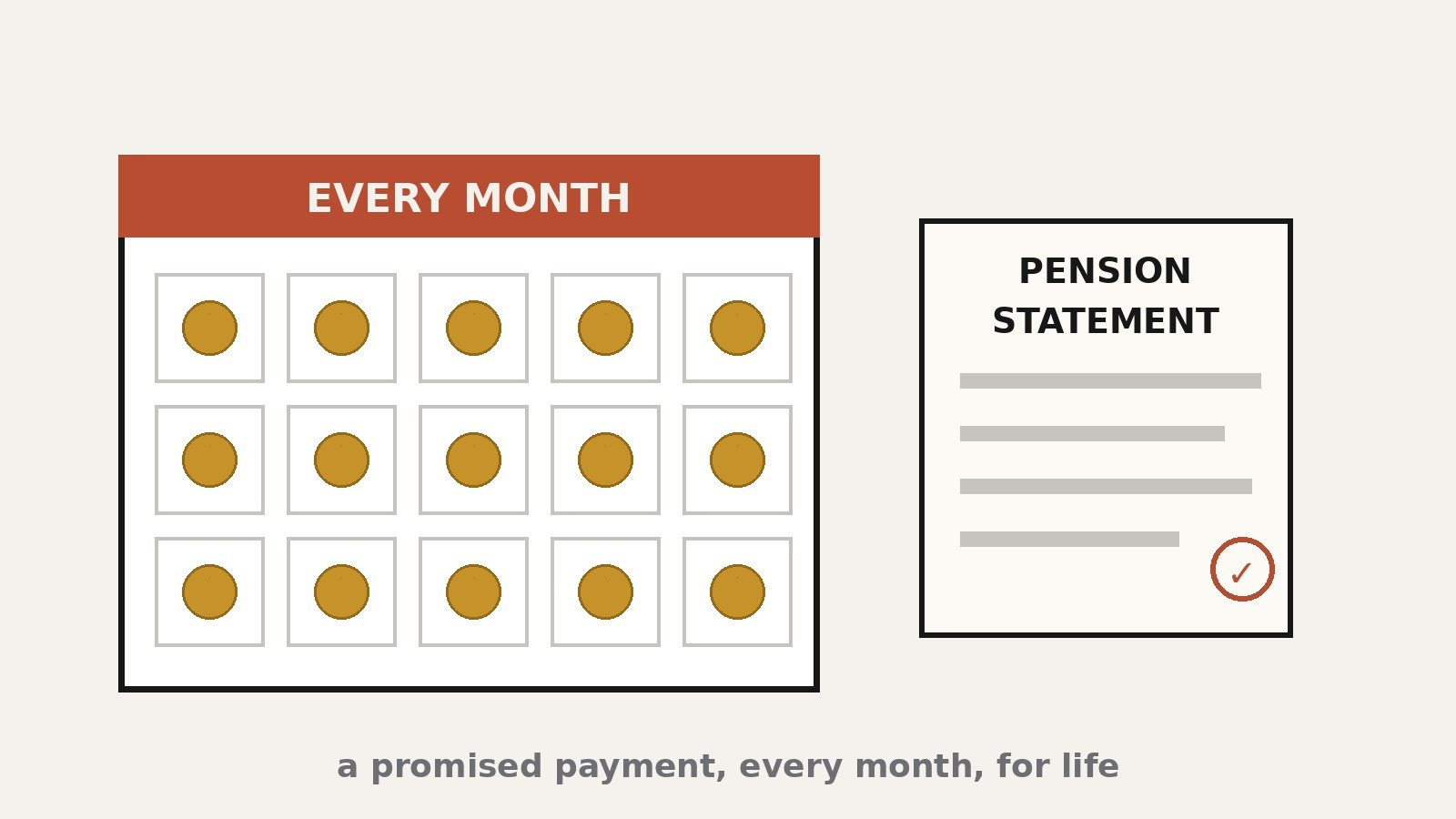
When Americans say the word “pension,” they usually picture a retiree receiving a dependable check every month for life. That picture captures the essential idea. A pension is a promise: in exchange for your work, your employer promises you a specific income after you retire. The employer, not you, is on the hook for making sure the money is there.
The details matter, though, because “pension” is used in several related senses. This guide walks through what a pension is, how pensions work, the two main types of retirement plans, how vesting works, what the federal pension insurer does, and how a pension differs from a 401(k), an IRA, and Social Security.
What a pension is: the simple definition
At its simplest, a pension is a retirement plan, funded by an employer, that promises workers a set benefit at retirement.
The U.S. Department of Labor describes a defined benefit plan this way: it is funded by the employer and promises you a specific monthly benefit at retirement. The plan may state the promised benefit as an exact dollar amount, such as $100 per month at retirement. More often, though, it calculates your benefit through a formula that includes factors such as your salary, your age, and the number of years you worked at the company.
Here is the example the Department of Labor gives: your pension benefit might be equal to 1 percent of your average salary for the last 5 years of employment, multiplied by your total years of service. So a worker who averaged $80,000 in salary over her final five years and worked 30 years would be promised a monthly benefit of 1 percent × $80,000 × 30 years, divided into monthly payments. That formula is a common pattern, though every plan sets its own terms.
The Internal Revenue Service puts it in similar terms: a defined benefit retirement plan provides a benefit based on a fixed formula, giving employees a fixed, pre-established benefit that is predictable and not dependent on how investments perform.
Three features set this kind of pension apart from other ways of saving for retirement:
- The employer does the funding. Generally, the employer makes most or all of the contributions. In many traditional pensions, employees contribute nothing at all.
- The employer bears the investment risk. The company invests the pension money, and if the investments fall short, the company must contribute more so the promised benefits can still be paid.
- The payout is defined in advance. You know what benefit the formula promises. You do not have to guess what your account balance might grow to.
Note that employers in the United States are not required to offer a retirement plan at all. The Department of Labor is explicit: federal law does not require employers to offer or to continue to offer a plan. A pension is a benefit an employer chooses to provide.
How a pension works, step by step
A traditional pension runs through a sequence of stages that repeat across your working life and continue into retirement.
1. You join and begin accruing benefits
Once you become eligible for the plan (typically after meeting age and service requirements, commonly age 21 and one year of service under federal minimum rules), you start to accrue benefits. Your accrued benefit is the amount of retirement benefits you have earned up to that point, based on the plan’s formula and your years of service.
2. Your employer funds the plan
Federal rules set amounts that employers must contribute to keep plans adequately funded, and there are penalties for failing to meet the requirements. The Department of Labor notes that the employer is responsible for ensuring that what it has put in, plus investment earnings, will be enough to pay the promised benefit. An enrolled actuary typically determines the plan’s funding levels, and the plan files an annual report (Form 5500) with the government.
3. Professionals manage the investments
Unlike a 401(k), where you usually pick your own investments, a traditional pension is managed by plan officials. You do not watch an account balance grow. Instead, you watch your accrued benefit grow as your years of service increase.
4. You vest in your benefit
Vesting is the point at which the benefit becomes permanently yours, even if you leave the company. Federal law sets minimum vesting schedules, which are explained in detail below.
5. You retire and collect your payments
Traditionally, pensions pay the retiree monthly annuity payments that continue for life, according to the Department of Labor. Some plans offer other payment options. If you leave the company after vesting but before the plan’s retirement age, your benefit generally stays with the plan until you file a claim for it at retirement.
One protection worth knowing: a defined benefit plan can change the rate at which you earn future benefits, but it cannot reduce the benefits you have already accumulated. The Department of Labor gives an example: a plan that accrues benefits at $5 a month for years of service through 2021 might be amended so that years of service starting in 2022 earn $4 per month, but the already-earned $5-per-month accruals are protected.
The two main types of retirement plans
The Department of Labor divides employer retirement plans into two major categories: defined benefit and defined contribution. The distinction is the single most important idea in this guide, so here is a side-by-side comparison.
| Feature | Defined benefit (traditional pension) | Defined contribution (e.g., 401(k)) |
|---|---|---|
| What is promised | A specific monthly benefit, set by a formula | Nothing specific; you receive whatever your account is worth |
| Who funds it | Primarily the employer | You and/or your employer, into your individual account |
| Who manages investments | Plan officials | Usually you, choosing from the plan’s options |
| Who bears investment risk | The employer | You |
| Payment at retirement | Traditionally, monthly payments for life | Your account balance, which you withdraw or convert to income |
| Federal guarantee | The PBGC guarantees some amount for most private plans | No federal guarantee |
| If you leave early | Vested benefit stays with the plan until retirement age | You can often roll the balance into an IRA or a new employer’s plan |
A few points from the comparison deserve emphasis. First, a 401(k) is the most popular type of defined contribution plan, but it is not a pension in the strict sense, because it promises no specific benefit. Second, the IRS notes that employers can generally contribute and deduct more each year under a defined benefit plan than under a defined contribution plan, but defined benefit plans are also the most costly and administratively complex type of plan to run.
There are also hybrid plans, such as cash balance plans, that contain features of both types. The Department of Labor mentions them as a hybrid category, and the IRS lists cash balance plans under defined benefit plans. In a cash balance plan, the employer still bears the funding responsibility, but your benefit is expressed as an account balance that grows with pay credits and interest credits. For the purposes of this guide, think of them as pensions with an account-style wrapper.
Vesting: when the pension becomes yours
Joining a pension plan does not mean the promised benefit is yours on day one. Vesting is the process by which you earn a permanent, non-forfeitable right to your benefit. Until you are vested, leaving the company can mean losing part or all of the employer-funded benefit you accrued.
The Internal Revenue Service says vesting can follow a variety of schedules, from immediate vesting to schedules spread out over seven years. Federal minimum standards require a plan to use one of two approaches:
- Cliff vesting. You vest all at once. Under the federal minimum, a plan can require up to five years of service before you become 100 percent vested. Leave after four years and you forfeit the benefit; stay five years and it is locked in.
- Graded vesting. You vest gradually. Under the federal minimum, vesting starts after three years of service (20 percent vested) and increases each year until you reach 100 percent after seven years. The typical pattern is 20 percent at three years, 40 percent at four, 60 percent at five, 80 percent at six, and 100 percent at seven.
Two qualifications matter. First, these are federal minimums: many employers vest workers faster. Second, any money you contributed yourself is always yours immediately, whatever the plan’s schedule for employer contributions. Cash balance plans, as hybrid plans, may use a faster three-year vesting schedule.
Vesting is also why pensions reward long tenure. A worker who stays with one employer for decades accrues a large benefit and is fully vested. A worker who changes jobs every few years may never vest anywhere and will get little from a pension. The Department of Labor notes that if you leave after vesting but before retirement age, the benefit generally stays with the plan until you claim it at retirement.
What happens if your employer cannot pay?
A pension is a promise, and promises depend on the promisor staying solvent. If your company goes bankrupt and its pension plan does not have enough money to pay the promised benefits, a federal safety net can step in: the Pension Benefit Guaranty Corporation, or PBGC.
The PBGC is a government corporation created by the Employee Retirement Income Security Act of 1974 (ERISA), the federal law that sets standards for most private employer retirement plans. Its job is to protect the pensions of participants and beneficiaries covered by private-sector defined benefit plans. According to a Congressional Research Service analysis, in fiscal year 2025 the PBGC insured about 23,500 defined benefit pension plans covering approximately 30.0 million workers, and it paid $6.4 billion in benefits in its single-employer program.
Here is what you should know about the guarantee:
- What is covered. The PBGC insures most private-sector defined benefit pension plans. It runs two programs: one for single-employer plans (one company sponsors the plan) and one for multiemployer plans (collectively bargained plans to which multiple companies contribute).
- What is not covered. Defined contribution plans such as 401(k)s are not insured, because they are individual accounts rather than promised benefits. Plans that fall outside ERISA, such as most state and local government plans, are not covered by the PBGC either.
- How it is funded. The PBGC is not funded by general tax revenues. Its programs are funded by premiums paid by the private-sector employers that sponsor pension plans, plus investment income, assets from plans it takes over, and recoveries from the companies that ended underfunded plans.
- The guarantee is capped. Participants receive the lower of their promised benefit or a statutory maximum set by Congress. For single-employer plans that terminate in 2026, the maximum guarantee is $93,477 a year for a worker aged 65. The cap is lower if benefits begin before age 65, or if the pension is paid in a form other than equal monthly payments for life. The cap is adjusted each year based on changes in the national average wage. The Congressional Research Service notes that most workers in single-employer plans taken over by the PBGC receive the full benefit they earned, because the cap exceeds most pensions.
- Multiemployer plans have a much lower cap. For a participant with 30 years of service in a multiemployer plan, the guaranteed limit is $12,870, and it is not adjusted for wage growth.
The PBGC is a backstop for failed plans, not a reason to ignore your plan’s health. But its existence is one of the reasons a traditional pension is considered more secure than a retirement account whose value depends entirely on the market.
Pension vs. Social Security
Many people use the words “pension” and “Social Security” loosely, and in some countries the government retirement program is literally called a pension. In the United States, they are different things.
Social Security is a federal program run by the Social Security Administration. You can typically get monthly retirement benefits starting at age 62 if you have worked and paid Social Security taxes for 10 years or more. It is funded by payroll taxes and administered by the government, and it covers nearly all American workers.
A pension, by contrast, is an employer-sponsored benefit tied to a particular job or employer. It is funded by your employer (not by payroll taxes sent to Washington), governed by your plan’s documents, and calculated from your salary and years of service with that employer.
The two are independent. Receiving a pension does not disqualify you from Social Security, and collecting Social Security does not reduce your pension, as a general matter. Many retirees receive both. The key distinction is the source of the promise: Social Security is a government program earned through years of taxed work; a pension is an employer promise earned through years of service with that employer.
Pension vs. 401(k) vs. IRA
This is the comparison most people are actually asking about. Here is how the three fit together.
A 401(k) is an employer-sponsored defined contribution plan: you (and often your employer) contribute money into your individual account, you usually choose the investments, and at retirement you receive whatever the account is worth. The Department of Labor calls it a popular type of defined contribution plan. It is flexible and portable, but nothing is guaranteed.
An IRA (individual retirement arrangement) is a personal account you set up yourself. The IRS says you can open one through a bank or other financial institution, a life insurance company, a mutual fund, or a stockbroker. IRAs allow you to make tax-deferred investments for retirement. A traditional IRA is a tax-advantaged personal savings plan where contributions may be tax deductible; a Roth IRA is a tax-advantaged personal savings plan where contributions are not deductible but qualified distributions may be tax free. An IRA is not tied to any employer, and it involves no promise of a specific benefit.
A pension (defined benefit plan) is an employer-funded promise of a specific benefit, usually monthly payments for life, with the employer bearing the investment risk and the PBGC providing a federal backstop for most private plans.
In short: a pension tells you what you will get; a 401(k) tells you what you have; an IRA is an account you open and fund on your own. It is common to have more than one across a working life. An employer can even sponsor both a pension and a 401(k), and the IRS notes that having a defined benefit plan does not prevent a business from having other retirement plans.
How pensions pay out
When the time comes to collect, traditional pensions pay out as a steady stream of income. The Department of Labor says these plans traditionally pay the retiree monthly annuity payments that continue for life, though plans may offer other payment options.
The most common choice retirees face is between the monthly-for-life payments and, where the plan allows it, a lump sum: a single large payment that represents the present value of the promised stream. Plans also commonly offer survivor options, where the monthly amount is reduced so that a surviving spouse continues to receive payments after the retiree’s death. The specific options, and whether you can change them after payments begin, depend entirely on the plan’s rules.
One practical note from the Department of Labor: if you leave the company after vesting but before the plan’s retirement age, you generally cannot collect early. The benefit waits with the plan until you file a claim at retirement age.
A brief history of pensions
The English word “pension” comes from the Latin pensio, meaning a payment, according to the 1911 Encyclopaedia Britannica. The idea behind it is older still: governments have promised support to soldiers, sailors, and civil servants for centuries, and the United States has paid military pensions continuously since the Revolutionary era.
The modern American pension system took its shape in the twentieth century, when large employers began offering pensions as a standard part of compensation. The landmark moment came in 1974, when Congress passed the Employee Retirement Income Security Act (ERISA). ERISA set minimum standards for private retirement plans, imposed responsibilities on the people running them, and created the PBGC to insure the benefits. The Department of Labor’s retirement-plan guide is built around the rights and protections ERISA established.
One thing has not changed since 1974: employers choose whether to offer a pension. Federal law does not require it. A pension remains an employer’s promise, regulated by ERISA, funded by the employer, and increasingly a feature of public-sector and union jobs rather than private-sector ones.
Frequently asked questions
Is Social Security a pension?
In the United States, no. Social Security is a federal program funded by payroll taxes and run by the Social Security Administration; you can typically claim monthly benefits from age 62 with at least 10 years of taxed work. A pension is an employer-sponsored plan funded by your employer. You can receive both at the same time.
Is a 401(k) a pension?
Not in the strict sense. A 401(k) is a defined contribution plan: you and your employer contribute to your individual account, and you receive whatever it is worth. A pension (defined benefit plan) promises a specific benefit regardless of investment performance. People sometimes use “pension” loosely for any retirement plan, but the Department of Labor treats them as two different types.
Are pensions guaranteed?
Partially. Most private-sector defined benefit plans are insured by the Pension Benefit Guaranty Corporation, a federal corporation funded by employer premiums. If your plan terminates without enough money, the PBGC pays benefits up to a statutory maximum ($93,477 a year for a 65-year-old in plans terminating in 2026). Benefits above the cap can be reduced, and 401(k)s are not insured at all.
Do I have to contribute to my pension?
Usually not. The Department of Labor notes that, generally, employees do not contribute to defined benefit plans, though some plans require or permit employee contributions. The IRS adds that the employer generally makes most of the contributions. Any money you do contribute is always yours.
What does “vested” mean for a pension?
Vesting means you have earned a permanent right to your benefit. Federal minimums allow a plan to require up to five years of service for cliff vesting (all at once) or graded vesting that reaches 100 percent after seven years. Leave before vesting and you can forfeit the employer-funded portion. Many plans vest workers faster than the minimum.
Can I lose my pension if I change jobs?
Once you are vested, no: the vested benefit is yours. The Department of Labor explains that if you leave after vesting but before retirement age, the benefit generally stays with the plan until you file a claim at retirement. But if you leave before vesting, you can lose the unvested portion of the employer-funded benefit.
Do I pay taxes on pension payments?
Tax rules for retirement income are detailed and depend on the plan and your situation. The Department of Labor directs readers to IRS Publication 575, Pension and Annuity Income, for the specifics. In general, pension benefits are taxed as income when received, but the details vary.
What is the difference between a pension and an annuity?
A pension is an employer-sponsored retirement plan promising a benefit based on your service and salary. An annuity is a contract, usually with an insurance company, that pays out a stream of income. Pensions often pay their benefits as annuities (monthly checks for life), which is where the confusion comes from. The pension is the plan; the annuity is the payment method.
Keep reading: What Is a Recession? The Official Definition Explained
Keep reading: What Is a Savings Bond? Series EE and Series I Explained
Keep reading: What Is a Joint Account? Ownership and Rights Explained
Keep reading: What Time Does the Stock Market Close? Regular Hours, Explained
Sources & references
- U.S. Department of Labor, "What You Should Know About Your Retirement Plan" (EBSA booklet: types of retirement plans, vesting, payment of benefits, PBGC coverage, employer obligations).
- Internal Revenue Service, "Defined benefit plan" (fixed formula, employer contributions, vesting schedules, administrative requirements).
- Internal Revenue Service, "Individual retirement arrangements (IRAs)" (IRA types, where to open one, tax treatment of traditional and Roth IRAs).
- Social Security Administration, "Retirement benefits" (monthly benefits from age 62 with 10+ years of Social Security taxes).
- Congressional Research Service, "Pension Benefit Guaranty Corporation (PBGC): A Primer" (PBGC creation under ERISA 1974, coverage, funding by employer premiums, 2026 guarantee caps, multiemployer limits, FY2025 statistics).
- 26 U.S. Code § 411, "Minimum vesting standards" (statutory vesting requirements; amendment history confirms 5-year and 3-to-7-year vesting regimes).
- 1911 Encyclopaedia Britannica, "Pension" (Wikisource reproduction; Lat. pensio, a payment).


