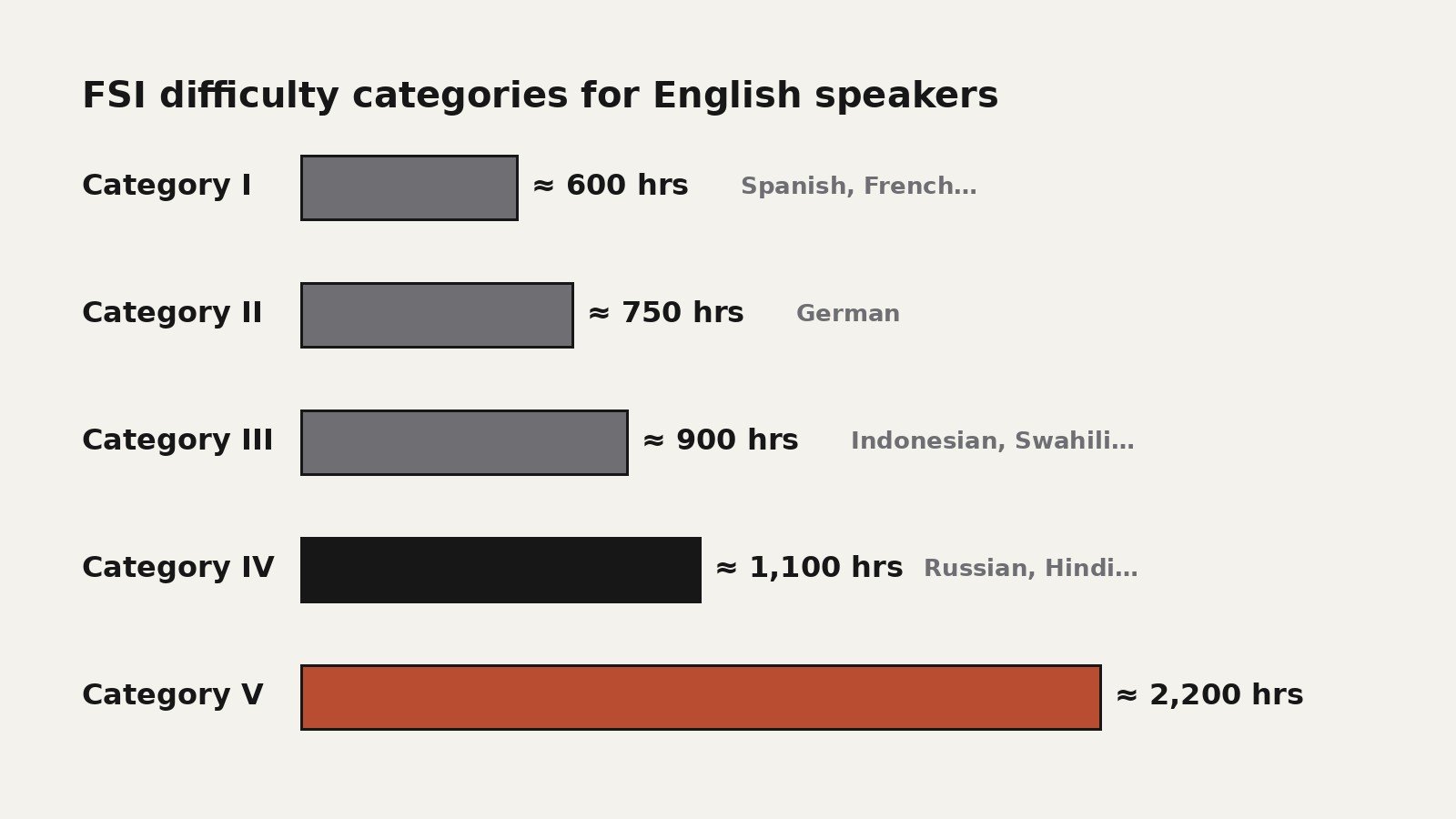
There is no single official answer to which language is the hardest to learn, because difficulty depends on the learner’s first language. For native English speakers, the best available evidence comes from the U.S. Foreign Service Institute, which trains American diplomats. It places five languages in its hardest tier, Category V, each estimated to take about 2,200 hours of intensive study, or 88 weeks, to reach professional working proficiency: Arabic, Cantonese, Mandarin Chinese, Japanese and Korean. That is roughly three to four times the study time of a language like Spanish or French.
Type “hardest languages to learn” into a search engine and you will get confident answers. One page says Mandarin. Another says Arabic. A third says Japanese. They cannot all be right, and in a sense none of them is, because the question has a missing word: hardest for whom?
A language is not hard the way a mountain is tall. Its difficulty is a relationship between two languages: the one you already speak and the one you want to learn. This article explains what the serious evidence says, which languages sit at the top of the rankings for English speakers and why, and how to read those rankings honestly before you choose a language to learn.
How language difficulty is actually measured
The closest thing the world has to an objective difficulty ranking comes from an unusual place: the school that trains American diplomats. The U.S. Foreign Service Institute (FSI) puts adult learners through intensive, full-time language courses and has kept records of how long it takes a native English speaker to reach professional working proficiency, the level at which someone can use the language in a professional setting.
The result is a set of five categories based on estimated study hours. The FSI’s figures assume a motivated adult studying full time in small classes, so they describe the relative difficulty of languages rather than a promise about any individual learner. But because every language is measured with the same learners, the same method and the same finish line, the ratios between languages are meaningful. A language that takes four times as many hours as Spanish is genuinely, substantially harder for an English speaker, no matter who is counting.
The full FSI language difficulty categories
Here is the classic FSI ranking, reproduced from the institute’s widely published chart. Languages marked with an asterisk are flagged by the FSI as usually more difficult than other languages in the same category.
Category I: 23 to 24 weeks (about 575 to 600 hours). Languages closely related to English. Afrikaans, Danish, Dutch, French, Italian, Norwegian, Portuguese, Romanian, Spanish, Swedish.
Category II: 30 weeks (about 750 hours). Languages similar to English. German.
Category III: 36 weeks (about 900 hours). Languages with linguistic or cultural differences from English. Indonesian, Malaysian, Swahili.
Category IV: 44 weeks (about 1,100 hours). Languages with significant linguistic or cultural differences from English. Albanian, Amharic, Armenian, Azerbaijani, Bengali, Bosnian, Bulgarian, Burmese, Croatian, Czech, *Estonian, *Finnish, *Georgian, Greek, Hebrew, Hindi, *Hungarian, Icelandic, Khmer, Lao, Latvian, Lithuanian, Macedonian, *Mongolian, Nepali, Pashto, Persian (Dari, Farsi, Tajik), Polish, Russian, Serbian, Sinhala, Slovak, Slovenian, Tagalog, *Thai, Turkish, Ukrainian, Urdu, Uzbek, *Vietnamese, Xhosa, Zulu.
Category V: 88 weeks (about 2,200 hours). Languages exceptionally difficult for native English speakers. Arabic, Cantonese (Chinese), Mandarin (Chinese), *Japanese, Korean.
Two things are worth noticing. First, the jump from Category IV to Category V is the big one: the hardest group takes roughly twice as long as the next group and nearly four times as long as Spanish. Second, published versions of this chart vary slightly in the exact figures for the easier categories, with some giving Category I as 600 to 750 hours over 24 to 30 weeks. The ordering and the ratios, which are what matter, stay the same.
The five hardest languages for English speakers
What puts these five languages in a class of their own? Each one stacks several kinds of difficulty at once: sounds English speakers do not have, grammar built on unfamiliar principles, and in four of the five, a writing system that takes years to master on its own.
Mandarin Chinese
Mandarin is the language most people name first, and it is easy to see why. It is a tonal language: pitch changes the meaning of a word. Modern Standard Chinese uses four tones, high level, high rising, falling-rising and falling, plus a neutral tone, and the same syllable can mean completely different things depending on which tone you use. The textbook example is ma: with a high level tone it means mother, with a rising tone hemp, with a falling-rising tone horse, and with a falling tone to scold.
The second mountain is the writing system. Mandarin is written in Chinese characters, or hanzi, which are logograms: each character represents a word or part of a word rather than a sound. Literacy takes years because reading a newspaper means knowing thousands of distinct characters. What helps is the grammar. Mandarin verbs do not conjugate, nouns do not change for number or gender, and sentences mostly follow a familiar subject-verb-object order. Learners who focus on speaking often find the grammar the easiest part.
Cantonese
Cantonese shares the characters with Mandarin but is a separate language, and by the FSI’s measure it is just as hard, for an additional reason. Where Mandarin has four tones, Cantonese has at least six, distinguished by fine differences in pitch. Several of them are level or near-level tones that sound deceptively similar to an untrained ear, which gives Cantonese a particularly steep listening curve.
Cantonese also preserves final consonants that Mandarin lost centuries ago, so its syllables end in clipped sounds like p, t and k. It is spoken by more than 55 million people in China’s Guangdong and Guangxi provinces, including Guangzhou, Hong Kong and Macau, with millions more speakers around the world. A final wrinkle for learners: most textbooks, dictionaries and courses teach Mandarin, so Cantonese simply has fewer learning resources, which makes the same study hours harder to fill.
Arabic
Arabic’s difficulty is different in kind. Its alphabet has 28 letters, almost all consonants, written from right to left. Short vowels are usually written as small marks that are left out of everyday text, so beginners must guess vowels from context until their vocabulary is large enough to fill the gaps. Words are built on three-consonant roots: change the vowels and affixes around a root and you get a whole family of related words, a system with no real parallel in English.
The deeper challenge is that “Arabic” is really two languages at once. Modern Standard Arabic is the formal written language used in news, books and official speeches, but nobody grows up speaking it at home. Everyday life runs on regional dialects, and those dialects differ so much from country to country that speakers from distant regions can struggle to understand each other. A learner therefore faces a double workload: the standard language for reading and writing, and a dialect for actual conversation.
Japanese
Japanese is the only language in Category V that the FSI flags with an asterisk, marking it as usually harder than the other languages in its own tier. The main reason is the writing system, the most complex of any major world language. Japanese mixes three scripts in a single sentence. Kanji are logographic characters borrowed from Chinese, used for the core meaning of words. Hiragana is a syllabary used for grammar endings, particles and native words. Katakana is a second syllabary used for foreign loanwords, emphasis and technical terms. A typical passage of Japanese writing contains all three, and each kanji character can have several different readings depending on context.
The grammar adds another layer. Japanese puts the verb at the end of the sentence, which forces an English speaker to hold the whole sentence in mind before it resolves. Then there is the elaborate system of politeness: different words, verb endings and levels of formality depending on who you are talking to, their status relative to you, and the social setting. Using the wrong level does not just sound awkward; it can sound rude.
Korean
Korean looks like it should be easier, because it has one of the most logical writing systems in the world. Hangul, the Korean alphabet, was created in the fifteenth century under King Sejong of Korea and is so systematic that its basic letters can be learned in a day. But the FSI still puts Korean in Category V, which tells you something important: the script is not what makes these languages hard.
Korean grammar works on completely different principles from English. It is an agglutinative language, meaning words are built by stacking suffixes onto a root in a fixed order, and sentences follow a subject-object-verb order. More demanding still is the honorific system. Korean requires the speaker to encode social relationships in the grammar itself, choosing different verb endings and vocabulary depending on the listener’s age, status and closeness, with several distinct speech levels from formal to casual. Getting the grammar right means constantly reading the social situation, not just the sentence.
What actually makes a language hard
Behind the five names on the FSI’s list are four recurring factors. Understanding them explains both the ranking and its limits.
Linguistic distance. The single biggest predictor of difficulty is how far the new language sits from the one you already speak, in vocabulary, grammar and sounds. Research on tens of thousands of adult learners has confirmed this systematically: linguists Job Schepens, Frans van der Slik and Roeland van Hout found, in a study published in the journal Language Learning, that lexical distance within language families and morphological distance between languages from different families reliably predict how learnable a new language is. The larger the gap a learner has to bridge, the lower the learnability. This is why the FSI’s ranking works so well for English speakers and why it would look completely different drawn from the starting point of, say, Hindi or Turkish.
Writing system. An unfamiliar alphabet adds months of work; a non-alphabetic script adds years. This is the honest reason four of the five Category V languages sit where they do. It also explains anomalies in the table. Korean’s easy alphabet is why some learners are surprised to find it in the top tier: for Korean, the difficulty is almost entirely in the grammar and the sounds, not the script.
Sounds. Tones, unfamiliar consonants and sound distinctions English does not make all slow learners down. Mandarin’s four tones and Cantonese’s six are the famous examples, but Arabic’s throaty consonants and the click consonants of Xhosa, a Category IV language, are the same kind of hurdle: the ear must learn to hear distinctions it has never needed before it can produce them.
Grammar. English speakers struggle most with grammar that reorganizes the sentence itself: verb-final word order in Japanese and Korean, the case systems of Finnish or Hungarian where endings do the work of English prepositions, and honorific systems that make every sentence a social calculation.
Hard for English speakers is not hard for everyone
This is the point most rankings gloss over, and it matters. The FSI ranking assumes a native English speaker with no relevant prior languages. Change the starting point and the map changes.
A native Hindi speaker learning Japanese meets a subject-object-verb word order that feels natural rather than backwards. A Spanish speaker learning Portuguese finds thousands of recognizable words. A Mandarin speaker learning Cantonese still faces new tones and vocabulary, but the characters and the basic logic of the language are familiar territory. Schepens and colleagues’ research makes the same point quantitatively: distance effects from languages a learner already knows shape how learnable the next language is, which means a multilingual learner’s “hardest language” can be very different from a monolingual’s.
It also means the popular debate about whether Mandarin, Arabic or Japanese is “the” hardest language in the world has no answer. They are all in the same FSI tier, and which one a particular learner finds hardest depends on what that learner finds hard: tones, characters, grammar or social nuance. The honest version of the ranking is a group, not a podium.
The next tier down: still seriously hard
Category IV deserves attention, because these languages take about 1,100 hours each, roughly one and a half times a language like German, and several of them have fearsome reputations of their own.
Finnish and Hungarian, both flagged by the FSI as harder than average for their tier, are famous for their case systems. Finnish nouns change their endings through about 15 grammatical cases to express relationships that English handles with prepositions, so “in the house,” “from the house” and “into the house” are all different forms of one word. The exact count depends on how grammarians draw the line, but the scale is what matters. Hungarian is usually credited with up to 18 cases, and both languages use vowel harmony, a rule requiring the vowels in a word’s endings to match the vowels in its stem.
Polish, with seven grammatical cases and dense consonant clusters, represents the Slavic side of Category IV alongside Russian. Thai and Vietnamese bring tones back into the picture, with Vietnamese using six. Turkish has an agglutinative grammar that stacks suffixes the way Korean does, and Icelandic keeps an archaic, heavily inflected grammar that its Scandinavian cousins long ago simplified.
Can you still learn one of these languages?
Two thousand two hundred hours sounds like a verdict, but it is really a budget. Spread over full-time study it is 88 weeks. Spread over an hour a day, it is about six years. That is the honest arithmetic, and it explains why so few casual learners reach fluency in a Category V language: most people simply do not have that many hours to give, not because they lack talent.
Three things genuinely help. First, time on task is the dominant variable, so consistency beats intensity. Second, living where the language is spoken compresses the hours dramatically, because daily life becomes study time. Third, and most important, is motivation. The FSI’s learners are highly motivated adults who need the language for their careers, and even among them the hours are long. Language teachers consistently report that a learner who loves the culture behind a “hard” language outlasts a bored learner grinding through an “easy” one. Difficulty rankings measure the size of the hill, not whether you will enjoy climbing it.
Frequently asked questions
What is the hardest language to learn?
For native English speakers, the U.S. Foreign Service Institute identifies five languages as the hardest tier: Arabic, Cantonese, Mandarin Chinese, Japanese and Korean. Each is estimated to take about 2,200 hours of intensive study to reach professional working proficiency. There is no official ranking within the group, though Japanese is flagged as usually harder than the other four. For speakers of other first languages, the answer is different, because difficulty depends on the distance between the languages.
What are the most difficult languages to learn?
The most difficult languages for English speakers, by study time, are the FSI’s Category V group: Arabic, Mandarin, Cantonese, Japanese and Korean, at roughly 2,200 hours each. The next tier, Category IV at about 1,100 hours, includes Russian, Hindi, Thai, Vietnamese, Turkish, Polish, Finnish, Hungarian and Icelandic, among others. Finnish and Hungarian are flagged as harder than average even within that tier.
How long does it take to learn the hardest languages?
The FSI estimates about 2,200 hours of intensive, full-time study, or 88 weeks, for an English speaker to reach professional working proficiency in Arabic, Cantonese, Mandarin, Japanese or Korean. That is roughly three to four times the 600 to 750 hours estimated for Spanish or French. For part-time learners, the calendar time is much longer: an hour a day stretches 2,200 hours over about six years.
Is Mandarin or Japanese harder?
The FSI places both in its hardest category but marks Japanese with an asterisk, meaning it is usually harder than other languages in the same tier. Mandarin’s main hurdles are its four tones and thousands of characters, while Japanese combines three writing systems with verb-final grammar and a complex politeness system. Which one feels harder depends on the learner: tones trouble some people more, writing systems trouble others.
Is Arabic harder than Chinese?
The FSI puts them in the same difficulty tier, at about 2,200 hours each. They are hard in different ways. Mandarin and Cantonese challenge learners mainly through tones and characters, while Arabic challenges them through its root-based word system, unfamiliar sounds, and the double workload of learning both Modern Standard Arabic and a spoken dialect. There is no meaningful way to declare one harder in absolute terms.
Does the FSI ranking apply if English is not my first language?
Only loosely. The ranking was built from the experience of native English speakers, so it measures distance from English. If your first language is close to one of the “hard” languages, your personal ranking will look different. Research on adult language learning confirms that the linguistic distance between the languages you know and the one you are learning is the strongest predictor of how hard it will be.
What is the hardest language to learn in the world?
There is no such title, and rankings that award one are oversimplifying. Every serious difficulty ranking is relative to the learner’s starting language. For English speakers the evidence points to a group of five, Arabic, Cantonese, Mandarin, Japanese and Korean, not a single winner. Anyone naming one definitive hardest language in the world is giving an opinion, not a measurement.
Sources & references
- U.S. Foreign Service Institute language difficulty chart, as reproduced with the institute's category structure and hour estimates on "Armed and Dangerous" (esr.ibiblio.org).
- Atlas & Boots, "Foreign Service Institute Language Difficulty Rankings," attributing the data to the Foreign Service Institute of the U.S. Department of State.
- Encyclopaedia Britannica, "Chinese languages."
- Encyclopaedia Britannica, "Cantonese language."
- Encyclopaedia Britannica, "Kana" (Japanese writing).
- Encyclopaedia Britannica, "Arabic language."
- Schepens, J. J., van der Slik, F. W. P., & van Hout, R. W. N. M. (2016). "L1 and L2 Distance Effects in Learning L3 Dutch." Language Learning, 66(1), 224-256.
- Schepens, J. J. (2015). "Bridging Linguistic Gaps: Effects of Linguistic Differences on the Adult Learnability of Dutch as an Additional Language." Doctoral dissertation, LOT Publications.
- The Northern Voices, "Northern Tongues, Eastern Roots" (Finnish, Hungarian and Polish case systems).


