Short answer
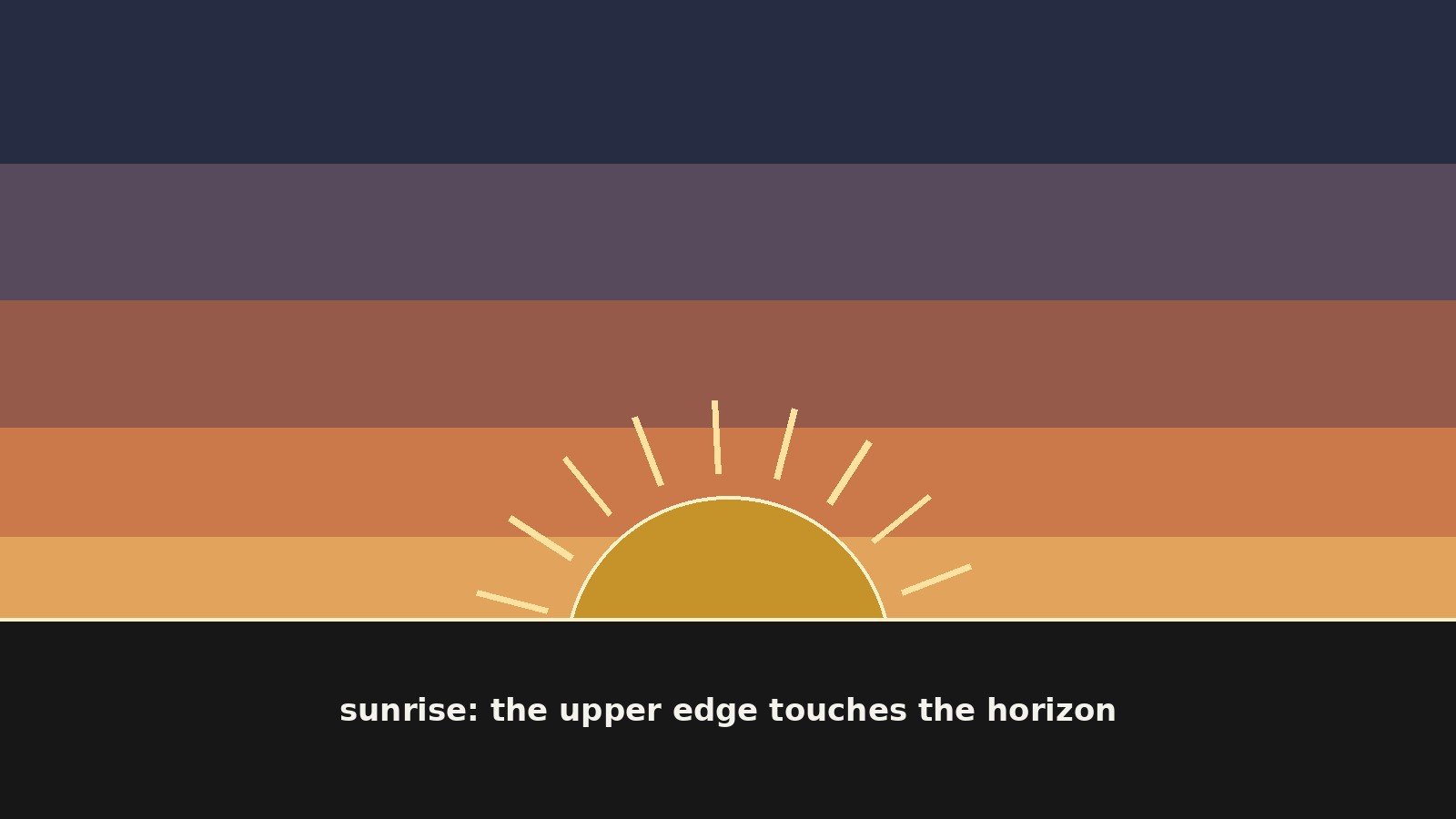
- There is no single time the sun rises. Sunrise depends on where you are, what date it is, and where you sit inside your time zone. Astronomically, sunrise is the moment the upper edge of the sun's disk appears on the horizon, measured at sea level under average air conditions. Because the time shifts every day, this article does not give "today's" sunrise; the closing section explains where to look up your local time from official almanacs.
Type the question into a search engine and you get an answer down to the minute: 7:07 am, perhaps, or 5:52 am in midsummer. What you do not get is the explanation. Why is the time different from yesterday’s? Why does your friend two states away see the sun an hour earlier on the same clock? Why is the earliest sunrise of the year not on the longest day? And what exactly counts as “sunrise” in the first place, the first glimmer or the full disk?
This article answers the question behind the question: what sunrise means to the astronomers who compute the tables, the three things that set the time for any place on Earth, the slow wobble that keeps sunrise sliding around the calendar, the glow that comes before it, and how to find your own local time from sources you can trust.
The Short Version: Three Ingredients Set the Time
If sunrise feels mysterious, it helps to know that the whole phenomenon reduces to three ingredients plus one wrinkle.
The ingredients are your latitude (how far north or south you are), the date (where Earth is in its yearly journey), and your position inside your time zone (how far east or west you sit within the zone, plus whether daylight saving time is in effect). Change any one of them and the sunrise time on your clock changes.
The wrinkle is that even the sun’s own schedule does not run on clock time. The real sun drifts ahead of and behind our evenly ticking clocks by up to about sixteen minutes over the year, a slow swing called the equation of time. It is the reason the earliest sunrise of the year lands a little before the longest day.
Before any of that, though, we need to pin down what “sunrise” means, because the astronomers’ definition is more precise than most people expect, and the precision matters.
What “Sunrise” Actually Means
The U.S. Naval Observatory, the official timekeeper whose tables underlie many published sunrise times, defines sunrise conventionally as the moment when the upper edge of the sun’s disk is on the horizon. The definition assumes average atmospheric conditions and a level location on the Earth’s surface. So sunrise is not the moment the whole sun is up, and not the moment its center crosses the horizon. It is the first instant the top of the disk touches the horizon.
For computing tables, the Observatory turns that convention into geometry. Sunrise is defined to occur when the center of the sun is geometrically 50 arcminutes below a horizontal plane. An arcminute is one sixtieth of a degree, so 50 arcminutes is a little less than one degree. For an observer at sea level with a flat, unobstructed horizon under average air conditions, that is exactly the geometry at which the upper limb of the sun appears tangent to the horizon.
Where does the number 50 come from? It is the sum of two corrections. The first is 16 arcminutes, the average apparent radius of the sun: the sun is a disk, not a point, so its center is one solar radius below the horizon when its upper edge touches it. The second is 34 arcminutes, the average amount by which the Earth’s atmosphere bends, or refracts, sunlight near the horizon. The bending lifts the sun’s image upward, so you see the upper edge a little before the geometry alone would allow. Sixteen plus thirty-four gives the fifty arcminutes, which is the same as saying sunrise happens when the sun’s center reaches a zenith distance of 90.8333 degrees.
Three honest caveats come with the definition, and the Observatory states all of them. First, the times cannot be computed exactly, because the real atmosphere never matches the average: even under ideal conditions, a computed sunrise can be off by a minute or more. Second, mountains on the horizon and the height of the observer shift the observed time, sometimes by much more. Third, accuracy falls off at high latitudes, where the sun meets the horizon at a very shallow angle and small changes in refraction move the time by many minutes. Published sunrise times are excellent predictions, not promises.
Ingredient One: Your Latitude
Latitude is the biggest lever on sunrise time, and its effects are easiest to see by comparing three bands of the planet.
Near the equator, the sun’s daily path meets the horizon almost vertically, like a ball dropping straight down a wall and bouncing back up. Days and nights stay close to twelve hours all year, and the difference between the longest and shortest day is tiny. Sunrise comes fast and the twilight is brief, because the sun plunges below the horizon instead of sliding along it.
In the middle latitudes, where most of the United States sits, the sun’s path is tilted. That tilt is what creates the familiar seasonal swing: early sunrises and long evenings in summer, late sunrises and short afternoons in winter. The exact steepness of the path depends on how far from the equator you are, which is why Miami’s winter days feel so much more generous than Minneapolis’s.
Toward the poles the geometry stretches to its extremes. NASA notes that the High Arctic can see almost twenty-four hours of daylight in the middle of summer and almost twenty-four hours of darkness in the middle of winter. Inside the Arctic and Antarctic Circles the sun can stay above the horizon for weeks around midsummer and below it for weeks around midwinter, the phenomena known as the midnight sun and the polar night. On those days there is simply no sunrise at all, which is one more reason no single answer to “when does the sun rise” can hold everywhere.
Latitude also moves the sunrise point along the horizon. Through the year, the place where the sun first appears travels northward and southward along the eastern horizon, reaching its northernmost rising point around the June solstice and its southernmost around the December solstice (in the Northern Hemisphere; the pattern reverses south of the equator). If you photograph sunrise from the same window every month, the sun appears to walk along the horizon and back.
Ingredient Two: The Date
The date matters because of the tilt of the Earth’s axis. NASA describes the axis as tilted about twenty-three degrees from a line perpendicular to the plane of Earth’s orbit (the more precise figure used in astronomical work is 23.4 degrees). As Earth travels around the sun, the axis keeps pointing in nearly the same direction in space, so each hemisphere takes turns leaning toward the sun and away from it. Lean toward, and the sun climbs higher, rises earlier, and stays up longer: summer. Lean away, and the reverse: winter.
The turning points of that lean are the solstices. Around the June solstice the Northern Hemisphere leans most directly toward the sun, giving the longest day of the year; around the December solstice it leans most directly away, giving the shortest. The halfway points are the equinoxes, when neither hemisphere leans toward the sun and day and night are most nearly equal. In 2026, timeanddate’s seasonal tables place the June solstice on June 21, the December solstice on December 21, and the equinoxes on March 20 and September 22. From the December solstice to the June solstice, each day’s sunrise comes a little earlier than the last (with a small wobble, covered below); from June to December, the trend reverses.
Distance from the sun is not the driver here, and it is worth saying plainly because it is a common misconception. Earth is actually closest to the sun in early January, in the depth of Northern Hemisphere winter. The seasons, and the shifting sunrise, come from the tilt, not the distance.
Ingredient Three: Your Place Inside Your Time Zone
Here is the ingredient people forget, and it explains why two cities at the same latitude can have very different sunrise times on the same clock.
Your wall clock shows zone time, but the sun keeps local time. The U.S. Naval Observatory calls the sun’s highest point of the day its transit, which is local solar noon, the moment a sundial reads twelve. At low and middle latitudes, transit falls approximately midway between sunrise and sunset. Everything about the sun’s daily schedule pivots around that local noon, and local noon depends on your longitude.
The Earth turns fifteen degrees of longitude every hour, which works out to one degree every four minutes. So for every degree of longitude you stand west of your time zone’s reference, the sun reaches its highest point about four minutes later by your clock, and sunrise and sunset shift later by the same amount. A city on the western edge of its time zone can easily see the sun an hour later on the clock than a city on the eastern edge, even at the same latitude on the same date. The sun is doing the same thing in both places; the clocks disagree.
Daylight saving time adds one more clock-level shift. When clocks spring forward, every sun event reads an hour later than it would on standard time, which is why summer sunrises look “late” on the clock compared with what the astronomy alone would suggest. In the United States in 2026, daylight saving time ends on November 1, when clocks fall back and sunrise times abruptly read an hour earlier. Any table you consult already accounts for this, but it is the reason the numbers jump at the start of November.
The Puzzle: Why the Earliest Sunrise Misses the Longest Day
Here is a fact that surprises almost everyone who checks. The longest day of the year, the June solstice, is not the day of the year’s earliest sunrise. The earliest sunrise arrives roughly a week before the solstice at mid-northern latitudes, and the latest sunset arrives roughly a week after it. In December the effect is even more lopsided: the earliest sunset falls a week or two before the shortest day, and the latest sunrise a week or two after it. The solstice still has the most (or least) total daylight. It is just not the extreme for the endpoints.
Geoscience Australia, the Australian government’s earth science agency, confirms the pattern and names the cause: Earth’s orbit is an ellipse rather than a circle, and the axis is tilted, and the combination makes solar time and clock time differ by several minutes. Around the solstices the true solar day, the time from one solar noon to the next, runs a little longer than twenty-four hours. The whole solar schedule drifts later on the clock day by day. Because sunrise and sunset are both drifting, the earliest sunrise bottoms out before the solstice even though the days are still lengthening, and the latest sunset peaks after it. In winter the same drift stretches further, which is why the latest sunrises land well into January.
If that sounds abstract, there is a concrete way to picture it. Imagine the days getting longer by two minutes a day, but the entire solar schedule also sliding thirty seconds later each day. The sunrise time is the combination of the two trends, and the combination reaches its minimum a few days before the day-length trend alone would put it. That sliding of the schedule is the equation of time at work.
Sundials vs. Clocks: The Equation of Time
The equation of time is the formal name for the gap between the real sun and the clock. It is defined as apparent solar time (what a sundial reads) minus mean solar time (what an evenly ticking clock reads). Over the year it swings from about sixteen minutes ahead of the clock in early November to about fourteen minutes behind in mid-February, passing through zero four times (around April 15, June 13, September 1, and December 25). In plain terms, on some dates the sun reaches its highest point several minutes before your clock strikes twelve, and on others several minutes after.
Two astronomical facts create the swing. The first is that Earth’s orbit is a slightly flattened ellipse. Earth moves fastest near perihelion, its closest approach to the sun around January 3, and slowest near aphelion, its farthest point around July 4. Because we are the ones moving, the sun appears to slide across the sky faster in January and slower in July, so the true sun runs ahead of the steady clock-sun for half the year and behind it for the other half. This eccentricity effect is an annual wave about seven to eight minutes at its largest.
The second cause is the 23.4-degree tilt itself. The sun travels along the tilted circle of the ecliptic, but our clocks effectively measure its progress along the celestial equator. Near the equinoxes the sun’s path slants steeply across the equator, so a day’s motion adds up to less eastward progress and the sun falls behind. Near the solstices the path runs nearly parallel to the equator, where the sky’s lines of longitude crowd together, so the same daily step counts for more eastward progress and the sun runs ahead. This obliquity effect is a twice-yearly wave about ten minutes at its largest, passing through zero at the equinoxes and solstices.
Add the two waves and you get the lopsided yearly curve of the equation of time. Photograph the sun at the same clock time on many days through the year and stack the images, and the sun traces a tall, slender figure-eight called the analemma: its height comes from the sun’s declination swinging between plus and minus 23.4 degrees with the seasons, and its width comes from the equation of time.
The Light Before the Light: Twilight
Sunrise has a long overture. Before the upper edge of the sun reaches the horizon, sunlight scattered by the upper atmosphere already lights the sky, and the Observatory defines three stages of that twilight by how far below the horizon the sun’s center sits.
Civil twilight begins in the morning when the sun’s center is six degrees below the horizon. This is the familiar glow before dawn: the Observatory notes that outside of civil twilight, artificial illumination is normally required to carry on ordinary outdoor activities. Nautical twilight begins at twelve degrees below the horizon, when the light is such that the horizon is still visible even on a moonless night, which once let navigators take reliable star sights. Astronomical twilight begins at eighteen degrees below, and before it starts in the morning, scattered sunlight is fainter than starlight and other natural sources.
For an observer near sea level with good weather and a level horizon, these computed times match what you actually see, though the Observatory cautions that haze, cloud, and terrain change the real lighting. Civil twilight is the one that matters most to daily life: it is the reason the sky is already bright well before the listed sunrise time. Readers who want the evening half of this story, when each stage of twilight ends after sunset, can continue with the companion article on what time it gets dark.
Refraction: Why You See the Sun Before It Arrives
The 34 arcminutes of atmospheric refraction in the sunrise definition deserve a closer look, because refraction is the quiet trick behind several sunrise oddities.
Air bends light. When the sun is near the horizon, its light passes through the thickest possible slice of atmosphere, and the bending lifts the sun’s apparent position by about 34 arcminutes on average, a little more than the sun’s own apparent radius. So at the listed moment of sunrise, the true geometric sun is still below the horizon; you are seeing a lifted image of it. The lift varies with temperature, pressure, and humidity, which is one reason computed times carry that minute-or-more uncertainty, and why a cold, high-pressure morning can deliver a slightly earlier sunrise than the table says.
The NOAA solar calculation documentation makes the same point from the computation side. Its calculators assume 0.833 degrees of refraction for sunrise and sunset (the same 50 arcminutes as the Observatory’s, expressed in degrees), and the results are theoretically accurate to within a minute for locations between 72 degrees north and south latitude, and within ten minutes outside those bounds. Errors grow with distance from the equator because the sun crosses the horizon at an ever shallower angle, so small atmospheric wobbles move the time more. This is the mathematical reason high-latitude sunrise predictions are the least trustworthy, and it is also why the Observatory warns that local hills and your own elevation above sea level can shift the observed time substantially.
One City, One Month: A Worked Example
Abstract ingredients are easier to trust with a concrete table in front of you, so here is one month of real almanac data, date-stamped as of 23 October 2026. The table below comes from timeanddate’s Sun pages for Waltham, Massachusetts, a mid-latitude American city, and it shows October 2026.
On October 1, sunrise was at 6:42 am. On October 31, it is listed at 7:17 am: thirty-five minutes later in a single month, with the days shrinking by well over two minutes each day. On October 23 itself, sunrise was 7:07 am, but civil twilight began at 6:38 am, about half an hour earlier, which is the pre-dawn glow the twilight section describes. Solar noon, the sun’s transit, fell at 12:29 pm, not at 12:00, a small daily reminder that clocks and the sun keep different schedules.
The point of the example is not the numbers, which belong to one city and one month. It is the motion: sunrise sliding later by more than a minute a day, the twilight glow preceding it by a fixed margin, and solar noon sitting off the clock hour. Every almanac table for every location tells the same kind of story with different numbers.
How to Find Your Own Local Sunrise
This article explains the machinery; for the daily numbers, go to the almanacs. Three sources are worth knowing.
The U.S. Naval Observatory’s Data Services publish complete Sun and Moon data for a single day and full-year tables of sunrise, sunset, and twilight times for any location. As the official source behind the definitions used in this article, it is the natural first stop for American readers.
The NOAA Solar Calculator computes the equation of time, solar declination, solar noon, apparent sunrise and sunset, and the sun’s position for any place on Earth, and can generate sunrise and sunset tables for each day of the year. One honest note: NOAA’s own page now carries a notice that the calculator is no longer actively supported or maintained and that its accuracy cannot be guaranteed, so treat it as a research tool and cross-check important times against the Observatory.
Timeanddate’s Sun pages give daily and monthly tables, like the Waltham example above, including all three twilights and solar noon, adjusted for daylight saving time. They are the most readable of the three for everyday planning.
Whichever you use, check three things: that the location is really yours (a few dozen miles of longitude moves the time by minutes), that the date is the one you mean, and whether daylight saving time is in effect. And remember the caveats from the definition section: a ridge to your east, a high apartment, or unusual air can move the observed sunrise by minutes from the computed one.
Frequently Asked Questions
Why is sunrise a different time every day?
Three things change continuously: Earth’s tilt turns your hemisphere toward or away from the sun through the year, shifting the sun’s rising point and the length of the day; the equation of time makes the whole solar schedule drift ahead of and behind the clock; and where you sit inside your time zone fixes how the sun’s schedule maps onto your wall clock. The daily change is the sum of all three.
When is the earliest sunrise of the year?
At mid-northern latitudes, the year’s earliest sunrise falls roughly a week before the June solstice, and the year’s latest sunset roughly a week after it. In winter the offsets are larger: the earliest sunset comes a week or two before the December solstice and the latest sunrise a week or two after. The solstice itself has the most or least total daylight, but the endpoints are displaced by the equation of time.
Does the sun rise at the same time everywhere on Earth?
No. Latitude sets how early or late sunrise can be and how much it varies through the year; longitude and time zone set what the local solar schedule reads on your clock; and near the poles there are weeks with no sunrise at all. Two cities at the same latitude can differ by an hour on the clock if they sit at opposite edges of a time zone.
Why was the sun already up before the listed sunrise time?
Most likely refraction plus terrain. The tabulated time assumes average air and a sea-level horizon; unusual atmospheric conditions can lift the sun’s image a little more, and an elevated observing position or a low eastern horizon reveals the sun sooner. The U.S. Naval Observatory notes that computed times can be off by a minute or more even in ideal conditions, and by much more where the horizon is not level.
What is civil twilight, in plain terms?
It is the brightening before sunrise (and the fading after sunset) while the sun’s center is within six degrees below the horizon. It is bright enough for ordinary outdoor activities without artificial light, which is why the sky looks fully awake well before the sun itself appears.
Is solar noon always at 12:00?
No. Solar noon, the sun’s transit, is the moment the sun stands highest, and it lands on 12:00 only for observers near their time zone’s reference longitude on standard time, and even then the equation of time shifts it by minutes through the year. The Observatory notes it falls approximately midway between sunrise and sunset at low and middle latitudes.
Does the sun always rise in the east?
Roughly, but the exact point moves. The sunrise point travels along the eastern horizon through the year, reaching its northernmost position around the June solstice and its southernmost around the December solstice in the Northern Hemisphere. Only the direction, not the precise compass point, stays constant.
Conclusion
“When does the sun rise?” turns out to be four questions in one. What counts as sunrise is a precise convention: the moment the sun’s upper edge appears on the horizon, computed as the instant its center sits fifty arcminutes below it. When that moment falls on your clock depends on your latitude, the date, and your seat inside your time zone. Why it slides around the calendar even near the solstices is the equation of time, the slow disagreement between the real sun and our even clocks.
None of that fits in a search snippet, which is exactly why the calculators give you a time and this article gives you the understanding. Look up the number in an almanac, and now you will know what it means.
Sources & references
- U.S. Naval Observatory, Astronomical Applications Department, "Rise, Set, and Twilight Definitions": sunrise and sunset conventionally occur when the upper edge of the sun's disk is on the horizon (average conditions, level location); computationally, the sun's center is geometrically 50 arcminutes below the horizon, i.e. a zenith distance of 90.8333 degrees, made up of the average apparent solar radius (16 arcminutes) plus average atmospheric refraction at the horizon (34 arcminutes); civil twilight at 6 degrees, nautical at 12 degrees, astronomical at 18 degrees below the horizon with their qualitative descriptions; transit of the sun is local solar noon, approximately midway between rise and set at low to middle latitudes; computed times may be off by a minute or more even under ideal conditions, with larger effects from topography, observer height, and high latitudes.
- NOAA Global Monitoring Laboratory, "Solar Calculator": computes equation of time, solar declination, solar noon, apparent sunrise and sunset, and solar azimuth/elevation for any place on Earth; generates sunrise/sunset tables for each day of the year; carries an official notice that the calculator is no longer actively supported or maintained and its accuracy cannot be guaranteed.
- NOAA Global Monitoring Laboratory, "Solar Calculation Details": calculations based on equations from Astronomical Algorithms by Jean Meeus; theoretically accurate within a minute for latitudes between plus and minus 72 degrees and within ten minutes outside; assumes 0.833 degrees of atmospheric refraction for sunrise/sunset; errors increase away from the equator because the sun rises and sets at a shallow angle.
- NASA Science, "Helio and You: Seasons on Earth, Mars, and Beyond": Earth's axis of rotation is tilted about 23 degrees from perpendicular to the plane of the ecliptic (23.4 degrees in the article's Mars comparison); the tilt causes the seasons; the High Arctic can see almost 24 hours of daylight in midsummer and almost 24 hours of darkness in midwinter.
- Geoscience Australia, "Summer and winter solstice": the solstice has the most (or least) daylight but not the earliest sunrise and latest sunset; the earliest sunrise comes before the solstice and the latest sunset after it; around the winter solstice sunrise keeps getting later afterwards; caused by the elliptical orbit and the tilted axis making solar time and mean time differ by several minutes.
- timeanddate.com, "Seasons: Dates of spring, summer, fall and winter": 2026 season dates used in this article: March equinox March 20, June solstice June 21, September equinox September 22, December solstice December 21.
- timeanddate.com, "Sunrise and sunset times in Waltham": October 2026 monthly table for Waltham, Massachusetts, opened and read 23 Oct 2026: sunrise 6:42 am on Oct 1 sliding to 7:17 am on Oct 31; Oct 23 sunrise 7:07 am with civil twilight beginning 6:38 am and solar noon at 12:29 pm; times local and adjusted for daylight saving time; note that US daylight saving time ends November 1, 2026.
- CycleCalcs, "The Equation of Time and the Analemma: Sundial vs Clock": equation of time defined as apparent solar time minus mean solar time; swings from about 16 minutes ahead in early November (maximum about 16.5 minutes around November 3) to about 14 minutes behind in mid-February (minimum about 14 minutes around February 11), with zeros around April 15, June 13, September 1, and December 25; the two causes are the elliptical orbit (perihelion around January 3, aphelion around July 4; annual wave up to about 7.7 minutes) and the 23.4-degree axial tilt (twice-yearly wave up to about 9.9 minutes); the analemma's height comes from declination swinging plus and minus 23.4 degrees and its width from the equation of time; around the December solstice the earliest sunset precedes the solstice by a week or two and the latest sunrise follows it by a week or two, with the reverse around the June solstice. Used as an explanatory source; it is an independent educational site, not a primary institution.


