Short answer
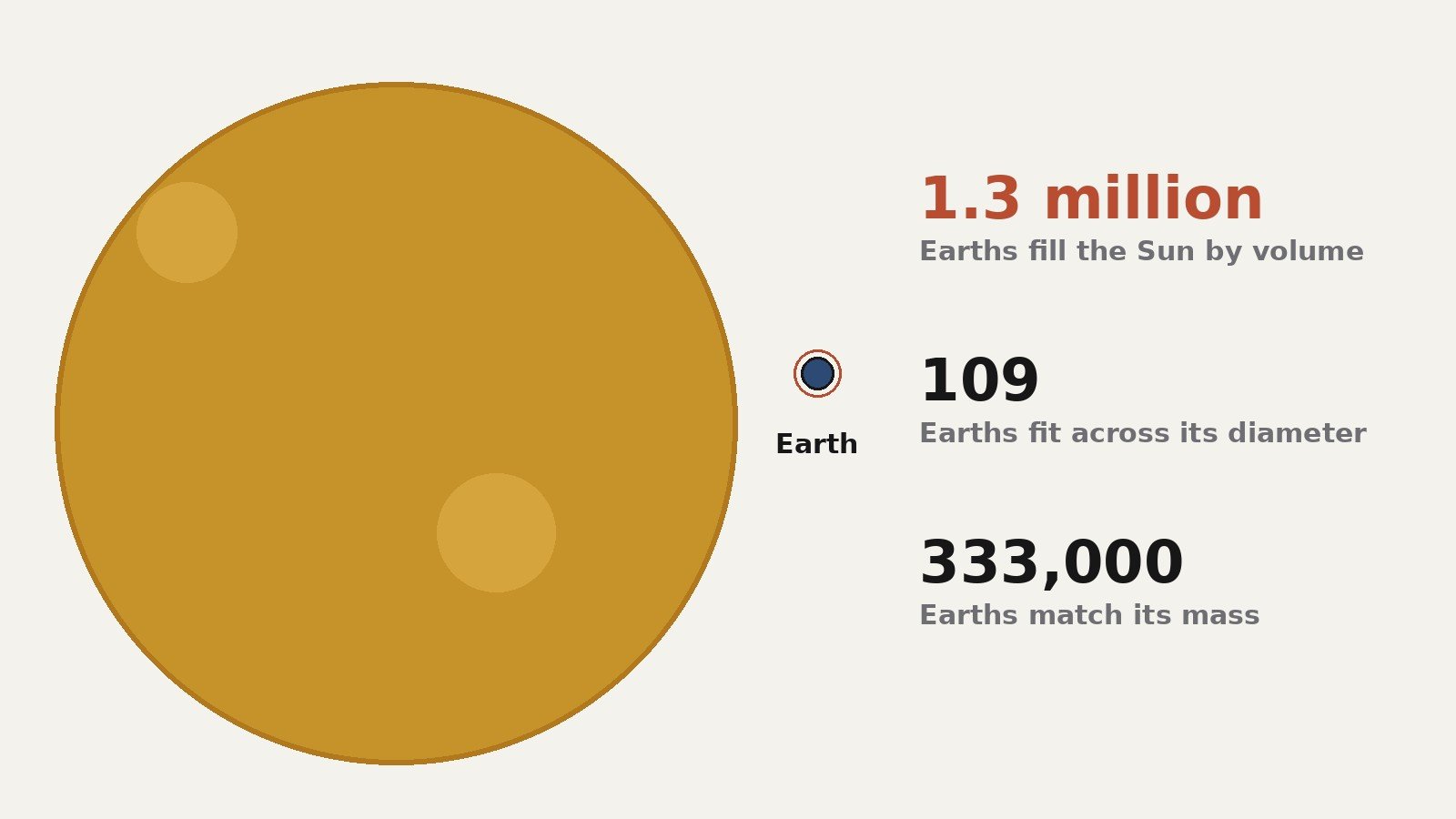
- By volume, about 1.3 million Earths would fit inside the Sun. NASA's Sun fact sheet lists the Sun-to-Earth volume ratio as 1,304,000. By diameter, about 109 Earths would span the Sun's width, and by mass, the Sun weighs about as much as 333,000 Earths. These are three different comparisons that answer three different questions: how much space, how wide, and how heavy. The volume figure also treats Earth as material that pours in without gaps; solid spheres packed together always leave empty space, so about 960,000 Earth-sized balls could physically be packed into the Sun's volume.
Ask how many Earths could fit inside the Sun and you will get one of several numbers: 1.3 million, 109, or 333,000. All three are correct. They just answer different questions. The 1.3 million figure, the one most people are looking for, is a comparison of volumes: it asks how many Earth-sized amounts of space the Sun’s interior contains. The other two numbers compare widths and masses. Confusing them is the most common way this question goes wrong online, and separating them is the whole point of this article. What follows is the volume answer, the arithmetic behind it, the honest caveats about packing spheres, and the diameter and mass comparisons kept carefully distinct.
Why “Fit” Is a Volume Question
When someone asks how many of something can “fit” inside something else, they are asking about three-dimensional space. A suitcase fits more socks than shoes not because the socks are shorter, but because they fill the available volume more completely. The same logic applies to the Sun and Earth. The question is really: how many Earth-sized volumes of space are enclosed by the Sun?
There is a subtlety worth stating up front. The Sun does not have a solid surface. NASA describes it as a huge ball of hydrogen and helium held together by its own gravity, a ball of plasma with no solid boundary. The “surface” we see, the photosphere, is simply the glowing layer where the gas becomes transparent enough for light to escape. So when astronomers talk about the Sun’s volume, they mean the volume enclosed by that visible boundary, the volume of a sphere with the Sun’s radius. That is the container in the comparison, and Earths are the objects being compared to it. Nothing in this article requires the Sun to be hollow; it is an occupied container, and the question is how many Earth-sized portions of its material it would take to fill that much space.
This framing also settles a point that trips up some explanations: the answer is not about destroying the Earths or compressing them. It is a comparison of amounts of space and amounts of matter, the way scientists compare sizes of planets and stars every day.
Where the 1.3 Million Comes From
The authoritative source for the headline number is NASA’s National Space Science Data Center (NSSDC) Sun Fact Sheet, which tabulates the Sun and Earth side by side. Its “Bulk parameters” table gives the volume of the Sun as 1,412,000 x 10^12 cubic kilometers and the volume of Earth as 1.083 x 10^12 cubic kilometers. Divide the first by the second and the ratio comes out to 1,304,000, which the table states directly. In plain language: the Sun’s volume is about 1.3 million times the Earth’s volume, so about 1.3 million Earth-sized volumes of space fit inside the Sun.
NASA states the same figure in plainer words on its public Sun facts page at science.nasa.gov: “it would take 1.3 million Earths to fill the Sun’s volume.” Two NASA sources, the same number, which is reassuring. The slight difference between 1,304,000 and 1.3 million is just rounding: both describe the same measurement. Whenever this article quotes the headline figure, it means 1.3 million as the rounded form of NASA’s 1,304,000.
There is a second, independent way to reach the same answer, and it is worth walking through because it explains why the diameter figure and the volume figure are so wildly different. The NSSDC fact sheet also gives each body’s volumetric mean radius: 695,700 kilometers for the Sun and 6,371 kilometers for the Earth. The ratio is 109.2. Cube that ratio (109.2 x 109.2 x 109.2) and you get about 1,302,000. That is within a fraction of a percent of the direct volume division, and both round to the same headline: about 1.3 million. Two routes, one answer. The tiny difference reflects the rounding of the radii, not a disagreement about the physics.
A word on Earth volume precision is useful here. The Earth is not a perfect sphere; it bulges slightly at the equator because of its rotation. NASA’s fact sheet handles this by using the “volumetric mean radius,” the radius of a perfect sphere that would have the same volume as the Earth. All the figures in this article use that convention, so the comparisons are apples to apples.
Why 109 Becomes 1.3 Million: The Cube Rule
The jump from 109 to 1.3 million surprises people, and it is worth pausing on, because the geometry behind it is the single most useful idea in this article. When you scale an object up in every direction at once, its volume grows with the cube of the scaling factor, not with the factor itself.
Start small. Double the width of a box, and its volume does not double; it grows by a factor of 2 x 2 x 2, which is 8. Make the box ten times wider and it holds 10 x 10 x 10, or 1,000 times as much. Width, depth, and height all grow together, so the multiplier stacks up three times.
Now apply that to the Sun. The Sun is about 109.2 times as wide as the Earth, in every direction at once. So its volume is 109.2 x 109.2 x 109.2 times the Earth’s volume. That is how a width advantage of roughly one hundred turns into a volume advantage of roughly one point three million. The cube rule is also why small errors in a diameter measurement get magnified in a volume estimate, and why scientists prefer to publish the volume ratio directly, as NASA does, rather than leaving everyone to cube the width.
This pattern is everywhere in astronomy. Jupiter is about 11 times Earth’s diameter but about 1,400 times its volume. The same rule that makes the Sun’s volume number look startling is what makes gas giants so much bigger inside than their widths suggest.
Packed Balls vs. Perfect Filling: The Honest Caveat
The 1.3 million figure answers the question “how many Earths’ worth of space is inside the Sun.” It treats Earth as if it were a fluid that could be poured in with no gaps. But if you imagine literal Earth-sized balls being stacked inside a Sun-sized container, the answer changes, because spheres never fill space perfectly. There is always leftover room in the gaps between them.
Geometers have studied this packing problem for centuries. The densest possible arrangement of equal-sized spheres, stacking them the way oranges are stacked at a market, fills about 74 percent of the available space. (This is the solution to the Kepler conjecture, proved in the early 2000s, and it applies to any orderly packing; a random pour fills less, around 64 percent.) Apply the orderly-packing efficiency to the volume ratio: 1,304,000 x 0.74 comes out to roughly 965,000. So about 960,000 solid Earth-sized spheres could physically be packed into the Sun’s volume, with the rest of the space taken up by unavoidable gaps.
Several qualifications keep this honest. First, the packing figure is a calculation, not a NASA-published number; NASA publishes the volume ratio, and the packing correction is geometry applied to it. Second, this is a thought experiment only. In reality, Earth-sized objects dropped into the Sun would be torn apart by its gravity and vaporized by its heat long before any stacking could happen. The 1.3 million remains the standard scientific comparison, the one NASA uses in its educational material, and the packed-spheres number is the physically careful version of it. Both are worth knowing, and now you know which is which.
By Diameter: 109 Earths in a Row
Set aside volume for a moment and ask the width question: how many Earths would it take to stretch across the Sun? The NSSDC fact sheet gives the answer as the volumetric mean radius ratio, 109.2, so about 109 Earths lined up side by side would span the Sun’s diameter. NASA’s public Sun page rounds the same comparison down slightly, saying the Sun is “about 100 times wider than Earth,” which is the same number given one significant figure. This article uses 109 throughout, because that is the figure from NASA’s data table.
For scale, the Sun’s diameter is about 1.4 million kilometers (NASA’s public page) or 865,000 miles. Earth’s mean diameter is 12,742 kilometers. The ratio between them is the 109.2 quoted above.
The diameter comparison is the most visual of the three. If the Sun were shrunk to the size of a basketball, roughly 24 centimeters across, the Earth would be about 2 millimeters wide: smaller than a pea, closer to a peppercorn. Diagrams that show the Sun and Earth side by side usually shrink the Sun dramatically or enlarge the Earth, because a true-to-scale drawing of a 109-to-1 pair is hard to fit on a page while keeping the smaller body visible. That editorial distortion is one reason the real ratio feels surprising when you first meet it.
The width comparison also explains a detail worth knowing. Because the Sun is only about 109 times wider than Earth but 1.3 million times larger by volume, most of the Sun’s interior is simply empty-by-Earth-standards space taken up by diffuse plasma. The Sun is not 1.3 million times wider; it is a hundred-odd times wider in each of three directions at once.
By Mass: About 333,000 Earths
The third comparison asks about weight: how many Earth masses would you need to equal the Sun’s mass? The NSSDC fact sheet lists the Sun’s mass as 1,988,400 x 10^24 kilograms and the Earth’s as 5.9722 x 10^24 kilograms, a ratio of 332,900. NASA’s public page rounds this to “more than 330,000 Earths to match the mass of the Sun.” This article states it as about 333,000, following NASA’s data table with plain-language rounding.
Notice that the mass ratio (about 333,000) is much smaller than the volume ratio (about 1.3 million). That gap has a one-word explanation: density. The Sun is far less dense than the Earth. NASA’s fact sheet gives the Sun’s mean density as 1,408 kilograms per cubic meter, compared with Earth’s 5,514 kilograms per cubic meter, roughly a quarter as dense. The reason is composition. The Earth is made mostly of rock and metal. The Sun is made mostly of hydrogen and helium in the form of hot, diffuse plasma. A given volume of the Sun simply weighs much less than the same volume of the Earth, so it takes fewer Earth masses to match the Sun’s total weight than it would take Earth volumes to fill the Sun’s space.
To put the density in everyday terms: the Sun’s average density is a little more than that of water, which is 1,000 kilograms per cubic meter. If you could somehow find a container big enough, the Sun’s material on average would barely sink in water. (That is a density comparison, not a feasible experiment.) The Earth, at five and a half times water’s density, would sink decisively.
The low average density hides an important internal contrast. The Sun’s material is not uniformly diffuse. Deep in the core, where nuclear fusion takes place, the density reaches about 162,000 kilograms per cubic meter, according to the NSSDC’s model values: more than a hundred times the average. The Sun’s average is low because most of its enormous volume is occupied by far more tenuous gas in its outer layers. The mass comparison and the density comparison together tell the story of what the Sun actually is: a vast, mostly thin ball of hot gas with an extraordinarily dense heart.
Feeling the Scale: A Few Honest Analogies
Raw ratios are hard to feel, so a few worked comparisons help, with the arithmetic shown so you can check them.
Counting to 1.3 million. If you placed one Earth into the Sun every second, without pausing, filling it would take 1,304,000 seconds. That is about 15 days of continuous counting, day and night. Most people’s mental image of “a million” is much smaller than 15 days of seconds.
The basketball Earth. As noted above, shrink the Sun to a basketball (about 24 centimeters) and the Earth becomes a sphere roughly 2 millimeters across. Shrink the Sun to a large beach ball a meter across and the Earth would be about 9 millimeters: smaller than a marble.
Surface area. The Sun’s surface area is about 12,000 times Earth’s. That comes from the same ratio squared rather than cubed (109.2 x 109.2 is about 11,925), because surface area grows with the square of the width. It is a reminder of how the three comparisons scale differently: width by 109, area by about 12,000, volume by about 1.3 million.
The mass context. The Sun accounts for about 99.8 percent of all the mass in the solar system, according to NASA’s Sun overview. Everything else, all eight planets, the dwarf planets, the moons, the asteroids, the comets, and the dust, makes up the remaining two-tenths of a percent. The Earth, for all its importance to us, is a rounding error in the solar system’s mass budget.
Distance does not change the answer. The Sun is about 93 million miles (150 million kilometers) from Earth on average, but that distance is irrelevant to the fit question. The ratios in this article describe the bodies themselves, not their separation. A question that sometimes gets tangled with this one, how far the Earth is from the Sun and why that distance changes, is covered separately (see the internal-link note below).
What the Numbers Say About the Sun Itself
The three ratios together sketch a portrait of the Sun that goes beyond trivia. The Sun is enormous but light for its size: 1.3 million Earth volumes containing only about 333,000 Earth masses. That lightness is why it can be a star at all. A star is a balancing act between gravity pulling inward and the outward pressure of hot gas and radiation pushing back. The Sun’s low average density, a consequence of being mostly hydrogen and helium plasma, is part of that story.
The volume comparison also clarifies what “inside the Sun” means for a star. With no solid surface, the boundary used in these comparisons is the photosphere, the visible layer where the Sun’s gas becomes transparent. Inside that boundary the conditions change gradually, from the thin outer layers down through the convection and radiation zones to the core, where temperatures reach about 15 million degrees Celsius and hydrogen fuses into helium. The 1.3 million Earths would not be stacked in a hollow shell; they are a measure of the total enclosed space, most of it occupied by plasma at steadily increasing temperature and density.
One more piece of context: the Sun is about 4.6 billion years old and roughly halfway through its main lifetime. In about 5 billion years it will expand into a red giant, at which point the volume comparison with the Earth will look very different indeed. For now, though, 1.3 million stands as the measured answer, and it has stood for as long as astronomers have had good values for the Sun’s radius.
Frequently Asked Questions
How many Earths can fit in the Sun?
By volume, about 1.3 million. NASA’s NSSDC Sun Fact Sheet lists the Sun-to-Earth volume ratio as 1,304,000, and NASA’s public Sun page phrases it as “1.3 million Earths to fill the Sun’s volume.” This is a comparison of enclosed space, not a claim that a million solid Earths could be physically stacked inside.
How many Earths fit across the Sun’s diameter?
About 109. The NSSDC fact sheet gives the Sun-to-Earth radius ratio as 109.2, so 109 Earths side by side would span the Sun’s width. NASA’s educational pages sometimes round this to “about 100 times wider,” which is the same measurement given less precisely.
How many Earths equal the Sun’s mass?
About 333,000. The NSSDC fact sheet lists the mass ratio as 332,900, and NASA’s public page says “more than 330,000 Earths to match the mass of the Sun.” The mass ratio is much smaller than the volume ratio because the Sun is far less dense than the Earth.
Why is the mass number so much smaller than the volume number?
Because of density. The Sun’s mean density is 1,408 kilograms per cubic meter versus Earth’s 5,514, so the Sun is roughly a quarter as dense. It is made mostly of hydrogen and helium plasma, while the Earth is rock and metal. Less mass per unit of volume means fewer Earth masses are needed to match the Sun’s total weight.
Could you actually pack Earth-sized spheres inside the Sun?
Not literally, and not completely. Spheres packed together always leave gaps; the densest possible packing fills about 74 percent of the space. Applying that to the volume ratio gives roughly 960,000 Earth-sized spheres, and that is a geometry calculation, not a NASA figure. In reality, anything dropped into the Sun would be destroyed by heat and gravity long before stacking. The 1.3 million figure remains the standard scientific comparison.
Is the Sun really 100 times wider than Earth, or 109?
Both come from NASA. The data table (NSSDC Sun Fact Sheet) gives 109.2 as the volumetric mean radius ratio; NASA’s public-facing page rounds to “about 100 times wider.” They are the same measurement at different precision. This article uses 109 throughout, following the data table.
How big is the Sun compared to Jupiter?
NASA’s Sun page notes the Sun is about 10 times wider than Jupiter, the largest planet. Cubing the data-table diameters gives a Sun volume about 920 times Jupiter’s, while Jupiter’s own volume is about 1,400 times Earth’s, which is consistent with the Sun’s roughly 1.3 million Earth volumes.
Does the Earth-Sun distance affect the answer?
No. The 93-million-mile average distance between the Earth and the Sun has nothing to do with the size ratios. The figures in this article describe the two bodies themselves: their widths, volumes, and masses.
Conclusion
The question “how many Earths can fit in the Sun” has a short answer and a better answer. The short answer is about 1.3 million, from NASA’s measured volume ratio of 1,304,000. The better answer keeps three numbers straight: about 1.3 million by volume, about 109 by diameter, and about 333,000 by mass. The volume number is the one the question asks for; the diameter number explains where it comes from through the cube rule; and the mass number, so much smaller, reveals what the Sun is made of, a vast ball of thin plasma rather than 1.3 million Earth masses of rock. Add the packing caveat, about 960,000 solid spheres with the gaps accounted for, and you have the complete, honest picture: a star whose size is genuinely hard to picture, measured carefully enough that you do not have to take it on faith.
Keep reading: How Far Is Earth From the Sun? The AU, and Why the Distance Changes
Sources & references
- NASA, National Space Science Data Center (NSSDCA), "Sun Fact Sheet" (last updated 9 May 2024, curator Dr. David R. Williams): Sun/Earth comparison table (bulk parameters): volume ratio 1,304,000 (Sun 1,412,000 x 10^12 km3, Earth 1.083 x 10^12 km3); volumetric mean radius ratio 109.2 (Sun 695,700 km, Earth 6,371 km); mass ratio 332,900 (Sun 1,988,400 x 10^24 kg, Earth 5.9722 x 10^24 kg); mean density Sun 1,408 kg/m3 vs Earth 5,514 kg/m3; model central density 1.622 x 10^5 kg/m3; effective temperature 5,772 K.
- NASA Science, "Our Sun: Facts": "it would take 1.3 million Earths to fill the Sun's volume" and "more than 330,000 Earths to match the mass of the Sun"; the Sun is "a huge ball of hydrogen and helium held together by its own gravity"; radius about 435,000 miles (700,000 km); diameter about 865,000 miles (1.4 million km); "about 100 times wider than Earth and about 10 times wider than Jupiter"; the Sun accounts for 99.8% of the solar system's mass; formed about 4.6 billion years ago.


