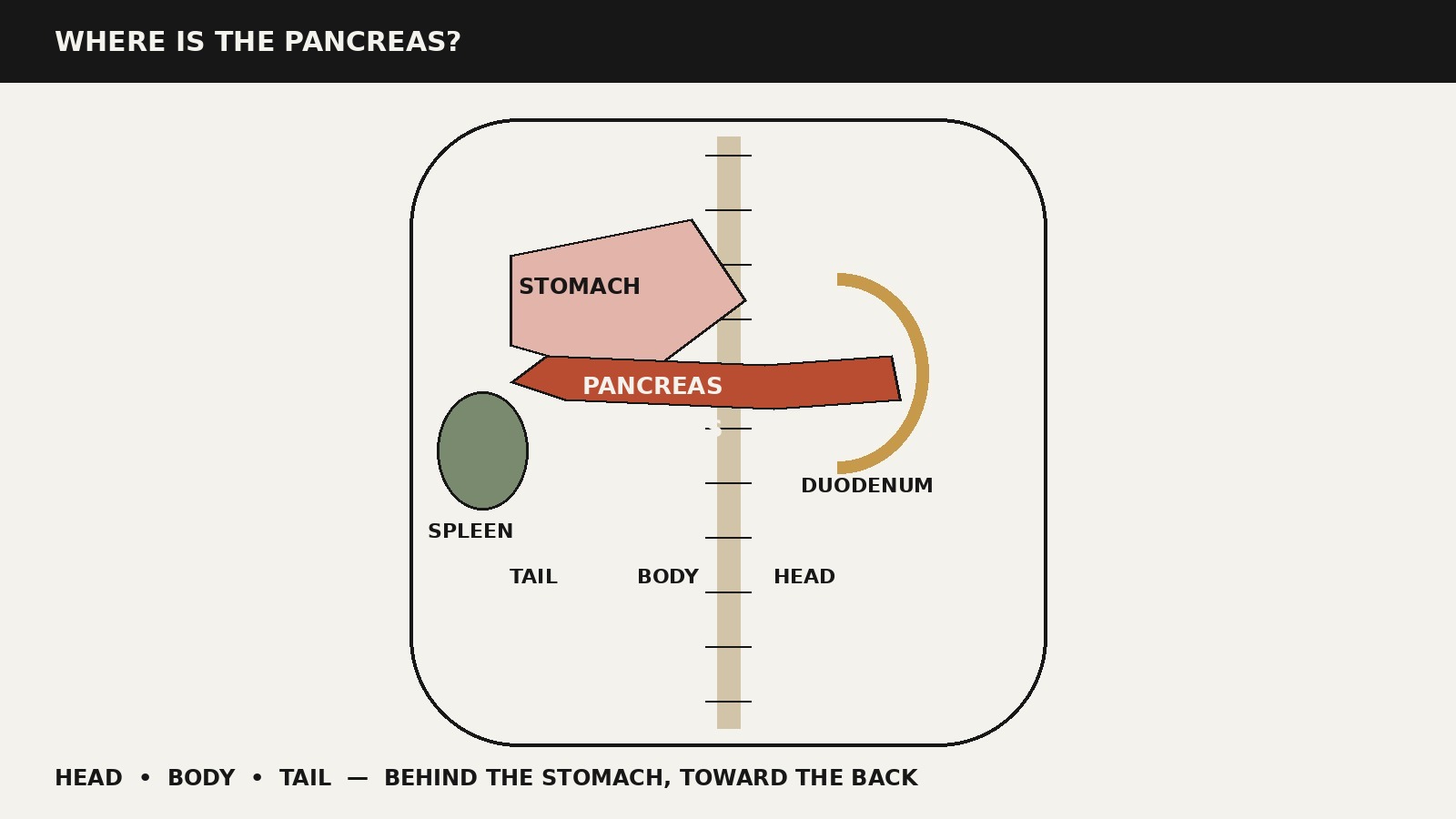
The short answer: Your pancreas sits deep in the upper part of your abdomen, tucked behind the lower part of your stomach and toward the back of your belly. It lies across the body at about the level of your lower ribs, with its wide head on the right cradled by the first part of your small intestine and its narrow tail reaching left toward your spleen.
Meet the organ you can never touch
Some organs announce themselves. Your heart thumps, your lungs rise and fall, your stomach growls. Your pancreas does none of that. It sits silently in one of the most sheltered spots in the human body, buried behind the stomach, in front of the back wall of the abdomen, and wrapped in a neighborhood of busy organs. Most people never think about it until they go looking for a map of their own insides.
That sheltered position is no accident of evolution. The pancreas is a factory with two production lines, and both lines need a safe, stable home. One line makes powerful digestive enzymes, chemicals strong enough to break down the food you eat, and the other makes hormones that travel in your blood and keep your blood sugar steady. An organ doing that kind of chemical work needs to be protected from bumps and jolts, and the body protects it the way you would protect something fragile: by putting it behind something sturdy.
This article gives you a precise, plain-language map of where the pancreas is, which structures sit around it, what it looks like and why its position matters. Every location and measurement below is checked against medical references from the U.S. National Library of Medicine, the National Institute of Diabetes and Digestive and Kidney Diseases and the OpenStax Anatomy and Physiology textbook.
The direct answer, in plain words
The National Institute of Diabetes and Digestive and Kidney Diseases describes the pancreas as “an organ located behind the lower part of your stomach.” MedlinePlus, the U.S. National Library of Medicine’s patient encyclopedia, places it “in the upper part of the abdomen, behind the stomach” and adds that it “resides in the back of the abdomen.”
Put those descriptions together and you get the complete picture:
- Depth: behind the stomach, toward the back of the abdominal cavity.
- Height: in the upper abdomen, roughly at the level of the bottom of your rib cage.
- Orientation: lying across the body, slightly tilted, like a fish stretched out sideways.
- Span: from the right side of the abdomen, where it meets the small intestine, to the left side, where it ends near the spleen.
The pancreas is sometimes described as a “retroperitoneal” organ, which is the technical word for that back-of-the-belly position. We will unpack that word in a moment, because understanding it is the key to understanding why the pancreas feels so hard to place on your own body.
Where to point: finding it on your own body
You cannot feel your pancreas, and no doctor would try to find it by pressing on your belly. But you can learn exactly where it sits under your skin.
Stand up straight and place your hand flat on the center of your upper belly, just below where your ribs meet in the middle. The pancreas lies underneath that spot, but much deeper than you might expect. It sits behind the stomach, and the stomach itself sits behind the abdominal muscles and a layer of other tissue. Between your hand and the pancreas there is skin, muscle, the front of the stomach and more. The organ is roughly six inches long, and it runs more or less horizontally across your body at that height, with a slight tilt.
Think of it this way. If your torso were a house, the pancreas would not be in the front room. It would be in the room at the very back of the house, behind the kitchen (the stomach), up against the rear wall. The MedlinePlus description that it “resides in the back of the abdomen” is the single most useful phrase for picturing this. It is not a surface organ. It is a back-wall organ.
Because the head of the pancreas sits on the right and the tail on the left, the organ stretches across the middle of your upper abdomen. The head sits slightly lower on the right, and the tail runs up and to the left from there, ending at the spleen in front of the left kidney, with the spleen itself tucked up under the left side of the rib cage.
What “behind the stomach” really means: the retroperitoneum
Anatomy textbooks use a special word for the pancreas’s neighborhood: the retroperitoneum. The word sounds complicated, but it breaks down simply. “Peritoneum” is the name of the thin membrane that lines the inside of your abdominal cavity and wraps around most of your abdominal organs, like cling film around leftovers. “Retro” means behind. So a retroperitoneal organ is one that sits behind that lining, between the lining and the muscles and bones of the back wall of the abdomen.
The OpenStax Anatomy and Physiology textbook, published by Rice University, describes the pancreas as lying “transversely in the retroperitoneum behind the stomach.” “Transversely” just means across, from one side to the other, rather than up and down.
This detail matters more than it might seem. Most of the organs you can picture easily, like the stomach, the liver and the intestines, sit inside the peritoneal cavity, wrapped in that membrane. The pancreas sits behind it. The one exception is the tail, which leaves the back wall and travels inside a fold of peritoneum, the splenorenal ligament, for its final stretch to the spleen, so anatomists count the tail alone as sitting inside the peritoneal cavity. That is one more layer of protection, and one more reason the pancreas is so well hidden. It also explains why surgeons describe the pancreas as an organ you have to go looking for: it is not the first thing you see when the abdomen is opened. It is the thing you find after moving other structures aside.
The three parts: head, body and tail
The pancreas is not a uniform blob. Like a tadpole or a comma, it has a thick end and a thin end, and anatomists divide it into three main regions. Each region has its own neighbors, which is why knowing the parts helps you place the whole organ.
The head
The head is the wide, rounded end of the pancreas, and it sits on the right side of the abdomen. It is nestled into the “C-shaped” curvature of the duodenum, which is the first, shortest part of the small intestine. Picture the letter C lying on its side, and the head of the pancreas sitting snugly inside the curve.
This is not a casual relationship. The head of the pancreas and the duodenum work as a team. The pancreas releases its digestive juices through ducts that empty into the duodenum, right where food arrives after leaving the stomach. The head being wrapped in the duodenum’s curve puts the factory next to its delivery point.
The body
From the head, the pancreas narrows slightly into the body, the middle section. The body stretches to the left across the abdomen, running behind the stomach. The OpenStax textbook gives the total reach of the organ as about 15.2 centimeters, roughly six inches, measured from the head across to the tip of the tail.
The body is the section that lies most directly behind the stomach and most squarely against the back wall of the abdomen. Between the head and the body there is a short, slightly pinched section that some textbooks call the neck, but for most readers the three-part picture of head, body and tail is enough.
The tail
The tail is the thin, tapering end of the pancreas. It reaches across to the left side of the abdomen and ends in the hilum of the spleen. The hilum is the indented spot on an organ where blood vessels enter and leave, so you can picture the tail of the pancreas pointing into the inner curve of the spleen like a finger pointing at a target.
MedlinePlus describes the whole organ as “an elongated, tapered gland,” and the tail is where that tapering is most obvious. The tail is the part of the pancreas that sits farthest to the left and slightly higher than the head.
The neighborhood: what sits around the pancreas
One of the best ways to fix an organ’s position in your mind is to learn its neighbors. The pancreas lives in crowded company, and each neighbor helps explain something about it.
In front: the stomach. The stomach is the pancreas’s most famous neighbor, because “behind the stomach” is how nearly every medical reference describes the organ’s location. The stomach is a muscular, J-shaped pouch that sits in the upper left of the abdomen. The pancreas lies directly behind its lower portion. When your stomach is full, it expands forward and downward, and the pancreas stays put behind it.
To the right: the duodenum and the liver. The duodenum, the first part of the small intestine, curves around the head of the pancreas in that C shape. Above and to the right sits the liver, the largest internal organ, tucked under the right ribs. The liver matters to the pancreas because the two organs share plumbing: the pancreatic duct joins the common bile duct coming from the liver, and the two empty together into the duodenum. MedlinePlus describes exactly this arrangement, noting that the pancreatic duct “joins the common bile duct from the liver and drains into the small intestine.”
To the left: the spleen. The spleen is a fist-sized organ tucked under the left ribs, and the tail of the pancreas points straight at it. The spleen filters blood and helps the immune system, and it has nothing to do with digestion, but its position makes it the pancreas’s left-hand landmark.
Behind: the back wall of the abdomen. This is the wall of muscle and, deeper still, the spine and the great blood vessels that run in front of it. The pancreas rests against this back wall, which is why MedlinePlus says it resides in the back of the abdomen.
Around it: the bile ducts. The common bile duct, carrying bile from the liver and gallbladder, passes near the head of the pancreas before joining the pancreatic duct. This shared doorway into the duodenum is called the hepatopancreatic ampulla. It is a small detail, but it explains why the head of the pancreas and the bile system are always described together.
Size and shape
The pancreas is a soft, oblong, glandular organ, in the words of the OpenStax textbook. MedlinePlus calls it “elongated” and “tapered,” which captures its essential look: thick at one end, thinning toward the other.
In an adult, the pancreas measures about 15.2 centimeters from the head to the tip of the tail, which is roughly six inches. To picture that, hold your hand flat with your fingers together: the pancreas is about as long as the width of an adult hand. It is a small organ for the amount of work it does, which is part of why it hides so well. There is simply not much of it to find, and what there is sits behind larger structures.
Its texture is soft and slightly lobed, more like a gland than like a muscle. It does not have the firm, smooth capsule of an organ like the kidney. It is a working gland, built for making and moving fluids, not for withstanding pressure.
What the pancreas actually does: two jobs in one organ
Location and function are linked in the body, and the pancreas is a perfect example. Its position, tucked between the stomach and the small intestine with ducts emptying into the duodenum, exists to serve its two jobs. The OpenStax textbook calls it “a curious mix of exocrine and endocrine functions,” and those two words describe the two production lines.
Job one: digestive enzymes (the exocrine job)
“Exocrine” means secreting outward through ducts, and the pancreas is one of the body’s great exocrine glands. Every day it produces over a liter of pancreatic juice, a clear fluid made mostly of water, salts, sodium bicarbonate and digestive enzymes.
The National Institute of Diabetes and Digestive and Kidney Diseases explains the essence of this job simply: the pancreas “makes a digestive juice that has enzymes that break down carbohydrates, fats, and proteins,” and “delivers the digestive juice to the small intestine through small tubes called ducts.”
The enzymes in that juice digest the three main types of nutrients: sugars, proteins and fats. The juice also contains sodium bicarbonate, which gives pancreatic juice a slightly alkaline character. That alkalinity matters, because food arrives in the small intestine mixed with strong stomach acid. The bicarbonate neutralizes that acid, protecting the lining of the intestine and creating the right conditions for the enzymes to work.
Here is a detail that shows how carefully the body handles this chemistry. The pancreas makes its protein-digesting enzymes in an inactive form. They only switch on once they reach the duodenum. The reason, as the OpenStax textbook notes, is blunt: if they were produced in their active form, they would digest the pancreas itself. Enzymes that digest starch, fat and nucleic acids are secreted ready to work, because they do not attack pancreatic tissue the way the protein-digesting ones would.
Job two: hormones for blood sugar (the endocrine job)
“Endocrine” means secreting inward, into the blood. Scattered through the pancreas are tiny clusters of hormone-making cells called the islets of Langerhans. According to the OpenStax textbook, these islets produce four hormones: insulin, glucagon, somatostatin and pancreatic polypeptide.
The two most famous are insulin and glucagon, and MedlinePlus names both. Insulin helps control the amount of sugar in the blood by moving sugar into the body’s cells, where it can be used for energy. Glucagon works in the opposite direction, raising blood sugar when it runs low. Together they keep blood sugar within a steady range.
The National Institute of Diabetes and Digestive and Kidney Diseases sums up the dual role in a single sentence: the pancreas “makes the hormone insulin to control blood glucose and also makes enzymes and fluids for digestion.” That is the whole organ in one line: a blood-sugar gland and a digestive-juice factory sharing one small, well-hidden body.
Why you cannot feel it
Given all of this, it is worth stating plainly: you cannot feel your pancreas from the outside, and pressing on your belly will not reveal it. Several layers of anatomy stand in the way. The skin and the abdominal muscles come first. Then come the organs of the front of the abdomen, including the stomach and the intestines. Only behind those, against the back wall of the abdominal cavity and behind the peritoneal lining, does the pancreas lie. It is also a soft organ, without a firm edge that fingertips could detect even if they could reach it.
This is also why the pancreas is located the way it is in medical imaging rather than by touch. In a living person, the organ’s position is mapped with scans that can see through the layers, not with hands. For the curious reader, that is the practical takeaway: the pancreas is an organ you learn about through diagrams and descriptions, not through feeling for it.
Why this position matters: the back connection
The pancreas’s address explains one of the most commonly described things about it: that sensations connected with the pancreas are often felt in the back rather than in the front of the belly. The anatomy makes the reason clear. The body and tail of the pancreas lie in the retroperitoneum, directly against the back wall of the abdomen, with the spine and its nerves just behind that wall. An organ pressed against the back wall will naturally make its presence known toward the back.
This is an anatomical explanation, not a medical one. It describes why the wiring runs the way it does, the way you might explain why a sound seems to come from behind a wall. It does not describe any condition or symptom, and this article does not go there. See a clinician for persistent or severe abdominal pain.
Frequently asked questions
Which side is the pancreas on?
Both sides, in a sense. The pancreas stretches across the upper abdomen. Its wide head sits on the right side, nestled in the curve of the duodenum, and its narrow tail reaches to the left, ending near the spleen. So the organ as a whole crosses the midline, with the head right and the tail left.
Is the pancreas in front of or behind the stomach?
Behind it. The National Institute of Diabetes and Digestive and Kidney Diseases defines the pancreas as “an organ located behind the lower part of your stomach,” and MedlinePlus places it “in the upper part of the abdomen, behind the stomach.” The stomach is the front neighbor; the pancreas is the organ hiding behind it.
Is the pancreas under the ribs?
Roughly at that level, but deeper. The pancreas sits in the upper abdomen at about the height of the lower ribs, running horizontally behind the stomach. The ribs protect the upper abdomen from the front and sides, while the pancreas itself sits behind the stomach and toward the back wall of the abdomen.
Can you feel your pancreas?
No. It lies too deep. Between your hand and the pancreas are skin, abdominal muscle, the stomach and other front-of-abdomen organs, plus the peritoneal lining. The pancreas is also soft and only about six inches long, with no firm edge to detect. Its position is mapped with medical imaging, not by touch.
Why do people say pancreas trouble is felt in the back?
Because of where the organ sits. The body and tail of the pancreas lie against the back wall of the abdomen, close to the spine. That back-wall position is the anatomical reason sensations from the area are often perceived in the back rather than the front. This is a description of anatomy, not of any medical condition.
What does the pancreas do?
It does two jobs. As an exocrine gland, it makes over a liter of digestive juice a day, containing enzymes that break down sugars, proteins and fats, plus bicarbonate that neutralizes stomach acid; the juice travels through ducts into the small intestine. As an endocrine gland, its islets of Langerhans release hormones into the blood, including insulin and glucagon, which keep blood sugar steady.
Keep reading: Kidney Location in Body: Where Your Kidneys Are
Sources & references
- National Institute of Diabetes and Digestive and Kidney Diseases (NIDDK), "pancreas - Definition": "An organ located behind the lower part of your stomach. The pancreas makes the hormone insulin to control blood glucose and also makes enzymes and fluids for digestion."
- NIDDK, "Your Digestive System & How it Works": "Your pancreas makes a digestive juice that has enzymes that break down carbohydrates, fats, and proteins. The pancreas delivers the digestive juice to the small intestine through small tubes called ducts."
- MedlinePlus Medical Encyclopedia, "Pancreatitis - series - Normal anatomy": "The pancreas is located in the upper part of the abdomen, behind the stomach... The pancreas secretes these enzymes into the pancreatic duct, which joins the common bile duct from the liver and drains into the small intestine."
- MedlinePlus Medical Encyclopedia, "Pancreas" image page: "The pancreas is an elongated, tapered gland that is located behind the stomach and secretes digestive enzymes and the hormones insulin and glucagon."
- MedlinePlus Medical Encyclopedia, "Pancreas transplant - series - Normal anatomy": "The pancreas resides in the back of the abdomen... One of the most important hormones produced by the pancreas is insulin. Insulin is produced by specialized cells of the pancreas called islets of Langerhans. Insulin regulates blood sugar levels."
- OpenStax, Anatomy and Physiology 2e (Rice University), section 23.6 "Accessory Organs in Digestion: The Liver, Pancreas, and Gallbladder": "The soft, oblong, glandular pancreas lies transversely in the retroperitoneum behind the stomach. Its head is nestled into the 'c-shaped' curvature of the duodenum with the body extending to the left about 15.2 cm (6 in) and ending as a tapering tail in the hilum of the spleen." Also: exocrine/endocrine mix; islets of Langerhans produce pancreatic polypeptide, insulin, glucagon and somatostatin; over a liter of pancreatic juice per day; enzymes digest sugars, proteins and fats; sodium bicarbonate buffers acidic chyme; main pancreatic duct fuses with the common bile duct and enters the duodenum via the hepatopancreatic ampulla.


