Short answer
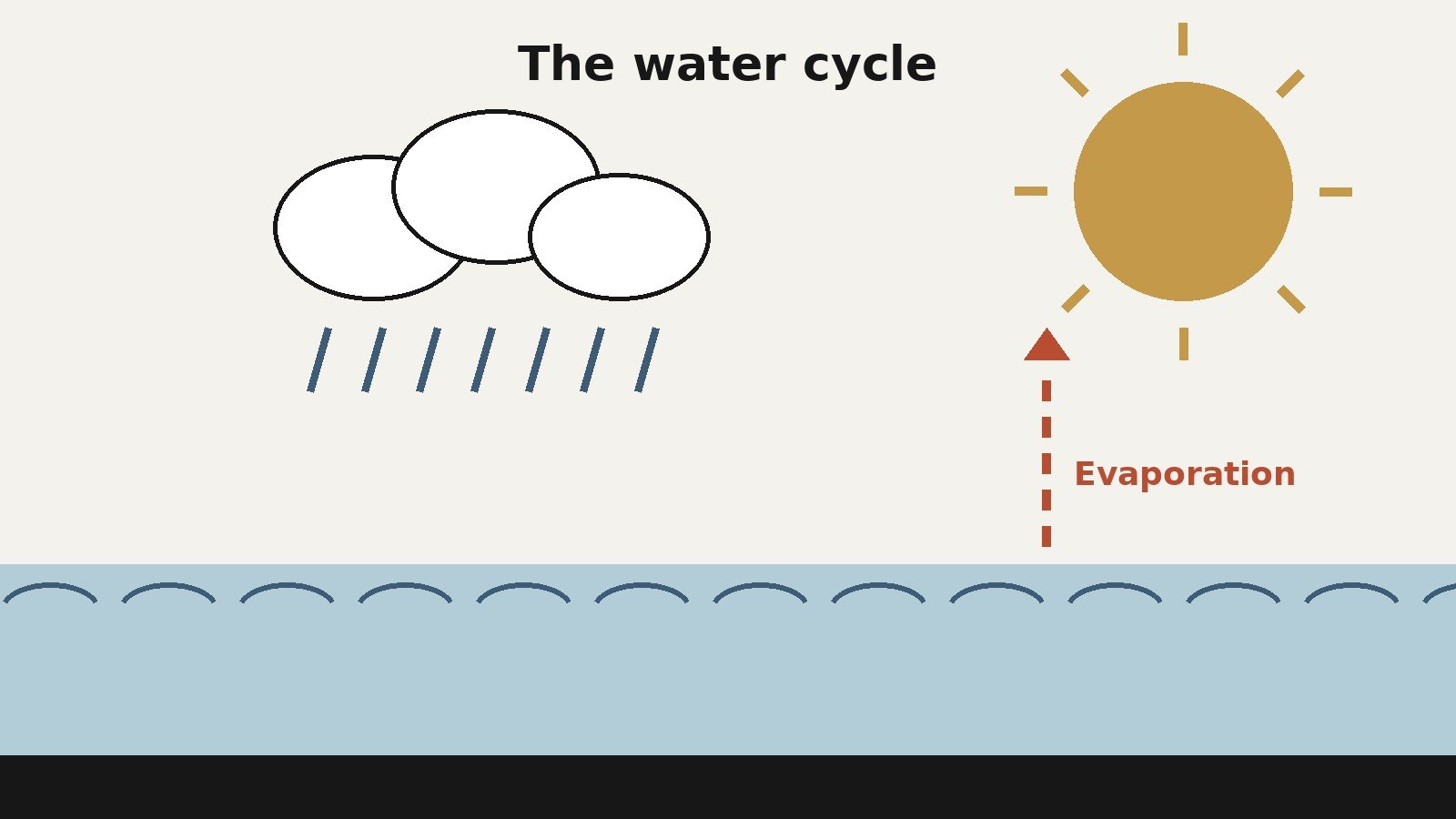
- The water cycle, also called the hydrologic cycle, is the continuous movement of water on, above, and below the surface of Earth. Water evaporates into the air, condenses into clouds, and returns to Earth as rain, snow, sleet, or hail, as NASA's Global Precipitation Measurement mission describes it. From there it may flow over land, soak into the ground, sit in a lake or glacier, or be taken up by plants, before the journey starts again. Energy from the sun and the force of gravity drive the whole system, according to the United States Geological Survey (USGS). There is no single starting point and no finish line. The same water keeps moving through different places and different forms, again and again. --- Every glass of water you drink, every raindrop on a window, and every cloud in the sky is part of one long journey. The water in that glass was not made yesterday. It has moved through oceans, skies, rivers, soil, plants, and ice, changing form as it went, and it will keep moving long after you have finished drinking it. That journey is the water cycle. It delivers fresh water to land, shapes weather, feeds plants and animals, and connects places that seem far apart, from a mountain glacier to a city tap. This article explains the water cycle in full: its definition, each stage, where Earth's water is stored, different journeys a drop of water can take, and how people change the cycle. By the end, the simple four-step diagram from school, evaporation, condensation, precipitation, and collection, will make more sense, because you will also know about the slower, hidden parts of the cycle that the diagram usually leaves out.
What the Water Cycle Means
The USGS gives a definition that is worth learning: the water cycle, also known as the hydrologic cycle, describes where water is stored on Earth and how it moves. That definition has two halves, and both matter. The first half is storage: water sits in the atmosphere, on the land surface, and below the ground. The second half is movement: water travels between those stores, at large scales through watersheds, the atmosphere, and below Earth’s surface, and at very small scales in people, in plants, and in other organisms.
Scientists use “hydrologic cycle” and “water cycle” to mean the same thing. The word “cycle” matters too. A cycle has no beginning and no end. Textbooks often start with evaporation from the ocean because the ocean is the largest store, but that is a teaching convenience, not a true starting point. A drop of water could just as well begin its story in a cloud, in a glacier, in a plant leaf, or deep underground.
Water is unusual, and that unusual quality is what makes the cycle possible. NOAA’s Ocean Today program puts it plainly: water is the only substance that naturally exists in three states on Earth, solid, liquid, and gas. Ice is the solid form. Liquid water fills oceans, rivers, and lakes. Water vapor, an invisible gas, floats in the atmosphere. Water shifts between all three, and each shift moves it to a new part of the cycle.
Two forces keep the cycle turning. The first is energy from the sun, which heats water and lifts it into the air. The second is gravity, which pulls water back down and pulls it downhill once it lands. The USGS names both forces directly: energy from the sun and the force of gravity drive the continual movement of water on Earth. Almost every stage described below is either sun lifting water up, gravity pulling water down, or water pausing in storage in between.
The Classic Four Stages
Most school diagrams show four stages. They are a good summary, but each one hides a lot of detail. Here they are, with what actually happens inside each one.
1. Evaporation: liquid water becomes vapor
Evaporation is the change of liquid water into water vapor, an invisible gas. Heat from the sun warms the surface of oceans, lakes, rivers, wet soil, and even puddles, and some water molecules gain enough energy to escape into the air. You cannot see water vapor. The white wisps rising from a hot cup are not vapor itself but tiny liquid droplets formed when vapor cools, a distinction that matters later in this article.
The ocean dominates this stage simply because it holds most of Earth’s water. NOAA notes that over 96 percent of total global water is in the ocean, so most evaporation starts there. But evaporation happens everywhere water sits in the open air, from a farm pond to a damp forest floor. Warm, dry, windy conditions speed it up. Cool, humid, still conditions slow it down.
Evaporation also purifies water in a practical sense. When liquid water turns to vapor, it leaves most salts and other dissolved material behind. That is why rain, which starts as evaporated water, is fresh even when much of it evaporated from salty oceans. The salt stays in the sea. The fresh water travels in the sky.
2. Condensation: vapor becomes cloud
As water vapor rises, the air around it gets colder. Cold air cannot hold as much vapor as warm air, so the vapor condenses, changing back into tiny liquid droplets, or, in very cold air, into tiny ice crystals. Those droplets cluster around microscopic particles in the air, such as dust, salt, or pollen, and together they form clouds and fog. Fog is simply a cloud that has formed at ground level.
Condensation is the reverse of evaporation, and it releases the heat that evaporation absorbed. That heat exchange is one reason storms carry so much energy. It also explains why a cloud looks solid from a distance but feels like nothing at all when you walk through one. A cloud is not a floating lake. It is a crowd of droplets so small and light that rising air can hold them up, at least for a while.
3. Precipitation: water returns to Earth
When cloud droplets collide and grow heavy enough, rising air can no longer hold them up, and they fall. That falling water is precipitation. NASA’s Global Precipitation Measurement mission lists the main forms: rain, snow, sleet, and hail. Rain is liquid droplets. Snow is ice crystals that have grown into flakes. Sleet is rain that has frozen into small ice pellets on the way down. Hail is larger ice pellets built up inside strong storm clouds.
Where precipitation falls decides what happens next. Rain that falls on the ocean returns to the largest store at once. Rain that falls on land has a longer and more varied journey ahead, and that land journey is where the rest of the cycle happens.
4. Collection: water gathers again
Collection is water gathering again after precipitation. Rain and snowmelt gather in oceans, lakes, and rivers, sit in glaciers, or soak into groundwater stores. From those stores, water waits until the sun lifts it back into the air, and the cycle starts again.
The Hidden Stages Most Diagrams Skip
The four classic stages tell only half the story. Between precipitation and the next round of evaporation, water can take several other paths, and some of them are slow, hidden, and very important.
Transpiration: plants breathe water into the sky. Plants move a large amount of water too. Roots draw water from the soil, it travels up through stems, and it escapes through tiny pores in leaves, mostly on the underside, as water vapor. This is transpiration. A single large tree can release a remarkable amount of water on a hot day, and a whole forest releases enough to affect local humidity and rainfall.
Scientists often combine evaporation and transpiration into one word, evapotranspiration, because both send water vapor into the atmosphere and both are hard to measure separately in the field. For the water cycle, the key point is that living things are not just passengers. Plants actively move water from the ground to the sky, and they do it every day they are growing.
Sublimation: ice straight to vapor. Ice does not always have to melt before it can enter the atmosphere. Under dry, cold, windy conditions, ice and snow can turn directly into water vapor without first becoming liquid. This is sublimation. It happens on glaciers, on snowfields, and on mountaintops, and it is one reason snow can shrink on a cold, sunny day even when the temperature stays below freezing.
Infiltration and percolation: soaking in. Water that does reach the ground may soak into the soil. That downward entry is infiltration. Once inside, water keeps moving downward through soil and rock under gravity, a process called percolation. How far and how fast it goes depends on the ground. Sandy soil lets water through quickly. Clay holds it back. Dry soil soaks up a shower eagerly, while soil that is already soaked, or ground that is paved over, lets most water run off instead.
Groundwater flow: the slow underground river. Water that percolates deep enough becomes groundwater, water stored in the spaces between grains of soil and cracks in rock. The USGS is careful about the picture here, because the common image is wrong. Groundwater is not usually a large underground lake or river. The USGS compares it instead to liquid trapped in a sponge, or liquid in a glass of ice water. Water sits in tiny pores and moves slowly through them, sometimes emerging later at a spring, seeping into a river, or being drawn up by a well. A river can carry water to the sea in days or weeks. Groundwater may take years, decades, or far longer to travel the same distance. That slowness matters for water supply, because groundwater is a store that refills slowly and can be drawn down faster than nature replaces it.
Runoff and streamflow: water on the move over land. Water that does not soak in flows over the surface. This is runoff. It gathers in small channels, then streams, then rivers, and rivers carry it back toward lakes or the sea. Runoff shapes the land as it goes, carrying soil and nutrients, and, in floods, reshaping whole valleys. NOAA’s description of the cycle follows this path directly: snow melts back into a liquid and runs off into a lake or river, which flows back into the ocean, where the process starts again.
Snowmelt: the delayed release. Snow is storage with a timer. A winter snowpack holds water in solid form for months, then releases it as meltwater in spring. That delayed release is vital in mountain regions, where spring snowmelt fills rivers and reservoirs just as the growing season begins. If winter brings rain instead of snow, or if a warm spell melts the snowpack early, the timing of that release changes, and farms and towns downstream feel the difference months later.
Where Earth’s Water Is Stored
The USGS estimates that Earth holds about 1,386,000,000 cubic kilometers of water in total. The table below, drawn from USGS figures, shows how that total is divided. The numbers are estimates, not exact counts, because some stores, especially deep groundwater, cannot be measured directly everywhere. But the proportions are clear, and they explain a lot about why fresh water is precious.
| Store | Estimated volume (cubic kilometers) | What it means |
|---|---|---|
| Oceans (saline) | 1,338,000,000 | The overwhelming majority of Earth’s water, and salty |
| Ice caps and glaciers (fresh) | 24,064,000 | The largest store of fresh water, but mostly locked in ice |
| Groundwater (fresh and saline) | 23,400,000 | The second largest store after ice caps and glaciers, hidden underground; the figure covers fresh and saline groundwater combined |
| Lakes, streams, and swamps (fresh) | 104,590 | A tiny share, but the most visible fresh water |
| Lakes (saline) | 85,400 | Salty lakes, not usable as drinking water without treatment |
Two lessons follow from this table. First, almost all water on Earth is salty ocean water. Second, most fresh water is locked away as ice or hidden underground. The rivers and lakes people picture when they think of fresh water hold only a small fraction of the total. That is why protecting groundwater, managing reservoirs, and using fresh water carefully matter so much. The water cycle moves water around, but it does not turn salty ocean water into fresh water on land except through evaporation and precipitation, and that natural process happens on nature’s timetable, not ours.
The atmosphere, by comparison, holds a very small amount of water at any moment, yet it is the great transporter of the cycle. Water passes through the atmosphere quickly, falling as precipitation and evaporating again, so a small store can move a large amount of water over a year.
What Drives the Cycle: Sun and Gravity
Every stage of the water cycle traces back to two drivers. The sun supplies heat. Gravity supplies direction. Sunlight warms the surface and gives water molecules the energy to evaporate, to transpire from plants, and to rise. Warm air rises, carrying vapor with it. As that air climbs, it cools, and condensation follows. Without solar energy, water would sit still. With it, water is constantly being lifted into the sky.
Gravity does the rest. It pulls condensed droplets down as precipitation. It pulls runoff downhill into streams and rivers. It pulls infiltrating water down through soil and rock into aquifers. It holds the ocean in its basin and pulls rivers toward the sea. Sun without gravity would scatter water into the sky and never bring it back. Gravity without sun would leave water pooled in the lowest places, never lifted to fall as rain on land.
Three Journeys of a Single Drop
The cycle is easier to grasp through examples. Follow one drop of water, and see how different its journey can be depending on where it lands.
Journey 1: The quick round trip. A drop evaporates from the surface of the Atlantic Ocean on a warm morning. It rises, cools, and condenses into a cloud. Wind carries the cloud a short distance, and by afternoon the drop falls as rain back into the same ocean. In this illustration, its whole journey takes a day or two. This is the shortest, simplest version of the cycle: water that evaporates from the ocean and falls straight back into it.
Journey 2: The long land journey. Another drop evaporates from the same ocean but travels further inland. It falls as rain on a forested hillside. Some soaks into the soil, is taken up by tree roots, and transpires back into the air days later. Some runs off into a stream, joins a river, and, in this illustration, reaches the sea weeks later. And some percolates deep into the ground, becoming groundwater that may not reach a spring or a river for many years. One rainfall, many fates, all part of the same cycle.
Journey 3: The long freeze. A third drop falls as snow on a high mountain glacier. It does not melt that summer, or the next. It is buried by more snow, compressed into ice, and creeps slowly downhill inside the glacier. It may stay locked in ice for decades, centuries, or far longer before the glacier finally reaches warmer air, melts, and releases it into a meltwater stream. NOAA makes this point directly: instead of melting and running off, snow can become part of a glacier and stay there for a very long time. The water cycle has fast lanes and slow lanes, and the glacier is the slowest lane of all.
These three journeys show why the cycle cannot be reduced to a single loop with a single speed. Water moves at many speeds at once. Some water returns to the sea in days. Some waits in ice or deep groundwater for ages. The cycle is one system, but it runs on many clocks.
Why the Water Cycle Matters
The water cycle matters because almost everything living depends on fresh water arriving in the right place at the right time, and the cycle is the delivery system.
First, it delivers fresh water to land. Oceans hold most water, but ocean water is salty and undrinkable without treatment. Evaporation leaves the salt behind, so precipitation delivers fresh water to farms, forests, towns, and reservoirs. Without that delivery, land would dry out and life on land could not survive.
Second, it shapes weather and climate. Clouds, rain, snow, storms, and humidity are all stages of the water cycle made visible. Evaporation cools surfaces. Condensation warms the air and powers storms. Snow cover reflects sunlight and cools regions. The cycle does not just respond to weather. In large part, it is weather.
Third, it sustains ecosystems. Wetlands, rivers, lakes, forests, and grasslands all depend on water arriving through precipitation, runoff, and groundwater. Fish need flowing rivers. Trees need soil moisture. When the timing or amount of water changes, whole ecosystems feel it.
Fourth, it underpins human life in practical ways NOAA lists together: the economy, energy production and use, health, recreation, transportation, agriculture, and drinking water. Farmers need rain or irrigation at planting and growing time. Cities need reservoirs filled by rain and snowmelt. Power stations need cooling water. Every one of those needs is a water cycle need, even when it is not labeled as one. That is also why NOAA calls understanding the water cycle one of its Grand Science Challenges.
How People Change the Water Cycle
The USGS states the human part of the story plainly: water moves both naturally and through the actions of humans, and human activities impact the water cycle by affecting where water is stored, how it moves, and how clean it is. Those three effects, storage, movement, and cleanliness, are a good way to organize what people do.
Changing where water is stored. Dams store water in reservoirs, holding back rivers and changing when water flows downstream. Pumping groundwater lowers water tables and shrinks an underground store that took a long time to fill. Draining wetlands removes a natural store that once held floodwater and released it slowly.
Changing how water moves. Paving land changes movement dramatically. A forest floor soaks up rain. A parking lot does not. Rain on pavement runs off fast, carrying oil and litter into drains and rivers, and it does not recharge groundwater on the way. Cutting down forests reduces transpiration, which can reduce local rainfall, because fewer trees mean less water vapor rising from the land.
Changing how clean water is. Pollution changes the third part of the USGS list, cleanliness. Fertilizer and pesticides washed from fields, sewage leaks, industrial waste, and road runoff can all contaminate rivers, lakes, and groundwater. Contaminated water is still part of the cycle. It evaporates, precipitates, runs off, and soaks in, carrying pollutants with it. Cleaning up a polluted aquifer is slow precisely because groundwater moves slowly.
None of this means people are outside the water cycle. People are inside it. Every town, farm, and factory sits in a watershed, the area of land that drains into a particular river or lake, and everything done in that watershed eventually touches the water cycle. The question is not whether people affect the cycle, but how carefully they do so.
The Water Cycle and a Changing Climate
Because the water cycle is driven by heat, it responds when temperatures change. Warmer air and warmer oceans change how much water evaporates and where it falls. The broad expectation, grounded in the sun driven mechanism described above, is a cycle that runs faster and more unevenly in places: more evaporation in some regions, heavier downpours in others, and longer dry spells where rain becomes less reliable.
Common Misconceptions
Misconception 1: Water is used up. Water is not used up in the way fuel is used up. When you drink water, it passes through your body and returns to the environment. When a plant takes up water, much of it transpires back into the air. Water can be moved, stored, polluted, or made temporarily unavailable, but the cycle keeps it moving. Shortages happen when water is in the wrong place, at the wrong time, or too dirty to use, not because the planet has run out of water molecules.
Misconception 2: Clouds are made of water vapor. Clouds are not made of invisible vapor. They are made of tiny liquid droplets, or ice crystals in cold clouds, formed when vapor condenses. Water vapor itself is invisible. If you can see it, you are looking at liquid or ice, not vapor.
Misconception 3: Groundwater is an underground lake. As the USGS explains, groundwater is more like liquid trapped in a sponge than water in an underground lake. It fills tiny spaces in soil and rock and moves slowly through them. Some groundwater does flow through larger cracks and caves, especially in limestone country, but the sponge picture is the right default image for most aquifers.
Misconception 4: Rain falls evenly everywhere. Rain does not fall evenly. Mountains force moist air upward, cooling it and squeezing out rain on one side while leaving the other side dry. Precipitation is uneven: some places receive far more rain than others, and some land receives very little.
Frequently Asked Questions
What is the water cycle in simple words? The water cycle is the continuous movement of water between Earth and the sky. Water evaporates, forms clouds, falls as precipitation, and then flows, soaks in, or freezes, before evaporating again. The sun provides the energy to lift water up, and gravity pulls it back down.
What are the main stages of the water cycle? The classic stages are evaporation, condensation, precipitation, and collection. A fuller account adds transpiration from plants, sublimation from ice, infiltration into soil, groundwater flow, runoff, streamflow, and snowmelt. All of these move water between the same stores: ocean, land, ice, groundwater, and atmosphere.
What is the difference between the water cycle and the hydrologic cycle? There is no difference. “Hydrologic cycle” is the scientific name for the water cycle. Both terms describe where water is stored on Earth and how it moves between those stores.
Where does most of Earth’s water come from, and where does it go? Most of Earth’s water is in the ocean. According to NOAA, over 96 percent of total global water is in the ocean. From the ocean, water evaporates into the atmosphere, falls as precipitation, and returns through rivers, groundwater, and direct rainfall on the sea. The USGS volume figures tell the same story: oceans hold about 1,338,000,000 cubic kilometers of Earth’s estimated 1,386,000,000 cubic kilometers of water.
Can humans change the water cycle? Yes. The USGS states that human activities impact the water cycle by affecting where water is stored, how it moves, and how clean it is. Dams change storage. Paving changes runoff and infiltration. Groundwater pumping lowers water tables. Pollution changes water quality. Because people live inside the cycle, their choices become part of it.
Why is the water cycle important for drinking water? Drinking water depends on the cycle delivering fresh water to land. Evaporation leaves salt behind in the ocean, so precipitation is fresh. That fresh water fills rivers, lakes, reservoirs, and aquifers that towns and cities draw on. If precipitation timing changes, or if groundwater is pumped faster than it refills, drinking water supplies feel the strain first.
Keep reading: Northern Red Oak Tree: Identification, Habitat, and Care for Quercus rubra
Sources & references
- United States Geological Survey (USGS), "What is the Earth's 'water cycle?'", (definition as where water is stored and how it moves; storage in atmosphere, land surface, and below ground; liquid, solid, and gas forms; sun energy and gravity as drivers; human activities affecting storage, movement, and cleanliness; total water estimate 1,386,000,000 cubic kilometers with ocean, ice, groundwater, and lake breakdown; groundwater compared to liquid trapped in a sponge)
- National Oceanic and Atmospheric Administration (NOAA), Ocean Today, "The Water Cycle", (water as the only substance naturally existing in three states on Earth; over 96 percent of total global water in the ocean; sun driven evaporation, condensation into clouds, precipitation as snow, snowmelt runoff through lakes and rivers back to the ocean; snow becoming part of a glacier for a very long time; groundwater taken up by plants and transpired; water cycle as a NOAA Grand Science Challenge affecting economy, energy, health, recreation, transportation, agriculture, and drinking water)
- National Aeronautics and Space Administration (NASA), Global Precipitation Measurement mission, "What is the water cycle?", (water cycle as the path water follows as it evaporates into the air, condenses into clouds, and returns to Earth as rain, snow, sleet, or hail)


