Short answer
- Artificial selection, also called selective breeding, is the process by which humans intentionally breed plants, animals, or other organisms to enhance traits they value. The breeder chooses which individuals reproduce based on preferred characteristics such as size, color, yield, or behavior, then repeats that choice over generations so the desired traits become more common and more pronounced. It is the human-directed counterpart of natural selection, and it is responsible for the dog breeds, crop varieties, and livestock breeds that surround us today. --- From the Great Dane to the Chihuahua, from broccoli to corn, thousands of years of human choices about which organisms reproduce have reshaped other species. This article explains what artificial selection is, how it works, how Darwin used it to build his theory of evolution, and how it differs from natural selection.
What Artificial Selection Means
In biology, selection is the preferential survival and reproduction (or the preferential elimination) of individuals with certain genetic compositions, driven by natural or artificial controlling factors (Encyclopaedia Britannica). Artificial selection is the half of that definition where the controlling factor is human choice.
The University of California’s Understanding Evolution project defines it as “a process in which humans consciously select for or against particular features in organisms”: the breeder allows only organisms with the desired feature to reproduce, or gives those organisms more resources. The result is evolutionary change, directly analogous to natural selection, with one difference: humans, not nature, do the selecting.
Three ingredients must be present for artificial selection to work:
- Variation. Individuals in a population must differ in the trait of interest. If every individual were identical, choosing among them would change nothing.
- Heritability. The trait must be passed from parents to offspring through genes. Britannica puts it plainly: artificial selection manipulates heritable variations through controlled breeding. You can breed for larger ears only if ear size runs in the family.
- Human choice. People decide which individuals reproduce and which do not. That deliberate decision is what makes the selection “artificial.”
The word “artificial” here does not mean fake or unnatural in a moral sense. It simply means human-directed, as opposed to directed by the environment. The organisms produced are perfectly real: they are the same species, reshaped.
The breeder’s goal is also worth noting. Britannica observes that the qualities selected are “economically or aesthetically desirable to humans, rather than useful to the organism in its natural environment.” A dairy farmer selects for milk output; a dog fancier selects for a flat face or a long coat. Neither trait helps the animal survive in the wild. Selection serves human purposes, not the organism’s.
How Artificial Selection Works, Step by Step
Artificial selection is not a single event. It is a cycle, repeated generation after generation:
Step 1: Survey the variation. The breeder starts with a population in which individuals differ: some plants have larger leaves, some dogs are calmer, some cows give more milk. Without this raw material, there is nothing to select.
Step 2: Choose the parents. The breeder picks the individuals that best show the desired trait and breeds them together, while limiting reproduction by the others. Britannica calls this mass selection: individuals are chosen on the basis of appearance, mated, and their progeny are further selected for the preferred characteristics, with the process continued for as many generations as desired.
Step 3: Evaluate the offspring. The next generation is inspected, and breeders may choose future breeding stock based on the performance of a parent’s offspring, a practice Britannica calls progeny selection. A prize bull is judged not only on his own body but on the quality of his calves.
Step 4: Repeat, intensifying each round. Each generation, the breeder again keeps only the best examples. Over time, the average value of the trait shifts. Done rigorously for many generations, this becomes pure-line selection: breeding progeny from superior organisms until a line with only the desired characteristics is established.
Step 5: Maintain the line. Once the desired type is achieved, breeders work to keep it stable, for example through pedigree selection (choosing stock on the basis of ancestral reproductive ability and quality) or family selection (mating organisms from the same ancestral stock that are not directly related). Related animal-breeding techniques include inbreeding, linebreeding (concentrating the genes of an outstanding ancestor), and outcrossing (mating unrelated individuals to restore vigor).
The power of this cycle is cumulative. Each generation is only a small step, but many steps in the same direction can transform a species beyond recognition. As one biology textbook summarizes it, artificial selection involves “choosing specific individuals with preferred characteristics, such as size, color, yield, or behavior, and breeding them to amplify those traits in future generations,” and over time it “can lead to significant genetic changes, sometimes resulting in organisms that are vastly different from their wild ancestors.”
The Language of Selective Breeding
Selective breeding has its own vocabulary:
- Selective breeding is the common synonym for artificial selection. The two phrases mean the same thing.
- Breed refers to a domesticated animal group shaped by breeding, such as a Labrador Retriever. Breeds are normally developed and maintained by professional breeders.
- Variety, cultigen, and cultivar are the plant-world equivalents: domesticated plant groups shaped by human selection, such as a Roma tomato.
- Crossbreed is the offspring of two purebred animals of different breeds. Hybrid is the plant-world equivalent: a crossbred plant.
The pattern is simple: animals have breeds, plants have varieties and cultivars, and both are the living output of artificial selection.
Darwin and Artificial Selection
Artificial selection is far older than the science of evolution. Long before Darwin and Wallace proposed their theories, farmers and breeders were already changing the features of plants and animals by allowing only the plants and animals with desirable characteristics to reproduce, “causing the evolution of farm stock” (UC Berkeley).
Charles Darwin saw something profound in this everyday practice. In 1859 he published On the Origin of Species, and its first chapter discusses artificial selection and the domestication of animals including pigeons, cats, cattle, and dogs. Darwin used artificial selection as a springboard to introduce and support his theory of natural selection.
His logic was straightforward. If humans could produce such dramatic change in domestic animals and plants simply by choosing which individuals bred, then nature, acting over vastly longer timescales, could do the same by “choosing” which individuals survived and reproduced. Artificial selection was the visible, small-scale model; natural selection was the same principle writ large. Studying how breeders’ small, gradual changes accumulated over generations helped Darwin argue that nature could shape life the same way and eventually produce new species.
It is worth keeping the history straight. Darwin and Alfred Russel Wallace proposed the theory of evolution by natural selection in 1858 (Britannica). Darwin did not invent artificial selection. What he did was recognize that a familiar farmyard practice revealed one of nature’s deepest mechanisms.
The Classic Example: Dog Breeds
No example illustrates artificial selection better than the domestic dog. According to UC Berkeley’s Understanding Evolution, domestic dogs evolved from ancient, now-extinct wolf ancestors tens of thousands of years ago, and then, over the last 200 years, humans further selected subsets of dogs to create Great Danes, Chihuahuas, and the full gamut of more than 450 breeds.
What is remarkable is that early breeders achieved all of this without knowing anything about genes. They simply focused on traits. They wanted dogs that were better at pulling fishing nets, and that line of selection produced the Chesapeake Bay Retriever and the Portuguese Water Dog. They wanted dogs that cleared out pests, and that produced the Rat Terrier. Generation after generation, humans kept the individuals that did the job best and bred from them.
Modern science has confirmed how deep this reshaping goes. A 2019 study published in the journal JNeurosci, reported by Smithsonian Magazine, found that thousands of years of selective breeding have changed not just dogs’ bodies but their brains. Researchers examined MRI scans from 62 dogs belonging to 33 different breeds and found that brain anatomy varies across breeds in ways linked to the behaviors each breed was developed to perform: scent-hunting breeds such as basset hounds and beagles showed distinctive patterns in brain regions tied to smell and taste, while herding and companion breeds showed their own patterns. Golden retrievers, bred to visually track birds, showed distinctions in parts of the brain linked to coordination, eye movement, and spatial navigation. The researchers concluded that at least some of this brain variation is due to selective breeding for particular behaviors such as hunting, herding, and guarding.
Genetics has now caught up with the breeders’ intuition. A team led by biologist Elaine Ostrander of the National Institutes of Health compared the genomes of sport-hunting dogs with those of terriers and identified 59 genes that appear to have been targets of recent selection. One of them, a gene called ROBO1, stood out: a particular variant of it was common in the most agile breeds, and its frequency across breed groups tracked agility closely enough to explain 77 percent of the variation between groups. The finding supports the conclusion that this gene variant was under strong artificial selection in breeds where agility was desired. Breeders centuries ago were selecting a trait they could see; they were unknowingly selecting genes they could not.
(Berkeley adds an honest footnote: scientists are still working out exactly how many wolf populations were involved in dog domestication, and where and when it happened. The broad picture is secure; the fine details are still being researched.)
From Wild Plants to Your Plate: Crop Domestication
Plants may be the most dramatic showcase of artificial selection, because the before-and-after contrast is so stark.
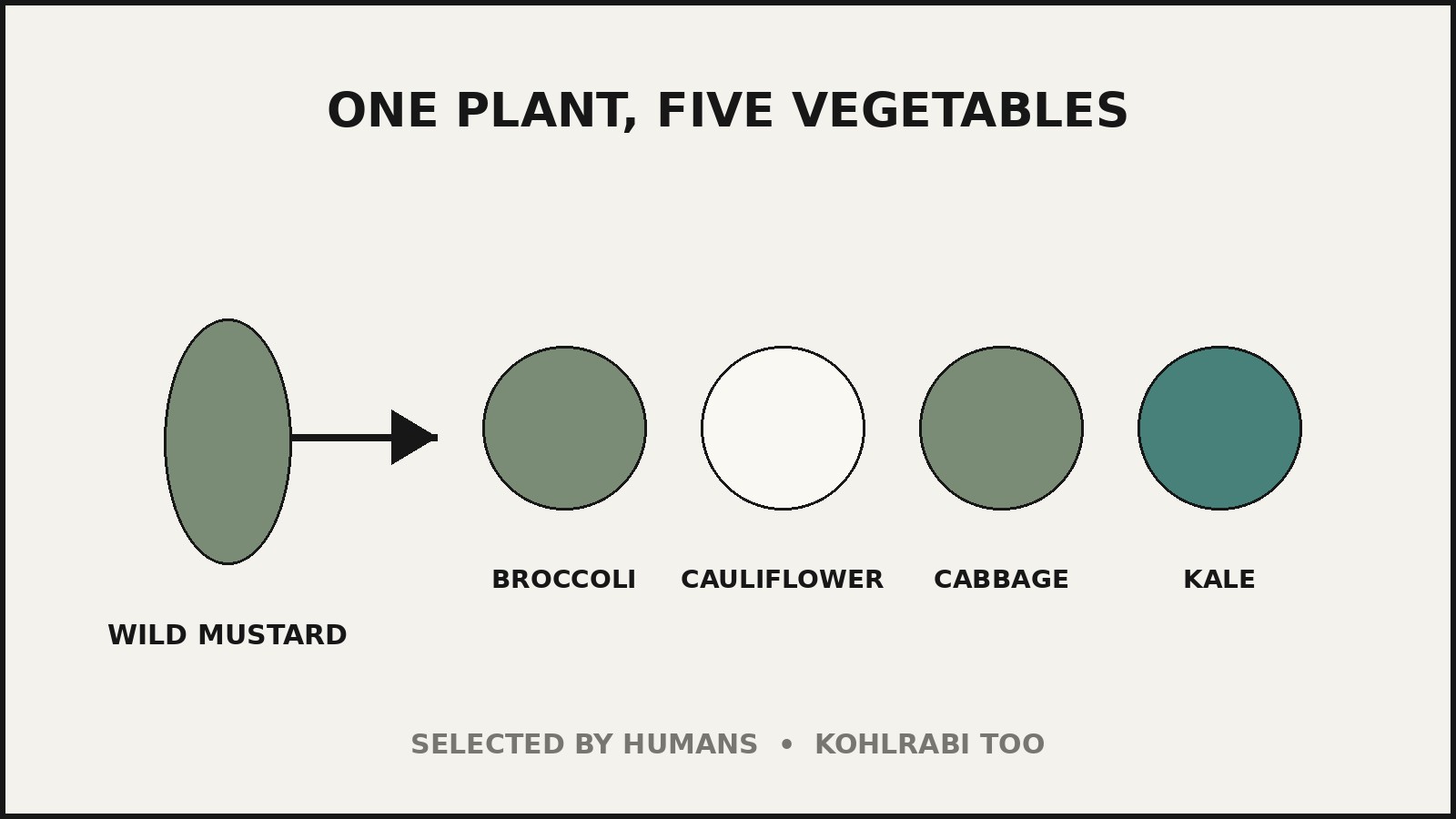
Consider the vegetables in the cabbage family. UC Berkeley’s Understanding Evolution describes how farmers cultivated a whole set of crops from a single wild mustard plant by artificially selecting for different attributes. Selecting for sterility of flowers produced cauliflower. Selecting for suppression of flower development produced broccoli. Selecting for suppression of internode length (the stem segments between leaves) produced cabbage. Selecting for enhancement of the lateral meristem (side-growing tissue) produced kohlrabi. Selecting for enlargement of the leaves produced kale. Five familiar vegetables, each unrecognizable as the same species, all sculpted from one weedy ancestor by choosing, in each line, a different trait to exaggerate.
The story of maize (corn) shows the same process playing out over thousands of years. According to research by Smithsonian scientists, maize began with its wild ancestor, teosinte. Teosinte bears little resemblance to the corn we eat today: its cobs are tiny, and its few kernels are protected by a nearly impenetrable outer casing. Early farmers selected for desirable traits anyway, and over time the descendants of the wild plant developed larger cobs and more tender, plentiful kernels.
The timeline is long. Researchers have deduced that teosinte’s transformation into maize began in the tropical lowlands of what is now southern Mexico about 9,000 years ago. But the story is not a simple one. A Smithsonian-led study, reported in 2018, found that a partially domesticated “proto-corn,” still carrying a mixture of wild and domesticated genes, was likely brought from Mexico to South America more than 6,500 years ago. Farmers in Mexico and the southwestern Amazon then continued to improve the crop over thousands of years until it was fully domesticated in each region: the final stages of maize’s domestication happened more than once in more than one place. Maize is now one of the world’s most important crops, and every kernel of it exists because humans kept choosing which plants would parent the next harvest.
Livestock: Breeding Animals for Human Use
The same principle built the modern farm: livestock selected for higher productivity, crops for greater resistance to pests, and domesticated animals for favorable temperaments. The qualities chosen are the ones humans value: more milk, more meat, faster growth, calmer behavior.
Sometimes the results are extreme. The Belgian Blue, a breed of cattle, carries a defect in its myostatin gene that is maintained through linebreeding and is responsible for its accelerated lean muscle growth. The trait is deliberately preserved because it serves a human market, even though the underlying genetic change would be a disadvantage in the wild. It is also a preview of the trade-offs discussed later: selection can fix a trait in a population for human reasons alone.
Artificial Selection vs Natural Selection
The two processes are siblings. Both act on heritable variation, and both shift populations over generations. The difference lies in who does the choosing and what gets favored.
| Artificial selection | Natural selection | |
|---|---|---|
| Who selects | Humans, deliberately | The environment, through survival and reproduction |
| What is favored | Traits humans find economically or aesthetically desirable | Traits that help organisms survive and reproduce in their environment |
| Goal | Serve human purposes: food, work, beauty, companionship | No goal; adaptation to local conditions |
| Speed | Often fast, because humans impose strong, consistent selection | Usually slower, acting over long timescales |
| Intent | Conscious and directed | Unconscious and undirected |
UC Berkeley captures the relationship in a single sentence: artificial selection “causes evolutionary change in the organism and is analogous to natural selection, only with humans, not nature, doing the selecting.” The key distinction is intent: in artificial selection, humans consciously select specific traits, while natural selection operates unconsciously, driven by environmental factors and survival challenges.
One practical consequence: traits produced by artificial selection often make the organism less fit for wild life. A dairy cow that produces far more milk than her calf could drink would struggle without human care. That is not a failure of the process. It is the process working exactly as designed, optimizing for human desires rather than wild survival.
Selection Is Not Always Intentional
Artificial selection can happen without anyone planning it. Simply cultivating plants and animals changes which individuals reproduce, and that alone can shift traits over generations.
One documented example involves grain crops. In some grains, an increase in seed size may have resulted from certain ploughing practices rather than from any deliberate choice of larger seeds: the way the soil was worked favored bigger seeds, so bigger seeds became more common. Researchers note that plant domestication most likely involved an interdependence between natural and artificial factors, not a neat line between them. The lesson: whenever humans manage a population, some form of selection is happening, whether or not it was the plan.
Artificial Selection Today
Far from being a historical curiosity, deliberate selective breeding “has become very common in agriculture and experimental biology.” Modern breeders have tools Darwin never imagined, but the core logic is unchanged: choose the parents, evaluate the offspring, repeat.
One modern development is that scientists can now see selection written in DNA. The dog studies described earlier are the model: researchers compare genomes across breeds, find regions where one group consistently carries one genetic variant and another group carries a different one, and identify the genes that past breeding unknowingly targeted. Selection leaves footprints, and genomics can read them.
It is important to keep artificial selection distinct from a newer and different technology: genetic engineering. Encyclopaedia Britannica defines genetic engineering as “the artificial manipulation, modification, and recombination of DNA or other nucleic acid molecules in order to modify an organism,” a term that today generally refers to recombinant DNA technology. Selective breeding works by choosing which organisms reproduce, shuffling and concentrating heritable variation that already exists in the population. Genetic engineering works by directly altering DNA in the laboratory. Both are human-directed ways of changing organisms, but they operate through different routes. (Britannica adds a historical footnote: the term “genetic engineering” initially embraced artificial selection too, but in the later 20th century it came to refer more specifically to recombinant DNA methods.)
A final limit worth stating: selection can only work with variation that exists. If no individual in a population carries the genetic basis for a trait, no amount of selective breeding will conjure it. Breeders are editors of the gene pool, not authors of it.
The Trade-Offs of Intense Breeding
Artificial selection is a powerful tool, and like any powerful tool, it has costs.
The most general cost is lost genetic diversity. When breeders select intensely for a few traits, they narrow the gene pool: fewer individuals contribute to the next generation, and unselected variants disappear. Populations shaped this way “may make populations more susceptible to diseases and environmental changes,” because there is less variation for the population to draw on when conditions shift. A uniform field of a single crop variety is efficient, but a single disease can sweep through it.
The second cost is the extreme trait itself. Pushing a trait to its limit can produce animals or plants that suffer for it. The Belgian Blue’s muscle growth comes from a genuine genetic defect, deliberately maintained. The same pattern appears wherever selection chases extremes: the trait humans want can carry health or welfare costs for the organism that bears it.
Neither cost means artificial selection is inherently harmful. It means selection is directional: it moves a population toward what is chosen and away from everything else, and the “everything else” includes resilience the breeder may not have been thinking about.
Frequently Asked Questions
What is artificial selection in simple words? Artificial selection is humans choosing which plants or animals get to have offspring, picking the ones with traits people want, so those traits become stronger in each new generation. Dog breeding is the everyday example: humans decided which dogs reproduced, and that is why we have hundreds of breeds.
Who invented artificial selection? Nobody invented it. Farmers and breeders were selecting plants and animals for desirable traits long before Darwin and Wallace, changing farm stock over centuries. Darwin’s contribution was not the practice but the insight: he recognized that this familiar human activity revealed how evolution works in nature.
What is the difference between artificial selection and selective breeding? There is none. “Selective breeding” is simply the common name for artificial selection. Encyclopaedia Britannica uses the two terms interchangeably.
What are three examples of artificial selection? First, dog breeds: more than 450 breeds created in roughly the last 200 years from wolf ancestors. Second, cabbage-family vegetables: broccoli, cauliflower, cabbage, kale, and kohlrabi were all bred from a single wild mustard plant. Third, maize: modern corn was bred over thousands of years from the wild grass teosinte.
Is artificial selection the same as genetic engineering? No. Artificial selection works by choosing which organisms reproduce, concentrating heritable variation that already exists. Genetic engineering directly manipulates or recombines DNA in the laboratory. The two are distinct techniques, though both are human-directed ways of changing organisms.
Can artificial selection create a brand-new trait from nothing? No. Selection can only amplify variation that already exists in the population’s genes. If no individual carries the genetic basis for a trait, breeding for it will not produce it. That is why breeders are sometimes described as editors of the gene pool rather than its authors.
What are the disadvantages of artificial selection? The main disadvantage is reduced genetic diversity: intense selection narrows the gene pool, which can leave populations more vulnerable to disease and environmental change. A second drawback is that pushing traits to extremes can produce health or welfare problems in the organisms themselves, as when a deliberately maintained genetic variant impairs the animal that carries it.
Keep reading: Largest Rift Valley in Africa
Sources & references
- UC Berkeley Understanding Evolution, Evo 101, "Artificial selection," (definition and mechanism; wild mustard selected into cauliflower, broccoli, cabbage, kohlrabi, and kale; dogs from ancient extinct wolf ancestors, more than 450 breeds over the last 200 years; Ostrander team's ROBO1 agility-gene study)
- UC Berkeley Understanding Evolution, Glossary, "artificial selection," (humans consciously select for or against particular features; evolutionary change analogous to natural selection, with humans doing the selecting)
- Encyclopaedia Britannica, "Selection," (selection by natural or artificial controlling factors; artificial selection manipulates heritable variations through controlled breeding for human-desired qualities; mass, pedigree, progeny, family, and pure-line selection methods; Darwin and Wallace proposed evolution by natural selection in 1858)
- Encyclopaedia Britannica, "Genetic engineering," (genetic engineering defined as the artificial manipulation, modification, and recombination of DNA, generally referring to recombinant DNA technology; term initially embraced artificial selection)
- Smithsonian Institution, "Scientists Overhaul Corn Domestication Story With Multidisciplinary Analysis," (teosinte as maize's wild ancestor; transformation began in southern Mexico about 9,000 years ago; proto-corn reached South America more than 6,500 years ago; final domestication stages occurred more than once in more than one place)
- Smithsonian Magazine, Brigit Katz, "Dog Breeding Has Changed Pooches' Brains," September 3, 2019, (MRI study of 62 dogs across 33 breeds; brain differences linked to behavioral specializations from selective breeding)
- Lumen Learning, Biology for Non-Majors II, "Artificial Selection," (breeds vs. varieties, cultigens, and cultivars; crossbreeds and hybrids; inbreeding, linebreeding, and outcrossing; Darwin's 1859 On the Origin of Species first chapter on pigeons, cats, cattle, and dogs; Belgian Blue myostatin defect; unintentional selection via cultivation; selective breeding very common in agriculture and experimental biology)
- Jung Choi, Mary Ann Clark, and Matthew Douglas, Principles of Biology I, Pressbooks, "Artificial Selection," (breeding to amplify traits over generations; reduced genetic diversity increasing susceptibility to disease and environmental change; Darwin's framework for understanding natural selection)


