Short answer
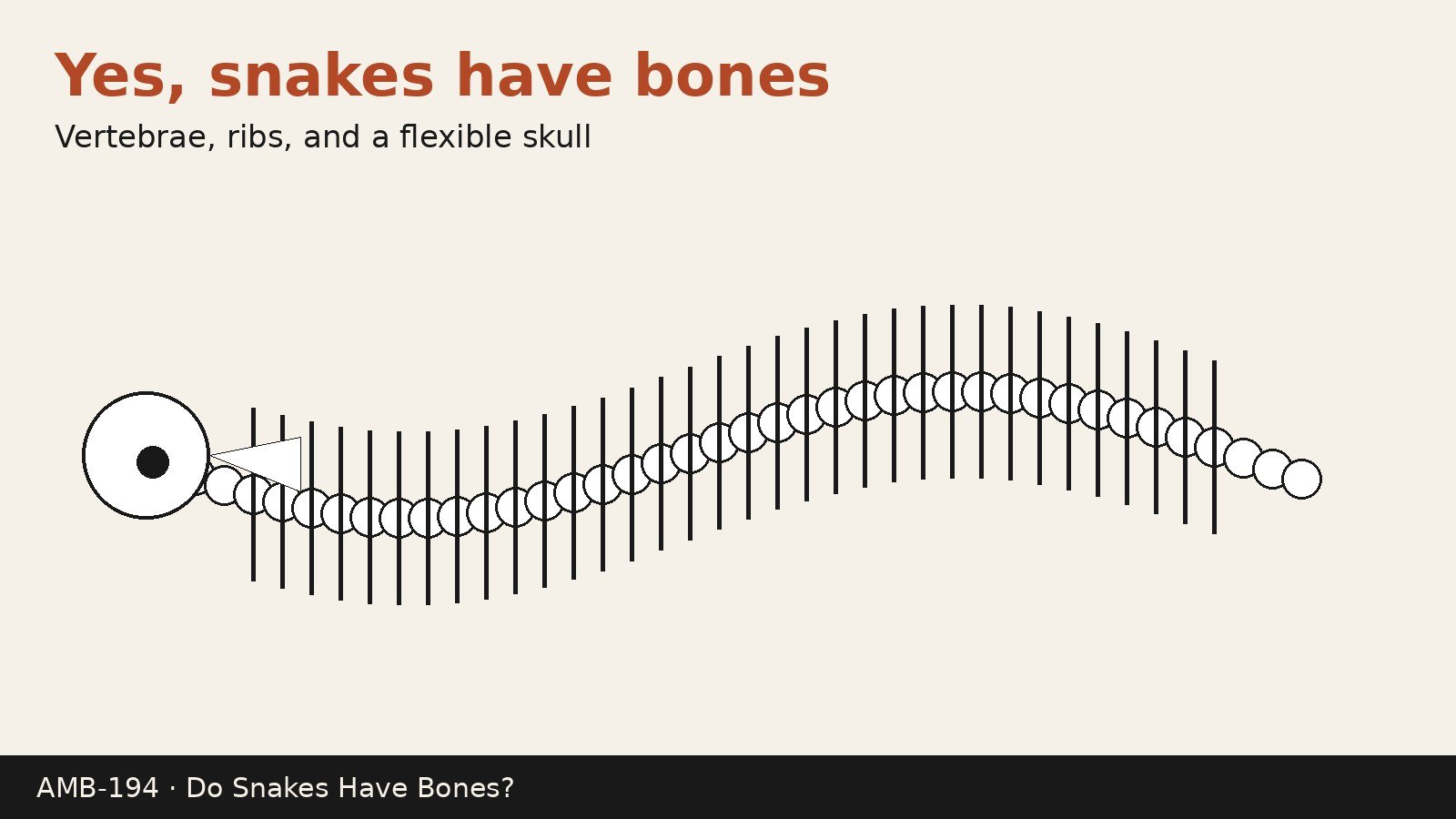
- Yes, snakes have bones. A snake is a vertebrate, which means it has an internal skeleton built around a backbone, made mainly of a skull, a long chain of vertebrae, and ribs. Most snakes have far more vertebrae than a person has, and most body vertebrae carry a pair of ribs. The skull is the most unusual part: its bones are joined by flexible ligaments and movable joints, so the jaws can spread and move separately while the snake swallows prey whole.
Why the question comes up
A snake looks soft because it has no legs, no arms, and no visible joints like elbows or knees. Its body bends in smooth curves, flattens, coils into a tight ball, and squeezes through gaps that look too small for a bony animal. It is natural to wonder whether all that movement comes from muscle alone, or from cartilage, or from some other soft structure.
The answer is that muscle does a great deal of the work, but muscle needs something to pull against. In a snake, that something is bone. Each bend is made by many small joints working together, not by one long flexible rod. Think of a bicycle chain rather than a rubber hose. A chain bends easily because it has many links, and it stays strong because each link is solid. A snake spine works in a similar way, with hundreds of small, solid links and the muscles that connect them.
Another reason is the way snakes swallow food. A snake can open its mouth far wider than its head looks able to open, and its body can stretch around a meal. That stretch does not mean the skeleton has come apart: the joints and ligaments in the skull and ribs are built to move farther than the equivalent joints in most other animals.
Yes, snakes are vertebrates
Snakes belong to the group of animals called vertebrates. In plain terms, a vertebrate is an animal with a backbone and an internal skeleton. Snakes are reptiles, and they are grouped with lizards in the order Squamata. OpenStax Biology 2e explains that limbless reptiles such as snakes are still classified as tetrapods, a word that means four limbed, because they descended from ancestors with four limbs. That history matters for understanding the skeleton. A snake did not start from a wormlike ancestor with no bones at all. It started from a limbed reptile ancestor and then lost its limbs over evolutionary time, while keeping and reshaping the rest of the skeleton.
Britannica notes that snakes possess increased numbers of vertebrae compared with other vertebrates. That longer spine drives almost everything else about the skeleton: the body is longer, the ribs run much farther down the body, and the organs are arranged in a long, narrow sequence.
A snake is therefore not an invertebrate like an earthworm or an insect. Those animals have no backbone, while a snake has a backbone from the base of its skull to the tip of its tail.
The snake skeleton at a glance
If you could see a complete snake skeleton laid out, three features would stand out at once. First, the skeleton is very long and narrow. Second, almost all of it is spine and ribs. Third, there are no legs and no arm bones, and in most species there is no trace of a shoulder girdle at all.
The main parts are:
- Skull: a complex set of bones that protects the brain and carries the teeth and jaws.
- Vertebral column: a long chain of vertebrae running from the neck region to the tail tip.
- Ribs: long, curved, movable bones attached to most of the vertebrae in the body, but not to the vertebrae in the tail.
- Vestigial limb remnants: in a small number of species, mainly boas and pythons, small pelvic bones and tiny external spurs near the cloaca. These are leftovers from hind limbs, not working legs.
- Hyoid apparatus: a much reduced structure below the throat, made of cartilaginous filaments rather than a large bone, which supports the tongue region.
There are no collar bones, no breastbone joining the ribs at the front, and no working limb bones in most species. With fewer types of bones to coordinate, the spine and ribs can do more jobs: support, protection, breathing, and movement.
Vertebrae: hundreds of small bones, not one long bone
The backbone of a snake is not a single bone. It is a chain of individual bones called vertebrae. Each vertebra is a small, solid bone, and neighboring vertebrae are joined to each other in a way that allows a little movement at each joint. Add up hundreds of small movements, and you get a body that can form an S curve, a tight coil, or a long straight line.
How many vertebrae does a snake have? The honest answer is that it depends on the species and on the individual snake, and published ranges differ because different authors count different groups. A widely used reference on snake skeletons gives a range of 175 to more than 400 vertebrae in the backbone, while another summary of the same material gives 130 to 500 vertebrae across the group. The safest way to read those numbers is as a broad range, not a single figure for all snakes. A short snake and a very long snake do not carry the same count, and longer species tend to carry more vertebrae.
Most general accounts place typical snakes in the range of about 200 to 400 vertebrae, inside that broader published range. The pattern matters more than any single total: many vertebrae, each contributing a small amount of movement, producing a very flexible whole.
The vertebral column is divided into regions, although the divisions are less sharp than in a mammal. The main regions are:
- Atlas and neck region: the first vertebrae behind the skull, including an atlas made of two vertebrae and without ribs. The first few vertebrae in this region lack ribs or carry only short ribs, depending on the species.
- Precaudal, or body, vertebrae: the long middle section. Almost all of these vertebrae carry a pair of ribs, except for the first one to three. This is where most of the length of the snake sits.
- Lumbar vertebrae: a short section near the rear of the body, usually two to ten vertebrae, without ribs but with forked side processes. These processes help enclose vessels in that region.
- Caudal, or tail, vertebrae: the vertebrae behind the cloaca. These have no ribs. Instead, their side processes are elongated and take the place of ribs in shaping the tail.
The tail is always shorter than the trunk. The long rib bearing section gives the body its width and its ability to grip and push, while the shorter, ribless tail tapers and can coil or grip a branch.
Each vertebra is joined to its neighbors by more than a simple hinge. The main body of each vertebra, called the centrum, forms a ball and socket joint with the next vertebra, and overlapping projections called zygapophyses, plus a wedge shaped process called the zygosphene fitting into a matching socket called the zygantrum, interlock the joint while still allowing it to bend. When hundreds of these joints work in sequence, the spine bends smoothly without any one joint moving very far.
Ribs: a long, flexible cage with no front join
If the vertebrae are the links of the chain, the ribs are the hoops that give the snake body its shape. Each body vertebra, except for the first few, carries a pair of long, movable, curved ribs. The ribs run outward and downward around the body, protecting the organs inside and giving muscles something to pull against.
Snake ribs differ from human ribs in one important way. In a human, most ribs join at the front to a breastbone, forming a fairly rigid cage. In a snake, the ribs do not join at the front. The textbook account of snake anatomy states that snakes have no sternum, the breastbone, and no costal cartilages joining the ribs at the front, so each rib pair is attached by muscles to the inner surface of the belly scales. That free ended design is central to how a snake lives. The rib cage can widen to let a large meal pass, narrow to squeeze through a gap, and move in waves to help the snake crawl.
The ribs also help with breathing. OpenStax notes that in snakes and lizards, the muscles of the spine and ribs expand or contract the rib cage, changing the pressure inside the lungs and drawing air in. Because the ribs are linked to the belly scales, the same rib muscles also help push the body forward when the snake crawls.
The ribs are not all the same length. They shorten toward the rear of the trunk, and the last body ribs are sometimes forked. In the tail there are no true ribs at all.
The skull: many bones, loosely joined, built to open wide
The snake skull is the most complex part of the skeleton. A human skull is mostly a solid case with a single movable lower jaw, while a snake skull is a set of many bones joined by ligaments and movable joints, so different parts can move relative to each other and the snake can swallow prey far larger than its head.
The braincase itself is solidly built and protects the brain. The bones around it, especially those carrying the teeth and forming the jaws, are much more mobile. The key parts are:
- Braincase: the solid, well ossified case that encloses the brain, formed from bones including the frontals and the united parietals.
- Upper jaw bones: including the maxilla, which carries teeth, and the palatine and pterygoid bones on the roof of the mouth, which also carry teeth in many species.
- Lower jaw bones: each side of the lower jaw is made of several bones, including the dentary at the front, plus splenial, angular, and articular elements toward the back. In boas and a few other groups, a coronoid bone is also present.
- Quadrate bone: a usually large and elongated bone on each side that links the lower jaw to the skull. It is attached to the cranium through the supratemporal bone, and it acts as an extra hinge.
- Premaxilla: a single small bone at the very front of the upper jaw, usually connected to the maxilla only by ligament.
Two features of this design do most of the work when a snake feeds. First, the two sides of the lower jaw are not fused together at the front. Instead, they are joined at the chin by a very extensible elastic ligament. That means the left and right lower jaws can spread apart and move independently. Second, the quadrate bone gives the jaw a second hinge. The lower jaw meets the quadrate, and the quadrate meets the skull, so the jaw can swing outward and downward farther than a single hinge would allow. As the snake swallows, it can move the left and right sides of the jaws alternately, walking the jaws over the prey in small steps.
The skull also lacks a temporal arch and a middle ear cavity like a mammal, and it has no separate cheek bones forming a rigid frame. A more open, loosely joined skull is less rigid, but it can open wider and adjust its shape around prey.
Teeth and fangs: part of the skeleton, replaced through life
Teeth are not bones, but they sit on bones and belong in any account of the skull. Most snakes have teeth on the dentary of the lower jaw, on the maxilla of the upper jaw, and on the palatine bone and pterygoid plate on the roof of the mouth. The inner row on the roof of the mouth can move separately, which helps walk prey inward during swallowing.
Snake teeth are generally curved backward, toward the throat, which helps hold prey in place while the jaws reposition. Teeth are lost during feeding and replaced through life.
Fangs are specialized teeth, and they differ by group. The reference on snake skeletons groups snakes into four dentition types, based on the form of the teeth:
- Aglyphous: no specialized fangs, with teeth similar in shape throughout the mouth. Most aglyphous snakes are nonvenomous, although a few are considered mildly venomous.
- Opisthoglyphous: rear fanged, with enlarged, grooved teeth at the back of the upper jaw that channel venom into a bite.
- Proteroglyphous: front fanged, with shortened upper jaws bearing enlarged fangs that are folded around a venom channel, forming a hollow needle. This form is found in elapids, the group that includes cobras.
- Solenoglyphous: front fanged, with each upper jaw reduced to a small bone supporting a single hollow fang that folds back against the roof of the mouth when the mouth is closed and swings forward when the mouth opens. This form is found in vipers, including rattlesnakes, and it allows deep injection of venom.
These differences are about tooth shape and jaw mechanics, not about the presence or absence of bones. Every one of these groups has the same basic skeleton: skull, vertebrae, and ribs. The fang type changes how the skull delivers a bite, not whether the animal has bones.
Vestigial limbs: the small bones that tell an evolutionary story
Most snakes have no external limbs at all, and no remains of a shoulder girdle. A small number keep traces of hind limbs, strong evidence for the evolutionary history described by OpenStax.
No living snake shows remains of the pectoral arch, the shoulder structure. Remains of the pelvis are found in boas and pythons, in the families Leptotyphlopidae, Aniliidae, and Typhlopidae, and in a few other groups. In boas and pythons, the remnant is a long ilium attached near the first forked transverse process of the lumbar vertebrae, bearing three short bones. The longest of these, regarded as the femur, ends in a clawlike pelvic spur that usually appears externally on each side of the cloaca. San Diego Zoo Wildlife Alliance makes the same point in simpler terms for pythons: pythons and boas are considered primitive snakes with the remnants of hind legs and pelvic bones.
These spurs are not legs. They cannot walk, climb, or grip in the way a leg can, although they are sometimes used during mating. They are vestigial structures, meaning they are reduced remnants of structures that were larger and functional in ancestors. Their presence in only some groups, and their absence in most modern snakes, fits the picture of limbs being lost in stages rather than all at once.
The spurs sit just to either side of the cloaca, the single opening near the rear of the body used for excretion and reproduction, which is why they are sometimes called anal spurs.
Cartilage: a smaller, supporting role
A snake skeleton is mostly bone, but cartilage still has a part to play. Cartilage is the firm, flexible tissue that cushions joints and supports some structures in vertebrates. In a snake, cartilage is verified in the hyoid apparatus, which the snake skeleton reference describes as reduced to a pair of cartilaginous filaments situated below the trachea and united in front. That small structure supports the tongue region, as the hyoid does in other tetrapods, but it is far smaller than the hyoid bone of a mammal.
The adult snake skeleton is not a cartilage skeleton like that of a shark. It is a bone skeleton with cartilage where flexibility and cushioning are needed most.
How bones make snake movement possible
Bones alone do not move a snake. Muscles move it, by pulling on bones and on the belly scales. But the bone design decides what kinds of movement are possible and how far the body can bend.
Britannica lists four main ways snakes move: serpentine locomotion, concertina locomotion, caterpillar or rectilinear locomotion, and sidewinding locomotion. Each uses the same skeleton in a different way.
In serpentine movement, the classic S shaped crawl, waves of muscle contraction pass down the body, each vertebra bends a little relative to its neighbors, and the ribs and belly scales grip the ground along the wave, pushing the body forward.
In concertina movement, used in narrow spaces, the snake bunches part of its body into curves that grip the surface, then extends the front part forward and pulls the rear part up.
In rectilinear movement, the caterpillar crawl, the snake moves in a straight line. San Diego Zoo Wildlife Alliance describes this for pythons: the snake stiffens its ribs to provide support, then lifts belly scales and moves them forward so the loose ends grip the surface, pushing the snake ahead.
In sidewinding, used on loose sand, the snake lifts parts of its body off the ground in loops while other parts stay in contact, producing a sideways track.
In every case, many small joints share the bending, so no single joint is forced to bend too far. The ribs give the muscles a frame and the belly scales a point of attachment.
How a snake swallows prey larger than its head
First, the skull opens. The quadrate bones swing outward, the lower jaws spread at the elastic ligament at the chin, and the upper jaw bones move separately. The mouth opening becomes much wider than the resting width of the head. The braincase stays protected while the jaw bones move around it.
Second, the teeth grip. The backward curved teeth on the jaws and on the roof of the mouth hold the prey and prevent it from sliding out. The left and right sides of the jaws then move alternately, walking over the prey in small steps. The inner tooth rows on the roof of the mouth help pull the prey inward.
Third, the body expands. As the prey passes into the throat and then down the body, the ribs spread apart. Because the ribs are not joined at the front, the body can widen around the meal. The vertebrae do not need to separate. They stay joined while the ribs and the muscles around them stretch.
Fourth, the meal moves down the body. Muscles along the spine and ribs contract in waves, pushing the prey toward the stomach. The snake does not chew at all: it swallows whole and lets digestion do the rest.
That is why a snake can look dramatically wider after a large meal and then return to its normal shape: the joints have moved to wider positions and then returned, without breaking or separating.
What a snake skeleton is not
Myth: snakes have no bones because they are so flexible. Correction: flexibility comes from many bones and joints, not from the absence of bones.
Myth: snakes dislocate their jaws to eat. Correction: the jaw joints are built to move widely and stay connected by ligaments during feeding.
Myth: a snake skeleton is just a spine. Correction: the skull, ribs, and in some species vestigial pelvic bones are also part of the skeleton.
Myth: all snakes have the same number of bones. Correction: the number of vertebrae varies by species and body length, so no single total describes every snake.
Myth: snake ribs or spurs are legs. Correction: ribs are trunk bones attached to vertebrae, and spurs in boas and pythons are vestigial hind limb remnants, not working legs.
Myth: snakes are worms. Correction: worms are invertebrates with no backbone, while snakes are vertebrates in the order Squamata.
Snake bones through life: growth, shedding, and injury
Snakes grow throughout their lives, as OpenStax notes for reptiles in general, and they regularly shed their skin to accommodate growth and to remove external parasites. Snakes tend to shed the entire skin at one time. Shedding is about the skin, not the skeleton: the bones grow with the animal, and the skin is replaced in a complete sheet.
A snake skeleton can also be injured. A broken vertebra or rib can limit movement, feeding, and breathing, because the same spine and ribs serve all three functions. The many joints make the spine flexible within its normal range, not unbreakable.
If you meet a wild snake, give it space and do not try to handle it.
Do all snakes have the same skeleton?
No, not in detail. The basic plan is the same across snakes: skull, vertebrae, ribs, and in a few groups vestigial pelvic remnants. The details vary in ways that match how each group lives.
Burrowing snakes have very compact skulls with a reduced maxilla, built for pushing through soil rather than opening extremely wide. Vipers have short, movable maxillae bearing hollow fangs, while pythons and boas have the most complete vestigial pelvic remnants. In each case, the variation is in the number, size, and proportions of the same bones, not a different skeleton.
FAQ
Do snakes have bones?
Yes. Snakes are vertebrates with an internal skeleton made mainly of a skull, vertebrae, and ribs. Their flexibility comes from having many small bones and joints, not from lacking bones.
How many bones does a snake have?
There is no single number for all snakes. Published ranges for vertebrae alone run from about 130 to 500 across the group, with a commonly cited backbone range of 175 to more than 400. The total depends on the species, body length, and how skull and vestigial bones are counted, so guides give a range rather than an exact total.
Are snakes vertebrates or invertebrates?
Snakes are vertebrates. They have a backbone, a skull, and an internal skeleton. They are reptiles in the order Squamata, grouped with lizards, and they descended from four limbed ancestors even though they have no working limbs.
Do snakes have a backbone?
Yes. The backbone, or vertebral column, runs from behind the skull to the tip of the tail. It is made of many individual vertebrae joined by ball and socket joints and overlapping projections that allow bending while keeping the spine interlocked.
Do snakes have ribs?
Yes. Most body vertebrae carry a pair of long, curved, movable ribs. The ribs protect the organs, help with breathing, and help with movement by linking to the belly scales. Tail vertebrae do not carry ribs.
Do snakes have a skull?
Yes, and it is a complex skull with many bones. The braincase is solid, while the jaw bones are loosely joined by ligaments and movable joints, including the quadrate bone, so the mouth can open very wide and the two sides of the lower jaw can move separately.
Do snakes dislocate their jaws when they eat?
No. The jaw joints are built to move that far, and the bones stay connected by ligaments. The lower jaws spread at an elastic ligament at the chin, and the quadrate bone provides an extra hinge, so the snake can swallow prey wider than its head without any joint coming apart.
Do snakes have legs or leg bones?
Most snakes have no legs and no trace of a shoulder girdle. A small number of species, mainly boas and pythons, retain vestigial pelvic bones and tiny external spurs near the cloaca. These are remnants of hind limbs from ancestors, not working legs.
Why are snakes so flexible if they have bones?
Because they have so many bones. Each vertebra moves only a little relative to its neighbors, but hundreds of small movements add up to large bends, coils, and waves. The ribs, which are not joined at the front, can also spread and narrow, which adds to the flexibility.
Sources & references
- OpenStax Biology 2e, Reptiles chapter, via Lumen Learning. Opened and read 24 October 2026. Used for reptile classification, limbless reptiles as tetrapods descended from four limbed ancestors, and rib and spine muscles in breathing.
- Britannica, Snake. Opened and read 24 October 2026. Used for snake classification in Squamata, increased numbers of vertebrae, and four modes of locomotion.
- Snake skeleton, reference article drawing on George Albert Boulenger, The Snakes of Europe, 2nd edition, 1913. Opened and read 24 October 2026. Used for skull structure, quadrate and jaw ligaments, vertebrae and rib regions, ball and socket and zygapophysis joints, fang groups, and vestigial pelvic bones.
- San Diego Zoo Wildlife Alliance, Python animal page. Opened and read 24 October 2026. Used for pythons and boas retaining hind leg and pelvic bone remnants, rectilinear movement using stiffened ribs and belly scales, and skull joints flexing during swallowing.


