Short answer
- The sovereign states whose national flags use red, yellow (gold), and green as the main design are Ethiopia, Ghana, Guinea, Mali, Senegal, Cameroon, Benin, Togo, and the Republic of the Congo in Africa, plus Bolivia in South America and Lithuania in Europe.
- The African flags share one origin: Ethiopia's tricolor, formalized in 1897 after its victory over Italy at Adwa, became the pan-African colors. Ghana (1957) was the first newly independent state to adopt them.
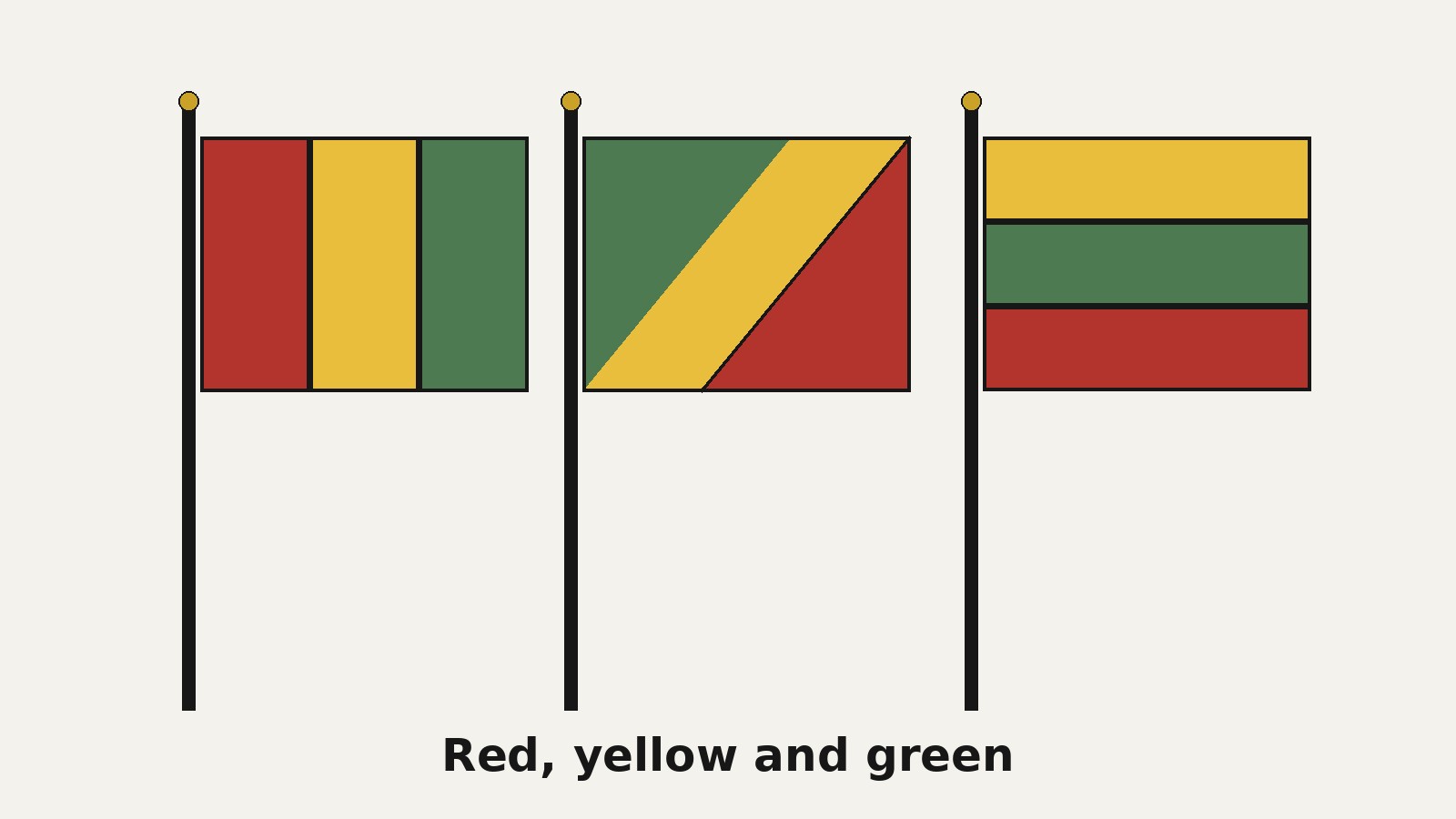
- The flags differ in layout and emblems: horizontal bands (Ethiopia, Ghana, Bolivia, Lithuania), vertical bands (Guinea, Mali, Senegal, Cameroon), a split design (Benin), stripes with a canton (Togo), and a diagonal band (Congo).
- Stars do much of the distinguishing: Ghana has a black star, Senegal a green star, Cameroon a yellow star on its red band, and Togo a white star on a red canton.
- Bolivia adopted its red, yellow, and green tricolor in 1851, long before the pan-African movement, and Lithuania's yellow, green, and red comes from its own folk traditions. Similar colors do not always mean a shared story.
No color combination in the world of flags has been borrowed as often as red, yellow, and green. Eleven countries fly national flags built from exactly these three colors, and most of them chose the palette deliberately, as a declaration about who they were and what they had survived. The trail leads back to Ethiopia, whose green, yellow, and red banner became the emblem of African independence because Ethiopia was the African state that famously defended its own. When Ghana became the first sub-Saharan colony to win independence in 1957, it took Ethiopia’s colors and added a black star, and new nations across the continent followed. Two countries outside that story, Bolivia and Lithuania, fly the same three colors for entirely separate reasons of their own. This guide names every country, explains where the colors came from, gives the meanings each country has actually attached to them, and finishes with the identification keys that separate flags people constantly confuse.
The Flags at a Glance
| Country | Layout | Emblem | First adopted in current lineage |
|---|---|---|---|
| Ethiopia | Horizontal, green-yellow-red | Blue disc with yellow star and rays | Tricolor 1897; current emblem 1996 |
| Ghana | Horizontal, red-gold-green | Black star | 1957 |
| Guinea | Vertical, red-yellow-green | None | 1958 |
| Mali | Vertical, green-yellow-red | None | 1961 (design from 1959) |
| Senegal | Vertical, green-yellow-red | Green star | 1960 |
| Cameroon | Vertical, green-red-yellow | Yellow star on the red band | 1975 |
| Benin | Green hoist band; yellow over red | None | 1959 (restored 1990) |
| Togo | Five horizontal green and yellow stripes | White star on a red canton | 1960 |
| Republic of the Congo | Diagonal yellow band, green and red triangles | None | 1959 (restored 1991) |
| Bolivia | Horizontal, red-yellow-green | Coat of arms on the state flag | 1851 |
| Lithuania | Horizontal, yellow-green-red | None | 1918 to 1922 era (restored 1989) |
The Source: Ethiopia
The colors carry special importance in Ethiopia back to at least the early 17th century, where they were linked to the Ethiopian Orthodox Church and the Solomonic dynasty that ruled the country. Through the nineteenth century they flew as three separate pennants. The turning point came on March 1, 1896, at the Battle of Adwa, where Ethiopian forces decisively defeated an invading Italian army, an event that made Ethiopia a symbol of African resistance around the world. On October 6, 1897, Emperor Menelik II ordered the three pennants combined into a single rectangular tricolor, red on top, then yellow, then green, with the first letter of his name on the central stripe. The colors were interpreted at the time as red for power and faith, yellow for church, peace, natural wealth, and love, and green for land and hope.
In the early twentieth century the order was reversed to green, yellow, and red, and the imperial flag commonly carried the Lion of Judah, a crowned lion holding a cross, at its center. Under Emperor Haile Selassie, who reigned from 1930 to 1974, the Ethiopian flag became the reference point for independence movements across Africa, precisely because Ethiopia had kept its sovereignty while the rest of the continent was colonized (Italy occupied the country from 1936 to 1941, but Ethiopia was never formally colonized). The emblem at the center has changed with Ethiopia’s governments, from the imperial lion to socialist emblems under the Derg regime, and since 1996 the flag has carried a blue disc with a yellow star and rays, representing the diversity and unity of Ethiopia’s peoples. The three bands beneath have not changed. When other African nations adopted these colors, vexillologists named them the pan-African colors, and Ethiopia is the reason why.
Ghana Carries the Colors Across Africa
Ghana, the former British colony of the Gold Coast, became independent on March 6, 1957, the first sub-Saharan African colony to do so, and the flag it raised that day set the template. Designed by the Ghanaian artist and teacher Theodosia Okoh, it has three horizontal bands of red, gold, and green with a large black five-pointed star in the center. Ghana was the second African flag, after Ethiopia’s, to use the three colors, with the order inverted. The meanings Ghana attached are the ones most often quoted for the whole family: red for the blood of those who died in the struggle for independence, gold for the country’s mineral wealth (the old colonial name, Gold Coast, made the point literal), and green for its forests and agricultural land. The black star stands for African emancipation and unity, and it is often described as the lodestar of African freedom; its inspiration is usually traced to the Black Star Line, the shipping company founded by the Jamaican pan-African leader Marcus Garvey.
The flag has one interruption in its history. In 1964 the government of Kwame Nkrumah replaced the gold band with white, matching the colors of his ruling party. When Nkrumah was overthrown in February 1966, the original red, gold, and green flag was restored within days, on February 28, 1966, and it has flown unchanged since. Nkrumah preached pan-African unity as state policy, and new governments across the continent heard him: within a decade, most of the flags in this article had been adopted.
The Vertical Tricolors: Guinea, Mali, Senegal, Cameroon
Four countries fly the colors as three vertical bands, a layout that echoes the French Tricolor flown by their former colonial power while replacing its colors with the pan-African set.
Guinea was the first follower. Guinea alone of France’s colonies voted in 1958 to break all ties with Paris, proclaimed independence on October 2, 1958, and adopted its flag on November 10, 1958: three vertical bands of red, yellow, and green with no emblem. Encyclopaedia Britannica records that Guinea’s first president, Sékou Touré, explained the colors himself: red symbolized sacrifice and labor, yellow stood for mineral wealth, the tropical sun, and justice, and green recalled the agricultural wealth of the land and stood for solidarity. The three colors map onto Guinea’s national motto, Work, Justice, Solidarity.
Mali flies the same three vertical bands in the reverse order: green, yellow, red. Its first version, adopted on April 4, 1959 for the Mali Federation, carried a black human figure with arms raised to the sky, called a kanaga, in the center of the gold band. When the federation broke up and Mali stood alone, the figure was removed, following objections to depicting the human form in a country whose population is overwhelmingly Muslim, and the plain tricolor was adopted on March 1, 1961. Mali’s stated meanings are green for the fertility of the land, gold for purity and mineral wealth, and red for the blood shed for independence from the French.
Senegal shares its flag’s origin with Mali’s. The Mali Federation’s green, yellow, and red tricolor, with the kanaga at its center, flew over both territories in 1960. When the federation split that August, Senegal kept the design and replaced the human figure with a five-pointed green star in the center of the yellow band. Its colors are commonly explained as green for Islam, progress, and hope, yellow for natural wealth, and red for the struggle for independence, with the star standing for unity and hope.
Cameroon arranges its vertical bands green, red, yellow, and puts a single yellow five-pointed star at the center of the red band. The design tells Cameroon’s political history in miniature. The tricolor dates to 1957, before independence, and was confirmed in the 1960 constitution; when French Cameroon and the southern part of British Cameroons united in a federation in 1961, the flag carried two stars; when Cameroon became a unitary state, the present single-star version was adopted on May 20, 1975. The star is officially the star of unity. The colors are explained geographically: green for the lush vegetation of the south, yellow for the savannas of the north, and red for national unity.
Three Flags That Break the Pattern: Benin, Togo, Congo
Benin uses the three colors in a design found nowhere else: a wide green vertical band at the hoist, taking up two-fifths of the flag, with the remaining space split into a yellow band above a red one. It was adopted on November 16, 1959, when the country was the Republic of Dahomey, replaced in 1975 by the Marxist government’s plain green flag with a red star, and restored on August 1, 1990 as the country returned to multiparty democracy. Benin’s color meanings are preserved in its national anthem, “L’Aube Nouvelle” (“The New Dawn”): green for hope of democratic renewal, red for the courage of the ancestors, and yellow as a call to preserve the nation’s treasures.
Togo stretches the palette across five alternating horizontal stripes of green and yellow, with a red square in the upper corner carrying a white five-pointed star. The flag was designed by the Togolese artist Paul Ahyi and adopted at independence on April 27, 1960. Its proportions approximate the golden ratio, an unusual distinction among national flags. The Togolese government’s own explanation gives yellow as the sign of faith, of the resources of the subsoil, and of maturity; green as the forest, agriculture, and hope; red as the blood of the martyrs of independence; and the white star as a symbol of peace, light, and intelligence.
The Republic of the Congo is the diagonal of the family: a yellow band running from the lower hoist corner to the upper fly corner, separating a green triangle at the hoist from a red triangle at the fly. Britannica records that the Legislative Assembly chose the design in the pan-African colors on August 18, 1959, and that it became official on September 15, 1959, surviving independence on August 15, 1960. A Marxist government replaced it at the end of 1969, and the original flag was restored on June 10, 1991. Congo’s flag holds this article’s most instructive detail about symbolism: in the 1959 record, green was given a meaning (agriculture and forests) and yellow was given one (the friendship and nobility of the people), but, as Britannica plainly states, the red was unexplained. Later sources routinely assign red the blood of the independence struggle, and the country’s embassy presents that reading today, but no meaning for red was recorded when the flag was adopted.
The Two Outsiders: Bolivia and Lithuania
Bolivia proves that the same colors can arise independently. Its horizontal tricolor of red, yellow, and green was adopted on October 31, 1851, more than a century before Ghana’s independence and four decades before Menelik II combined Ethiopia’s pennants. The civil flag is plain; the state flag carries Bolivia’s coat of arms in the center, an oval scene of Mount Potosí with an alpaca, wheat, and a breadfruit tree, framed by flags, cannons, and laurel, and topped by an Andean condor. Bolivia’s color meanings were set down in an 1888 supreme decree and are still official: red represents the blood shed by the heroes for the birth and preservation of the republic; yellow represents the country’s wealth and resources, above all its minerals; green represents the richness of its natural areas and hope. Since the 2009 constitution, Bolivia has had a co-official second national symbol, the Wiphala, a square rainbow checkerboard emblem of the Indigenous peoples of the Andes, which is flown alongside the tricolor on government buildings.
Lithuania is the European case, and its order is different: horizontal bands of yellow, green, and red. The colors come from Lithuanian folk textiles and national dress, not from any African connection. A simple tricolor was first flown on November 11, 1918, as Lithuania re-emerged from the First World War, and was officially adopted on August 1, 1922; suppressed under Soviet rule, it was reestablished on March 20, 1989, a year before Lithuania proclaimed independence from the Soviet Union. Britannica gives the attributed meanings: yellow suggests ripening wheat and freedom from want; green is for hope and the forests of the nation; red stands for love of country, for sovereignty, and for the courage and valor that keep the flame of liberty burning.
What the Colors Mean, and What We Actually Know
Read across the family and a pattern is obvious: red is almost everywhere the blood of sacrifice or the courage of ancestors, yellow is wealth, minerals, or the sun, and green is the land, its forests, farms, and hope. That pattern is real, but two cautions belong with it. First, each country defined its own colors for itself. Touré’s explanation for Guinea ties the bands to a national motto; Cameroon’s are a map of its own geography; Benin’s are written into an anthem. The shared palette signals solidarity, not a shared dictionary. Second, not every meaning in circulation was recorded at adoption. Congo’s red had no documented meaning in 1959, and some of the tidy three-line explanations attached to other flags today are later summaries rather than founding documents. Where a meaning is documented in a decree, an anthem, a constitution, or a founder’s own speech, this article has said so; where it is traditional or commonly repeated, it is presented that way.
One more boundary is worth drawing. The red, black, and green tricolor associated with Marcus Garvey’s movement and widely flown as a pan-African flag is a different flag with a different history, and several other African flags, including those of Guinea-Bissau, São Tomé and Príncipe, Burkina Faso, and Zimbabwe, borrow parts of this color family alongside other colors or layouts. This article covers the national flags whose main design is the red, yellow, and green set itself.
Telling Them Apart
- Guinea or Mali? Both are plain vertical tricolors. Guinea starts with red at the hoist (red, yellow, green); Mali starts with green (green, yellow, red). They are mirror images, and they are the most confused pair in this family. An earlier flag of Rwanda (1961 to 2001) was nearly identical to Guinea’s and had to carry a large black letter R in the yellow band to distinguish it.
- Senegal or Mali? Senegal is Mali’s green, yellow, red order with one addition: a green star in the center. Remove the star and you have Mali.
- Cameroon or Senegal? Both are vertical with a central star, but the bands differ. Cameroon runs green, red, yellow, and its star is yellow and sits on the red band. Senegal runs green, yellow, red, and its star is green and sits on the yellow band.
- Ghana or Bolivia? Both are horizontal red, yellow (gold), green. Ghana carries a black star at the center and nothing else. Bolivia’s civil flag is plain, and its state flag carries a detailed coat of arms. If there is a black star, it is Ghana.
- Ethiopia or Ghana? Ethiopia runs green, yellow, red, the reverse of Ghana’s order, and carries a blue disc with a yellow star emblem at the center. Ghana runs red, gold, green with a black star and no disc.
- Anything diagonal? Only one national flag in the family is diagonal: the Republic of the Congo. A yellow diagonal band with green toward the hoist and red toward the fly identifies it at once. Do not confuse it with the Democratic Republic of the Congo, a different country whose flag is sky blue.
Frequently Asked Questions
Which country has a red, yellow, and green flag?
Eleven sovereign states fly flags built on this color set: Ethiopia, Ghana, Guinea, Mali, Senegal, Cameroon, Benin, Togo, and the Republic of the Congo in Africa, plus Bolivia and Lithuania. Most searchers are looking for one of the African flags, which share the pan-African origin explained in this article.
Why do so many African flags use red, yellow, and green?
Because Ethiopia did. Ethiopia’s tricolor, formalized in 1897 after the victory over Italy at Adwa, was the banner of the one African state that had defended its independence, so the colors became a symbol of African freedom. Ghana adopted them at independence in 1957 under the pan-Africanist Kwame Nkrumah, and the wave of new states that followed in 1958 to 1961 largely did the same.
What is the difference between the flags of Guinea and Mali?
Only the order of the outer bands. Guinea’s vertical tricolor is red, yellow, green from the hoist; Mali’s is green, yellow, red. Neither carries an emblem. Senegal’s flag is Mali’s arrangement with a green star added.
What do the colors red, yellow, and green mean?
Each country defined its own. The recurring readings are red for the blood shed for independence, yellow or gold for mineral wealth and the sun, and green for the land, forests, and hope. Documented examples include Bolivia’s 1888 decree, the meanings in Benin’s national anthem, and Sékou Touré’s explanation of Guinea’s flag. Not every meaning dates from adoption: the Republic of the Congo recorded no meaning for its red band in 1959.
Is the Lithuanian flag part of the pan-African family?
No. Lithuania’s horizontal yellow, green, and red tricolor comes from Lithuanian folk traditions and was first flown in 1918. Its color order is also different from most of the African flags. The resemblance is a coincidence of palette, not a borrowing.
Which red, yellow, and green flag has a black star?
Ghana. The black five-pointed star at the center of Ghana’s horizontal red, gold, and green flag stands for African emancipation and unity, and it is the quickest single identifier in the whole family.
Sources & references
- Encyclopaedia Britannica (britannica.com), "Flag of Guinea": vertical red-yellow-green flag, ratio 2 to 3, adopted November 10, 1958 after independence on October 2, 1958; Sékou Touré's explanations of the three colors and their link to the national motto.
- Encyclopaedia Britannica (britannica.com), "Flag of the Republic of the Congo": diagonal yellow stripe separating a green triangle at the hoist from a red triangle at the fly, ratio 2 to 3; chosen August 18, 1959, official September 15, 1959; green for agriculture and forests, yellow for the friendship and nobility of the people, the red unexplained; Marxist replacement from December 30, 1969; original flag restored June 10, 1991.
- Encyclopaedia Britannica (britannica.com), "Flag of Lithuania": horizontal yellow-green-red flag; tricolor first flown November 11, 1918, officially adopted August 1, 1922, reestablished March 20, 1989; attributed symbolism of yellow (ripening wheat, freedom from want), green (hope, the forests), and red (love of country, sovereignty, courage and valor).
- Flags of the World (FOTW) and FOTW-derived national flag references, cross-checked in the Flag Makers "Brief History" series and national flag databases: Ghana (designed by Theodosia Okoh, adopted March 6, 1957, gold band replaced by white 1964 to 1966 and restored February 28, 1966; red for the blood of independence, gold for mineral wealth, green for forests and farmland, black star for African emancipation); Mali (vertical green-gold-red, adopted March 1, 1961, the 1959 federation flag's black kanaga figure removed; meanings of fertility, purity and mineral wealth, and blood shed for independence); Senegal (Mali Federation tricolor retained in 1960 with a green star replacing the kanaga); Cameroon (present form May 20, 1975, single star of unity, the two-star federal flag of 1961 to 1975; green for the southern forests, yellow for the northern savannas, red for unity); Benin (adopted November 16, 1959 as Dahomey, replaced 1975, restored August 1, 1990; meanings preserved in the national anthem "L'Aube Nouvelle"); Bolivia (adopted October 31, 1851; the 1888 supreme decree meanings; coat of arms on the state flag; Wiphala a co-official national symbol under the 2009 constitution); Ethiopia (colors important since the early 17th century, pennants combined by Menelik II on October 6, 1897 after Adwa, order later reversed to green-yellow-red, blue disc emblem since 1996).
- Office of the Prime Minister of Togo (primature.gouv.tg), "The symbols of the Togolese Republic": flag designed by Paul Ahyi, adopted April 27, 1960; official explanations of the yellow, green, and red bands and of the white star as a symbol of peace, light, and intelligence.
- Embassy of the Republic of Congo (ambacongo-us.org), "National Symbols": flag approved August 18, 1959 and official September 15, 1959, restored June 10, 1991; the embassy's current presentation of the color meanings, including red for the blood of the independence struggle.


