Short answer
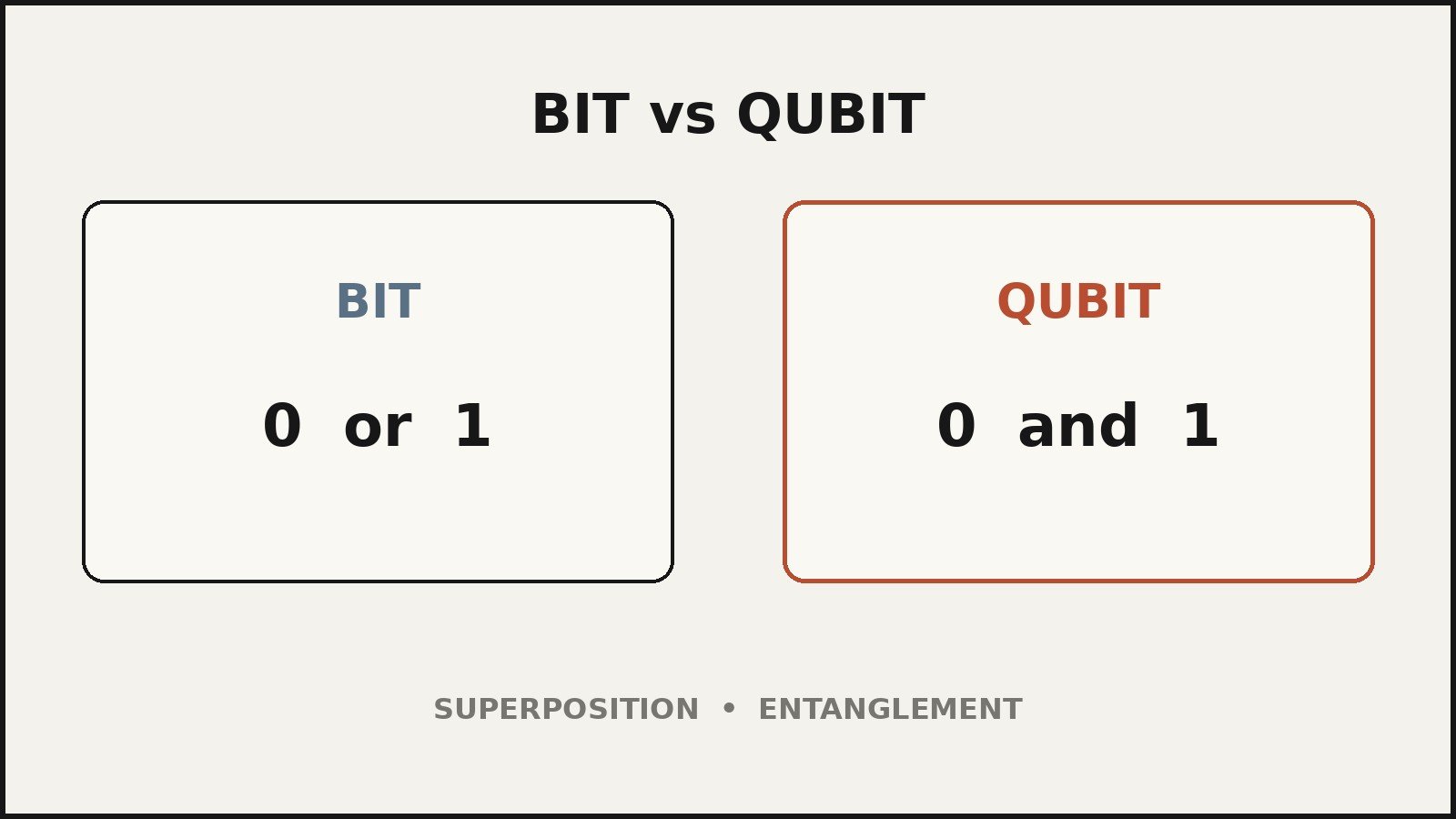
- A quantum computer processes information with qubits instead of classical bits. A bit is either 0 or 1; a qubit can be 0, 1, or a mixture of the two.
- Superposition lets qubits hold combinations of states at once, and entanglement links qubits so they share a single quantum state.
- Quantum gates manipulate those states, and measurement reads out an answer, collapsing each qubit to a definite 0 or 1.
- Quantum computers will not replace ordinary computers. They could work alongside them on special problems: simulating molecules, factoring huge numbers, and some optimization tasks.
- Today's machines are fragile and error-prone, with only hundreds of interconnected qubits, and most hoped-for applications are years or even decades away, according to NIST.
A computer that could break the encryption guarding your private information on the internet. A machine that designs new drugs by simulating individual molecules precisely. A device that untangles complex supply chains so companies assemble products in the most efficient way possible.
Those are examples of what an emerging technology, the quantum computer, could one day do. It is not a faster laptop. It is a fundamentally different kind of machine, built on the strange rules of quantum physics, the laws that govern the universe at its smallest scales. Today’s quantum computers are rudimentary and error-prone. But if more advanced and robust versions can be made, they could rapidly work through certain problems that would take current computers years. That promise is why governments, companies, and research labs around the world are working toward the goal.
This article explains quantum computing in plain English: what a qubit is, what superposition and entanglement really mean, how a quantum computer runs a calculation, what it could actually do, and why you cannot buy one yet.
What a Classical Computer Is, and What a Bit Is
To understand quantum computing, start with the machine you already know. At its most fundamental level, a computer is any device that takes in data, processes it, stores it, and produces output. The phone in your pocket, the servers in data centers, the microprocessors in cars, and the room-sized supercomputers at national labs all qualify. As NIST explains, all of these digital computers encode and process information using bits: binary digits that represent information as 1s and 0s. For example, computers typically represent the letter “A” with the bit string “01000001”.
Bits are not just mathematical concepts. They must exist as physical objects that can be placed in one of two distinct states. NIST gives the examples of tiny bar magnets or electric switches, pointed up or pointed down. In a typical laptop, billions of transistors use different levels of electrical voltage to represent 0 or 1. Put a bit into a 0 or 1 state and it usually stays there for a long time, so the information it encodes is stable and long-lasting. But bits are also limited: each one holds exactly one definite value, and all of conventional computing is built on manipulating those definite values.
That limitation matters because some problems are awkward for definite 0s and 1s. Modeling the behavior of individual atoms inside a molecule, for instance, is a problem IBM notes that we do not know how to solve with classical computers at any scale. The laws of quantum mechanics dictate the order of the natural world, so computers that calculate using quantum states should, in many situations, be our best tools for understanding that world.
The Quantum Idea: Superposition
Quantum physics describes the universe at its smallest and most fundamental scales: atoms and molecules, light and energy. Things at these scales behave very differently from everyday objects.
One of the most important differences involves a concept called superposition. NIST offers a helpful ladder analogy. Consider a person standing on a ladder. Depending on the rung, the person has a certain amount of potential energy: a person on the ground has the least, someone on the first rung has slightly more, and so on up to the highest rung. Now imagine tiny objects such as atoms behaving as though they have two or more distinct amounts of energy at once. In ladder terms, that would be like simultaneously standing on the lowest and highest rungs, something that makes no sense for a person.
Once placed into this kind of mixed energy state, known as a quantum superposition, an atom stays there until it is measured or disturbed by the outside world. Then it collapses to a single energy state: either the low or the high rung of the ladder. The collapse is random and instantaneous.
Physicist Erwin Schrödinger captured the strangeness with a famous, deliberately absurd thought experiment: a sealed box containing a cat and a poison trap triggered by the decay of a radioactive atom. Because the decay is uncertain, the cat is in a superposition of dead and alive until someone opens the box and measures it, at which point the state collapses to definitively alive or definitively dead. Real cats cannot be both alive and dead, but the imaginary cat has become an enduring metaphor for superposition.
What matters for computing is that this strangeness is real at the atomic level. A particle in superposition is not secretly 0 or 1 with us not knowing which. As IBM puts it, a qubit in superposition represents the probability of its state, and the probability amplitude can encode more than one bit of data when combined with other qubits.
Entanglement: Qubits That Share a State
Building on superposition, multiple atoms or other quantum objects can be entangled with each other to share a single quantum state. NIST extends the cat metaphor: imagine several cats in Schrödinger’s box, potential victims of the same trap. These cats are entangled in a superposition of all being alive or all being dead. When someone opens the box, the states of all the cats collapse at once.
“Entanglement means you’ve got at least two things that are always connected; they have no independent existence,” explains NIST physicist Andrew Wilson. When one entangled particle is measured, both must randomly collapse such that their outcomes are correlated. The collapse is instantaneous for both particles, no matter how far apart they are. Wilson offers the striking image: put one particle of an entangled pair on the Moon and the other on Earth, and doing something to the one on Earth simultaneously affects the other.
Albert Einstein famously called this “spooky action at a distance.” IBM’s explainer adds two clarifications worth keeping in mind. First, entangled qubits do not transfer information faster than light; nothing usable travels between them. Second, entanglement dramatically increases the power of quantum circuits because the qubits must be described together rather than separately.
Qubits Versus Bits
The basic unit of quantum information is the qubit, short for quantum bit. IBM calls it the quantum equivalent of the traditional bit, and credits the term “qubit” to American theoretical physicist Benjamin Schumacher.
A classical bit can be in a 0 position or a 1 position. A qubit, as NIST explains, can be in state 0, state 1, or a mix of the two. And the quantum states of individual qubits can be entangled with each other.
These capabilities give quantum computers their distinctive power. Whereas two classical bits can hold only one combination of states at a time (such as 1 and 0), two qubits can contain a superposition of four combinations of 0s and 1s simultaneously. Three qubits can contain eight combinations, four qubits can contain 16 combinations, and so on. Each additional qubit doubles the number of combinations: an exponential increase.
Qubits are made by manipulating and measuring real quantum systems. IBM lists examples: photons, electrons, trapped ions, superconducting circuits, and atoms. In theory, any two-level quantum system, any system whose measurable properties come in binary positions such as up or down, can serve as a qubit.
Quantum Gates, Interference, and Measurement
A quantum computer does not just sit in a superposition; it operates on qubits with quantum gates. Quantum gates are the building blocks of quantum circuits, and they manipulate qubits through quantum operations. They are the quantum counterpart of the logic gates in classical computing, but they work on superpositions and entangled states rather than definite 0s and 1s.
One important property gates exploit is interference. As IBM describes it, the probability amplitudes of qubits behave like waves, and waves overlap and interfere. When asynchronous waves overlap, they can cancel out some possible solutions while reinforcing others, so that the remaining coherent wave or waves present the answer. Interference is how a quantum computation steers a vast space of possibilities toward a useful result.
At the end of the computation comes measurement. Measuring a qubit collapses its superposition to a definite state, either 0 or 1. NIST emphasizes a point that popular descriptions often lose: quantum computers are limited in the amount of data they can extract from their computations. “Different computations can indeed be done in superposition, achieving a kind of parallel computing,” says Stephen Jordan, a Google quantum computing researcher and longtime NIST staff member, “but contrary to popular belief, this doesn’t allow quantum computers to do an efficient ‘brute force’ search over all the potential solutions.” The measurement at the end can only extract a small amount of information about the results of all those computations. “The key is to design the measurement so that it extracts useful information about the whole set of results done in superposition.” In other words, quantum computers are not trying every answer at once in a way we could read out; they are carefully arranging for the one answer they can read to be the useful one.
How a Quantum Computer Runs a Calculation, Step by Step
Pulling the pieces together, a quantum computation proceeds roughly like this:
- Initialize. Qubits are prepared in known starting states.
- Entangle. Someone using a quantum computer must first entangle qubits to harness their exponential computing power, as NIST puts it. Depending on the type of machine, electromagnetic signals or lasers create the entanglement and the operations.
- Operate. Quantum gates transform the qubits: addition, multiplication, or more complicated computations on the superposed states. Interference amplifies the paths leading to correct answers and cancels the rest.
- Measure. The final measurement collapses each qubit to 0 or 1, and the pattern of 0s and 1s is the answer.
Two side notes keep expectations honest. First, some scientists and companies are pursuing a different technology called quantum annealing, which could solve certain physics and optimization problems faster than classical computers can, but it works differently from the gate-based quantum computers described above. Second, a classical computer still runs alongside the quantum hardware: it orchestrates the sequence of operations and interprets the measurement results.
What Quantum Computers Could Do
The field has a long intellectual history. At a 1981 gathering of physicists outside Boston, Richard Feynman spoke about the possibility of “simulating physics with computers.” Others had independently developed similar ideas around the same time, but Feynman’s talk is often credited with launching quantum computing.
That first application remains one of the most promising. Scientists have explored how quantum computers could, in theory, simulate the fundamental quantum rules that govern molecules, chemicals, and materials, something today’s computers can only approximate with great effort. If machines eventually become large and powerful enough, such simulations could bring major advances in materials science and drug development. NIST names possible transformative applications: discovering a new blockbuster drug, or chemical catalysts that make producing fertilizer or capturing greenhouse gases from the air more efficient.
A very different application arrived in 1994, when mathematician Peter Shor published a paper that instantly made quantum computing a national security issue. The algorithms that encrypt much of our data work by multiplying very large prime numbers together to create a secret key, something very hard for classical computers to undo. Shor’s paper described a quantum algorithm that could quickly factor the immense products of those huge primes, potentially putting much of the world’s encrypted information at risk. Factoring is the canonical example of a problem where a large quantum computer would outpace classical machines by an enormous margin.
Scientists also believe quantum computers could outpace classical computers at solving complicated optimization problems, such as helping companies organize complex processes like airplane assembly in more efficient ways. MIT’s researchers point to the same areas: factoring large numbers for cryptography and digital security, simulating complex molecular systems that could aid drug discovery, and in principle many areas of research and industry.
How close is any of this? NIST’s assessment, current as of its page’s May 2026 update, is carefully hedged. Scientists have started publishing papers claiming quantum computers have demonstrated a “quantum advantage,” meaning they can outdo classical computers for certain tasks. Machines have calculated the energies of small molecules and simulated the magnetic properties of collections of interacting atoms. But so far, says NIST physicist Scott Glancy, none of these early demonstrations has proved truly useful, and in some cases scientists later showed that traditional computers could equal or exceed the quantum processors’ performance. The demonstrations do prove that quantum computers work and can be scaled up. Most of the hoped-for applications are years, perhaps even decades, in the future. Glancy adds a notable line: “It seems to me we’re just on the threshold of quantum systems doing genuinely new simulations that we can’t do classically.”
Why You Cannot Buy One Yet
Qubits are exquisite but fragile. A stray electric or magnetic field, temperature fluctuations, or even a cosmic ray can ruin a superposition or entanglement, forcing qubits into a 0 or 1 state in which they act like ordinary bits. Anyone building a quantum computer must manipulate the qubits carefully while protecting them from outside disturbances.
Scale makes the problem harder. A single qubit by itself is worth little. For a quantum device to do something useful, many qubits must be entangled with each other while sustaining superpositions. NIST reports that the best quantum computers today contain hundreds of interconnected qubits and make an error roughly once in every thousand operations. An error changes a qubit’s state, destroying or corrupting the information it carries.
Compare that with a classical computer, which makes around one error, such as a bit randomly flipping from 0 to 1, for every quintillion calculations (a 1 followed by 18 zeroes). Correcting errors is also much easier classically: a classical bit can simply be copied repeatedly and the correct value taken from the majority. Quantum error correction cannot work that way, because copying an unknown quantum state is forbidden by the laws of quantum mechanics, which is why researchers are developing specialized algorithmic quantum error correction instead.
MIT describes the same tension from the engineering side. A qubit’s superposition is highly sensitive, and minor disturbances or material defects cause decoherence: the loss of quantum information, which limits a qubit’s useful lifetime. Controlling the qubit to perform logical functions is typically done with a finely tuned pulse of electromagnetic radiation, but that manipulation itself can generate enough incidental noise to cause decoherence. Engineers must therefore balance protecting qubits from disturbance with still allowing them to be manipulated for calculations.
For the code-breaking application, the gap is enormous. NIST notes that running Shor’s algorithm may need millions of qubits that can run error-free indefinitely, the way classical computers do. Such a machine is probably still much further away. Even so, NIST has developed new algorithms thought to be quantum computer-proof and is encouraging businesses and government agencies to adopt them, as part of its post-quantum cryptography program.
The Main Kinds of Qubits
In theory, any particle or system that obeys the rules of quantum physics, from atoms to tiny circuits to semiconductors, can act as a qubit. Researchers are experimenting with several leading approaches, each with advantages and disadvantages.
Trapped ions. These qubits use electrically charged atoms, trapped with electric or magnetic fields so they hover inside a vacuum chamber, controlled and measured with lasers and electromagnetic fields. As NIST explains, the quantum energy states of electrons inside these ions represent the 0s, 1s, and combinations used for computation. MIT researcher John Chiaverini notes that atoms make for simpler qubits than supercooled circuits: “Luckily, I don’t have to engineer the qubits themselves. Nature gives me these really nice qubits.” Charged ions are used rather than neutral atoms because they are easier to contain and localize. Ion qubits can sustain superpositions for a long time but are relatively slow at computing.
Superconducting circuits. These use tiny integrated circuits cooled to near absolute zero, where electrons in the circuits create quantized energy states that can be observed and manipulated with weak electromagnetic signals. IBM’s superconducting qubits are manipulated using microwave pulses. MIT’s William Oliver engineers qubits from superconducting aluminum circuits chilled close to absolute zero, where the circuit acts as an oscillator with two energy states corresponding to 0 and 1. Superconducting qubits are relatively large, about one tenth of a millimeter along each edge, hundreds of thousands of times larger than a classical transistor, which makes them easy to manipulate but also exposes them to decoherence. They allow fast computations and can be made with existing chip manufacturing techniques, but their quantum states are more fragile and shorter-lived than ion qubits’.
Neutral atoms. Neutral, uncharged atoms are trapped using laser light so they hover in a vacuum chamber, with their states controlled and measured by lasers and electromagnetic fields. IBM notes that any two of an atom’s excited energy states can be used to create a qubit well suited for scaling up operations.
Photonic qubits. Individual particles of light can encode quantum information in their polarization, wavelength, time of arrival, or photon number, with beamsplitters and single-photon detectors used for control and measurement. IBM notes photon qubits can send quantum information across long distances through optical fiber cables, and they are presently used in quantum communication and cryptography.
Semiconducting qubits (quantum dots). Electrodes trap electrons inside a tiny region of semiconductor material such as silicon, cooled near absolute zero, and the electron’s quantum state is controlled and measured with electromagnetic fields. IBM notes they are interesting for potential scalability and compatibility with existing semiconductor technology.
Topological qubits. A radically different, still hypothetical type that would have some built-in immunity to errors. NIST explains that in theory, topological qubits could encode information into the braiding pattern of “quasiparticles” that emerge from the collective behavior of particles such as electrons, protecting quantum states from some outside disturbances. But they have proved challenging to build, and researchers are still seeking definitive evidence that one has been created in the lab.
NIST suggests the future may combine several kinds, each playing to its strengths: superconducting or photonic qubits could crunch through operations quickly, then transfer their information to ion or diamond-based qubits for storage.
Where Things Stand and What Comes Next
Today’s quantum computers are, in NIST’s words, being used mainly to explore certain physics, chemistry, and mathematical problems and as test beds for learning how to make more powerful machines. MIT’s researchers agree that commercial quantum information processing will arrive only gradually, over the coming years and decades, as the science and engineering advance. In the meantime, MIT’s Oliver envisions linked classical-quantum systems, where a classical machine runs most of an algorithm and sends select calculations to the quantum machine before its qubits decohere; in the longer term, improved error-correcting codes could let quantum computers function more independently.
Many experts believe quantum computers will probably never sit on our desks or in our pockets. Because they are so complex and delicate, NIST notes, they are more likely to live inside commercial computing centers, national labs, and universities, where they crunch quantum information and deliver solutions outward. That division of labor is already the pattern: quantum machines as specialized accelerators for the hardest problems, working together with the classical computers that do everything else.
Frequently Asked Questions
What is quantum computing in simple terms?
Quantum computing is a way of computing that uses the quantum properties of matter, mainly superposition and entanglement, to process information. Instead of bits that are definitely 0 or 1, it uses qubits that can be 0, 1, or a mixture of the two. That lets quantum computers approach certain problems, like simulating molecules or factoring huge numbers, in fundamentally better ways than classical computers can.
How is a qubit different from a bit?
A bit holds one definite value: 0 or 1. A qubit can be 0, 1, or a superposition of both, which represents the probability of measuring 0 or 1. Two bits can hold one combination of two states at a time; two qubits can contain a superposition of four combinations at once. But a measurement of a qubit still returns only a definite 0 or 1.
What are superposition and entanglement?
Superposition is a qubit being in a mixture of 0 and 1 until it is measured, at which point it collapses to one definite state. Entanglement links qubits so they share a single quantum state and have no independent existence; measuring one instantly determines the correlated outcome of the other, no matter the distance, though no usable information travels faster than light.
Can a quantum computer try every answer at once?
Not in a useful sense. This is one of the most common misconceptions. Different computations can indeed happen in superposition, a kind of parallel computing, but the final measurement can only extract a small amount of information about all those computations. Quantum algorithms work by arranging interference so the answer that can be read out is the right one, not by brute-forcing every possibility.
Will quantum computers replace my laptop?
No. NIST is explicit that quantum computers will not replace our familiar classical computers. NIST expects the two types of machines to work together, with classical computers remaining better for most workloads. Quantum machines are expected to work alongside them on special problems that resist classical methods.
When will quantum computers be useful?
Honestly, nobody knows exactly. NIST says most hoped-for applications are years, perhaps even decades, away, and MIT’s researchers agree commercial use will arrive only gradually. Early demonstrations have shown quantum computers can outdo classical machines for certain narrow tasks, but none has yet proved truly useful, and running something like Shor’s code-breaking algorithm may need millions of error-free qubits that do not exist yet.
Conclusion
Quantum computing is a new way of processing information built on quantum physics rather than on definite 0s and 1s. Qubits exploit superposition to hold mixtures of states and entanglement to link those states together; quantum gates manipulate them through interference; and measurement reads out an answer. That machinery could one day simulate molecules for new drugs and materials, factor the huge numbers behind today’s encryption, and solve complex optimization problems. But the machines we have are fragile, error-prone, and small, with only hundreds of interconnected qubits and an error roughly every thousand operations. The path from today’s experiments to large, reliable quantum computers runs through better qubits, better error correction, and careful engineering. The science is real, the potential is large, and the timeline is genuinely uncertain. For the details behind every claim here, see the sources below.
Sources & references
- NIST, Quantum Computing Explained (nist.gov; created 18 March 2025, updated 28 May 2026): bits vs. qubits; ladder analogy for superposition; Schrödinger's cat; entanglement and Andrew Wilson quotes; qubit combination math (2 qubits = 4 combinations); entangling qubits to harness exponential power; measurement limits and Stephen Jordan quotes; quantum annealing note; Feynman 1981; molecular simulation and drug/catalyst hopes; Shor 1994 and encryption risk; optimization; quantum advantage demonstrations and Scott Glancy assessment; qubit fragility; hundreds of qubits with ~1 error per 1,000 operations vs. classical 1 error per quintillion; millions of error-free qubits needed for Shor; NIST post-quantum algorithms; quantum computers unlikely to sit on desks.
- IBM, What is a qubit? (ibm.com; accessed 24 Oct 2026): qubit as quantum equivalent of the bit; term attributed to Benjamin Schumacher; qubits made by manipulating and measuring quantum particles (photons, electrons, trapped ions, superconducting circuits, atoms); probability amplitude and wave interference; Einstein's "spooky action at a distance"; entanglement properties and no faster-than-light data transfer; refrigeration near absolute zero, colder than outer space; decoherence and algorithmic quantum error correction; qubit types (superconducting, trapped ions, quantum dots, photons, neutral atoms) and their traits.
- MIT News, Explained: Quantum engineering (news.mit.edu; 10 Dec 2020): physical limits of classical scaling since the 1940s; quantum computing idea spawned in the 1980s; Google's demonstration of outperforming a supercomputer for certain tasks; early days with 100+ MIT researchers; bits as voltage levels in billions of transistors; Chiaverini on superposition and entanglement enabling exponentially faster solutions for some problem types; factoring and drug-discovery applications; decoherence and qubit control challenges; superconducting vs. trapped ion trade-offs; Oliver's superconducting aluminum circuits (~0.1 mm qubits); Chiaverini's trapped-ion lasers and electrode chips; gradual commercial arrival over years and decades; linked classical-quantum systems; error-correcting codes.


