Short answer
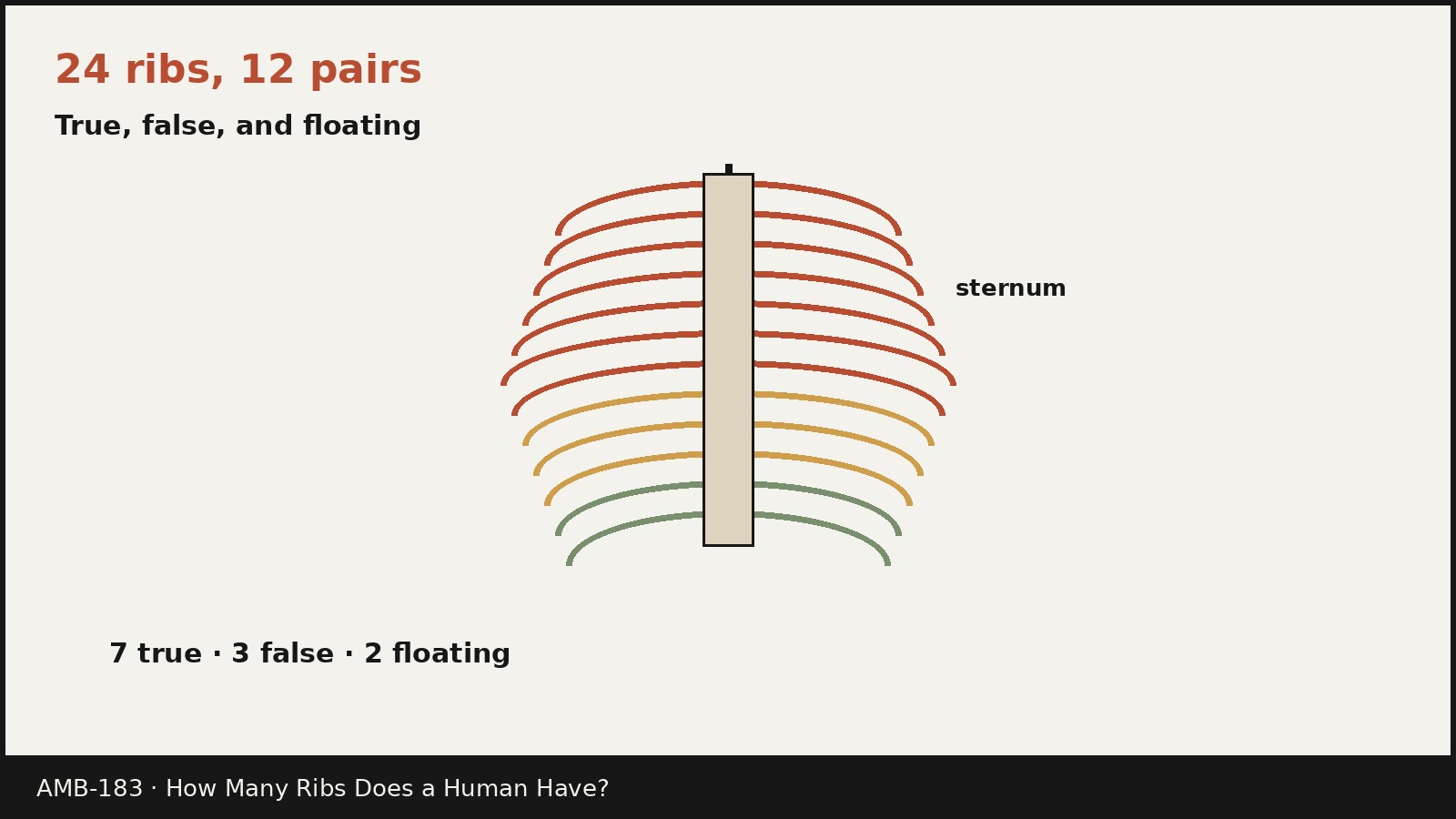
- Most people have 24 ribs, arranged as 12 pairs, with 12 ribs on the left and 12 on the right. Each pair is numbered to match one of the 12 thoracic vertebrae in the middle section of the spine, from T1 at the top to T12 at the bottom. The first seven pairs are true ribs, the next three pairs are false ribs in the narrower sense, and the last two pairs are floating ribs. This article is an anatomy explainer only, not medical advice. The two numbers that cause confusion, 12 and 24, are both correct in different senses. There are 12 pairs, and 12 pairs contain 24 individual ribs. Counting pairs is useful because the left and right ribs at each level mirror each other, but the answer to the question as most people ask it is 24 individual ribs. The word "most" matters as well. The 24 rib pattern is the typical human pattern, not a rule with no exceptions. A small minority of people are born with an extra rib or with one fewer pair, and the front attachments of the lower ribs vary more than textbook diagrams suggest. That is why careful sources say "generally" or "typically."
How the count works
The thoracic cage, often called the rib cage, is made up of the 12 pairs of ribs with their costal cartilages and the sternum, or breastbone. The ribs are anchored at the back to the 12 thoracic vertebrae. At the front, most ribs are anchored, directly or indirectly, to the sternum through costal cartilage. The thoracic cage protects the heart and lungs, and its shape and movement are part of how the chest changes volume during breathing.
Each rib is a curved, flattened bone, numbered 1 to 12 in accordance with the thoracic vertebrae: the first rib pairs with the first thoracic vertebra, and so on down to the twelfth rib and the twelfth thoracic vertebra. If you know the level, you know roughly where the rib sits and how it connects at the front.
The ribs do not all look alike. They grow longer from the first rib down to about the seventh rib, and then become shorter again toward the twelfth rib. The upper ribs are shorter and more strongly curved, the middle ribs are the longest and form the widest part of the cage, and the lower ribs are shorter and more open at the front.
True ribs: pairs 1 to 7
Ribs 1 to 7 are called true ribs, or vertebrosternal ribs. The costal cartilage from each of these ribs attaches directly to the sternum. That direct attachment is the whole basis of the name. “True” does not mean that these ribs are more real than the others, and it does not mean that the other ribs are fake. It is simply the traditional label for ribs whose cartilage reaches the sternum on its own.
Each true rib has its own strip of costal cartilage reaching the sternum at its own level. The first rib attaches to the manubrium, the wide upper part of the sternum. The second rib attaches at the sternal angle, the slight bend where the manubrium joins the body of the sternum. Because the first rib is hidden behind the collarbone, the second rib is the highest rib that can be identified by touch. Ribs 3 to 7 attach to the body of the sternum. True ribs account for 14 of the 24 ribs, seven on each side, and they give the upper thoracic cage much of its rigidity.
False ribs: pairs 8 to 10
Ribs 8 to 12 are called false ribs, or vertebrochondral ribs, because their costal cartilages do not attach directly to the sternum. Within that group, ribs 8 to 10 form a narrower subgroup. For ribs 8 to 10, the costal cartilage of each rib attaches to the cartilage of the next higher rib. The cartilage of rib 10 attaches to the cartilage of rib 9, rib 9 attaches to rib 8, and rib 8 attaches to rib 7. In this way, ribs 8 to 10 reach the sternum only indirectly, through the cartilage chain that ends at the seventh rib.
This chain forms the costal margin, the curved lower edge of the front of the rib cage, felt running downward and outward from the bottom of the sternum toward the sides of the abdomen. The costal margin is cartilage, not bone, and it marks the boundary between the bony upper chest and the softer abdominal wall below. Ribs 8 to 10 account for six of the 24 ribs, three on each side. Calling them “false” can mislead a reader into thinking they are incomplete. They are complete ribs, with heads that join the spine at the back and shafts that curve around the sides of the body; only their front attachment differs.
Recent cadaver studies reported in StatPearls show that these front attachments vary more than the classic picture suggests: in one study of 30 cadavers, the tenth rib was effectively floating in more than half of the specimens, and in another study of 40 cadavers, a floating tenth rib was found in 59 percent. These findings do not change the standard count of 12 pairs. They mean that the boundary between “false” and “floating” is less sharp in real bodies than in a diagram.
Floating ribs: pairs 11 and 12
Ribs 11 and 12 are called floating ribs, or vertebral ribs. They are short ribs that do not attach to the sternum at all, and they do not attach to another rib either. Instead, their small costal cartilages end within the muscles of the lateral abdominal wall. Floating ribs account for four of the 24 ribs, two on each side.
The name “floating” is the most misunderstood label in rib anatomy. Floating ribs are not loose inside the body, and they do not drift around freely. Each floating rib is firmly attached at the back to its thoracic vertebra, just like every other rib. The word “floating” refers only to the front end, which has no bony or cartilaginous connection to the sternum or to a neighboring rib. At the back, the rib is anchored. At the front, it ends in muscle. That combination gives the lower ribs freedom to move with the abdominal wall while still keeping the overall cage intact.
Because they are short and their front ends are free, floating ribs vary more in length than the other ribs. The twelfth rib in particular can be easy or hard to locate by touch, depending on its length. That variation is normal within the typical 12 pair pattern, not evidence of a missing rib: a rib counts as present even when it is short, because it still has the head, shaft, and vertebral attachment that define a rib at that level. Some sources also classify the tenth rib as floating when its cartilage does not join the ninth rib. That describes that body’s cartilage connections, not a different total number of ribs.
The sternum and costal cartilage
No account of rib numbers is complete without the sternum, because the classification of ribs depends entirely on how they relate to it. The sternum is the elongated bony structure that anchors the front of the thoracic cage. It consists of three parts: the manubrium, the body, and the xiphoid process. The manubrium is the wider, upper portion. The body is the long central portion. The xiphoid process is the small tip at the lower end, which is cartilaginous early in life and gradually becomes ossified starting during middle age.
The bony ribs do not extend all the way around to the sternum on their own. Instead, each rib ends in a costal cartilage. These cartilages are made of hyaline cartilage and can extend for several inches. Most ribs are then attached, directly or indirectly, to the sternum through their costal cartilage. Costal cartilage is what gives the front of the chest its combination of strength and flexibility. Bone alone would be too rigid for breathing, and cartilage alone would be too soft to hold the shape of the cage. Together, bone at the back and sides plus cartilage at the front produce a structure that holds its shape and still moves.
The sternum also explains why rib counting by touch starts where it does. The top of the manubrium has a shallow, U-shaped border called the jugular notch, felt at the front base of the neck between the inner ends of the collarbones. The first rib is hidden behind the collarbone, so it is hard to feel directly. The second rib attaches at the sternal angle, felt as a ridge across the front of the chest, and from there a counter can work downward rib by rib.
The sternum itself is sometimes miscounted in popular explanations. It is a single midline bone with three parts, not a pair of ribs, and the costal cartilages are extensions of the ribs, not additional ribs. Counted properly, there are 12 pairs of ribs, 12 thoracic vertebrae, and one sternum, and the total remains 24.
The parts of a single rib
A typical rib has several named parts. The back end is called the head, which articulates mainly with the costal facet on the body of the same numbered thoracic vertebra and to a lesser degree with the facet on the body of the next higher vertebra. Lateral to the head is the narrowed neck. A small bump on the back surface is the tubercle, which articulates with the facet on the transverse process of the same numbered vertebra.
Beyond the tubercle lies the body, or shaft, of the rib, which is the long curved portion that forms most of the side of the chest. Just lateral to the tubercle is the angle of the rib, the point of greatest curvature, and the angles of the ribs form the most posterior extent of the thoracic cage. In the anatomical position, the angles line up with the inner border of the shoulder blade. A shallow costal groove runs along the lower margin of each rib and carries blood vessels and a nerve. The front end of the rib then terminates at its costal cartilage.
Not every rib has every feature in the typical form. StatPearls notes that the 1st, 2nd, 10th, 11th, and 12th ribs are atypical: the first rib is short and wide, the second is thin and long, the tenth has only one articular facet, and the eleventh and twelfth each have a single facet and lack a neck. An atypical rib is still a rib at its numbered level; the typical rib is simply a teaching model based on the middle ribs.
What the rib cage does
The thoracic cage has two main jobs. First, it protects the heart and lungs, along with the great vessels and other structures of the chest: the sternum closes the front, the vertebrae support the back, and the ribs span the sides. Second, the rib cage moves. Rib movement changes the volume of the thoracic cavity, and that change in volume is part of breathing. StatPearls describes rib movement in upward, downward, forward, and backward directions as facilitating breathing, controlled by the diaphragm, the external intercostal muscles, and part of the internal intercostal muscles. When the ribs lift and move outward, the chest volume increases; when they move down and inward, it decreases.
Muscles also use the ribs as attachment points, most directly the intercostal muscles that fill the spaces between the ribs and help move the cage during breathing. The shape of the cage changes over a lifetime: as a child grows, it becomes deeper from front to back and the ribs take on a more downward slope, and in adult life the costal cartilages become more rigid and the xiphoid process ossifies. None of these changes alters the number of ribs.
How ribs develop before birth
Ribs form early in development, which is why the typical count is already established long before birth. According to StatPearls, ribs develop through somite differentiation. Somites are blocks of embryonic tissue that form along either side of the developing spine, and the ribs arise from the costal processes associated with the thoracic somites. Ribs become recognizable at Carnegie stage 17, about 41 days after fertilization, and reach full formation by Carnegie stage 23, about 56 days after fertilization. In plain terms, the 12 pair pattern is laid down in the first two months of development, as part of the same process that forms the thoracic vertebrae.
This early formation explains why the rib count matches the thoracic vertebra count so exactly: ribs and thoracic vertebrae develop together, level by level, from the same segmented plan. It also explains why variations usually take the form of an extra rib at the boundary of the thoracic region, rather than a random rib in the middle of the cage: the boundaries between the neck, chest, and lower back regions are where the developmental plan is most likely to shift by one segment.
The sternum develops separately, from cartilage bars in the front body wall that fuse and then join with the costal cartilages. That is why the front attachments can vary even when the back attachments and the total count are standard. The classic classification is therefore a description of the usual front connections, not a claim that every body follows the diagram exactly.
Variations: extra ribs, missing ribs, and other differences
Most people have 24 ribs, but anatomy references describe a range of normal variants, and understanding them prevents a great deal of confusion. StatPearls lists normal rib variants that include cervical, intrathoracic, and pelvic ribs, forked or bifid ribs, rib fusion and bridging, and a variant of the first rib. Numerical and structural rib abnormalities together occur in about 0.15 percent to 3.4 percent of individuals, according to the review cited there. Supernumerary ribs, including cervical and lumbar ribs, account for about 30 percent of all congenital costal anomalies. Missing ribs account for 26 percent of those anomalies, while segmentation defects and fusions account for 20 percent.
A cervical rib is an extra rib that arises from the seventh cervical vertebra, above the first thoracic rib, and can range from a short nub of bone to a nearly complete rib. A lumbar rib is the equivalent variation at the lower boundary, arising from the first lumbar vertebra just below the twelfth thoracic rib. Neither changes the standard thoracic count, but either changes the total number of rib-like bones in that body: a person with a cervical rib on one side would have 25 rib-like bones on a full count, even though the thoracic count remains 12 pairs.
A bifid rib splits into two branches toward the front, like a fork. Rib fusion joins two neighboring ribs along part of their length, and bridging is a connection between ribs that is not part of the standard pattern. None of these adds a new numbered level to the spine. A forked rib is still one rib at its level, and fused ribs are still two ribs that have joined.
Keep the scale of variation in proportion. The figures above cover all numerical and structural variants combined, including minor differences in shape and connection that would never be noticed without imaging. They do not mean that up to 3.4 percent of people have an obviously different number of ribs. Most variants are minor, so the standard answer of 24 ribs remains right for the overwhelming majority of people.
Do men and women have the same number of ribs?
Yes. Men and women typically have the same number of ribs: 24, in 12 pairs. There is no separate male count and female count in standard anatomy. The thoracic cage generally contains 12 pairs of ribs, and that statement applies to humans generally, not to one sex alone.
The misconception that men have one fewer rib than women is persistent. The idea is often linked to a familiar creation story in which a rib is taken to form a partner, and the story is then misread as a claim about anatomy. Anatomy does not support that reading: standard references give the same 12 pair pattern for both sexes, and the differences that do exist are in size, shape, and proportion, not in number.
StatPearls summarizes those shape differences clearly. Results from three dimensional studies showed that sex specific trajectories of thoracic size and shape diverge at about 12 years of age. Adult male rib cages are deeper, shorter, and wider than female rib cages, and they have more horizontally oriented ribs. Ribs also tend to grow longer relative to the axial skeleton in women than in men. These differences in geometry do not imply an extra or missing rib on either side.
Counting ribs is a different task from measuring a cage: counted level by level, from T1 to T12, both sexes show the same 12 levels in the typical pattern.
Counting ribs: pairs, sides, and common mistakes
Most wrong answers come from counting mistakes rather than from anatomy itself. The first mistake is counting pairs as ribs: a diagram showing “12 ribs” on one side means 12 pairs in total, or 24 ribs altogether, and a textbook saying “12 pairs of ribs” also means 24 ribs. The second mistake is counting only the ribs that reach the sternum. True ribs reach it directly and false ribs reach it indirectly, so forgetting the floating ribs gives 20 rather than 24. Floating ribs are easy to miss in a front view diagram, but they are present at the back and sides, and they count. The third mistake is counting the sternum or the costal cartilages as ribs: the sternum is one bone, not a pair, and the costal cartilages are parts of the ribs. The fourth mistake is assuming that a short or hard to feel rib is absent. The first rib is hidden behind the collarbone and the twelfth rib can be short, but a rib is counted by its vertebral level and bony structure, not by how easy it is to feel.
A simple check helps. Count the thoracic vertebrae, from T1 to T12: 12 levels, each with a left rib and a right rib, equals 24 ribs. Seven levels on each side are true ribs, three are false ribs in the narrower sense, and two are floating ribs. Seven plus three plus two equals 12 pairs, and 12 pairs times two sides equals 24 ribs.
Related questions
Do children have the same number of ribs as adults? In the typical pattern, yes. The 12 pair pattern is laid down before birth, and children do not gain or lose numbered rib levels as they grow. What changes is the size, shape, and rigidity of the cage, not the count.
How many ribs are on each side? Twelve, in the typical pattern. The left and right sides mirror each other level by level, one rib at each level from 1 to 12 on each side. Asymmetry in length or front attachments does occur, especially in the lower ribs, but the level by level pairing is the standard plan.
Why are some ribs called false if they are real? Because “false” is a technical term for the sternal attachment, not a judgment about reality. False ribs are real ribs with a different front connection, and “floating” describes a free front end, not a rib that floats freely in the body.
Do other mammals have the same number of ribs? Not necessarily. Rib numbers vary across species because the number of thoracic vertebrae varies. Humans have 12 thoracic vertebrae and therefore 12 pairs of ribs in the typical pattern; other mammals have different thoracic counts, so their rib counts differ accordingly.
A simple summary to remember
A typical human has 24 ribs in 12 pairs. Pairs 1 to 7 are true ribs, with costal cartilage that attaches directly to the sternum. Pairs 8 to 10 are false ribs, with costal cartilage that attaches to the cartilage of the rib above. Pairs 11 and 12 are floating ribs, with small costal cartilages that end in the muscles of the side abdominal wall and do not reach the sternum. The ribs attach at the back to the 12 thoracic vertebrae, and together with the sternum and costal cartilages they form the thoracic cage. Men and women have the same typical count. Variations exist, most often as an extra rib at the neck or lower back boundary, a missing rib, or a difference in shape or front connection, but they are uncommon and they do not change the standard answer.
The classification behind the number explains the structure of the chest: a direct connection at the top, an indirect chain in the middle of the lower cage, and a free ending at the bottom.
Frequently asked questions
How many ribs does a human have in total?
Most people have 24 ribs in total, arranged as 12 pairs. There are 12 ribs on the left side and 12 on the right side, numbered 1 to 12 to match the 12 thoracic vertebrae.
How many true ribs does a human have?
A typical human has 14 true ribs, seven pairs, numbered 1 to 7 on each side. Each true rib has costal cartilage that attaches directly to the sternum.
How many false ribs does a human have?
In the broader classification, there are 10 false ribs, five pairs, numbered 8 to 12, because none attaches directly to the sternum. In the narrower usage, “false ribs” means only pairs 8 to 10, six ribs, while pairs 11 and 12 are called floating ribs. Both usages describe the same anatomy.
How many floating ribs does a human have?
A typical human has four floating ribs, two pairs, numbered 11 and 12 on each side. Their small costal cartilages end in the muscles of the side abdominal wall and do not attach to the sternum or to another rib.
Do floating ribs actually float?
No. Floating ribs are firmly attached at the back to their thoracic vertebrae. The name refers only to their front ends, which have no connection to the sternum. They do not move freely around the body.
Do men have fewer ribs than women?
No. Men and women typically have the same number of ribs, 24 in 12 pairs. Adult male and female rib cages differ on average in depth, width, and rib orientation, but not in the typical number of ribs.
Can a person be born with more or fewer than 24 ribs?
Yes, but it is uncommon. Extra ribs most often appear at the boundaries of the thoracic region, as a cervical rib above the first thoracic rib or a lumbar rib below the twelfth. Numerical and structural rib variants together are reported in about 0.15 percent to 3.4 percent of individuals in the review cited by StatPearls.
Why is the count sometimes given as 12 instead of 24?
Because 12 is the number of pairs. There are 12 pairs of ribs, and each pair contains a left rib and a right rib, which makes 24 ribs in total.
What is costal cartilage?
Costal cartilage is the hyaline cartilage at the front end of each rib. It bridges the gap between the bony rib and the sternum or, for ribs 8 to 10, between one rib and the cartilage of the rib above. It gives the front of the chest flexibility while keeping the shape of the cage.
What bones make up the thoracic cage?
The thoracic cage is made up of the 12 pairs of ribs with their costal cartilages, the sternum, and the 12 thoracic vertebrae to which the ribs attach at the back. The sternum itself has three parts: the manubrium, the body, and the xiphoid process.
Sources & references
- OpenStax, Anatomy and Physiology, section 7.4, "The Thoracic Cage." Opened and read 24 October 2026. This is the primary source for the 12 pair count, the true, false, and floating classification, the parts of the sternum, the parts of a typical rib, and the role of costal cartilage.
- StatPearls, Safarini and Bordoni, "Anatomy, Thorax, Ribs." Opened and read 24 October 2026. This is the source for the typical and atypical rib features, rib movement and breathing, rib development timing at Carnegie stages 17 and 23, sex differences in cage shape, variant types and frequencies, and recent cadaver findings on tenth rib attachment.
- Cleveland Clinic, "Rib Cage (Thoracic Cage): What It Is, Anatomy and Function." Opened 24 October 2026. Used as a corroborating reference for the 24 rib count and the true and false rib classification; the main anatomical detail in this article rests on OpenStax and StatPearls, as noted above.


